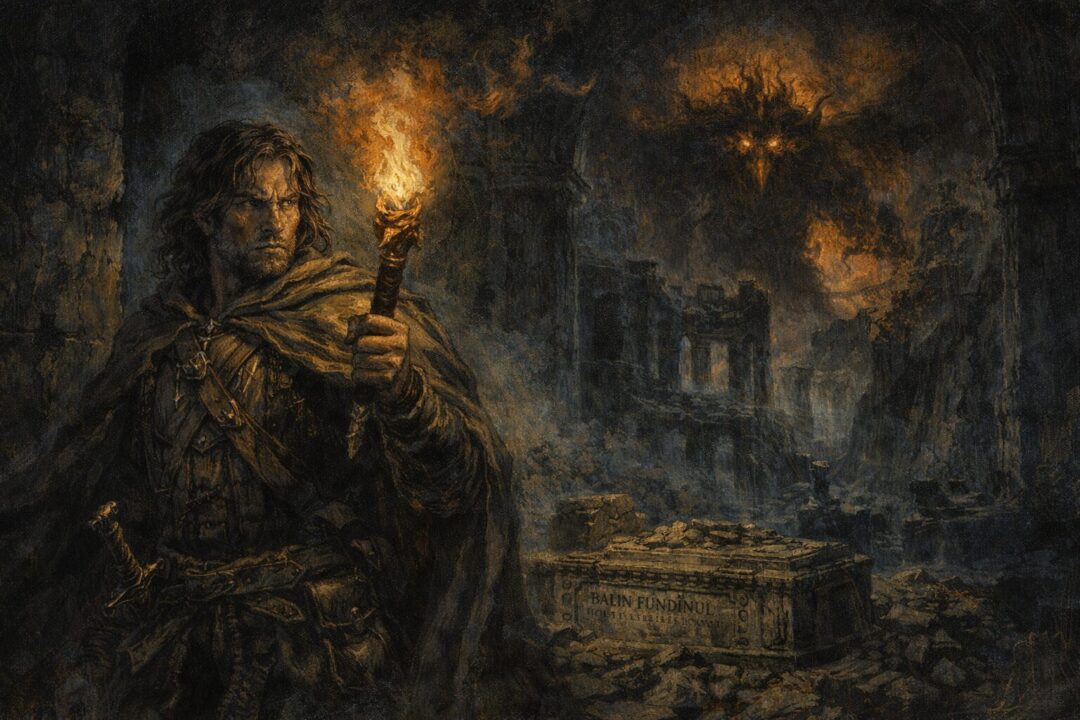
When the Fellowship turns toward Moria, Aragorn is not merely reluctant.
He is troubled in a way that stands apart from the others.
Gimli still hopes.
Boromir resists openly.
The Hobbits do not yet understand the full weight of what lies ahead.
But Aragorn speaks like someone who has already brushed against that darkness and wants no part of it again.
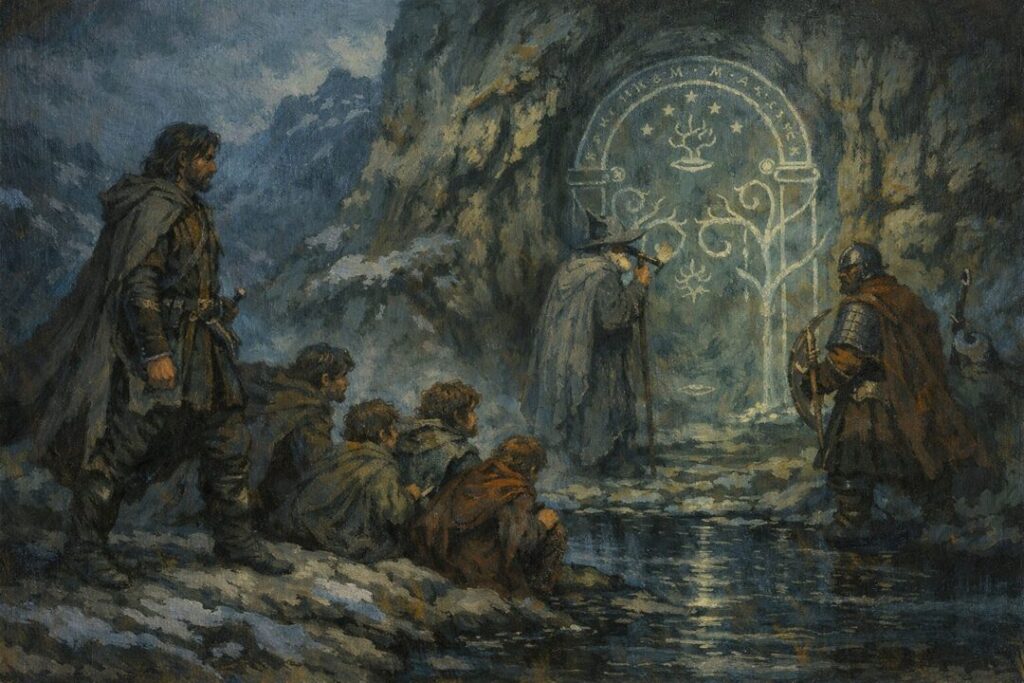
He says he once passed the Dimrill Gate and came out again, but that the memory is “very evil.” He even warns Gandalf personally before they enter, saying it is not the Ring or the others he is thinking of, but Gandalf.
And yet later, when Durin’s Bane appears, readers often ask the same question:
How could Aragorn be this wary of Moria and still not know what a Balrog was?
The answer begins by separating two different ideas that are often blurred together.
Knowing that Balrogs exist is one thing.
Knowing that the hidden terror in Moria is specifically a Balrog is another.
Aragorn Almost Certainly Knew What a Balrog Was
This part should be stated carefully.
The text does not give us a scene in which Aragorn sits in Rivendell and receives a lesson on Balrogs. It does not pause to catalogue his education in that way.
But nothing about his background suggests ignorance of the ancient history of Middle-earth.
Aragorn is raised in Elrond’s house.
He is heir to Isildur.
He lives among lore, memory, and the preserved knowledge of older ages.
So the idea that Aragorn had literally never heard of Balrogs is possible only in the weakest and most technical sense. The books do not say, “Aragorn knew the history of Balrogs,” but they strongly support the conclusion that he would have known of them as beings from the elder wars.
That, however, is not the real issue.
The real issue is identification.
Middle-earth contains many old fears that survive in story long after they vanish from ordinary experience. Knowing the name of an ancient terror does not mean you expect to meet one face to face beneath the mountains.
And it certainly does not mean you can identify one before it stands revealed.
The Hidden Nature of Durin’s Bane
This is where the question becomes much more interesting.
By the time of the Fellowship, Khazad-dûm has been lost for generations. The Dwarves know that Durin VI was slain after delving too deep. They know that Náin also died. They know Moria became a place of dread.
But the narrative does not present the outside world as possessing a neat, settled conclusion that says: yes, a Balrog of Morgoth lives there.
In fact, the scene at the Bridge of Khazad-dûm suggests the opposite.
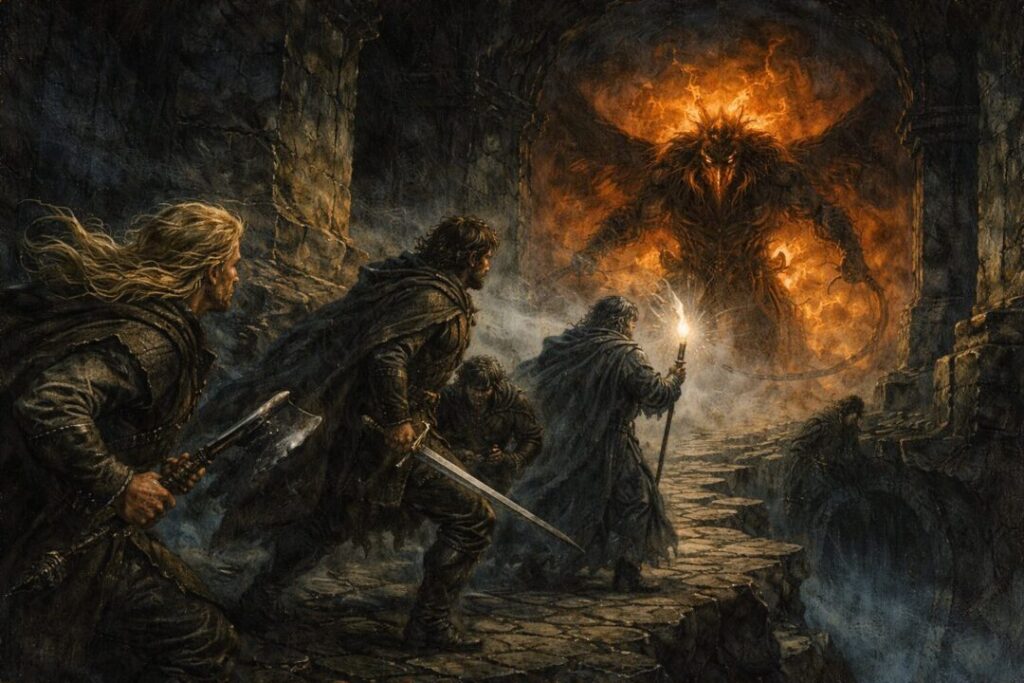
When the creature appears, Legolas cries out that a Balrog has come.
Gimli calls it Durin’s Bane.
Then Gandalf says, “Now I understand.”
That line matters enormously.
If Gandalf only understands at that moment, then the identity of the power in Moria was not fully known beforehand. The dread had a history. The ruin had a cause. But the exact nature of the cause had remained uncertain, hidden, or at least unconfirmed.
So the problem is not that Aragorn failed to recognize a well-known public fact.
The problem is that readers sometimes assume there was a public fact to recognize.
The text does not require that assumption.
Fear Does Not Equal Knowledge
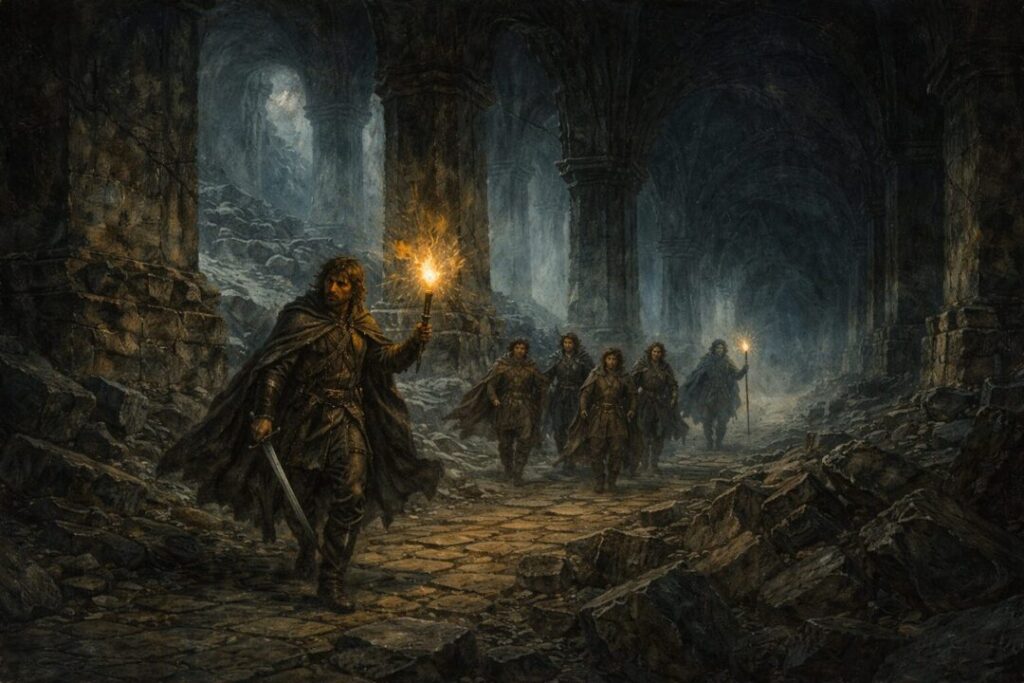
Aragorn’s warning to Gandalf is one of the most haunting moments before the Company enters Moria.
It sounds almost prophetic.
He says he is not thinking of the others, but of Gandalf.
That can tempt readers into assuming Aragorn must already have guessed the truth.
But the books do not say that.
They do not tell us that Aragorn suspected a Balrog specifically.
They do not tell us that his earlier journey through Moria brought him close enough to identify the evil there.
They do not tell us what exactly happened on that earlier passage at all.
They tell us only that the memory was “very evil.”
That is a crucial limit.
Aragorn may have sensed dread.
He may have encountered signs of danger.
He may have felt, in the way some great figures in the story sometimes do, that Gandalf was especially imperiled if they went that road.
But those possibilities must remain possibilities.
None of them equals confirmed identification.
This is one of the places where the restraint of the text matters more than any theory built on top of it.
The books allow Aragorn to fear Moria profoundly without requiring him to know exactly what dwelt there.
And that is not a weakness in the story.
It is part of what makes Moria feel ancient and real.
Why Legolas Recognizes It First
Another detail often gets overlooked.
It is Legolas who names the creature first.
That does not prove that Aragorn was ignorant in some absolute sense. But it does show how recognition works in the moment.
Legolas sees it and cries out at once.
Gimli responds in horror as one hearing the old terror of his people confirmed before his eyes.
Gandalf understands.
The others react to the revelation.
The sequence matters.
The recognition is dramatic because it is happening there and then.
The scene does not read like a group calmly encountering something they had already discussed and categorized in advance. It reads like the dreadful naming of a thing that had remained, until that instant, partly veiled.
That is why Gandalf’s response is so important.
“Now I understand” does not sound like a man observing the obvious.
It sounds like a man finally fitting the last piece into place.
And if even Gandalf reaches clarity only then, Aragorn’s uncertainty becomes far easier to understand.
Aragorn’s Earlier Passage Through Moria Tells Us Less Than People Think
The line about Aragorn having gone through Moria before is one of those details that feels as though it should explain more than it actually does.
Readers naturally want the hidden story.
When did he go?
Why did he go?
What did he see?
What pursued him?
How close did he come to the deeper evil?
But the text refuses to elaborate.
That silence is meaningful.
If Tolkien had wanted Aragorn’s earlier journey to function as secret proof that he knew the truth about Durin’s Bane, he could have said so. Instead, all we are given is the emotional residue: the memory is evil, and Aragorn does not wish to return.
So the most careful reading is also the strongest one:
Aragorn’s first passage through Moria explains his dread, not his knowledge.
It tells us that he has personal reason to fear the place.
It does not tell us that he solved its central mystery.
The Real Horror of Moria
In a way, the deeper answer is more unsettling than the simple question.
Aragorn’s problem is not that he did not know what a Balrog is.
His problem is that Moria belongs to a category of evil that can be felt before it is understood.
That is what the story builds so well.
The West-gate is beautiful and ominous.
The halls are empty but not dead.
The drums begin before the final revelation.
The Company is hunted by enemies they can name, and by something behind them that they cannot.
Moria is not frightening because everyone knows exactly what is there.
It is frightening because they do not.
The dread comes first.
The name comes later.
And when the name finally comes, it is worse than the dread had yet explained.
So Did Aragorn Know What a Balrog Was?
The most precise answer is this:
Aragorn very likely knew what Balrogs were in the lore of the Elder Days.
What he did not know with certainty was that Durin’s Bane in Moria was one.
That distinction resolves the problem.
It explains why he could fear Moria deeply.
It explains why he could warn Gandalf.
It explains why the revelation still lands with force at the bridge.
And it fits the crucial detail that even Gandalf says, “Now I understand,” only when the creature is revealed.
So the question is not really how Aragorn failed to know what a Balrog is.
It is how long Middle-earth could live beside an ancient terror, feel its shadow, tell stories around its ruin, and still not fully name it until the moment it stepped into fire and darkness before them.
That is what makes Moria so memorable.
Not ignorance in the shallow sense.
But the terrifying gap between knowing that something is there and knowing, at last, what it is.
Sources & Notes
- J.R.R. Tolkien, The Lord of the Rings, Book II, Chapter 4, “A Journey in the Dark” — Aragorn recalls passing the Dimrill Gate before and warns Gandalf that Moria may be perilous for him.
- J.R.R. Tolkien, The Lord of the Rings, Book II, Chapter 5, “The Bridge of Khazad-dûm” — Legolas names the Balrog, Gimli calls it Durin’s Bane, and Gandalf says, “Now I understand.”
- J.R.R. Tolkien, The Lord of the Rings, Appendix A, “Durin’s Folk” — gives the Dwarvish history of Khazad-dûm’s fall and the terror awakened beneath the mountains.
- J.R.R. Tolkien, The Silmarillion, “Of the Ruin of Beleriand and the Fall of Fingolfin” — places Balrogs among the ancient servants of Morgoth in the wars of the Elder Days.