At first glance, this seems like a question that should have a simple answer.
The Shire is one of the most detailed places in Middle-earth. Its family lines are preserved. Its calendar is explained. Its customs are remembered. Its villages, roads, and social habits are all drawn with unusual care. So it is natural to assume that somewhere in the legendarium there must also be a tidy answer to the question of Hobbit money.
What coins did they use?
What were the denominations?
Did the Shire mint its own currency?
Was there a distinctly Hobbit monetary system?
But when the texts are examined closely, the answer becomes both clearer and narrower.
Yes, Hobbits used money.
No, the books do not give us a full Shire monetary system.
That gap is the real key to the question.
The Text Does Confirm That Hobbits Used Money
The first point should be stated plainly, because this is where the evidence is strongest.
Hobbits in the Shire did use money.
In The Hobbit, Bilbo rushes out of Bag End so suddenly that he finds himself outside “without a hat, a walking-stick or any money,” which only makes sense if carrying money was part of ordinary daily life. Later in the same scene, Bilbo says outright that he has come away without any money.
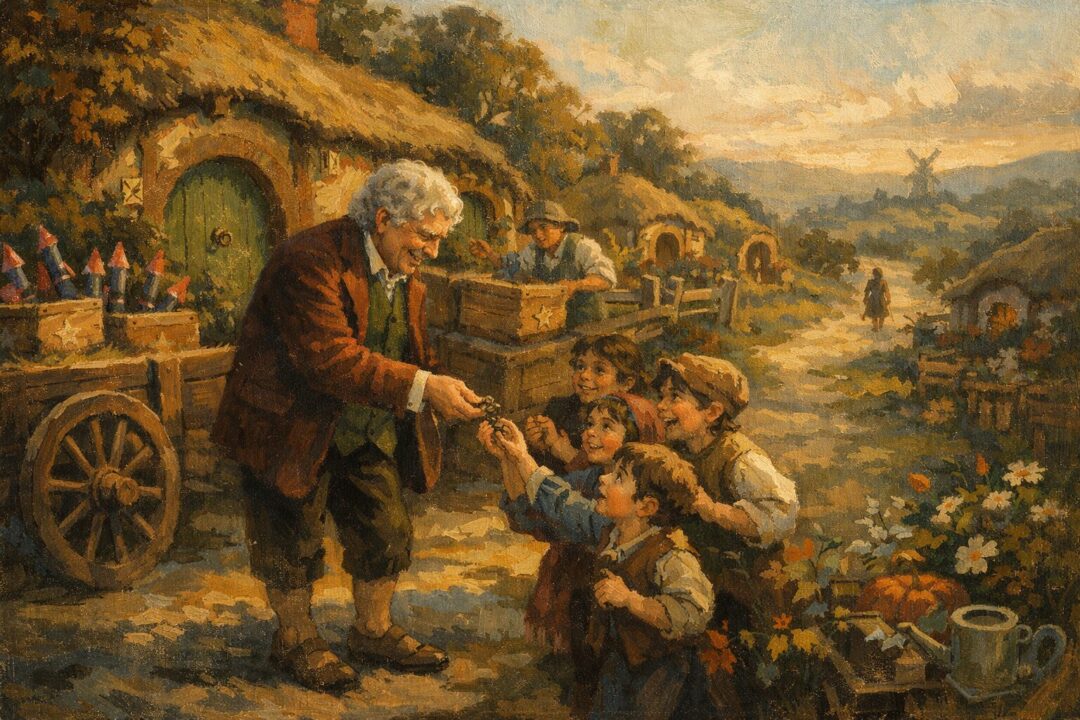
In The Fellowship of the Ring, Bilbo “gave a few pennies away” while preparations were underway for his birthday celebration. That is a direct reference not just to money in general, but to small coin in Hobbit hands.
The Shire also contains ordinary assumptions about wealth, spending, and personal means. When Frodo sells Bag End, one rumor in Hobbiton is that “Frodo’s money was running out” and that he intends to live on the proceeds of the sale. That detail matters because it shows money functioning not as an exotic or foreign thing, but as part of normal social understanding.
And after Bilbo’s departure, the narration is explicit that no money is being distributed among his parting gifts: “not a penny-piece or a glass bead was given away.” Again, the wording assumes a world where coin is familiar and recognizable.
So the basic claim is not in doubt.
The Shire had coin money.
Hobbits knew it, used it, counted it, and noticed its absence.
But the Books Never Describe a Full Shire Coin System
This is where many readers quietly add more certainty than the texts allow.
The books never lay out a formal Shire currency system.
We are not told the names of specifically Hobbit coins. We are not given a table of denominations. We are not shown a Shire mint, a treasury, a tax structure, or a monetary law. No passage explains what metals were standard in the Shire, how values were reckoned there, or whether Hobbit coinage differed from that of neighboring lands. The surviving references are real, but they are sparse.
That means any answer claiming that the Shire had a fully documented internal currency with defined coin types goes beyond the evidence.
The safer conclusion is simpler:
Hobbits used coin money, but the canon does not preserve a detailed account of the Shire’s monetary system.
That is not a weak answer. It is the accurate one.
The Strongest Clue: “Pennies” and “Penny-Piece”
The most revealing Hobbit terms are also the most modest.
Bilbo gives away “a few pennies.” Later the text refers to “not a penny-piece” being given away from Bag End.
That tells us at least three things.
First, small coin circulated in the Shire.
Second, these coins were ordinary enough that the narration uses them without explanation.
Third, the language presented to us is part of the work’s broader translation effect: the Red Book is rendered into modern English terms for the reader. That makes “penny” a translated expression, not necessarily the original spoken word in Westron. The books do something similar elsewhere with calendars, place-names, and familiar social vocabulary.
So when we read “pennies,” we should be careful.
It does prove the existence of coin money.
It does not prove a complete Hobbit coinage chart.
And it does not prove that “penny” was literally the native Shire word rather than the English equivalent chosen for translation.
That distinction matters.
Bree Gives Us More Detail Than the Shire Does
One reason the question becomes confusing is that nearby Bree gives us a sharper glimpse of northern money than the Shire itself.
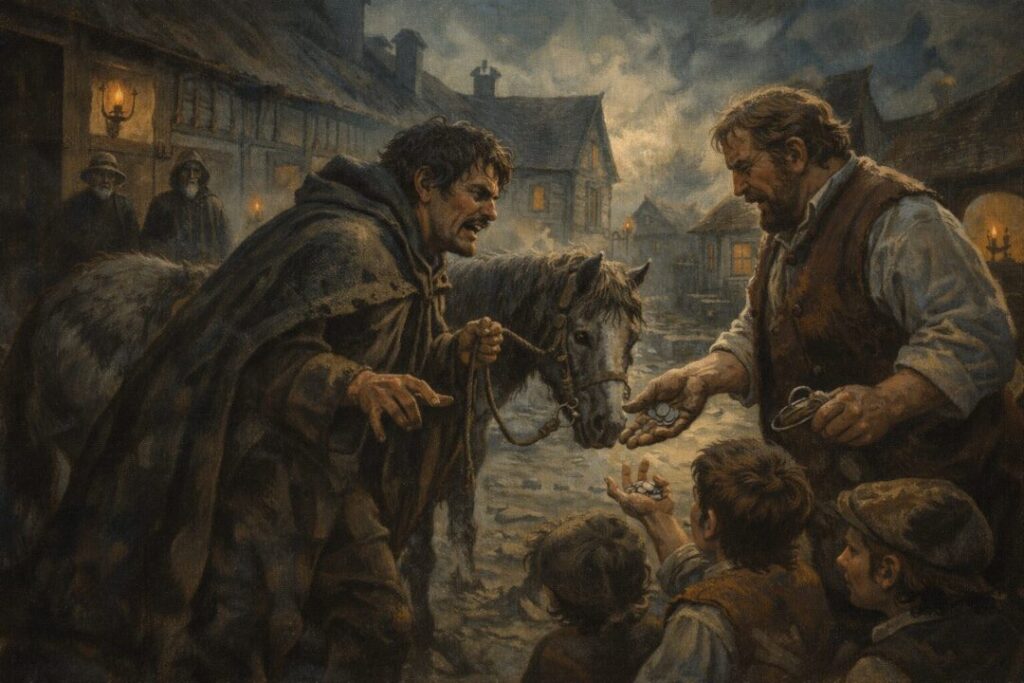
In Bree, Bill Ferny demands twelve silver pennies for his miserable pony, and the text notes that this was at least three times the animal’s value in those parts. Butterbur then adds another eighteen pence in compensation, making thirty silver pennies a painful loss for him.
That is one of the clearest monetary passages in The Lord of the Rings.
It gives us denomination, rough value, and local economic scale.
But Bree is not the same as the Shire.
The two regions are connected, and both contain Hobbits, but the canon does not explicitly state that the Shire used exactly the same coin standard as Bree. It is a reasonable inference that northern trade was compatible across nearby communities, especially since Hobbits did not live in isolation from the wider Westlands. But it remains inference, not direct statement.
So the cautious position is this:
The Bree evidence suggests that silver pennies were part of the wider northern economy and may well have been the kind of coin Hobbits in the Shire also used. But the texts stop short of spelling that out as a formal rule for the Shire itself.
The Shire’s Economy Feels Larger Than Its Coinage
What is striking is not just that money existed.
It is that the Shire is described through many other kinds of exchange as well.
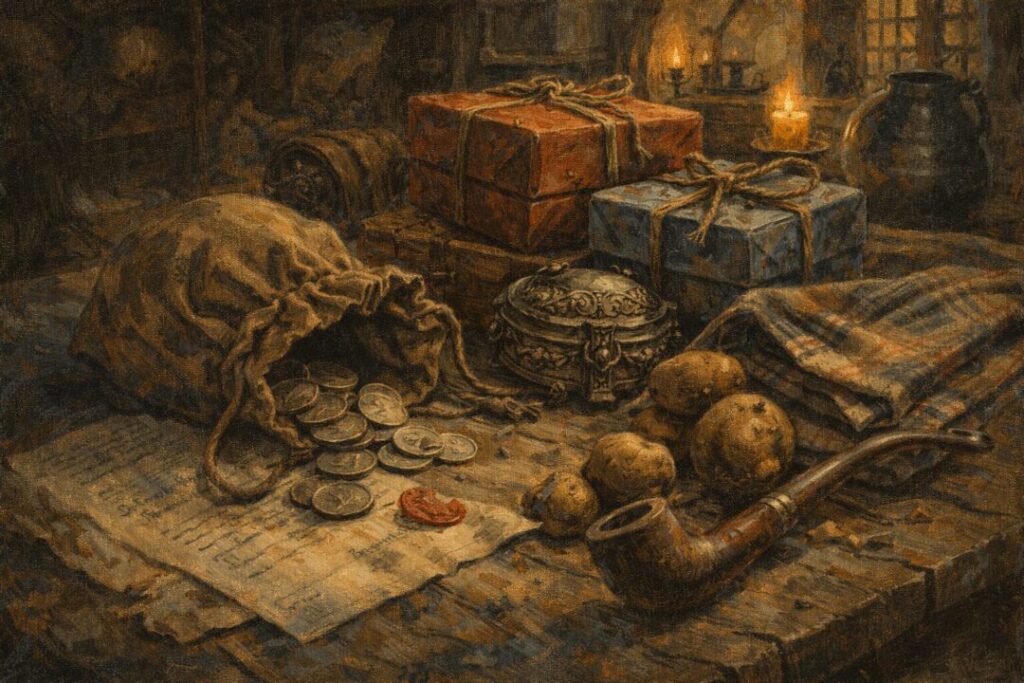
Hobbits are famous for birthday gift-giving. “Hobbits give presents to other people on their own birthdays,” and in places like Hobbiton and Bywater that custom is so widespread that almost everyone expects regular small gifts through the year.
The Prologue also explains mathoms: objects Hobbits had no immediate use for but were unwilling to throw away. These passed from hand to hand, often as presents, and many accumulated in the Mathom-house at Michel Delving.
This matters because it shows that social exchange in the Shire was not defined only by purchase and price.
Gift culture mattered.
Reputation mattered.
Household stores mattered.
Inheritance mattered.
Property mattered.
When Frodo sells Bag End, the sale is socially explosive not just because it concerns money, but because land, status, family resentment, and local gossip are all bound up together.
The same is true of Bilbo’s party gifts. Some are practical. Some are pointed jokes. Some are old mathoms recirculated. Some are clearly valuable. The whole scene feels like an economy of use, affection, memory, and social standing as much as one of hard cash.
So if someone asks what the Shire’s monetary system was, the truest answer may be that the Shire had money, but its life was not narrated primarily through money.
That is why readers can feel the place to be economically real even though the formal system remains mostly undescribed.
There Is Detailed Coinage Elsewhere — Just Not for the Shire
Another useful comparison comes from outside the Shire.
In later material published in The Peoples of Middle-earth, Gondor is given named currency: the castar as a chief coin, and the tharni as a smaller silver coin worth a quarter of a castar.
That is important because it proves the legendarium could, when needed, be precise about currency.
So the lack of equivalent detail for the Shire does not mean money was absent.
It means the books never chose to preserve that level of economic specification for Hobbit society.
In other words, the silence is not accidental evidence that Hobbits had no monetary structure.
It is simply silence.
And silence in this case should not be filled with invented certainty.
So What Did Hobbits Actually Use?
If the question is asked conservatively, the answer becomes clear.
Hobbits in the Shire used coin money.
The text explicitly mentions money, pennies, and penny-pieces in Hobbit life.
The most likely broader context is that the Shire participated in the same general northern economy that also appears in Bree, where silver pennies are named directly. But that connection, while plausible, is stronger as implication than as direct statement.
What the canon does not give us is a fully worked-out Shire monetary system with official Hobbit denominations, minting arrangements, or exchange tables.
That part is not preserved in the primary texts.
And that is exactly why the question is more interesting than it first appears.
Because the Shire feels complete enough that many readers assume the answer must exist somewhere in detail.
But the texts leave us with something more restrained:
a lived-in rural society where coin exists, trade exists, sales exist, wealth exists, and yet everyday life is narrated just as much through gifts, stored goods, meals, property, and local custom.
The Shire is not a place without money.
It is a place where money is present, but not central enough to dominate the texture of life.
That may be the most Hobbit answer of all.
Sources & Notes
- J.R.R. Tolkien, The Hobbit, Chapter 1, “An Unexpected Party” — has Bilbo leave Bag End without any money, confirming that ordinary Hobbit life assumed coin or cash on hand.
- J.R.R. Tolkien, The Lord of the Rings, Book I, Chapter 1, “A Long-expected Party” — mentions Bilbo giving away “a few pennies,” Frodo’s supposed money troubles, and the pointed absence of any “penny-piece” among Bilbo’s parting gifts.
- J.R.R. Tolkien, The Lord of the Rings, Prologue, “Concerning Hobbits” — explains Shire customs of birthday presents and mathoms, useful context for a society where exchange is not described only through coin.
- J.R.R. Tolkien, The Lord of the Rings, Book I, Chapter 11, “A Knife in the Dark” — gives the Bree pony transaction in silver pennies and pence, the clearest nearby example of northern coin values.
- J.R.R. Tolkien, The Peoples of Middle-earth, “The Heirs of Elendil” — preserves more technical Gondorian currency terms such as castar and tharni, a contrast to the much thinner evidence for Shire coinage.