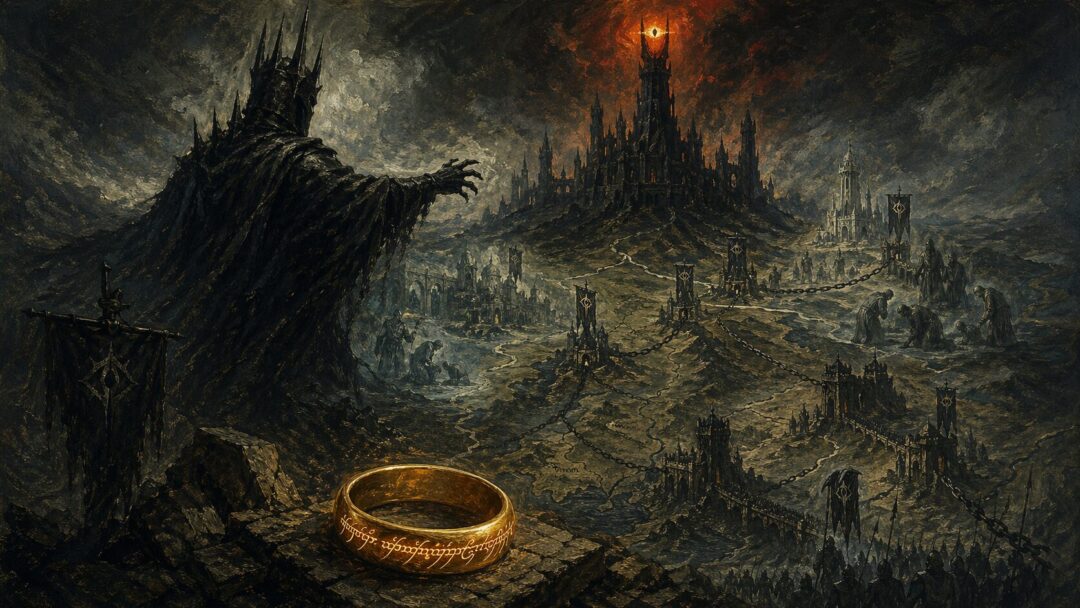
When the Captains of the West stand before the Morannon, they are not expecting mercy.
They have marched there to do something nearly hopeless: to challenge Sauron openly, not because they think they can defeat him by force, but because they need to draw his eye away from the true danger moving inside Mordor.
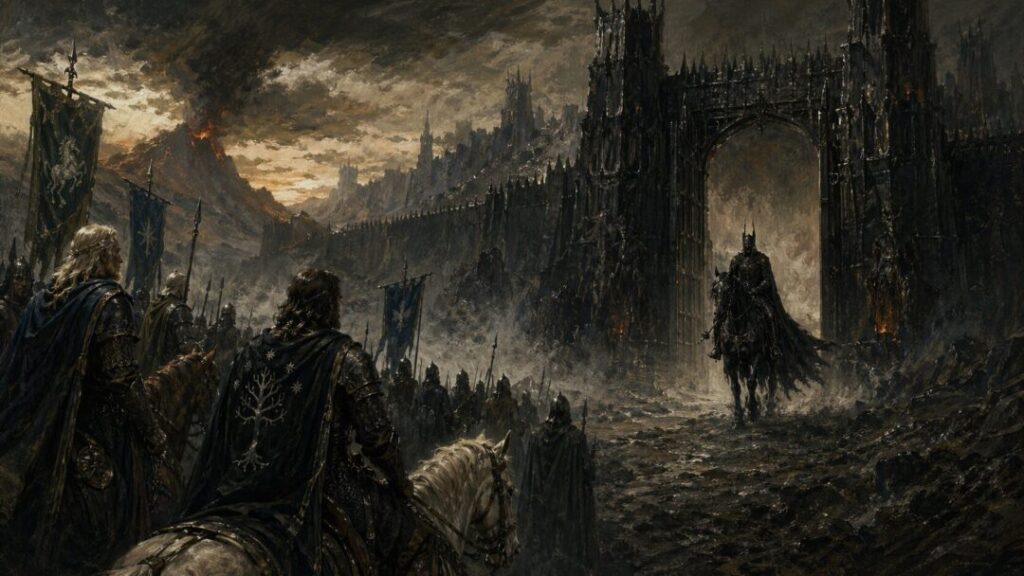
And then, before the battle begins, the Black Gate opens.
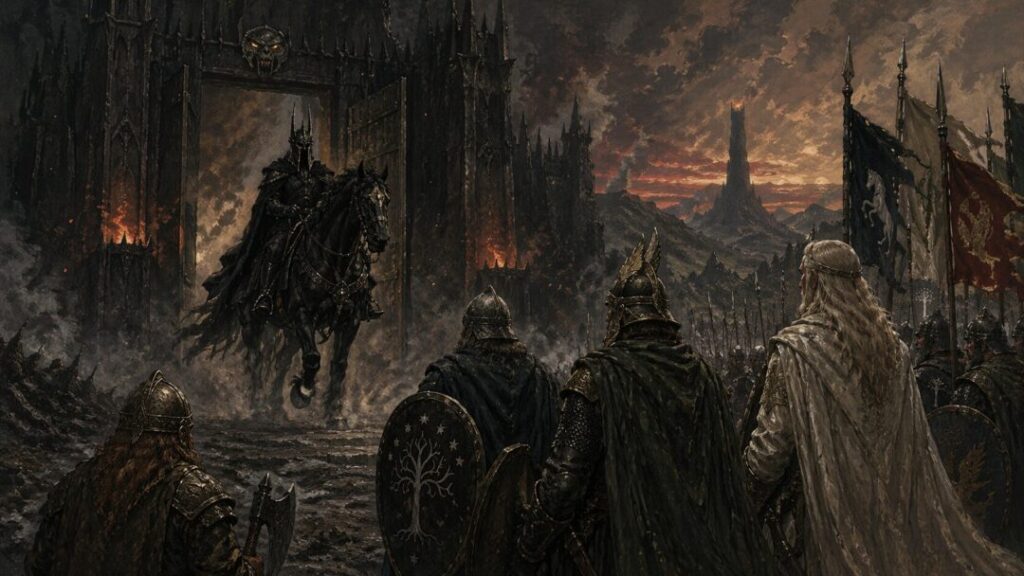
Out rides the Mouth of Sauron.
He is not a mere Orc-captain or common messenger. The text presents him as Sauron’s lieutenant, a Black Númenórean who has long entered the Dark Tower’s service, learned much of his master’s mind, and now speaks for him at the edge of the final war.
He comes with cruelty, confidence, and calculated insolence.
And then he offers terms.
That moment raises one of the most unsettling questions in the whole war:
Would Sauron actually have honored them?
The instinctive answer is usually no.
But the deeper answer is more disturbing than a simple lie.
What the terms actually were
The Mouth of Sauron does not offer reconciliation.
He offers a conquered peace.
Gondor and its allies are to withdraw beyond the Anduin. They are to swear never again to assail Sauron in war. All lands east of the Anduin are to belong to Sauron forever. Lands west of the river, as far as the Misty Mountains and the Gap of Rohan, are to become tributary to Mordor. The Men there are to bear no weapons, though they may supposedly govern their own affairs. They must also help rebuild Isengard, where Sauron’s lieutenant will dwell in Saruman’s place.
At first hearing, this may sound like one of those dark bargains that leaves a defeated people bruised but still alive.
That is exactly why the scene matters.
Because Tolkien does not leave the reader trapped inside the wording.
He immediately reveals the substance behind it.
Looking into the messenger’s eyes, the Captains understand what this “peace” really means: the lieutenant would gather what remained of the West under his sway, he would be their tyrant, and they would be his slaves.
That line is decisive.
It means the text itself refuses to treat the offer as sincere in any ordinary sense.
The offer is already domination
This is the first thing that must be kept clear.
Even if Sauron had “kept” the terms, the terms were already a form of enslavement.
The West would be disarmed.
Its territory would be reduced.
Its peoples would pay tribute.
Its strategic freedom would be gone.
Its former enemy would rule from Isengard over what remained.
So the question cannot simply be whether Sauron would have honored a fair settlement.
There is no fair settlement here to honor.
The proposed arrangement is already built to end the political and military independence of the surviving West while preserving just enough outward structure to make subjugation look orderly.
That is one reason the scene is so effective.
The terror does not lie only in force.
It lies in force translated into administration.
Sauron’s nature matters here
To answer whether he would have kept even this much, we have to step beyond the Black Gate itself and ask what kind of being Sauron is by the end of the Third Age.
The legendarium is consistent on this point.
Sauron is not merely ambitious. He is defined by domination.
In the account of the Rings of Power, he deceives the Elves and forges the One Ring in secret to control the others. In that same tradition, the Ring is associated directly with his cruelty, malice, and will to dominate life.
The Silmarillion’s account of his rise becomes even more explicit. Sauron’s lust and pride increase until he seeks to become master of all things in Middle-earth. He “brooked no freedom nor any rivalry,” and even while pursuing that domination he still wears a mask when useful, so that he may deceive the eyes of Men.
That combination matters.
He does not simply overpower.
He deceives, absorbs, subordinates, and then rules.
So if we ask whether Sauron would have observed the wording of his own settlement, the answer depends on what kind of observation we mean.
Would he preserve genuine freedom for the West?
No. The text rules that out already.
Would he preserve the appearance of local rule while draining it of real independence?
That is much more plausible.
In fact, that is almost exactly what the terms describe.
“They may govern their own affairs”
This is perhaps the most sinister phrase in the entire offer.
Because in isolation it sounds moderate.
It suggests a reduced but surviving autonomy. A humiliated people, perhaps, but not a destroyed one.
Yet the rest of the terms strip that phrase of substance.
A tributary state without arms, under the shadow of Mordor, with Isengard occupied by Sauron’s lieutenant, is not free in any meaningful sense. It is a puppet order.
And the text tells us that the Captains see this.
They do not debate legal wording. They do not wonder whether the promise is technically binding. They perceive the reality immediately.
That is important because Tolkien is often careful about what remains implied and what is made explicit.
Here, he makes the hidden meaning explicit.
The slavery is not a later theory.
It is the point of the scene.
Would Sauron have kept the literal terms?
This is where the answer becomes more precise.
If by “honored” we mean: would Sauron immediately exterminate everyone after they surrendered, despite what had just been said?
The text does not require that conclusion.
Sauron had strong reasons to prefer submission, tribute, and stable control over pointless waste. Even in later commentary on his character, he is described as having once desired order and reorganization before that impulse hardened into a lust for complete power.
So it is entirely possible that he would have observed the outer form of the agreement for a time.
The peoples west of Anduin might indeed have been left in place. Some local administration might have survived. The shells of Gondor and Rohan might have remained standing.
But that is not the same as good faith.
It would only mean that Sauron preferred domination through subordination rather than immediate annihilation.
And that is exactly the trap in the question.
Because the terms are crafted so that “keeping” them still destroys the freedom they seem to spare.
Why the offer had to sound plausible
There is another detail worth noticing.
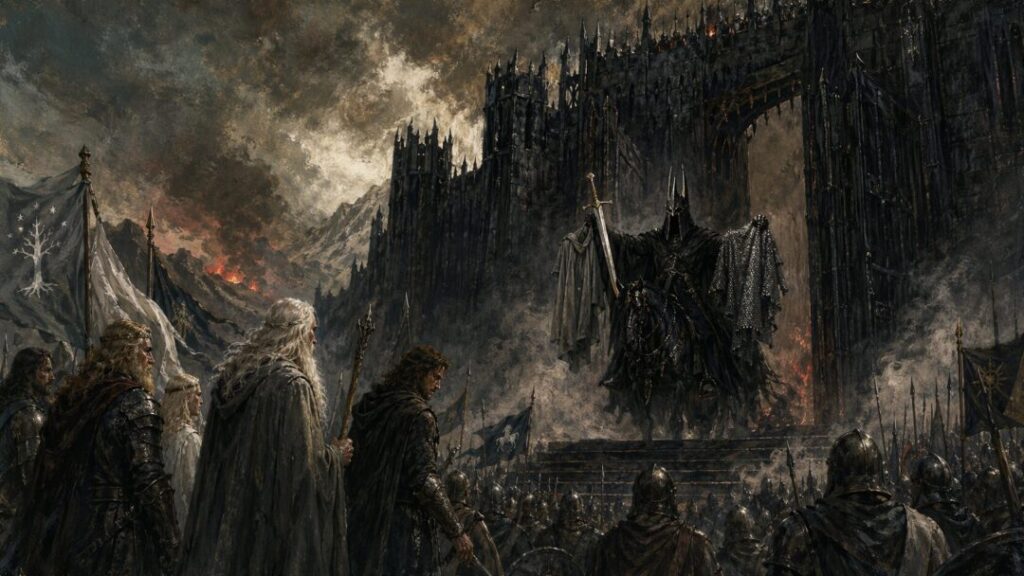
The Mouth of Sauron comes as a herald and demands the protections due to one. When he is confronted, he protests that an ambassador may not be assailed, and Gandalf replies that where such laws hold, ambassadors also use less insolence.
That exchange matters because it frames the entire scene in the language of diplomacy, law, and formal negotiation.
But Mordor is not entering into fellowship with the West.
It is weaponizing the appearance of diplomacy.
The offer is meant to break morale, isolate the leaders, and translate military defeat into moral surrender.
That is why Frodo’s tokens are displayed. That is why the language is formal. That is why the terms include just enough recognizable structure to feel thinkable.
A naked promise of massacre would have no persuasive power.
A plausible tyranny might.
The real answer
So would Sauron have honored the terms offered by the Mouth of Sauron?
Not in the sense most people mean when they ask the question.
He would not have granted the West real peace, real self-rule, or any durable freedom. The text itself interprets the offer as tyranny disguised as settlement.
But he may well have honored the wording in a narrower and darker sense.
He may have allowed the defeated lands to survive outwardly.
He may have left their local customs and lesser governance in place.
He may have preferred tribute, disarmament, and permanent dependence to immediate destruction.
In other words, he might have kept the form in order to betray the substance.
And that is far more characteristic of Sauron than a simple broken promise would be.
Because Sauron’s evil is not only that he destroys.
It is that he takes what lives, empties it of freedom, and leaves it standing long enough to serve him.
That is what the Black Gate scene reveals.
The most chilling possibility is not that Sauron would have lied and then attacked anyway.
It is that he might have told the truth in the most poisonous way possible.
The West would have lived.
And ceased to be free.
Sources & Notes
- J.R.R. Tolkien, The Lord of the Rings, Book V, ch. 10 “The Black Gate Opens”: the Mouth of Sauron’s terms, including disarmament, tribute, loss of lands east of Anduin, and the rule of Sauron’s lieutenant from Isengard.
- J.R.R. Tolkien, The Lord of the Rings, Book V, ch. 10 “The Black Gate Opens”: the Captains’ recognition that the proposed “peace” would leave the West under a tyrant and reduced to slavery.
- J.R.R. Tolkien, The Silmarillion, “Of the Rings of Power and the Third Age”: Sauron’s deception as Annatar, forging of the One Ring, and intent to rule the bearers of the other Rings.
- J.R.R. Tolkien, The Silmarillion, “Of the Rings of Power and the Third Age”: Sauron’s Third Age ambition to become master of all Middle-earth and his use of fear, guile, and force to dominate Men.
- J.R.R. Tolkien, Letter 131: Tolkien’s account of Sauron’s original desire for order and reorganization hardening into tyranny and absolute power over other wills.