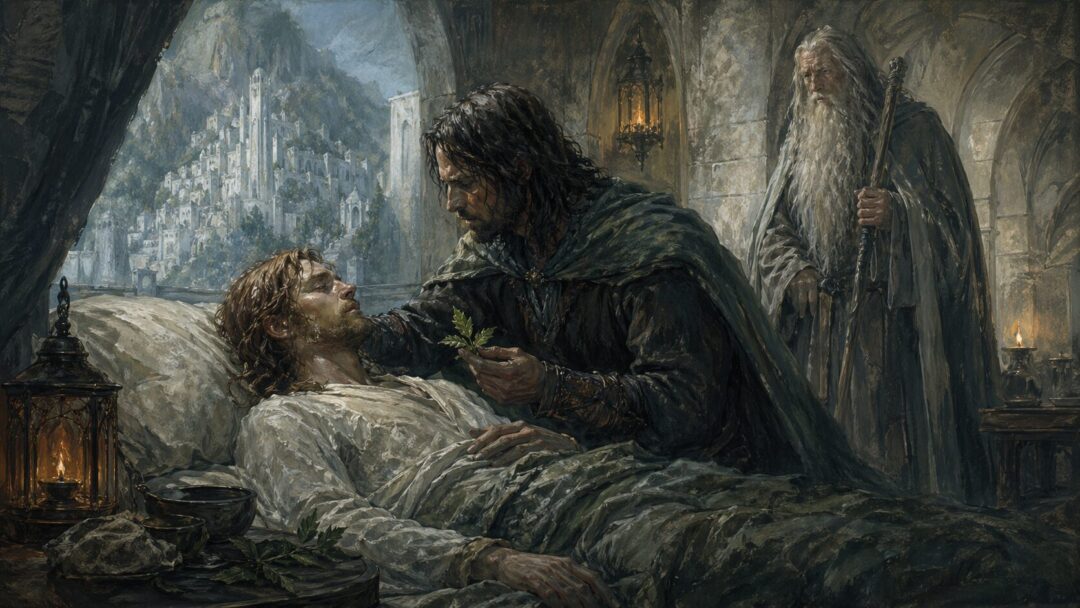
When Faramir wakes in the Houses of Healing, he says something that can feel almost impossible on a first reading.
He opens his eyes, sees Aragorn bending over him, and calls him king.
Not captain.
Not healer.
Not lord of some distant people.
King.
“My lord, you called me. I come. What does the king command?”
It is a startling moment because Faramir has not watched Aragorn enter Minas Tirith in triumph. He has not seen him crowned. He has not heard the formal proclamation before the people. As far as the public order of Gondor is concerned, the city is still ruled by the Stewardship, even though Denethor is dead and the war is not yet finished.
And yet Faramir knows.
Or at least, he recognizes.
That distinction matters.
Because the scene is not written like a political deduction. Faramir is not weighing claims of descent, examining tokens, or asking for proof. He has just come back from the edge of death, and his first response is immediate, personal, and full of recognition.
So how did he know?
The answer is not one single clue. It is a convergence of old lore, Faramir’s own character, the nature of Aragorn’s healing, and the strange clarity that enters the room when the rightful king finally acts as king.
Faramir Was Not an Ordinary Soldier
To understand the scene, we have to remember who Faramir is before he ever meets Aragorn.
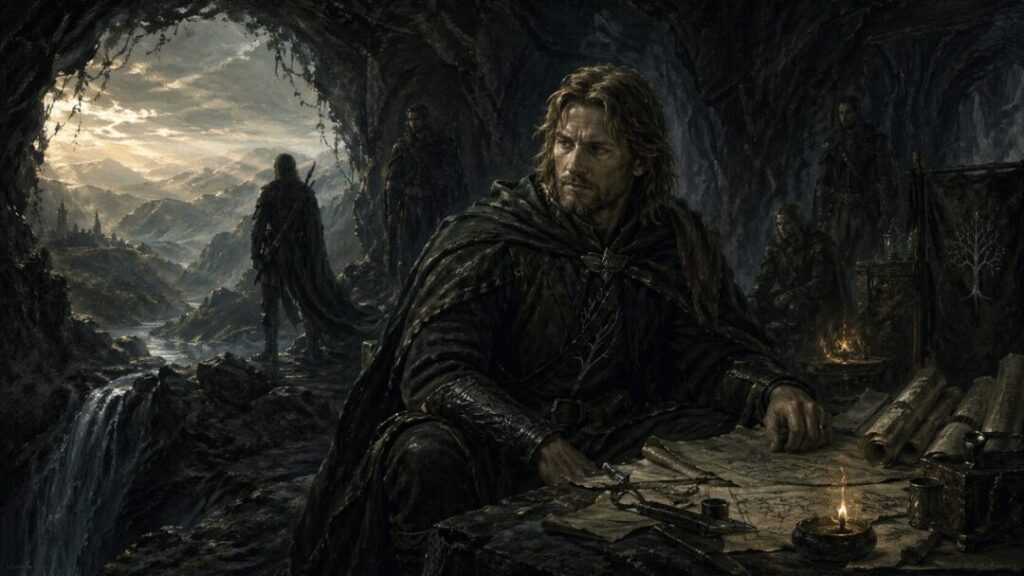
Faramir is not merely the younger son of Denethor. He is a captain of Gondor, a man trained in war, judgment, and restraint. He commands the Rangers of Ithilien. He understands danger, secrecy, and the weight of command.
But he is also deeply connected to the old learning of Gondor.
In his conversation with Frodo in Ithilien, Faramir makes it clear that the house of Denethor preserves ancient lore. He knows of old records, traditions, and matters that most men of Gondor would likely never study closely. He is not ignorant of prophecy. In fact, the dream that eventually sends Boromir to Rivendell first comes to Faramir, and more than once.
That is important.
Faramir is already a man who has stood near the edges of mystery. He has heard words in a dream about the Sword that was broken, Imladris, Isildur’s Bane, and the Halfling. He has spoken with Frodo and Sam. He has guessed more than they wished to reveal. He has chosen mercy where Boromir chose desire.
So when he wakes in the Houses of Healing, he is not a blank mind encountering a stranger.
He is a lore-wise man of Gondor, already shaped by prophecy, already aware that the great events of his age are moving toward something larger than the rule of the Stewards.
The Old Saying of Gondor
The most direct answer lies in the old lore quoted in the Houses of Healing:
“The hands of the king are the hands of a healer, and so shall the rightful king be known.”
This saying is remembered by Ioreth, a woman of the Houses of Healing. At first, it almost sounds like a piece of folk wisdom—one of those old sayings that survives in a city long after people have stopped expecting it to matter.
But the story treats it seriously.
Gandalf hears it and immediately understands its importance. Aragorn is summoned because the saying is not merely decorative. It points to a sign of kingship that Gondor itself has preserved, even if only dimly.
The rightful king will be known by healing.
This is very different from how kingship is usually recognized.
Aragorn is not first revealed to Minas Tirith by force. He does not seize the city. He does not demand the throne in the hour of crisis. In fact, he refuses to enter as king before the proper time, waiting outside the city after the battle.
But when the wounded lie under the Black Shadow, he enters.
Not to claim power.
To restore life.
That is the first public sign of the King’s return.
Aragorn Does Not Merely Treat a Wound
Faramir’s condition is not a normal battlefield injury.
He has been struck by a Southron arrow, but the deeper danger is the Black Breath, the shadow of the Nazgûl. This is not simply fever or blood loss. It is a spiritual and physical darkness that draws the sufferer toward death, despair, and coldness.
The healers of Gondor cannot cure it.
Gandalf himself does not simply heal Faramir by his own hand. Instead, Aragorn is needed.
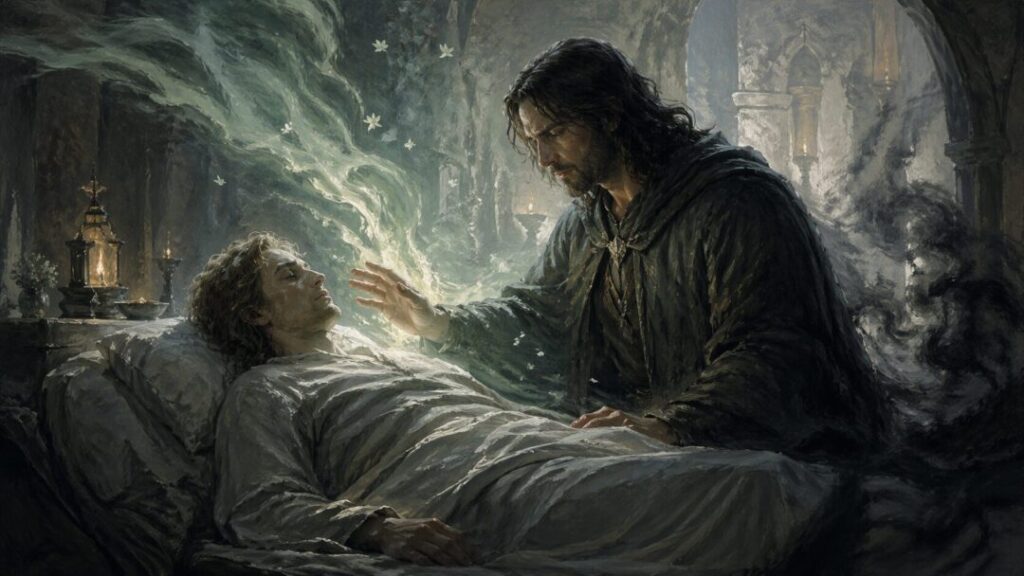
That does not mean Aragorn performs a casual miracle with no effort. The text is careful. Aragorn uses athelas, or kingsfoil. He calls Faramir by name. He puts forth such power and skill as has been given to him.
This matters because Aragorn’s healing is not presented as ordinary medicine alone.
It is medicine, lore, authority, and personal power working together.
And Faramir is not merely waking from sleep. He is being called back.
That is why his first words matter so much. He does not say, “Where am I?” or “Who are you?” He says, “My lord, you called me.”
Faramir recognizes that the voice has reached him in the shadow.
And the one who called him back is the King.
The “Light of Knowledge and Love”
One of the most revealing details in the scene is easy to miss.
When Faramir opens his eyes and looks on Aragorn, the text says that “a light of knowledge and love” is kindled in them.
That phrase is doing a great deal of work.
It does not say Faramir calculated Aragorn’s identity. It does not say someone explained the matter to him. It does not say he remembered a rumor from the battlefield.
It says knowledge and love.
That suggests a recognition that is both inward and immediate. Faramir sees something in Aragorn that answers what he already knows, hopes, and perhaps has been prepared to receive.
This does not mean we should invent a private vision that the text never describes. The story does not tell us that Faramir saw Aragorn’s lineage in a dream, or that some hidden voice announced his name.
But the language does allow something deeper than ordinary deduction.
The texts imply that Faramir’s recognition comes in the act of healing itself. Aragorn’s authority is revealed not by a crown, but by what his presence does to the shadow.
Faramir knows because the King has done the thing the old lore said the King would do.
Faramir Had Already Been Prepared for the Return
There is another layer beneath this.
Faramir’s life has been shaped by the absence of the King.
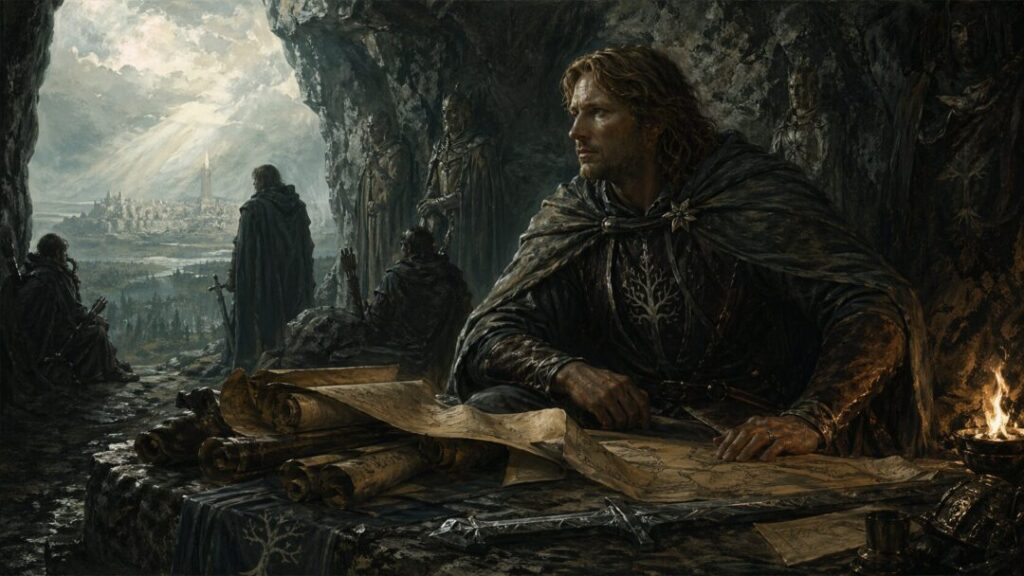
Gondor has been ruled by Stewards for many generations. The Stewards do not sit on the throne. They guard it. Their rule is real, but it is also waiting. The very structure of Gondor carries an unfinished question: what if the King returns?
Denethor resists that possibility with pride and suspicion. Boromir is drawn toward military power and the desperate defense of his people. Faramir is different.
He does not seek glory for himself. He does not clutch at the Ring when he learns what Frodo carries. He does not try to twist prophecy to his own advantage. He is one of the few powerful men in the story who can recognize authority without trying to possess it.
That is why his reaction to Aragorn feels so right.
Faramir is not diminished by the King’s return. He is completed by it.
His first instinct is not rivalry.
It is service.
“What does the king command?”
In that sentence, the Steward’s true purpose is fulfilled. Not as a humiliation, but as restoration.
Why Aragorn’s Kingship Is Revealed Through Healing
Aragorn’s claim to the throne is supported by lineage, by the reforged sword, by the signs surrounding him, and by his deeds in war.
But in Minas Tirith, the most intimate proof comes through healing.
That is not accidental.
The city has been wounded in every possible way.
Its ruler has fallen into despair.
Its soldiers have been broken by war.
Its people have lived for generations under the shadow of Mordor.
Its hope has narrowed into endurance.
A conquering king could enter such a city and still leave it spiritually unchanged.
But Aragorn enters first as the one who heals what the city itself cannot heal.
Faramir, Éowyn, and Merry each suffer in different ways, but all three are touched by the shadow of the war. Aragorn’s healing does not erase their grief or undo all pain, but it brings them back into life.
That is the shape of his kingship.
He does not merely defeat Sauron’s servants in battle. He begins to undo the shadow they leave behind.
This is why Faramir’s recognition is so important. He is the first Steward of the restored order. He is the man who must yield the authority of Gondor back to the line of kings. And he recognizes Aragorn not in a throne room, but from a sickbed.
The King comes to him before Faramir can come to the King.
Did Faramir Know from Prophecy Alone?
It is tempting to say Faramir knew simply because he remembered the old saying.
But that is probably too simple.
The old lore explains the sign, but it does not fully explain the emotional force of the scene. Faramir does not wake and say, “You must be the king, because the proverb has been fulfilled.” He speaks as one already certain.
The best reading is that several things meet at once.
Faramir is lore-wise enough to understand the meaning of a healer-king. He has already been drawn into the prophetic movement surrounding the War of the Ring. He has encountered Frodo and learned enough to know that the fate of the age is turning. He is lying under a shadow that ordinary healers cannot lift. Then Aragorn calls him by name and draws him back.
In that moment, knowledge becomes recognition.
The old lore gives the shape.
The healing gives the proof.
Faramir’s own heart gives the response.
The Steward Recognizes the King
There is a beautiful restraint in the scene.
Aragorn does not force recognition from Faramir. He does not announce himself as lord of Gondor over a helpless man. He does not make Faramir’s healing conditional on loyalty.
He simply heals him.
And Faramir, once restored, gives the answer freely.
That matters because the return of the King is not portrayed as a mere replacement of one ruler by another. It is the healing of a broken order. The Steward who should have preserved hope has fallen into despair and death. But the Steward’s son, saved from that despair, becomes the first to receive the King with love.
Faramir’s recognition is therefore not just personal.
It is symbolic.
Gondor itself, through its noblest surviving Steward, awakens and says: the King has returned.
The Quiet Power of the Scene
The Houses of Healing may not be the loudest moment in the story, but it is one of the clearest.
On the Pelennor, Aragorn helps win the battle.
At the Black Gate, he helps draw out Sauron’s gaze.
At the coronation, he is publicly acknowledged.
But in the Houses of Healing, he is revealed.
Faramir knows because Aragorn’s kingship is not just a legal claim. It is something alive in him. It can be seen in mercy, felt in authority, and proven in healing.
The crown comes later.
The recognition comes first.
And that is why Faramir’s first words are so powerful. He wakes from shadow and immediately understands what many in Gondor have forgotten how to hope for.
The long waiting of the Stewards is ending.
The throne is no longer empty.
And the King has returned not with a demand for obedience, but with a hand laid upon the dying.
That is how Faramir knew.
Sources & Notes
- J.R.R. Tolkien, The Lord of the Rings, Book V, Chapter 8, “The Houses of Healing” — Ioreth’s saying, “The hands of the king are the hands of a healer,” frames Aragorn’s healing as the sign by which the rightful king is known.
- J.R.R. Tolkien, The Lord of the Rings, Book V, Chapter 8, “The Houses of Healing” — Aragorn calls Faramir back from the Black Shadow, and Faramir wakes with “a light of knowledge and love” before asking what the king commands.
- J.R.R. Tolkien, The Lord of the Rings, Book IV, Chapter 5, “The Window on the West” — Faramir is shown as lore-wise, perceptive, and already involved in the prophetic dream of Imladris, the Broken Sword, and Isildur’s Bane.
- J.R.R. Tolkien, The Lord of the Rings, Appendix A, “Gondor and the Heirs of Anárion” — the Stewardship is presented as a guardianship of the empty throne, giving context to Faramir’s recognition and service when the King returns.