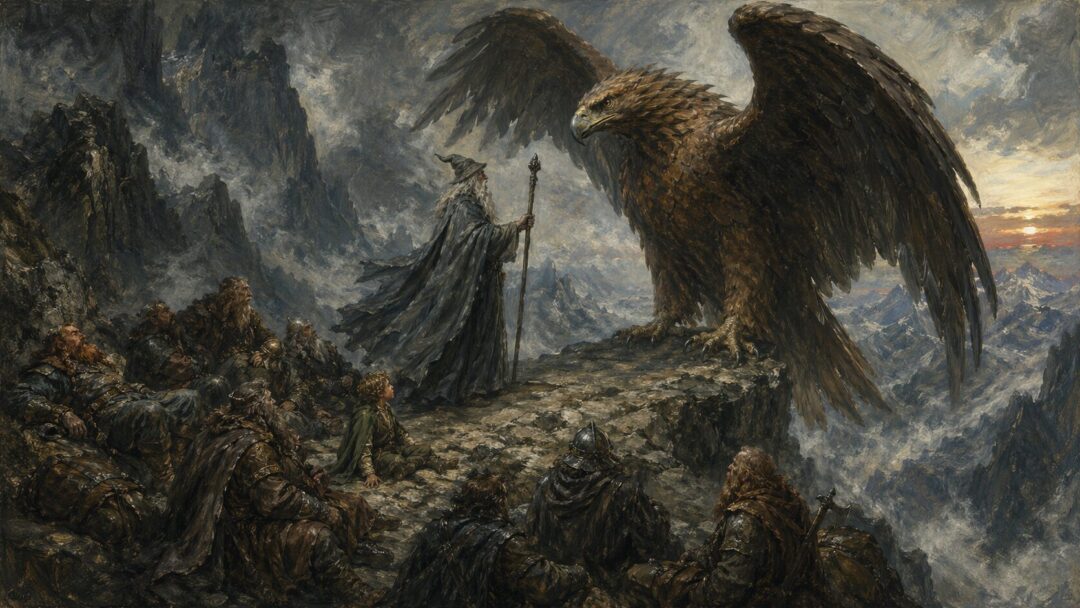
The Eagles of Middle-earth are usually remembered as saviors.
They appear when the story has almost reached the edge of disaster. They rescue Thorin’s company from the burning trees. They arrive at the Battle of Five Armies when goblins and wolves are pressing hard. They bear Gandalf from danger. They come again above the Black Gate, when the armies of the West are surrounded and hope seems almost spent.
Because of this, readers often imagine them as pure symbols of rescue.
High, noble, untouchable, and entirely good.
But The Hobbit gives us one small detail that complicates that picture.
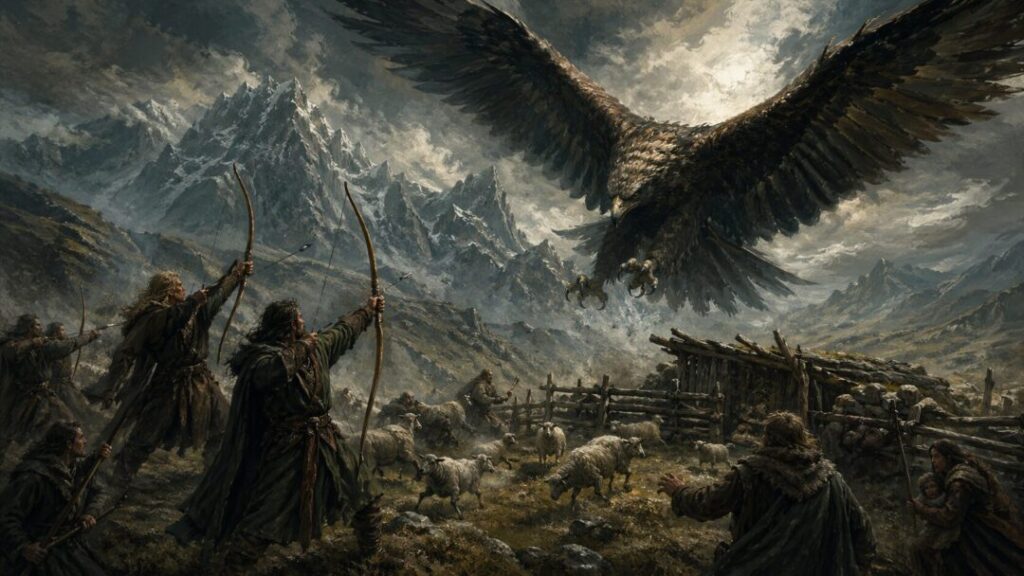
The Lord of the Eagles refuses to take Bilbo, Gandalf, and the Dwarves anywhere near where Men live.
His reason is not mysterious.
Men would shoot at them.
And why would Men shoot at the Eagles?
Because they would think the Eagles had come for their sheep.
Then the Lord of the Eagles adds the detail that makes the whole matter more interesting:
Sometimes the Men would be right.
That is the key.
The Eagles are not hated and feared because Men simply misunderstand goodness. They are feared because, from the ground, the Eagles are not only helpers. They are also predators.
The Eagles Are Not Tame Rescuers
One of the most important things The Hobbit says about Eagles is also one of the easiest to overlook.
They are not described as harmless.
The text says that Eagles are not “kindly birds.” Some are even cowardly and cruel. The great race of the northern mountains is set apart from those lesser Eagles, and they are described as proud, strong, and noble-hearted. But even that praise does not make them gentle pets of the Free Peoples.
They are not horses with wings.
They are not servants waiting for commands.
They are not a convenient way to move heroes from one point of the map to another.
The Great Eagles act according to their own judgment. They help when they choose. They refuse when they choose. Their friendship is real, but it is not ownership. Gandalf can speak with them, and they respect him, but he does not command them like a king commanding soldiers.
That matters because the fear of Men is not presented as irrational superstition.
It is practical.
If a great Eagle descended near a settlement, the Men below would not necessarily know whether it came as a friend, a messenger, or a hunter. They would see wings large enough to carry off living things. They would see claws. They would think of their flocks.
And in a world where livestock means survival, that fear makes sense.
Sheep Are Not a Small Matter
Modern readers may pass over the sheep detail as a joke.
But in the world of The Hobbit, sheep are wealth, food, clothing, and livelihood. For people living near the wild lands east of the Misty Mountains, losing animals would not be a minor inconvenience. It could mean hunger. It could mean poverty. It could mean danger in winter.
So when Men shoot at Eagles, they are not necessarily acting out of malice.
They are defending what keeps them alive.
The Eagles, from their own point of view, may not think of themselves as thieves. They are hunters. They live in the high places. They take prey. A sheep in a field may not look to an Eagle like property in the way it looks to a shepherd.
But Men would see it differently.
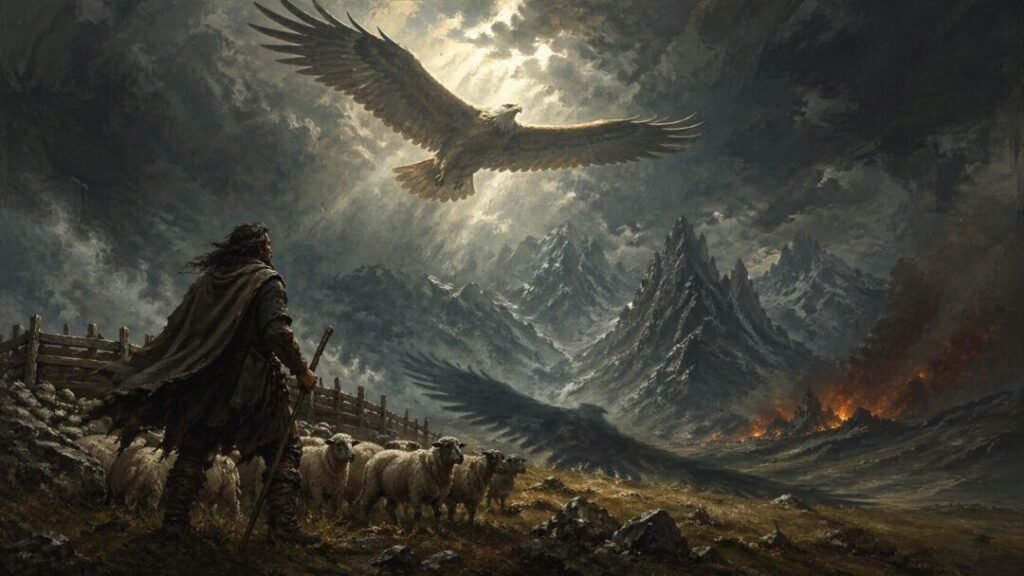
To them, the Eagle is not merely a noble creature of the mountains. It is a threat from above.
This is one of the quiet strengths of the passage. It refuses to turn the world into a simple division between good creatures and bad creatures. The Eagles oppose goblins. They assist Gandalf. They belong to the side of light in the great wars of the legendarium.
And yet a shepherd might still be right to fear them.
Noble Does Not Mean Safe
This is where the Eagles become more interesting than a simple rescue device.
They are noble, but they are not safe.
They hate goblins, but that does not mean they love Dwarves.
They help Gandalf, but that does not mean they will carry his companions wherever he wishes.
In The Hobbit, their help has limits. After rescuing the company from the goblins and wolves, the Lord of the Eagles agrees to carry them onward, but only so far. He will not risk the Eagles near Men, and he will not endanger them for the sake of Dwarves in the southern plains.
That is not cruelty.
It is independence.
The Eagles are willing to intervene against wickedness. They are willing to repay gratitude. They are willing to act with courage. But they are not absorbed into the purposes of others. They remain themselves.
This is why the line about Men shooting at them is so important. It reminds us that Middle-earth is not built like a game board where every “good” piece can be used by the heroes whenever useful.
The Eagles are good, but they are not tools.
What Men Saw from the Ground
From a high mythic perspective, the Great Eagles carry deep significance.
In the older histories of Middle-earth, the Eagles are associated with the highest powers of the world. They appear in the struggles against Morgoth. They keep watch. They intervene at crucial moments. Their presence often suggests that help can arrive from above when all ordinary paths have failed.
But ordinary Men living near the mountains may not experience them that way.
The texts do not tell us exactly what those Men knew about the divine role of the Eagles, so we should be careful. It would be speculation to say they understood the full history of the Great Eagles and rejected it.
The safer reading is much simpler.
They saw enormous birds that sometimes came after sheep.
That was enough.
A farmer does not need a complete theology of Eagles to string a bow. He only needs to know what happened the last time one came low over the pasture.
This contrast is very Middle-earth.
The same being can appear as a sign of providence in one story and a danger to livestock in another. Both can be true. The world is large enough for myth and ordinary hunger to exist at the same time.
The Eagles and the Goblins
The fear of Men is also different from the fear of goblins.
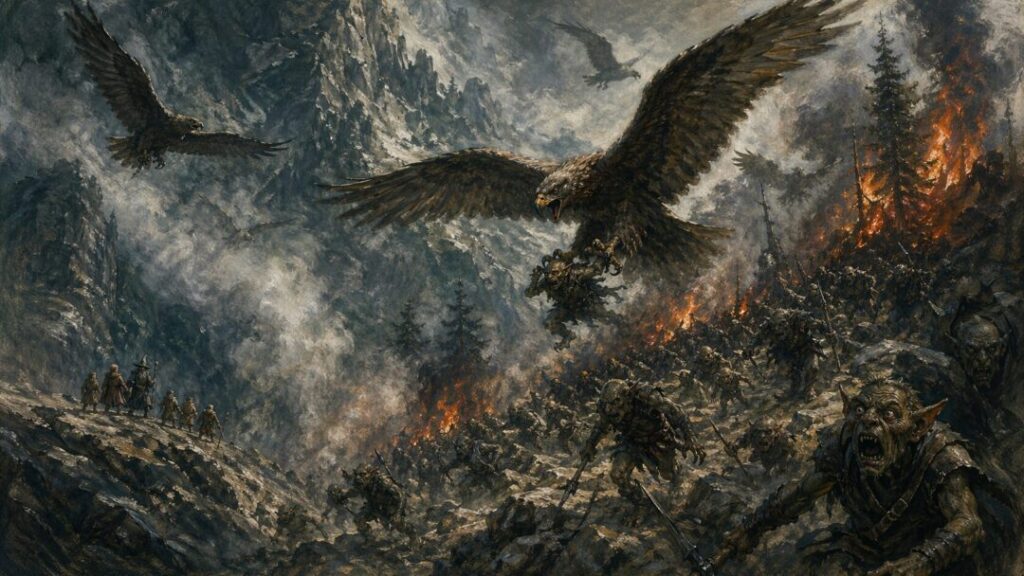
Goblins hate and fear the Eagles because the Eagles are their enemies. The Eagles swoop down on them, drive them back into their caves, and disrupt their wickedness. There is a moral conflict there. The Eagles are not hunting goblins for food; the text makes clear they do not eat such creatures. They oppose them because goblins are doing evil.
Men fear the Eagles for a more earthly reason.
Not because the Eagles are servants of darkness.
Not because they are enemies of Men.
But because they are dangerous.
That difference matters.
The same Eagle that is a terror to goblins may be a threat to a shepherd, though in a completely different way. Against goblins, the Eagle is a force of justice. Near a sheepfold, the Eagle may be a hungry power of the wild.
This is why the Eagles never become sentimental.
They belong to the good side of the story, but they do not lose their wildness.
Why This Matters for the Larger Story
This small detail also helps explain why the Eagles cannot simply be treated as the answer to every problem in Middle-earth.
The famous question is usually asked about the Ring: why not just fly it to Mordor?
There are many answers within the logic of the story, including secrecy, danger, the power of Sauron, and the fact that the Eagles are not under anyone’s command. But The Hobbit already gives us a simpler starting point.
The Eagles are cautious about danger.
They do not want to be shot by Men with great bows. They do not want to risk themselves unnecessarily. They do not agree to carry Thorin’s company as far as the company would like.
So it is not lore-accurate to imagine them as fearless transport animals who would fly into any danger because the heroes asked.
That is not what they are.
They are proud beings with their own will, their own limits, and their own judgment. When they come, their coming feels miraculous precisely because it cannot be scheduled.
You do not summon the Eagles like calling for a horse.
You hope they come.
Help from Above Is Not Control
The Eagles often appear at moments when ordinary strength has failed.
That is part of their power in the story.
But their help is never presented as something the heroes possess. It comes from beyond their plans. It arrives unexpectedly. It saves, but it does not make the journey easy.
This is especially clear in The Hobbit. The Eagles rescue Bilbo and the others from immediate death, but they do not carry them to the Lonely Mountain. They set them down much earlier. The company still has to face Beorn, Mirkwood, the Elvenking’s halls, Lake-town, Smaug, and the ruin that follows.
The Eagles do not cancel the adventure.
They preserve it from ending too soon.
That pattern continues later. The Eagles do not prevent the War of the Ring. They do not carry the Fellowship into Mordor. They do not remove the need for sacrifice, endurance, secrecy, pity, and courage.
They come at the edge.
Not at the beginning to make everything simple.
The Fear Was Reasonable
So why did Men hate and fear the Eagles?
Because the Eagles were not merely beautiful symbols in the sky.
They were real powers in the world.
They could speak. They could reason. They could choose mercy. They could fight evil. But they could also descend on sheep. And to the Men who depended on those sheep, that was enough to make them feared.
This does not make the Eagles evil.
It makes them wild.
And that wildness is essential to understanding them.
Middle-earth is full of beings who cannot be reduced to human convenience. Ents do not hurry because Men want them to. Tom Bombadil does not become a weapon because the Wise have a war to win. The Eagles do not become transport because the road is dangerous.
They are part of the world’s older freedom.
They help, but they are not possessed.
They rescue, but they are not tame.
They are noble, but they are not harmless.
The Deeper Meaning of the Sheep
The sheep detail seems almost too ordinary for such majestic beings.
That is exactly why it matters.
It brings the Eagles down from pure symbol into lived reality. A creature can be connected with high purposes and still be frightening to the people beneath its shadow. A being can serve the good and still not be safe to invite near your flock.
That tension is what makes the Eagles feel ancient rather than convenient.
They are not written as a solution to every problem. They are written as powers beyond the reach of ordinary command. Their friendship is a gift. Their arrival is a grace. Their refusal is part of their nature.
So the next time the Eagles come sweeping into the story, it is worth remembering what the Men near the mountains knew.
From far away, the Eagles may look like rescue.
From below, they may look like judgment.
And if you are standing in a field with your sheep, watching those wings descend from the high places, the difference might not be clear until it is already too late.
Sources & Notes
- J.R.R. Tolkien, The Hobbit, Chapter 6, “Out of the Frying-Pan into the Fire” — gives the key passage: the Lord of the Eagles will not fly near Men because they shoot with great bows, fearing the Eagles have come for sheep, and “sometimes they are right.”
- J.R.R. Tolkien, The Hobbit, Chapter 6, “Out of the Frying-Pan into the Fire” — also says Eagles are not “kindly birds” as a whole, while distinguishing the proud, strong, noble-hearted Eagles of the northern mountains.
- J.R.R. Tolkien, The Hobbit, Chapter 7, “Queer Lodgings” — shows the Eagles setting the company down short of its destination, underscoring that their help has limits and is not ordinary transport.
- J.R.R. Tolkien, The Hobbit, Chapter 17, “The Clouds Burst” — presents the Eagles as decisive allies against goblins and wolves, a different kind of fear from the practical fear of shepherds and bowmen.
- J.R.R. Tolkien, The Silmarillion, “Of the Return of the Noldor” — places the Eagles of Manwë in a higher mythic role as watchers and messengers, useful context for why their wild danger does not make them servants of evil.