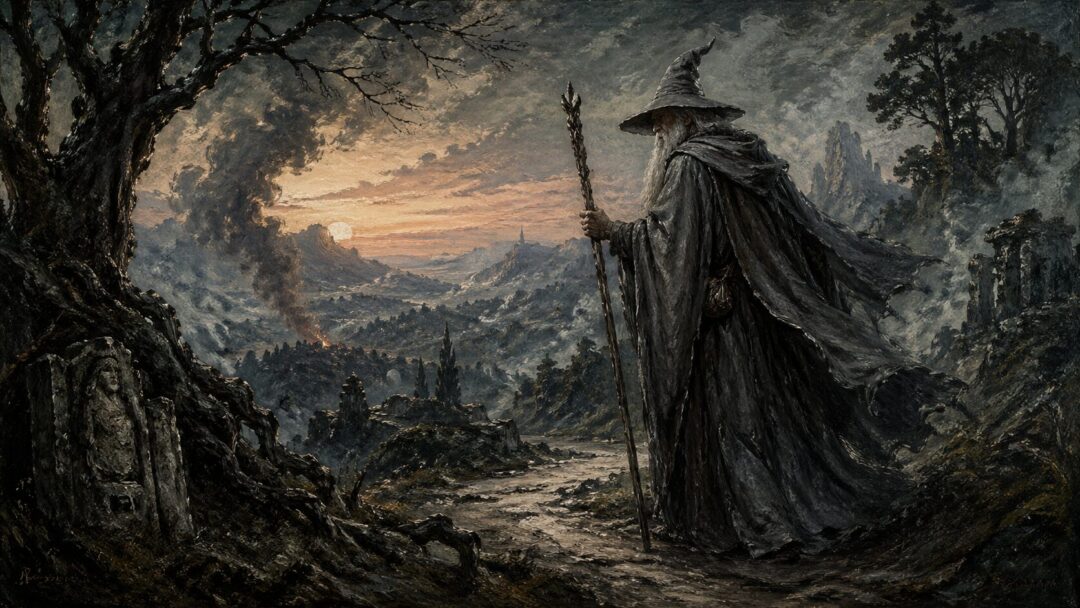
Gandalf does not enter Middle-earth like a shining lord.
He does not descend in glory.
He does not reveal himself as a spirit from the West.
He does not walk among Men and Elves with an unveiled majesty that makes kings bow and armies tremble.
He appears as an old man.
Grey-cloaked. Weather-worn. Bearded. Often weary. Often underestimated.
To the people of Middle-earth, he is a wanderer, a counsellor, a disturber of comfortable plans. Some call him wise. Some call him meddlesome. Some distrust him entirely.
And yet this old man is not truly a Man.
Gandalf belongs to the order of the Istari, the Wizards sent into Middle-earth from the West. Their true nature is far higher than their outward appearance suggests. They are not merely learned mortals with unusual powers. They are spiritual beings, Maiar, sent to oppose the growing shadow of Sauron.
Which raises a question that is easy to miss:
Why do the Wizards look Human?
Why not Elven?
If the West was sending messengers into Middle-earth, an Elven form might seem more natural. Elves are ancient, wise, beautiful, and closely tied to the memory of the Blessed Realm. They are already associated with light, knowledge, and resistance to the Shadow.
So why does Gandalf not appear as an Elf-lord?
Why does Saruman not come as a prince of the Eldar?
Why does Radagast not look like one of the ancient people who first awoke beneath the stars?
The answer is not that Men are greater than Elves.
It is much stranger than that.
The Wizards were not sent to look glorious.
They were sent to look humble.
The Wizards Were Not Men
The first thing to make clear is that Gandalf, Saruman, Radagast, and the others were not ordinary human beings.
They were Istari, a small order of messengers sent into Middle-earth during the Third Age. Their purpose was connected to the renewed threat of Sauron, who had begun to stir again after long ages of hidden power.
Their origin is not fully explained inside the main narrative of The Lord of the Rings, which is part of the mystery around them. To most people in Middle-earth, the Wizards are simply strange old men with great wisdom and occasional flashes of power.
But the deeper lore identifies them as Maiar.
That means they belong to the same broad order of spiritual beings as Sauron himself, though not corrupted as he was. They are lesser than the Valar, but far greater in origin than Elves, Men, Dwarves, or Hobbits.
This makes their appearance even more important.
The old body is not their true nature.
But it is also not a simple costume.
The texts are careful on this point. The Istari were clothed in bodies “as of Men,” and those bodies were real. They were not illusions. They were not masks that could be casually removed when the moment became inconvenient.
They could hunger.
They could thirst.
They could grow weary.
They could suffer pain.
They could be slain.
That means Gandalf’s old form is not just aesthetic.
It is part of the mission.
They Were Clothed as Men, Not Elves
The lore states that the Istari came in bodies like those of Men.
That alone answers the surface question.
They looked Human because that is the form in which they were sent.
But the more interesting question is why that mattered.
The texts do not give a long, direct explanation saying, “They were not made Elven because…” So we have to be careful. Any deeper answer must be phrased as interpretation based on what the texts do say.
And what they say is revealing.
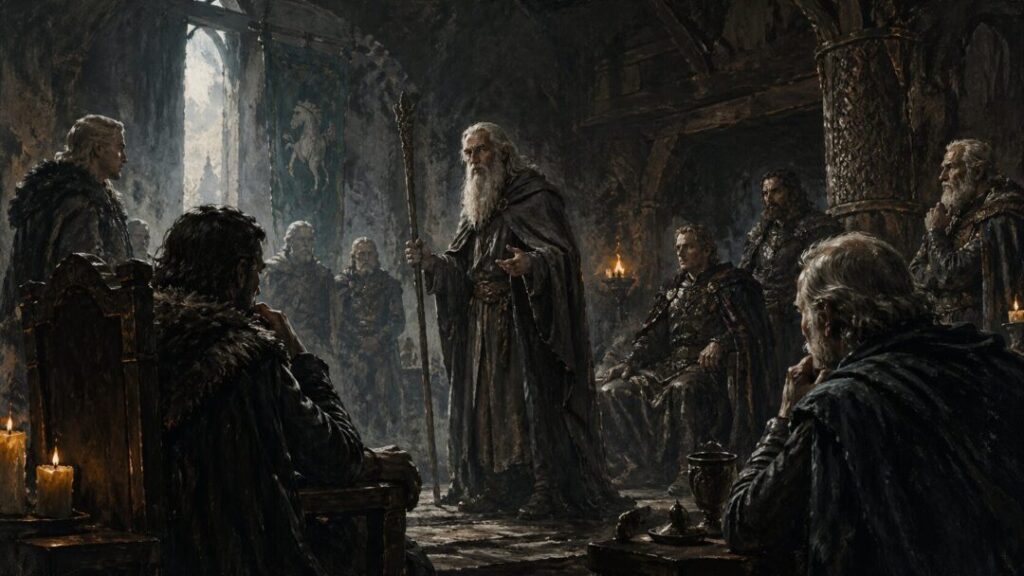
The Wizards were forbidden to reveal themselves in forms of majesty. They were not meant to rule the wills of Elves or Men by open displays of power. They were sent to advise, persuade, encourage, and unite those who might resist Sauron.
That mission required limitation.
They were not sent as conquerors.
They were not sent as angelic kings.
They were not sent to replace Sauron with a better master.
They were sent to awaken resistance from within Middle-earth itself.
An Elven form might have carried the wrong kind of authority. Not because Elves are evil or unworthy, but because an Elven appearance could easily have suggested splendour, nobility, and ancient command. A radiant figure of the Eldar might have been obeyed too easily, admired too quickly, or mistaken for the answer in himself.
The Istari were not supposed to be the answer in themselves.
They were supposed to help others choose the answer.
The Danger of Majesty
This is the heart of the matter.
Sauron’s power is not only military. It is also spiritual and psychological. He dominates, corrupts, orders, commands, and bends other wills toward his own.
The response to Sauron could not simply be another overwhelming power doing the same thing in a nobler cause.
That would miss the moral structure of the story.
The Wizards were specifically restricted. They were not meant to match Sauron’s power with power. They were not meant to terrify the Free Peoples into obedience. They were not meant to gather nations beneath themselves and rule by force.
Their task was persuasion.
That sounds weaker.
But in Middle-earth, it is profoundly important.
Gandalf’s greatness lies not in making everyone obey him, but in helping people become brave enough to do what they must do without being enslaved by him.
He counsels Thorin, but does not rule the Quest of Erebor.
He guides Frodo, but does not take the Ring from him.
He helps Théoden awaken from despair, but does not become King of Rohan.
He stands beside Aragorn, but does not replace him.
Again and again, Gandalf’s role is powerful but restrained.
He lights fires in others.
He does not make himself the fire everyone must worship.
Why an Old Man Fits the Mission
The old human form matters because it lowers the Wizard.
It makes him approachable.
It also makes him vulnerable.
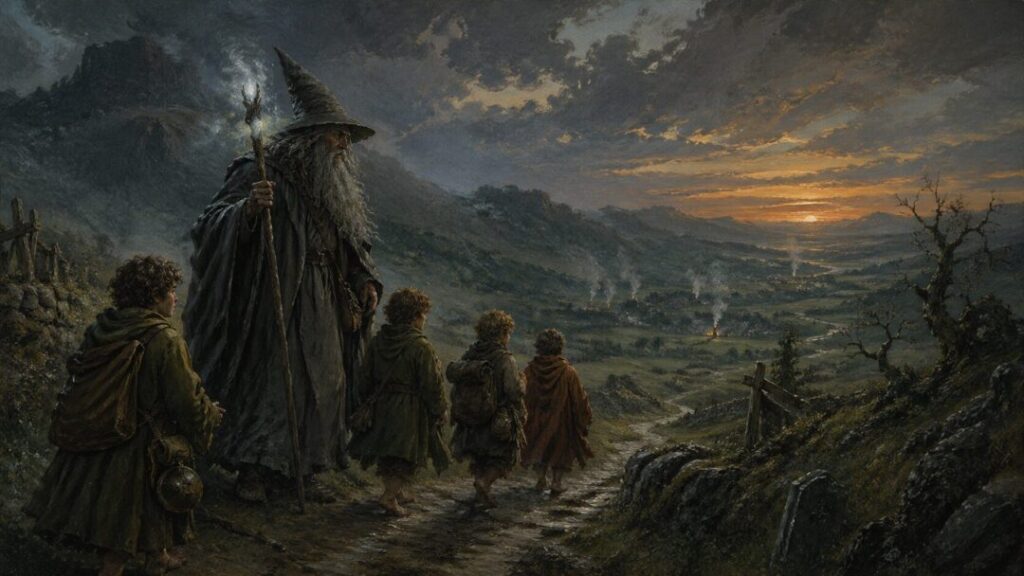
An old man can enter a court as a counsellor rather than a conqueror. He can walk roads. He can sit by fires. He can speak with Hobbits. He can be dismissed by the proud and welcomed by the humble.
That is exactly the kind of presence Gandalf has.
He is known in many lands by many names. To some he is Mithrandir, the Grey Pilgrim. To others he is Gandalf, the wandering Wizard. He is not fixed in one throne, one realm, or one people.
An Elven form might have tied him too strongly to the Elves.
A kingly form might have made him too politically dangerous.
A majestic form might have made refusal almost impossible.
But an old wanderer must be listened to freely.
That is crucial.
Because the struggle against Sauron depends on free choices.
Bilbo must choose pity.
Frodo must choose the road.
Sam must choose loyalty.
Aragorn must choose humility before kingship.
Théoden must choose courage after despair.
Faramir must choose not to take the Ring.
Gandalf can guide these choices.
He cannot make them meaningless by forcing them.
The Form Was a Limitation
The Wizards’ bodies were not merely humble in appearance.
They limited them.
The Istari entered Middle-earth under conditions that made failure possible. They could forget parts of what they were. They could become attached to the world. They could be distracted, delayed, corrupted, or broken.
This is not a small detail.
If they had come in unveiled power, the story would be entirely different. They might have overwhelmed resistance, frightened enemies, and commanded allies. But that would not have healed Middle-earth. It would have made Middle-earth dependent on powers from outside itself.
Instead, the Wizards must work slowly.
They must endure time.
They must suffer the frustrations of history.
They must persuade people who do not always listen.
And they themselves must remain faithful.
That is why Saruman is so important.
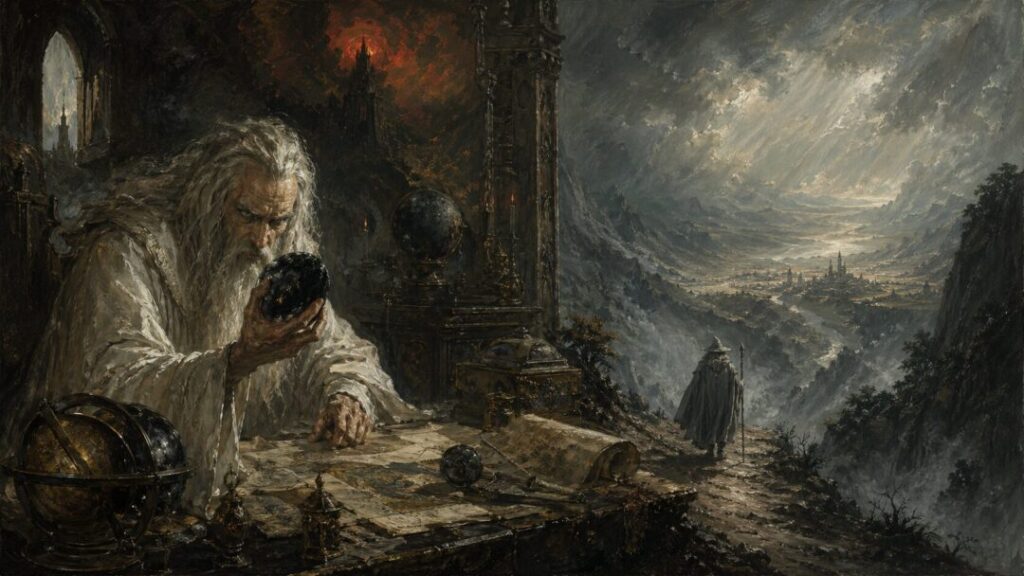
Saruman does not fall because he is weak in intelligence. He falls because he turns away from the humility of the mission. He begins to desire control. He studies the devices of the Enemy. He seeks power to oppose power, and in doing so becomes a mirror of the thing he was sent to resist.
His failure shows why the old human form mattered.
The danger was never only Sauron.
The danger was that a being sent to oppose Sauron might begin to think like him.
Why Not Elven Beauty?
Elven beauty in Middle-earth is rarely just physical.
It carries memory. Authority. Ancient sorrow. A connection to a world that is already passing away.
By the late Third Age, the Elves are not the rising future of Middle-earth. Their time is waning. The Three Rings preserve what can still be preserved, but even that preservation cannot last once the One Ring is destroyed.
The coming age belongs to Men.
This does not mean the Wizards look Human simply because the Age of Men is approaching. The texts do not state that directly.
But the form is fitting.
The Istari come in bodies like Men at a time when the fate of Middle-earth increasingly depends on Men accepting responsibility. Gondor, Rohan, Dale, and other realms of Men matter deeply in the resistance to Sauron. Aragorn’s return is not just a political event. It marks the renewal of rightful human kingship after long decline.
The Wizards are not sent to keep Middle-earth under Elven guardianship forever.
They are sent to help the Free Peoples resist Sauron until Middle-earth can stand without the visible guidance of the ancient powers.
An Elven-looking Wizard might have belonged too much to the fading world.
An old man walking the roads belongs more strangely to everyone.
Gandalf’s Humility Is Not Weakness
It would be a mistake to think the old form makes Gandalf powerless.
The story repeatedly hints that something far greater is hidden beneath the grey cloak.
Others sense it.
The wise recognize more than ordinary people do. The enemies of the West fear him. Even when he appears tired or irritable or half-comical, there are moments when the veil thins and something deeper shows through.
But those moments are controlled.
Gandalf does not live in a constant display of glory.
His power is usually hidden under patience, humour, sternness, and compassion. He spends much of his time doing things that look small: arranging meetings, giving counsel, investigating rumours, encouraging the fearful, rebuking the proud.
That is the strange brilliance of his role.
He is powerful enough to matter.
But limited enough that others must still act.
He can stand against terror, but he cannot simply solve the War of the Ring by force. He can guide the Fellowship, but he cannot carry the Ring. He can oppose the servants of Sauron, but he cannot become a second Dark Lord in the name of victory.
His human-like form is a constant reminder of that boundary.
The Old Man Is the Point
So why do Tolkien’s Wizards look Human, and not Elven?
The safest lore answer is simple:
Because the Istari were sent clothed in bodies as of Men.
But the deeper answer lies in what that form accomplishes.
They came as old men because they were not meant to dazzle Middle-earth into obedience. They were not meant to reveal divine splendour, command kingdoms by fear, or defeat Sauron by becoming a rival power of the same kind.
They came in weakness so that others could become strong.
They came in humility so that freedom would remain meaningful.
They came in bodies that could suffer so that their counsel would not be detached from the pain of the world they had entered.
That is why Gandalf’s appearance matters so much.
The grey cloak is not a disguise hiding the real story.
It is part of the real story.
The staff, the weariness, the old face, the wandering road—all of it belongs to the mission. Gandalf does not save Middle-earth by standing above it in unveiled glory. He saves it, in part, by entering it low enough to walk beside those who must make the great choices themselves.
An Elven lord might have looked more beautiful.
A shining spirit might have looked more powerful.
But an old man at the door can be refused.
And that is exactly why his guidance matters.
Because Middle-earth is not saved by domination, even benevolent domination.
It is saved by courage awakened freely.
And the Wizard’s humble shape is one of the quietest signs of that truth.
Sources & Notes
- J.R.R. Tolkien, Unfinished Tales, “The Istari” — the key account of the Wizards as Maiar sent in bodies “as of Men,” real and subject to weariness, fear, and pain.
- J.R.R. Tolkien, Unfinished Tales, “The Istari” — explains that the Istari were forbidden to reveal themselves in forms of majesty or to dominate Elves and Men by force.
- J.R.R. Tolkien, The Silmarillion, “Of the Rings of Power and the Third Age” — summarizes the Wizards’ mission as emissaries from the West sent to contest Sauron by counsel rather than matching him in open power.
- J.R.R. Tolkien, The Lord of the Rings, Book I, Chapter 2, “The Shadow of the Past” — Gandalf refuses Frodo’s offer of the Ring, showing why even well-meant power can become mastery.
- J.R.R. Tolkien, The Lord of the Rings, Book III, Chapter 10, “The Voice of Saruman” — Saruman’s fall into persuasive domination provides the contrast for why the Istari’s humble, limited form mattered.
- J.R.R. Tolkien, The Letters of J.R.R. Tolkien, Letter 131 — Tolkien’s description of Sauron’s will to order and domination supports the article’s larger contrast between counsel and coercive mastery.