At the very end of The Lord of the Rings, after the War of the Ring is over and Frodo has departed over the Sea, Samwise Gamgee returns home.
The moment is famously quiet.
There is no great speech.
No feast.
No heroic welcome from the Shire.
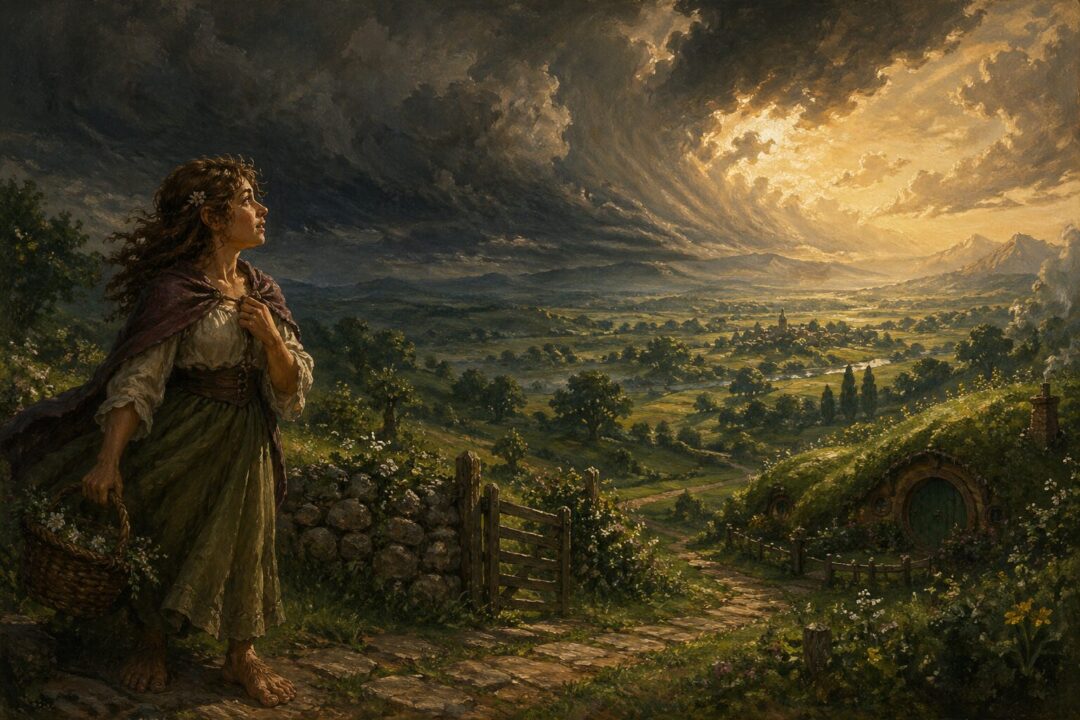
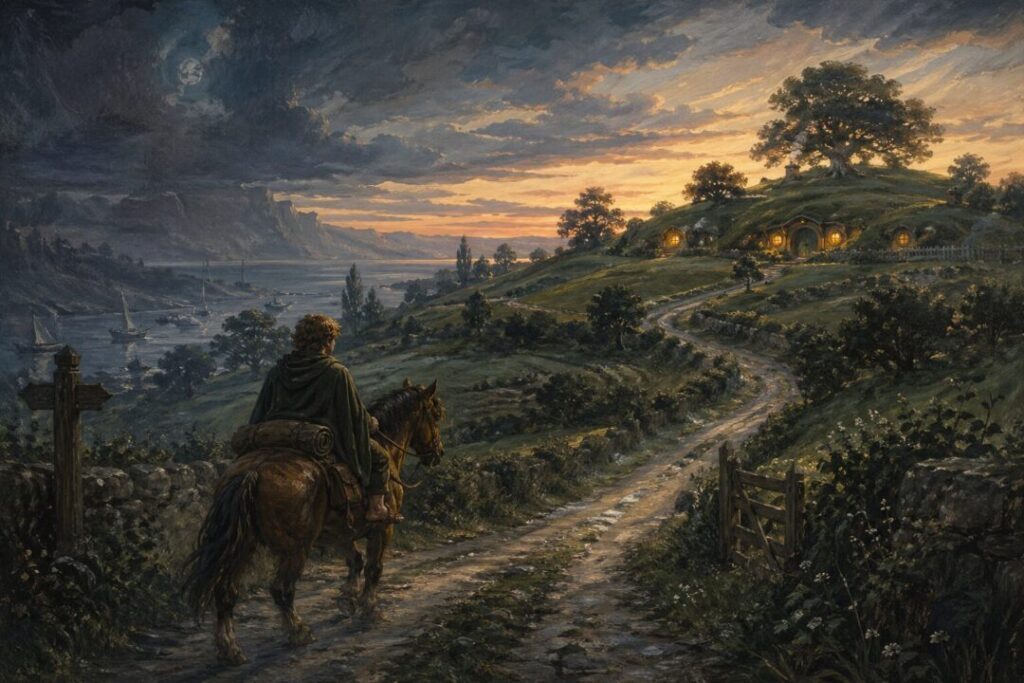
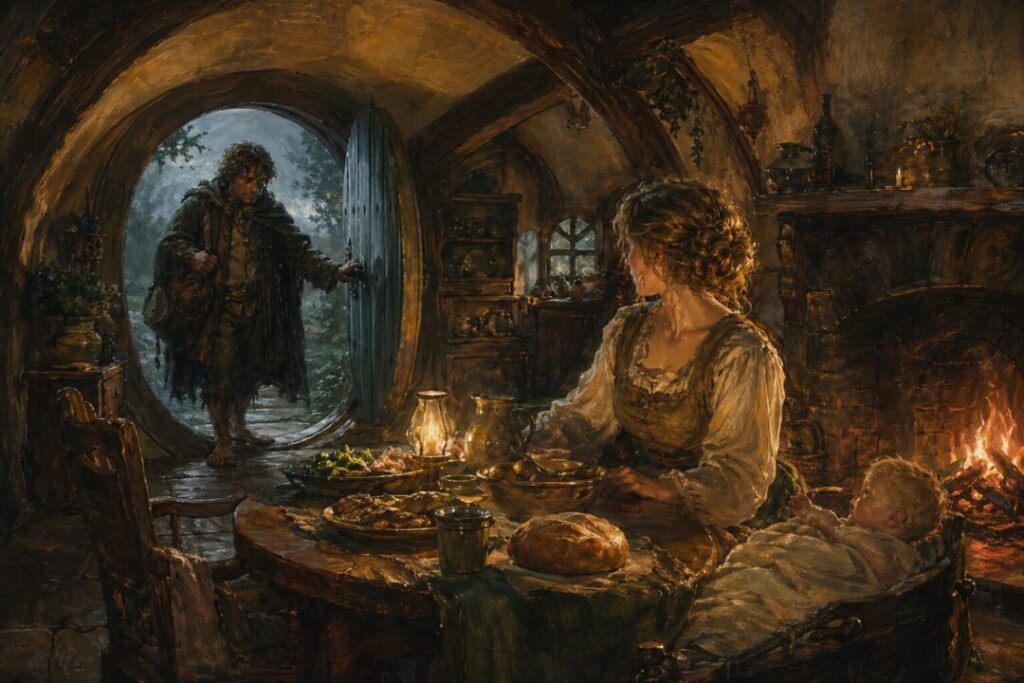
Sam comes back up the Hill as evening falls. There is yellow light in the windows of Bag End. There is fire inside. The evening meal is ready.
And Rose is waiting for him.
The text says something easy to miss: Sam was expected.
Then Rose draws him in, sets him in his chair, places little Elanor on his lap, and Sam says the final words of the book:
“Well, I’m back.”
It is one of the simplest endings in fantasy literature.
But hidden inside that simplicity is a question many readers eventually notice.
How did Rose know Sam was coming back?
The answer is not quite what it first appears to be.
Rose Was Not Just Guessing
In the published ending, Rose’s expectation is not explained in detail.
Sam has returned from the Grey Havens, where Frodo, Bilbo, Gandalf, Elrond, and Galadriel have sailed into the West. Merry and Pippin go on toward Buckland. Sam turns back toward Bywater and comes home alone.
Yet Rose is ready for him.
This does not necessarily mean she knew the exact hour of his return. The text does not say she had been told where Sam had gone, or that a messenger reached her before he did. It simply presents the home as prepared, warm, and waiting.
That matters.
Rose is not shown as startled. She does not ask where he has been. She does not treat him like someone who has vanished unexpectedly. She receives him as someone whose return belongs to the pattern of the day.
In an ordinary story, that might be only domestic realism. A wife knows her husband’s habits. She expects him home before nightfall.
But Sam and Rose’s story has another layer.
Because this is not the first time Rose expected Sam.
The Earlier Waiting
When Sam leaves the Shire with Frodo, Rose does not know the full truth of the Quest.
She does not know about the Council of Elrond, the Fellowship, Mordor, or Mount Doom. As far as the Shire is concerned, Sam has gone away with Frodo Baggins on business that most hobbits do not understand.
Then things grow darker.
The Shire is taken over by ruffians. Lotho Sackville-Baggins becomes a figurehead for power he cannot control. Sharkey’s men spread fear, rules, and ugliness through a land that was never meant for such things.
In that setting, Rose has every reason to lose hope.
Sam is gone.
Frodo is gone.
Merry and Pippin are gone.
No news comes from the wide world.
And yet when Sam finally returns to the Cottons’ house during the Scouring of the Shire, Rose tells him she has been expecting him since the spring.
That line is important.
Rose did not merely hope Sam would return someday. She connects her expectation to a particular time: the spring of 3019, the season when the Ring was destroyed and Sauron fell.
The published story gives us the clue. The unpublished Epilogue gives the clearer answer.
What the Epilogue Reveals
In the unpublished Epilogue to The Lord of the Rings, Rose and Sam speak years later about the day hope returned to her.
Sam remembers that on the day Sauron fell, he had not expected to see Rose again. From his side of the story, that makes perfect sense. He and Frodo were in Mordor. The Quest seemed beyond hope. Sam had endured hunger, exhaustion, terror, and the growing certainty that even victory might not bring them home.
But Rose’s side of the story is different.
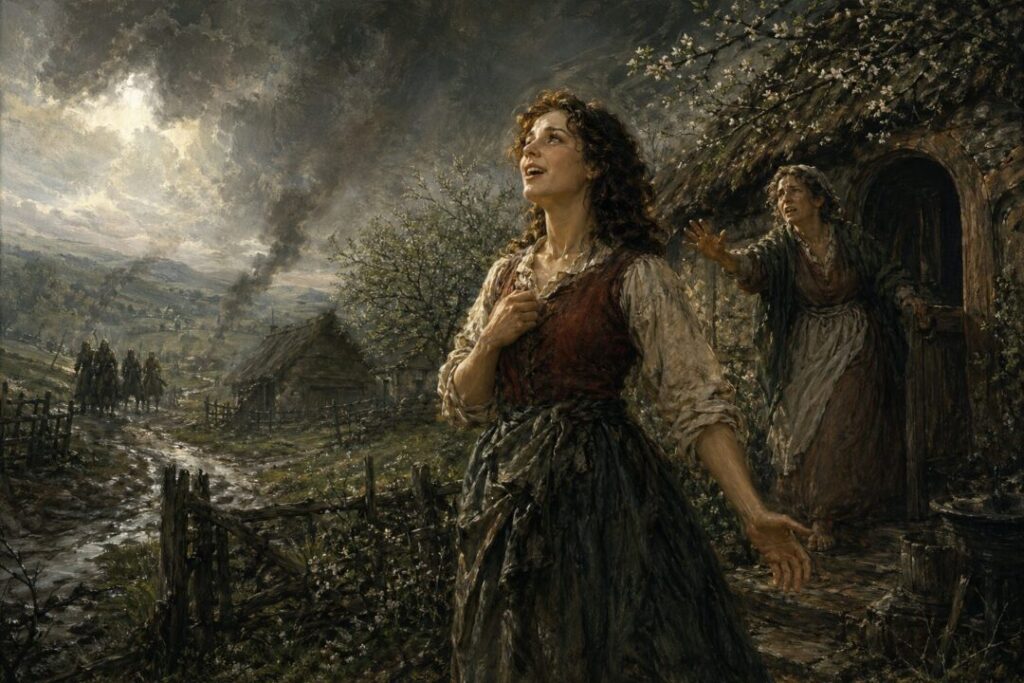
She says she had not hoped at all until that very day. Then, around noon, she suddenly felt glad and began singing. Her mother warned her to be quiet because ruffians were about. Rose answered, in effect, that their time would soon be over.
Then she said Sam was coming back.
This is the closest thing we have to a direct answer.
Rose knew because, on the day the Shadow broke, hope came to her.
But that answer needs care.
The text does not present Rose as a prophet. It does not say she saw Sam in a vision. It does not say a voice spoke to her. It does not give her a hidden role among the Wise.
She simply feels joy before she has any outward reason for joy.
And in Middle-earth, that kind of joy is not meaningless.
The Day the Shadow Broke
March 25 is one of the great turning points of the Third Age.
On that day, the Ring is destroyed. Sauron falls. Barad-dûr collapses. The power that has been pressing upon the world is suddenly broken.
The effects are not only military or political.
The change is felt.
Far away from Mount Doom, Faramir and Éowyn stand in Minas Tirith and experience a sudden lifting of dread before the news is fully known. Faramir says that his reason tells him darkness may have come, but his heart says otherwise. Hope and joy come upon him in a way he cannot explain.
The people of the City also begin to sing for joy, though they do not yet know the cause.
That is the pattern Rose seems to share.
She is not in Minas Tirith. She is not among the captains of the West. She is not one of the great figures of the age. She is a hobbit-woman in the Shire, living under the shadow of ruffian rule.
Yet when the Shadow breaks, something reaches even there.
Not news.
Joy.
Was It Foresight?
This is where the answer must stay careful.
It is tempting to say Rose had foresight. But the texts do not explicitly describe it that way.
Elves sometimes show a deeper awareness of things beyond ordinary sight. Certain dreams and warnings in the legendarium carry real weight. Gandalf, Galadriel, Elrond, Aragorn, and others move within a world where providence and perception often meet in mysterious ways.
But Rose is not placed in that category.
She is not trained in lore. She does not possess one of the Three Rings. She is not descended from Númenórean kings. The story never suggests she has a formal gift of prophecy.
So the safest answer is this:
Rose’s knowledge is best understood as a sudden intuition of hope, tied to the breaking of Sauron’s power.
It is not ordinary information.
It is not confirmed magical foresight.
It is not a message in the usual sense.
It is one of those moments in Middle-earth where the world itself seems to respond to a great turn in the story.
The darkness falls, and hearts know before mouths can explain.
Why Rose?
That still leaves another question.
Why Rose?
Why should she, of all people in the Shire, feel that Sam was coming back?
The text never gives a mechanical explanation. But it does give us enough to understand the emotional truth.
Rose is the one waiting for Sam. She is tied to the life he longs to return to. Throughout Sam’s journey, the Shire is never just a place on a map. It is a garden, a home, a memory of normal life, and a promise that the world is still worth saving.
Rose belongs to that promise.
Sam’s courage is often grand in action but humble in desire. He does not dream of thrones. He does not seek glory. Even when he briefly bears the Ring, its temptation tries to inflate him into a mighty gardener-lord, but Sam’s own plain sense pulls him back.
What he truly wants is simpler.
He wants the Shire healed.
He wants Frodo safe.
He wants his garden.
He wants Rose.
So when Rose says Sam is coming back, the line feels almost like the Shire answering Mordor.
Sauron’s world says there is no return.
Rose’s hope says there is.
The Hope That Comes Before Proof
One of the most powerful things about Rose’s knowledge is that it arrives before evidence.
That is what makes it moving.
If a rider had come from Gondor with news, Rose’s expectation would be easy to explain. If Gandalf had sent word ahead, there would be no mystery. If Sam had written a letter, the whole question would disappear.
But Rose has none of that.
She has only a sudden gladness in a dark time.
And that is deeply consistent with the moral world of The Lord of the Rings. Again and again, hope appears before victory can be seen.
Frodo and Sam keep going when success seems impossible.
Aragorn marches to the Black Gate with no certainty of triumph.
Faramir and Éowyn feel joy before the tidings arrive.
The people of Minas Tirith sing before they know why.
Rose’s moment belongs to that same pattern.
Hope in Middle-earth is not always optimism. It is not pretending things are safe when they are not.
It is a kind of faithfulness to the good, even when the visible facts are still dark.
Rose does not know the whole story.
But she knows enough.
The Final Homecoming
This makes the final scene at Bag End even more beautiful.
When Sam returns from the Grey Havens, he is carrying a grief Rose cannot fully remove. Frodo has gone. The great adventure is over. The world has been saved, but something beloved has passed beyond reach.
And once again, Rose is waiting.
The meal is ready.
The fire is lit.
Elanor is placed on Sam’s lap.
This is not a small domestic detail added after the important story is finished. It is the shape of Sam’s healing.
Frodo cannot remain in Middle-earth because his wounds are too deep. Sam, however, can return. Not because he has suffered less in any simple way, but because his story still has a home that can receive him.
Rose is central to that.
She does not explain the war.
She does not ask for a report.
She does not turn the moment into legend.
She draws him inside.
That is exactly what Sam needs.
“Well, I’m Back”
Sam’s final line is often read as cheerful, humble, and perfectly hobbit-like.
It is all of those things.
But it is also a line spoken after loss.
Sam is back from Mordor.
Back from the Scouring.
Back from the Grey Havens.
Back from the edge of a world that is passing away.
And Rose has been the figure of return from the beginning.
She waited when the Shire was under shadow. She believed Sam would come back when she had no proof. Years later, she waits again with light, food, warmth, and their child.
That is why the ending works.
The last word is not about kingship, power, or victory. It is about coming home.
And Rose knew Sam was coming back because the fall of darkness had reached her heart before the news reached her ears.
Not as a battle report.
Not as prophecy in the grand sense.
But as hope.
And in Middle-earth, that is often how the deepest truths arrive first.
Sources & Notes
- J.R.R. Tolkien, The Lord of the Rings, Book VI, Chapter 8, “The Scouring of the Shire” — Rose Cotton greets Sam on his return to the Shire and says she had been expecting him since the spring.
- J.R.R. Tolkien, The History of Middle-earth, Vol. IX: Sauron Defeated, “The Epilogue” — the unpublished epilogue has Rose recall the sudden gladness and certainty of Sam’s return on the day Sauron fell.
- J.R.R. Tolkien, The Lord of the Rings, Book VI, Chapter 5, “The Steward and the King” — Faramir, Éowyn, and Minas Tirith feel the Shadow lift before ordinary news of victory arrives.
- J.R.R. Tolkien, The Lord of the Rings, Book VI, Chapter 9, “The Grey Havens” — Sam’s final homecoming to Rose, Elanor, and Bag End ends the story with “Well, I’m back.”