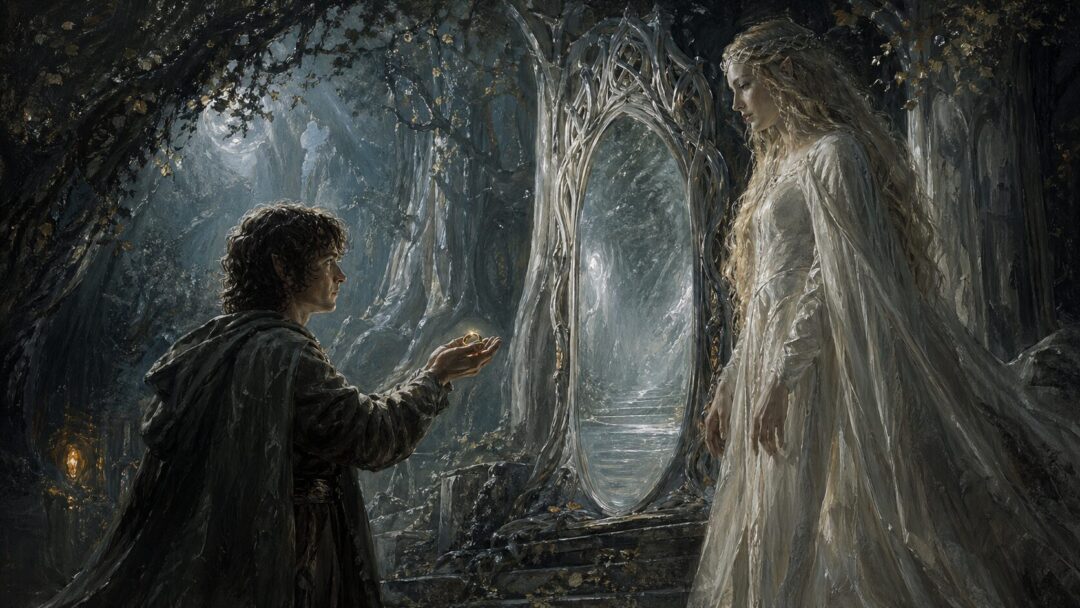
When Frodo offers the One Ring to Galadriel, the story enters one of its most dangerous quiet moments.
There is no battle.
No army.
No open threat from Mordor.
Only Frodo, Galadriel, the Mirror, and the Ring.
Yet what happens in that moment may be one of the greatest tests in The Lord of the Rings. Frodo offers the Ring freely, and Galadriel does not pretend the offer means nothing. She does not laugh it away. She does not act as if she is beyond temptation.
She says the temptation has come at last.
Then, for one terrible instant, she imagines what she would become if she accepted it.
Not a servant of Sauron.
Not a shadow beside his throne.
Not a hidden traitor in Lothlórien.
A Queen.
And then comes the line that has unsettled readers for generations:
“All shall love me and despair.”
It is easy to hear that line as simple villainy. Galadriel is tempted, power flashes around her, and for a moment we glimpse what an evil Galadriel might look like.
But the meaning is deeper than that.
The horror is not that Galadriel would become obviously monstrous.
The horror is that she might become beautiful.
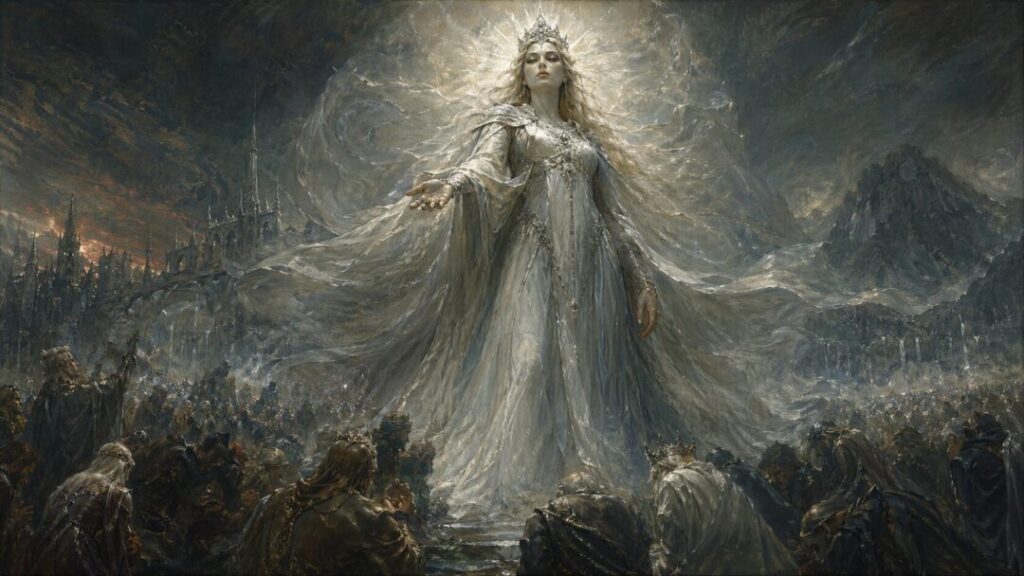
Galadriel Is Not Imagining Herself as Sauron
The first mistake is to treat Galadriel’s temptation as though she would simply become another Dark Lord.
That is not how she describes herself.
She does not say she would rule by ugliness, darkness, or open cruelty. She imagines herself as something radiant and overwhelming. Her danger would not be that she looked like Sauron. Her danger would be that she did not.
Sauron’s power is tied to domination, fear, deception, and the ordering of all wills beneath his own. His Ring was made to rule the other Rings and bend their bearers to him.
But Galadriel’s imagined rule would have a different face.
She would be fair.
She would be majestic.
She would be adored.
And that is exactly why it is frightening.
A Dark Lord is easier to recognize. A beautiful Queen who claims to bring healing, wisdom, preservation, and order might be much harder to resist.
The Ring does not need to tempt Galadriel with something crude. It does not need to offer her mere cruelty. It can offer her the chance to become the savior of Middle-earth.
But a savior who rules all things is still a ruler.
And under the One Ring, even noble desires can become domination.
“All Shall Love Me” Is Not Free Love
The most important word in the line may be “shall.”
“All shall love me.”
That is not the language of ordinary affection. It is not friendship. It is not loyalty freely given. It is not the love the Fellowship feels for one another, or the reverence the Elves show to things beautiful and ancient.
It is command.
Galadriel is imagining a world where love itself becomes unavoidable.
Everyone would love her because her beauty, wisdom, and power would be too great to withstand. They would be drawn to her, overwhelmed by her, perhaps even grateful to her. But their love would no longer be entirely their own.
That is the nightmare inside the line.
She would not merely conquer bodies.
She would conquer devotion.
This is very different from saying Galadriel secretly wants people to flatter her. The text is subtler than that. Her temptation is bound up with greatness, protection, and rule. She has power already. She bears Nenya, one of the Three Rings, and Lothlórien is a place preserved against decay and weariness in a way that feels almost outside ordinary time.
But the One Ring would take that preserving power and enlarge it into mastery.
What was once guardianship could become possession.
What was once beauty could become compulsion.
What was once reverence could become worship.

Why Would They Despair?
The second half of the line is just as important.
“All shall love me and despair.”
At first, the two ideas seem to clash. Why would people despair if they loved her?
Because this love would not save them.
It would trap them beneath something too great.
To love Galadriel under the power of the Ring would be to stand before a being so magnificent that one could no longer remain fully free. Her subjects might not despair because she was hideous or openly cruel. They might despair because her glory would leave no room for anything outside it.
There would be no equal relationship.
No true freedom.
No ordinary life untouched by her will.
The despair would come from the realization that the darkness had not been defeated by freedom, humility, and mercy, but replaced by another absolute power.
A brighter one.
A fairer one.
Perhaps even a gentler one at first.
But still absolute.
That is the great danger of the Ring. It does not only corrupt through hatred. It corrupts through the desire to set things right by force.
Boromir wants to use the Ring to defend his people. Gandalf refuses it because he understands that his wish to do good would become terrible through the Ring. Galadriel faces the same kind of temptation, but on an even more majestic scale.
She could overthrow Sauron.
But the victory might leave Middle-earth kneeling.
The Ring Offers Galadriel What She Must Refuse
Galadriel’s test is not random. It strikes at something central to her character.
She is one of the greatest of the Eldar remaining in Middle-earth. She is ancient, wise, powerful, and deeply connected to the fading beauty of the Elven world. In Lothlórien, the past seems to live more fully than almost anywhere else east of the Sea.
But that preservation cannot last forever.
The Three Rings help maintain what is beautiful, but they are bound to the fate of the One. If the One is destroyed, the power of the Three will fail. If Sauron recovers it, all who used the Three will be exposed to him.
Galadriel knows this.
So when Frodo offers her the Ring, the temptation is not only personal greatness. It is the possibility of preserving what she loves. Lothlórien. Elven beauty. Memory. Wisdom. A world that is slipping away.
This is why the temptation is so piercing.
The Ring does not merely whisper, “Rule.”
It can whisper, “Save.”
Save your people.
Save your realm.
Save beauty from fading.
Save Middle-earth from Sauron.
But the price would be mastery.
And mastery, even in the name of preservation, is still the way of the Ring.
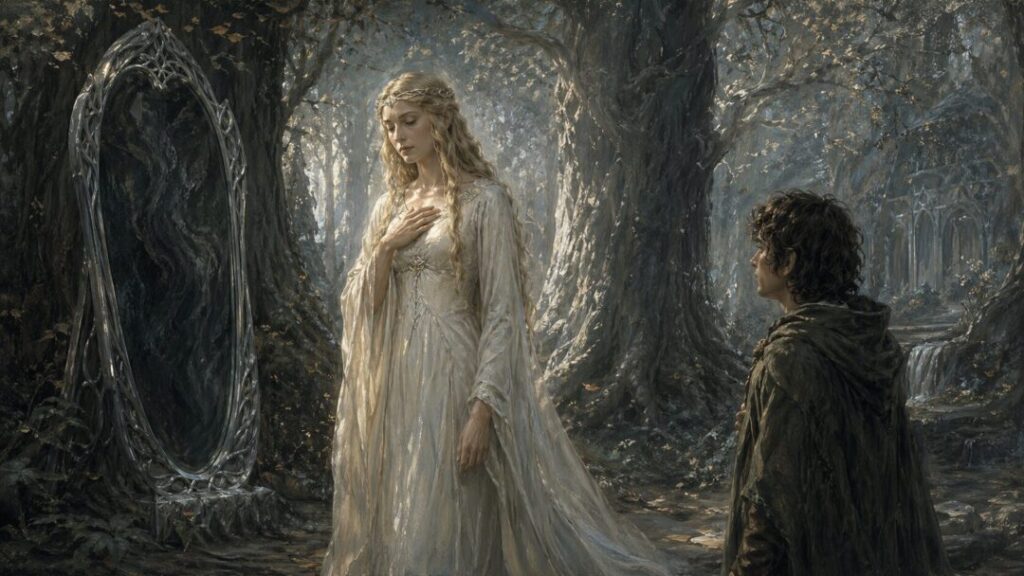
“I Pass the Test”
Galadriel’s victory is not that she was never tempted.
Her victory is that she sees the temptation clearly and refuses it.
That matters.
Some characters are spared the full weight of the Ring because they never receive a direct offer in the same way. Others fail quickly because the Ring finds the crack in their desire. Galadriel stands at the edge of something enormous, names what she could become, and then lets it go.
Her words afterward are quiet, but they change everything.
She says she passes the test.
Then she accepts what refusal means: she will diminish, go into the West, and remain Galadriel.
That is the opposite of what the Ring offers.
The Ring offers increase.
Galadriel accepts diminishment.
The Ring offers rule.
Galadriel accepts departure.
The Ring offers the power to preserve her realm.
Galadriel accepts that her realm will fade.
This is why her refusal is not merely moral discipline. It is a surrender of the future she might have seized for herself.
She chooses not to become the beautiful Queen of a conquered world.
She chooses to remain herself.
The Terror of Beautiful Power
Galadriel’s line endures because it reveals one of the deepest truths in The Lord of the Rings: evil does not always appear as darkness.
Sometimes it appears as order.
Sometimes as wisdom.
Sometimes as beauty.
Sometimes as the promise to fix what is broken.
That is what makes the Ring so dangerous to the great.
A small person may want safety, comfort, or escape. But the wise and powerful may want to heal the world. They may want to defeat evil more efficiently. They may want to use power only once, only for good, only until the danger has passed.
Yet the Ring turns that very desire into domination.
Galadriel understands this. She knows that if she accepts the Ring, she may begin as an enemy of Sauron, but she will not remain merely that. She will become the center of all things. She will draw love into herself, and that love will become another form of bondage.
The despair would not come because she lacked beauty.
It would come because her beauty would be inescapable.
What the Line Really Means
“All shall love me and despair” means that Galadriel, with the One Ring, would become a ruler whose power was not merely feared but adored.
She would not need to make Middle-earth hate her.
She could make it love her.
And that is more terrifying.
Because hatred can resist.
Fear can rebel.
But love twisted into compulsion is harder to name as slavery.
That is the nightmare Galadriel sees in herself. Not that she would become a crude villain, but that she would become so magnificent that the world would bow willingly—or believe it was willing.
Her subjects might praise her.
They might bless her.
They might believe she had saved them.
And still, they would despair.
Because beneath the radiance, the Ring would have done what it was made to do.
Rule.
Why Her Refusal Matters
Galadriel’s refusal is one of the great hidden victories of the War of the Ring.
No sword is drawn. No fortress falls. No song is sung for it in that moment.
But if she had taken the Ring, the Quest would have failed in a different way. Sauron might have been challenged, perhaps even overthrown, but the Ring would not have been unmade. Its logic would have survived.
Power would answer power.
Mastery would answer mastery.
The world would remain bound.
Instead, Galadriel lets the Ring pass from her.
She accepts loss rather than domination.
She accepts fading rather than possession.
She accepts an ending rather than a throne.
That is why the moment is so powerful.
Galadriel does not prove her greatness by becoming Queen.
She proves it by refusing to become Queen.
And the line that sounds, at first, like a threat is really a warning from someone who understands herself too well.
“All shall love me and despair” is not Galadriel revealing that she was secretly evil.
It is Galadriel seeing the shape her goodness could take if the Ring bent it into tyranny.
That is the terror of the scene.
Not that she would become dark.
That she would become unbearable light.
Sources & Notes
- J.R.R. Tolkien, The Lord of the Rings, Book II, Chapter 7, “The Mirror of Galadriel” — Frodo offers the Ring, Galadriel imagines herself as a Queen, says “All shall love me and despair,” and then refuses it.
- J.R.R. Tolkien, The Lord of the Rings, Book I, Chapter 2, “The Shadow of the Past” — Gandalf explains that the Ring would gain mastery over its bearer and must not be used as a weapon against Sauron.
- J.R.R. Tolkien, The Lord of the Rings, Book II, Chapter 2, “The Council of Elrond” — Elrond and Gandalf reject using the Ring, framing its danger as power turned toward domination even by the wise.
- J.R.R. Tolkien, The Silmarillion, “Of the Rings of Power and the Third Age” — the One Ring is made to rule the other Rings, while the Three preserve Elven realms but remain bound to the One’s fate.
- J.R.R. Tolkien, Letter 131 — Tolkien describes Sauron’s basic motive as ordering and dominating all things, useful context for why the Ring corrupts even apparently noble desires.