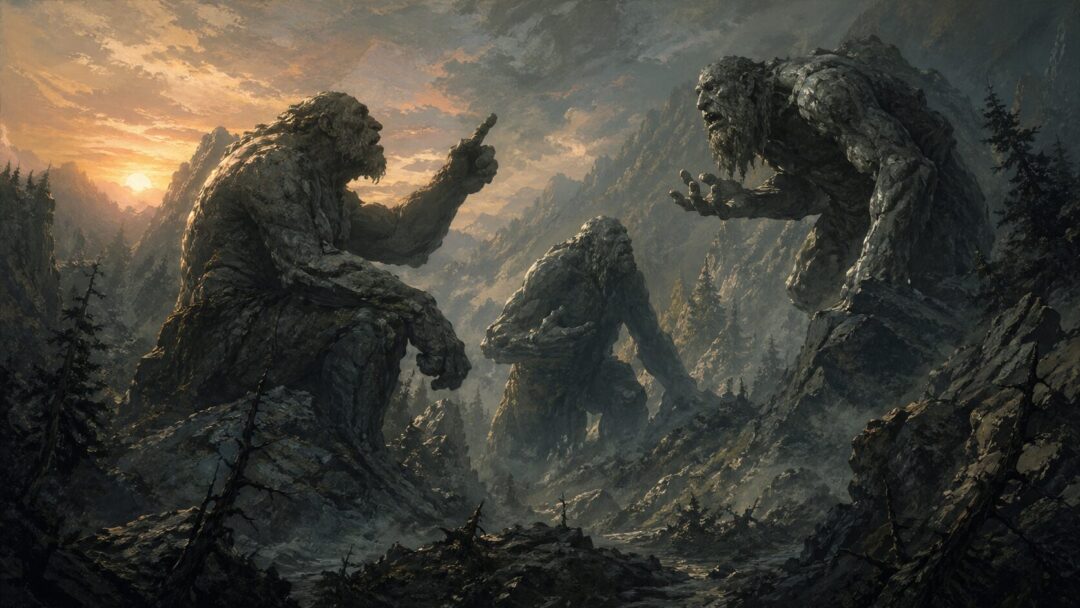
It is one of the most memorable troll moments in Middle-earth.
Three trolls sit in the dark, arguing, grumbling, and wasting time. They have captured the Dwarves. Bilbo is nearby. Gandalf is working quietly against them. And then the danger ends not with a sword-stroke, but with sunrise.
The dawn comes.
Tom, Bert, and William are caught before they can get underground.
And they turn to stone.
That scene in The Hobbit is so clear that it almost becomes the rule everyone remembers: trolls cannot endure sunlight. If dawn finds them, they become part of the stone of the hills forever.
So when Sauron falls at the end of the War of the Ring, and the Shadow of Mordor is broken, a natural question appears.
Did the cave-trolls turn to stone too?
It sounds simple at first.
The darkness lifts. The Sun returns. Mordor’s creatures lose their master. Surely the trolls must meet the same fate as the three trolls in the Trollshaws.
But the answer is not quite that straightforward.
Because Tolkien’s trolls are not all one single kind of creature. And the trolls serving Mordor at the end of the Third Age are not necessarily the same sort Bilbo encountered on the road to Rivendell.
The real answer is more unsettling.
The texts do not say that cave-trolls turned to stone when Sauron fell.
But they do give us enough to say why some trolls may have become helpless, broken, or doomed once the will of Sauron was gone.
And the difference matters.
The Rule We Learn in The Hobbit
The clearest case of trolls turning to stone comes from The Hobbit.
Bilbo and the Dwarves encounter three trolls named Tom, Bert, and William. They are dangerous, crude, and not especially wise. Gandalf keeps them arguing until the first light of dawn arrives.
Then they are transformed.
The narrator explains that trolls must be underground before dawn, or they go back to the stuff of the mountains from which they were made and never move again.
That is the foundation of the idea.
For that kind of troll, sunlight is not merely unpleasant. It is fatal. It does not weaken them slowly or drive them away. It fixes them permanently into stone.
And this is not forgotten later.
In The Lord of the Rings, Aragorn and the hobbits come across the very same stone trolls on the way to Rivendell. They are still there, frozen in the shape of their final foolish argument.
So the rule is real.
Some trolls absolutely do turn to stone in daylight.
But that does not automatically answer what happened to every troll in Mordor.
Cave-Trolls Are a Different Question
The famous cave-troll appears in Moria.
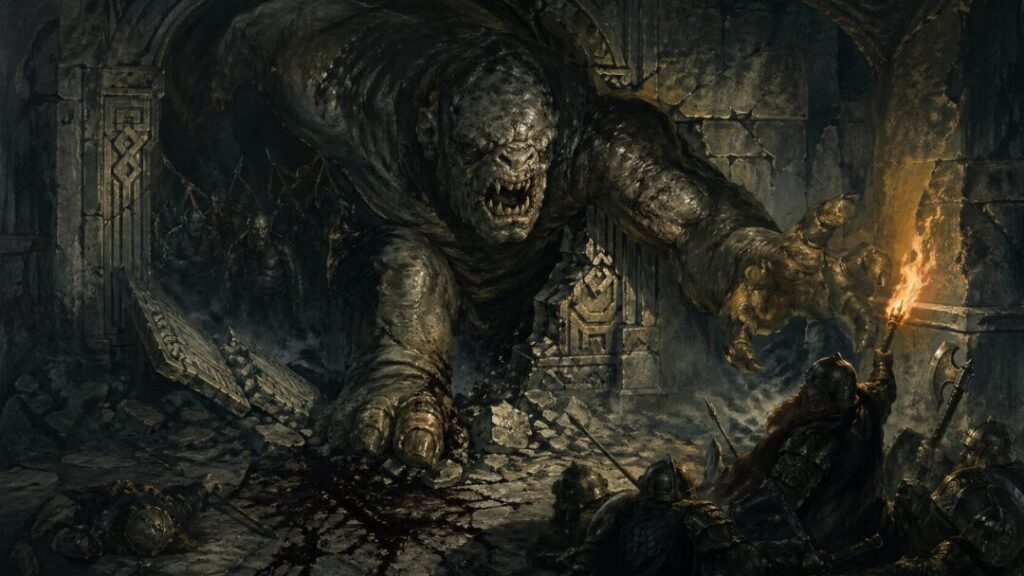
During the attack on the Chamber of Mazarbul, the Fellowship is assaulted by Orcs and a huge troll. The creature thrusts its foot through the door. Frodo wounds it with Sting, and black blood flows from the cut. Later, the Fellowship is pursued through the halls, and more troll-like attackers appear.
This is a very different setting from the troll camp in The Hobbit.
The Moria troll is encountered underground, in darkness, inside the ancient Dwarven kingdom of Khazad-dûm. The story never places this cave-troll under the Sun. It never shows what would happen if dawn struck it. It never says that cave-trolls share the exact same sunlight fate as the three trolls from Bilbo’s first adventure.
That means we have to be careful.
It is tempting to assume that all trolls behave exactly alike. But the text does not give us a direct cave-troll sunlight test.
So the most accurate answer is this:
Tolkien never explicitly states that cave-trolls turned to stone when the Shadow lifted from Mordor.
That does not mean they were safe from sunlight. It only means the specific claim cannot be stated as fact from the texts.
And once we move from Moria to Mordor, the matter becomes even more complicated.
Mordor’s War-Trolls Were Not Ordinary Trolls
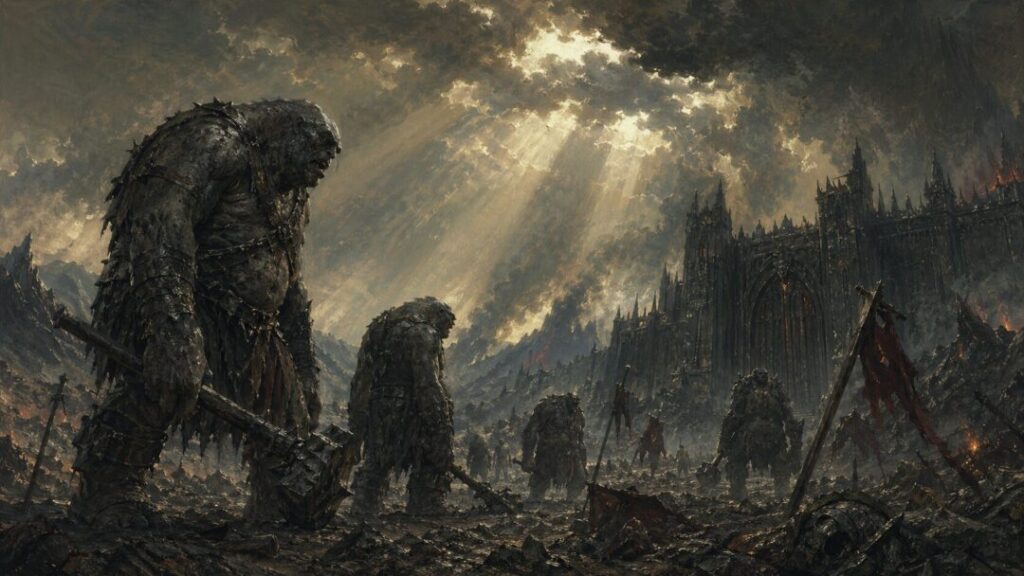
By the end of the Third Age, Sauron’s armies include terrible troll-creatures.
At the Siege of Gondor, mountain-trolls are used in the assault on Minas Tirith. They are involved with the great battering ram Grond, which breaks the Gate of the City. At the Black Gate, great hill-trolls come out of Gorgoroth and crash into the forces of the West.
These are not comic roadside monsters.
They are weapons of war.
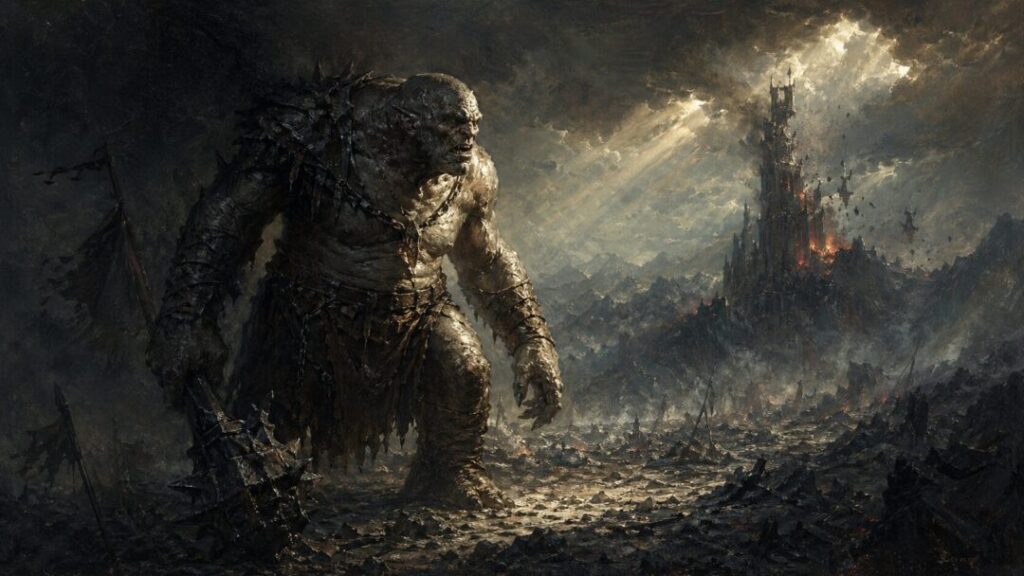
The most important detail comes from the description of the Olog-hai, a troll-race that appears near the end of the Third Age. They are stronger, more cunning, and more dangerous than older trolls. Most importantly, they can endure the Sun—but only while the will of Sauron holds sway over them.
That sentence changes everything.
It means Sauron’s war-trolls are not simply trolls that somehow no longer care about daylight. Their resistance is tied to Sauron’s power.
They can endure the Sun because his will is upon them.
So what happens when that will is removed?
The text does not give us a battlefield scene of Olog-hai turning into statues.
But it gives us a terrifying implication.
Their ability to function in sunlight may have depended on the very master who had just been overthrown.
The Shadow Lifts, But the Text Does Not Say “They Turned to Stone”
When the Ring is destroyed, Sauron’s power collapses.
Barad-dûr falls. The foundations of his rule are broken. His armies lose the force that held them together. The servants of Mordor do not continue in disciplined strength. They scatter, panic, and fail.
This is one of the great patterns of the ending.
Sauron’s power was not just political. It was spiritual domination. His will pressed upon Orcs, trolls, and other servants. Once that will is removed, the armies of Mordor are no longer the same terrible instrument.
But here is the key point:
The text does not specifically say that cave-trolls turned to stone when the Shadow lifted.
Nor does it give a clear scene of the Olog-hai becoming stone at the moment of Sauron’s fall.
That silence matters.
A dramatic version of the scene is easy to imagine: the clouds tear open, the Sun pours down, and every troll in Mordor freezes into rock.
But that is not directly described.
The safer conclusion is that ordinary trolls vulnerable to sunlight would still be vulnerable to sunlight. The Olog-hai, whose endurance depended on Sauron’s will, would lose the protection or domination that allowed them to endure the Sun. But whether that meant instant petrification, death, collapse, madness, or helplessness is not directly explained.
The texts imply disaster for them.
They do not describe the exact mechanics.
Why Cave-Trolls Specifically Are Hard to Place
The question often says “cave-trolls,” but that word matters.
A cave-troll is associated with deep places like Moria. Its environment is darkness. It does not need to be shown under the Sun, because the story uses it as a horror of the underworld: a huge thing in a buried kingdom, battering through doors in blackness.
The trolls at the end of the war are described differently.
We hear of mountain-trolls, hill-trolls, and the Olog-hai. These are connected with Mordor’s armies and open battle. Some of them clearly operate in conditions where older trolls would have been useless.
So if we ask, “Did the cave-trolls turn to stone when Mordor’s shadows lifted?” the answer must be cautious.
There is no direct textual scene of cave-trolls in Mordor being struck by sunlight and becoming stone.
There is no statement that the Moria cave-troll’s kind all perished in this exact way.
And there is no canon passage describing cave-troll statues left behind after the fall of Sauron.
The question becomes stronger if we ask about Olog-hai instead.
Because with the Olog-hai, the text gives us the crucial condition: they could endure the Sun while Sauron’s will held sway.
When Sauron fell, that condition ended.
The Real Horror Is Dependence
This may be darker than simple petrification.
The Olog-hai were not just improved trolls. They were creatures bound into Sauron’s war-machine. Their strength, cunning, and ability to endure daylight were connected to his domination.
That means their power was not truly their own.
They were sustained as instruments of a will outside themselves.
When the Ring is destroyed, that will is broken. Sauron can no longer command, uphold, or drive his creatures in the same way. His armies become confused and scattered. The structure behind them collapses.
For Orcs, this means terror and disarray.
For trolls whose endurance of sunlight depended on Sauron, it may mean something even worse.
They may have suddenly become what older trolls had always been: creatures of darkness caught in a world where the light had returned.
But again, the text does not pause to show us the exact end of each troll.
That restraint is important. The fall of Mordor is described on a vast scale. Towers collapse. armies flee. the earth shakes. Sauron’s shape rises like a shadow and is blown away. Individual monster fates are not catalogued.
The silence leaves room for interpretation—but not for certainty.
So Did They Turn to Stone?
The most lore-accurate answer is:
Some trolls in Middle-earth definitely turn to stone in sunlight, as shown in The Hobbit.
Cave-trolls are not directly shown turning to stone, and the texts do not confirm that they did so when Sauron fell.
The Olog-hai could endure the Sun only while Sauron’s will held sway over them, so after his fall they likely lost that protection. However, Tolkien does not explicitly state that they all turned into stone at that moment.
So the answer is not a simple yes.
It is more like this:
If any older, sunlight-vulnerable trolls were caught above ground after the darkness lifted, they would be in deadly danger from the Sun.
If the Olog-hai were still under open daylight after Sauron’s will failed, their special ability to endure the Sun would likely fail with it.
But the image of every cave-troll in Mordor instantly becoming a statue is not directly confirmed in the text.
It is a plausible visual interpretation for some trolls.
It is not a stated canon event.
Why This Question Matters
This is why the troll question is so fascinating.
It looks like a small monster-detail at first. A bit of leftover curiosity from The Hobbit. Did the trolls freeze? Did the Sun get them? Were there stone bodies all across Mordor?
But underneath that is one of the deeper truths of Middle-earth.
Evil in these stories often imitates life without truly giving life.
Morgoth twisted and corrupted. Sauron organized, bred, dominated, and weaponized. Their creatures could be made stronger, harder, and more terrible—but that strength often depended on darkness, control, and fear.
The Olog-hai are a perfect example.
They seem like an improvement over older trolls. Smarter. Fiercer. Able to fight in the Sun.
But the detail that makes them powerful also reveals their weakness.
They can endure the Sun only while Sauron’s will holds them.
Once he falls, the power that made them so terrible becomes a chain with nothing left to pull it.
That is the deeper answer.
The trolls of Mordor may not need to turn dramatically into stone for the story to condemn them.
Their master falls.
The darkness withdraws.
The world is no longer arranged for them.
And whatever exactly happened in those final hours, the age that allowed such creatures to march beneath Sauron’s will was over.
Sources & Notes
- J.R.R. Tolkien, The Hobbit, Chapter 2, “Roast Mutton” — Gandalf keeps Tom, Bert, and William arguing until dawn, and the narrator explains that trolls caught by daylight return to stone.
- J.R.R. Tolkien, The Lord of the Rings, Book I, Chapter 12, “Flight to the Ford” — Aragorn and the hobbits pass the same three stone-trolls, confirming that Bilbo’s troll episode remains part of the later story-world.
- J.R.R. Tolkien, The Lord of the Rings, Book II, Chapter 5, “The Bridge of Khazad-dûm” — the Moria cave-troll is shown underground in darkness, with no direct test of what sunlight would do to that kind of troll.
- J.R.R. Tolkien, The Lord of the Rings, Appendix F, “Of Other Races: Trolls” — distinguishes older trolls from the Olog-hai and says the Olog-hai could endure the Sun while Sauron’s will held sway over them.
- J.R.R. Tolkien, The Lord of the Rings, Book VI, Chapter 3, “Mount Doom” — when the Ring is destroyed, Sauron’s power collapses and his servants lose the dominating will that held his war-machine together.