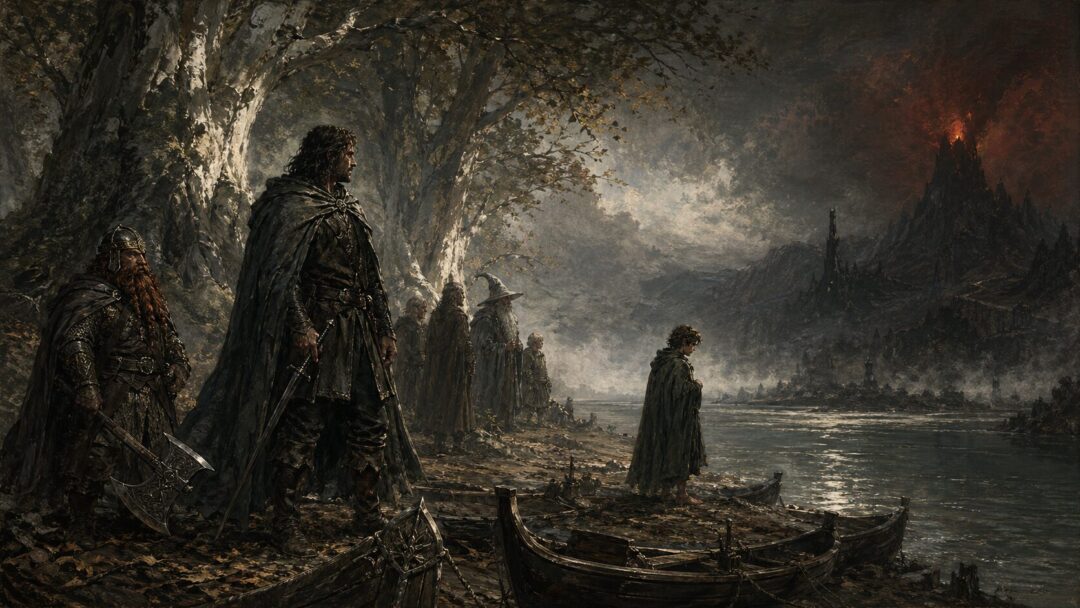
At the breaking of the Fellowship, Aragorn is remembered for one of the most painful choices in The Lord of the Rings.
Frodo has vanished.
Boromir has fallen.
Merry and Pippin have been taken by Orcs.
Sam has followed Frodo across the River.
And Aragorn, who has tried to hold the Company together after Gandalf’s fall, must decide where his road now lies.
Should he pursue Frodo and try to aid the Ring-bearer?
Or should he follow the Orcs and attempt to rescue the captured hobbits?
By then, the choice has almost become impossible.
But earlier, before disaster struck, Aragorn had already imagined a different version of the road ahead.
If Frodo chose to go east into Mordor, Aragorn did not think the whole Fellowship should go with him.
He would have chosen only three companions.
Sam.
Gimli.
And himself.
That raises a surprisingly difficult question.
Why Gimli?
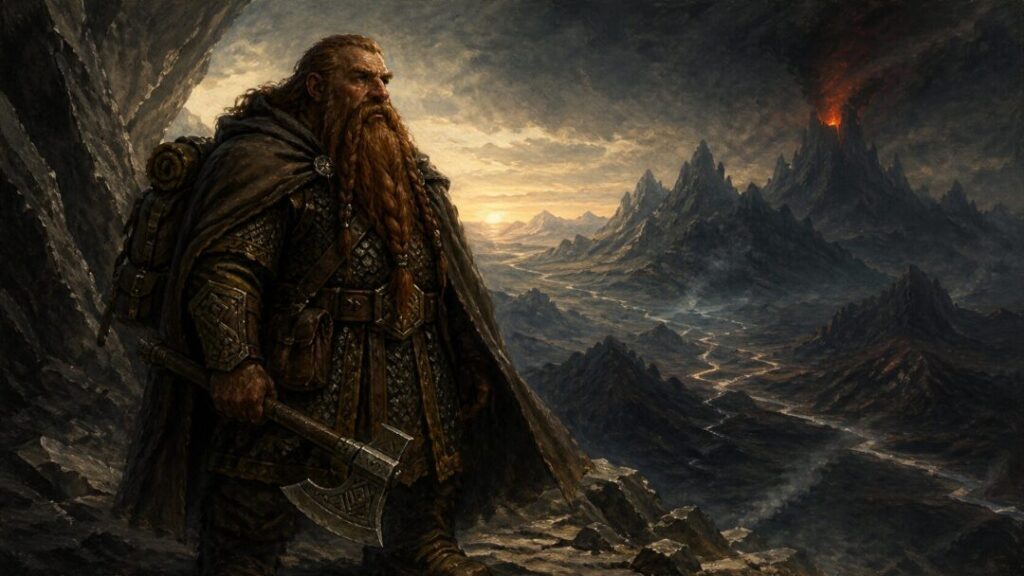
Aragorn Was Not Planning to Send Everyone into Mordor
The first important point is that Aragorn was not thinking like a general sending a large guard into enemy land.
He understood that the Quest of the Ring was not a normal military mission.
A larger company would not necessarily make Frodo safer. In fact, it might make the Quest more visible, more difficult to conceal, and more vulnerable to inner failure.
That is why Aragorn says that if Frodo goes east, not all need go with him — and he does not think all should.
This is crucial.
Mordor is not a battlefield where numbers guarantee strength. The Ring itself changes the nature of the danger. The more people near it, the more wills it can touch. The more companions around Frodo, the more chances there are for fear, pride, pity, ambition, or despair to become openings.
Boromir’s fall proves this with terrible clarity.
He is not evil. He is not a servant of Sauron. But the Ring finds the place where his hope and fear are already burning: Gondor’s need.
The danger is not only outside the Company.
It is inside it.
Why Sam Was the First Obvious Choice
Sam’s place needs little explanation.
Aragorn says Sam could not bear being separated from Frodo. That is not sentimentality. It is accurate judgment.
Sam’s loyalty is not abstract. It is personal, stubborn, and almost impossible to break. He does not join the Quest because he dreams of glory or understands all its stakes. He goes because Frodo goes.
That makes him uniquely suited to remain beside the Ring-bearer.
Sam is not drawn by command.
He does not want the Ring for strategy.
He does not imagine himself as a lord or savior.
His love is narrow in the best possible way.
He wants Frodo alive.
In Mordor, that becomes more important than almost anything else.
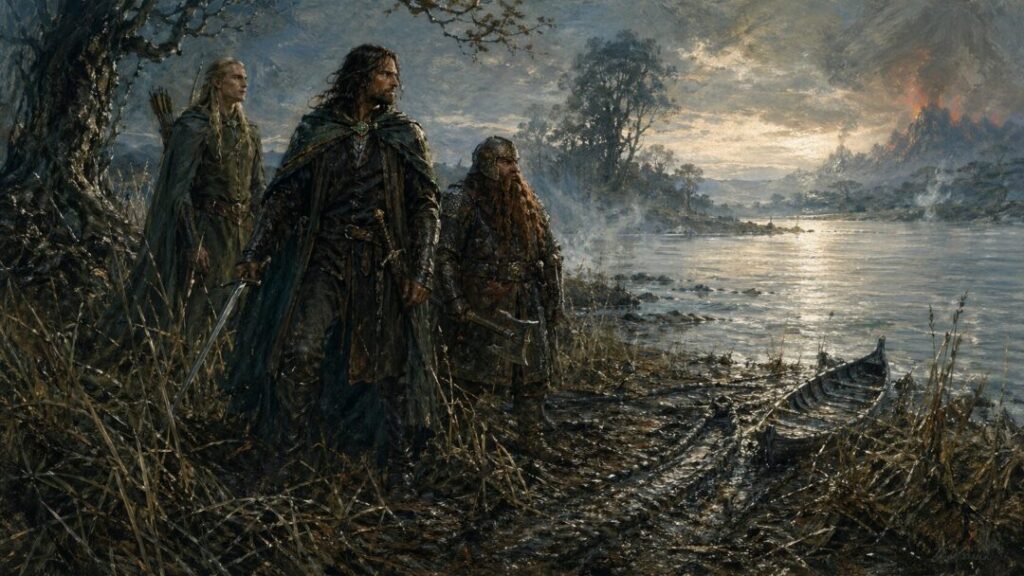
Why Aragorn Would Have Gone Himself
Aragorn’s own place is also clear.
After Gandalf falls in Moria, Aragorn becomes the guide of the Company. He does not claim mastery over the Quest, but he accepts responsibility for leading what remains of it.
He knows wilderness.
He knows hardship.
He knows fear.
And he has already spent years moving in secrecy, far from courts and armies.
If anyone among the remaining Company could help Frodo find a path through danger, Aragorn seems the natural choice.
Yet Aragorn is also divided.
His road is not simple. Boromir is going to Minas Tirith, and Aragorn’s own destiny is bound to Gondor. He has a claim, a duty, and a longing that all point south.
This is part of the tension at Parth Galen.
Aragorn is not merely choosing between two routes on a map. He is choosing between parts of his own fate.
To go with Frodo would mean delaying, perhaps losing, the open road to kingship.
Still, he is ready to do it.
That tells us how seriously he takes the Ring-bearer’s need.
The Strange Choice of Gimli
Then comes the more mysterious name.
Gimli.
Aragorn does not explain why he chooses him. The text does not give us a speech about Dwarven endurance, Dwarven resistance, or Gimli’s special role in Mordor.
So we have to be careful.
It would be too strong to say that Aragorn chose Gimli because Dwarves were immune to the Ring. The books do not say that. The Dwarves were resistant in certain ways to domination through the Seven Rings, but that does not mean Gimli could safely stand near the One Ring without danger.
No one should be treated as safe around it.
It would also be too strong to say that Gimli was chosen because he had some secret skill that made Mordor easier to enter. The text never says this.
But the story does show us what kind of companion Gimli is.
And that may be enough.
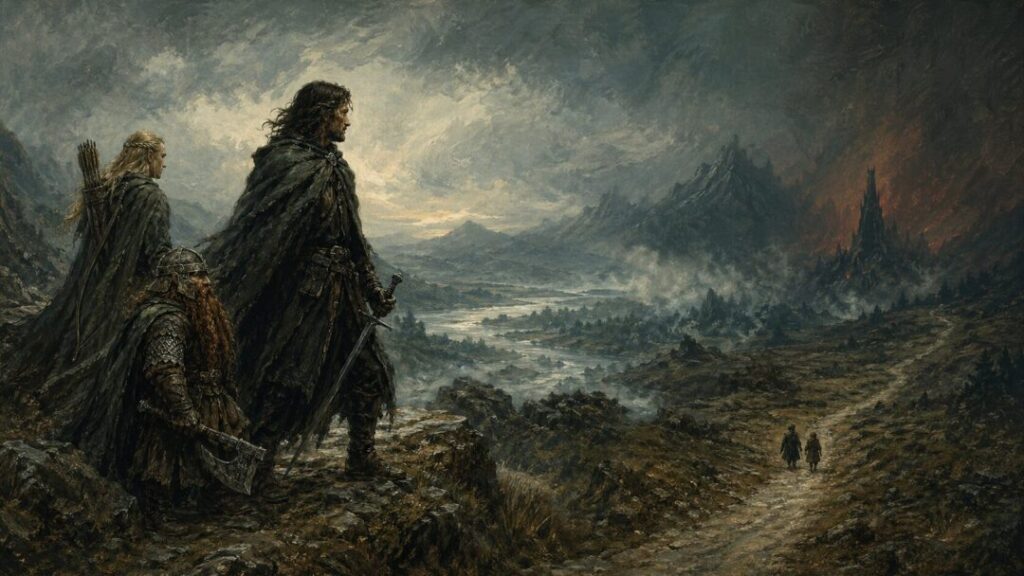
Gimli Is Steadfast When the Road Darkens
Before the Company leaves Rivendell, Gimli says one of the clearest lines about loyalty in the whole Fellowship:
Faithless is the one who says farewell when the road darkens.
That statement is not just brave talk. It reveals how Gimli understands fellowship.
He does not see loyalty as something that lasts only while the road is clear, honorable, or likely to succeed. He believes the true test comes when the road becomes darker.
That matters deeply for Mordor.
The path east is not only physically dangerous. It is spiritually crushing. It leads into a land where hope becomes thinner and thinner, where even Sam and Frodo nearly lose the ability to imagine anything beyond the next step.
A companion on that road cannot be someone who needs certainty.
Gimli does not.
He is not careless. He is not naive. He often sees danger clearly. But once he has given his loyalty, he does not easily withdraw it.
For Aragorn, that steadiness would have mattered.
Gimli Has No Rival Claim Pulling Him Away
There is another quiet possibility.
Boromir has a clear road to Minas Tirith. His heart is already turned toward the war of Gondor, and the Ring has begun to work through that desire.
Merry and Pippin love Frodo, but they are young, vulnerable, and not suited to a hidden march into Mordor.
Legolas could certainly have gone. The text never says he could not. Any answer that turns Legolas into the “wrong” choice goes beyond what the story tells us.
But Legolas is not named.
Gimli is.
One reason may be that Gimli, at this point, has no separate mission competing with the Ring-quest. He is not being called to defend his own city in the way Boromir is. He is not tied to Aragorn’s royal destiny. He is not one of the young hobbits whose presence would make Frodo more emotionally burdened.
He can simply be a companion.
That simplicity may be part of his strength.
Gimli Does Not Try to Possess the Quest
Gimli’s story also quietly resists the idea of possession.
He comes from a people often associated, fairly or unfairly, with deep love of crafted things, treasure, and the works of stone and metal. Yet Gimli’s own conduct in the Fellowship is not shaped by greed.
In Lothlórien, when he is offered a gift, he does not ask for wealth, weapons, or power. His request is personal, reverent, and almost impossible to turn into domination.
This does not make him immune to temptation.
But it does show that Gimli is not written as someone grasping for mastery.
That is important near the Ring.
The Ring feeds on desire to command, possess, correct, rule, or save by force. Aragorn himself is wise enough to fear that. Boromir tragically is not.
Gimli, by contrast, is often at his best when he gives loyalty rather than seeks control.
That may help explain why Aragorn could imagine him walking beside Frodo.
The Plan Was Never Fulfilled
But the most important part of this question is that Aragorn’s plan never happens.
Gimli does not go into Mordor with Frodo.
Neither does Aragorn.
The Fellowship breaks before any orderly division can be made. Boromir tries to take the Ring, repents, and dies defending Merry and Pippin. Frodo decides to leave alone. Sam follows him. Merry and Pippin are carried away by Orcs.
By the time Aragorn understands what has happened, the decision has changed.
He no longer has the clean choice he imagined.
He cannot simply pick the best companions for Frodo. Frodo has already gone beyond his reach.
That is why Aragorn’s later choice is so powerful.
He admits that he would have guided Frodo to Mordor and gone with him to the end. But if he now searches for Frodo in the wilderness, he must abandon Merry and Pippin to torment and death.
So he lets Frodo go.
Not because Frodo is safe.
Not because Mordor is less terrible.
Not because the Quest matters less.
But because Aragorn understands that the fate of the Ring-bearer is no longer in his hands.
The Fellowship Did Not Fail in the Way It Seemed
On the surface, the breaking of the Fellowship looks like disaster.
The Company is scattered.
Boromir is dead.
Frodo and Sam are alone.
Merry and Pippin are prisoners.
Aragorn’s road to Minas Tirith is delayed again.
But the deeper pattern is stranger.
Frodo and Sam reach Mordor precisely because they are separated from the larger Company. Merry and Pippin’s capture leads them into Fangorn and eventually into the story of the Ents. Aragorn, Legolas, and Gimli become the Three Hunters and are drawn into Rohan, where their presence helps change the war.
No one at Parth Galen can see this.
That is the point.
Aragorn makes the right choice without being able to see the full design.
So Why Gimli?
The most honest answer is this:
The text never tells us directly.
But it gives us enough to understand why Gimli makes sense.
Aragorn needed the company to be small.
Sam had to go because of his bond with Frodo.
Aragorn would go because he had taken up the burden of guidance.
And Gimli, among the remaining companions, represented something rare and necessary: steadfast loyalty without a rival claim to command the Quest.
He was brave, but not reckless.
Strong, but not seeking mastery.
Loyal, but not possessive of Frodo.
Willing to continue when the road darkened.
That is not a small thing in Middle-earth.
It may be one of the highest virtues there is.
The Deeper Meaning of Aragorn’s Choice
Aragorn’s imagined choice of Gimli shows us something about the Fellowship that is easy to overlook.
The Quest was never meant to be won by the obviously powerful.
Not by armies.
Not by kingship.
Not by Elven wisdom.
Not by the strength of warriors alone.
It required people who could bear the road without trying to own it.
Gimli’s possible place beside Frodo is meaningful because he is exactly that kind of companion.
And yet his greater role comes because he does not go.
He follows Aragorn instead. He runs across the plains of Rohan. He passes through Fangorn. He stands at Helm’s Deep. He enters the Paths of the Dead. He reaches the Black Gate.
Gimli’s loyalty is not wasted because he is not beside Frodo.
It is redirected.
That is the hidden beauty of the broken Fellowship.
No one ends up where they expected.
But each faithful choice still becomes part of the victory.
Sources & Notes
- J.R.R. Tolkien, The Lord of the Rings, Book II, Chapter 10, “The Breaking of the Fellowship” — Aragorn says that if Frodo chooses the eastward road, not all need go with him, naming Sam, Gimli, and himself as the likely companions.
- J.R.R. Tolkien, The Lord of the Rings, Book II, Chapter 10, “The Breaking of the Fellowship” — Boromir’s attempt to take the Ring and Frodo’s secret departure show why a smaller, less divided company may serve the Quest better.
- J.R.R. Tolkien, The Lord of the Rings, Book II, Chapter 3, “The Ring Goes South” — Gimli’s “faithless is he that says farewell when the road darkens” line establishes the steadfastness the article sees in him.
- J.R.R. Tolkien, The Lord of the Rings, Book II, Chapter 7, “The Mirror of Galadriel” — Gimli asks Galadriel only for a strand of her hair, supporting the article’s contrast between reverent loyalty and possessive ambition.
- J.R.R. Tolkien, The Lord of the Rings, Book III, Chapter 1, “The Departure of Boromir” — Aragorn recognizes he cannot now pursue Frodo and instead leads the pursuit of Merry and Pippin, turning the broken Fellowship into the road of the Three Hunters.