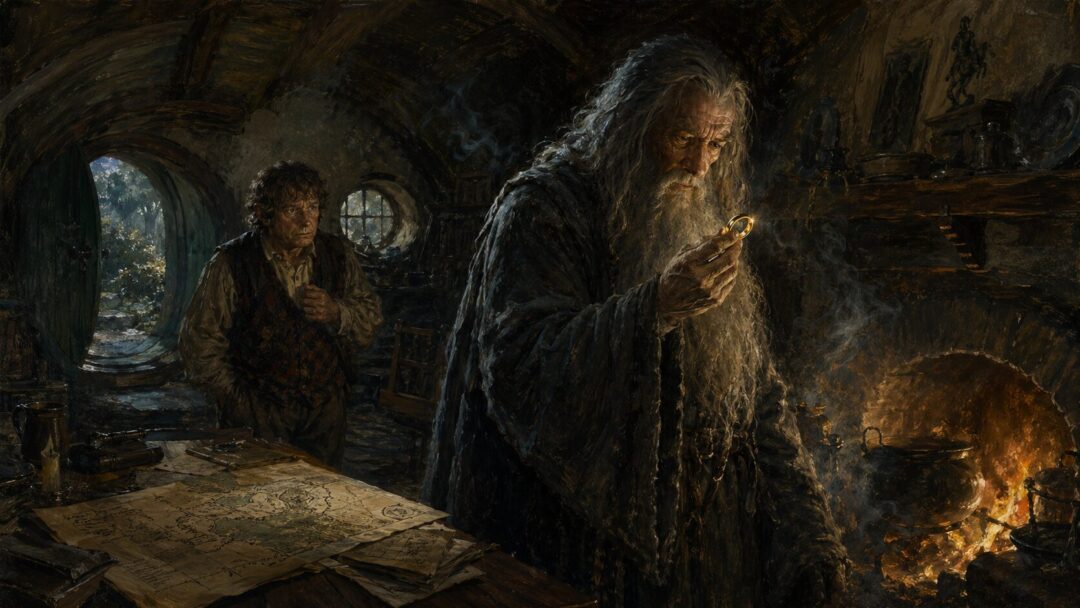
At first, it sounds like the simplest solution in Middle-earth.
What if Gandalf had learned the truth earlier?
Not in T.A. 3018, when he finally proved that Frodo’s Ring was the One Ring. Not even in T.A. 3001, when Bilbo’s strange behavior at his farewell party stirred Gandalf’s deepest suspicion.
But in T.A. 2953.
That date matters.
It was almost half a century before Frodo left the Shire. Bilbo had possessed the Ring for only twelve years. Sauron had returned openly to Mordor only recently. The War of the Ring had not yet begun. The Shire was still quiet, unnoticed by the great powers of the world.
On the surface, this seems like an enormous advantage.
The Ring is found early.
Sauron has not yet learned the names “Baggins” and “Shire.”
Gandalf has decades more time to act.
But Middle-earth is rarely saved by simply knowing things sooner.
Sometimes knowledge itself becomes the danger.
And in T.A. 2953, the secret of the Ring would have entered the world at one of the most unstable moments possible.
The Year That Changes Everything
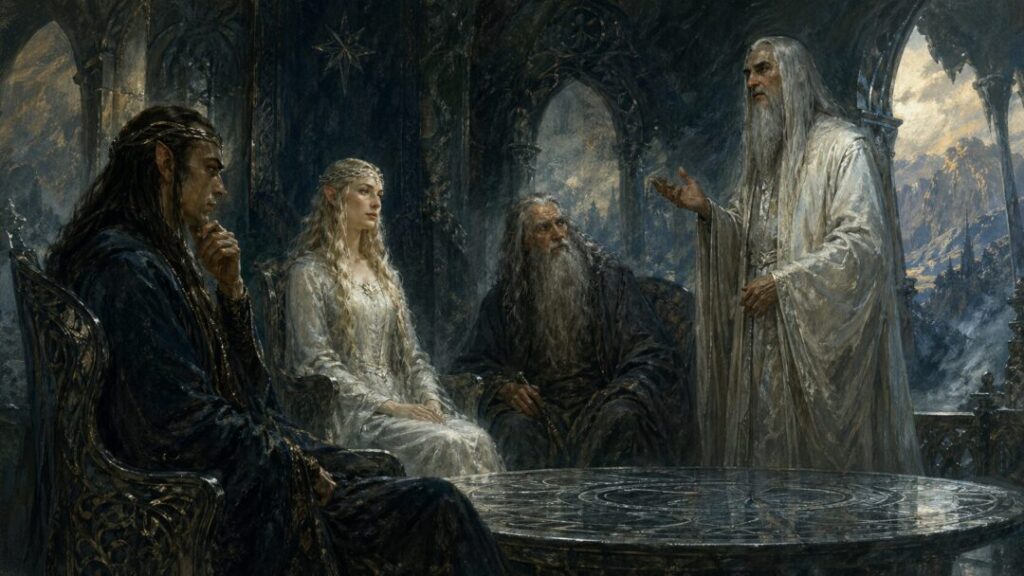
T.A. 2953 was the year of the last meeting of the White Council.
That alone makes the scenario dangerous.
The Wise gathered and debated the Rings of Power. Saruman, who was head of the Council and deeply learned in Ring-lore, claimed that the One Ring had passed down Anduin and into the Sea.
But the chronology tells us this was false.
Saruman was not simply mistaken. He feigned certainty. He presented the loss of the Ring as settled while his own desire for it had already begun to shape his choices.
After this meeting, he withdrew to Isengard, fortified it, and began setting watchers on Gandalf. He noticed Gandalf’s interest in the Shire. Eventually, his agents appeared in places connected with hobbits and pipe-weed.
So if Gandalf discovered the Ring in 2953, the first problem would not be Mordor.
It would be secrecy.
The White Council, which should have been the safest place to bring such knowledge, was no longer safe.
Bilbo Would Still Be the Ring-bearer
This is easy to overlook.
In 2953, Frodo had not yet been born.
That means the Ring would still be with Bilbo.
Bilbo at this point was not the ancient, sleepy figure we later meet in Rivendell. He was about sixty-three years old, still living in Bag End, still wealthy, peculiar, and deeply attached to the strange ring he had found beneath the Misty Mountains.
He had possessed it for twelve years.
That is much less than the sixty years he would eventually bear it. Because of that, it is reasonable to wonder whether he might have surrendered it more easily in 2953 than he did in 3001.
But this must remain interpretation.
The texts do not show Bilbo being asked to give up the Ring in 2953. We cannot know how he would have responded. What we can say is that even in 3001, after decades of possession, Bilbo did finally surrender it — though with great difficulty and only under Gandalf’s pressure.
So an earlier surrender is possible.
But it would not be simple.
The moment Gandalf names the Ring for what it truly is, Bilbo’s harmless “magic ring” becomes something else. It becomes the central object of Sauron’s will. It becomes a burden no hobbit was ever meant to understand.
And Bilbo would have to be protected not only from enemies, but from the Ring’s growing claim on him.
Gandalf Could Not Simply Take It
The most tempting answer is also the most dangerous one:
Why would Gandalf not take the Ring himself?
The answer is already built into the moral structure of the story.
Gandalf refuses the Ring when Frodo offers it to him because he knows what it would do through him. He does not fear that he would use it for petty evil. He fears that he would begin by wanting to do good.
That is exactly why the danger is so great.
The Ring is not merely a weapon. It is a temptation toward mastery. In the hands of someone powerful, wise, and compassionate, it might become more terrible, not less.
So in 2953, Gandalf’s task would not be to claim the Ring.
It would be to arrange for someone else to bear it, guard it, or carry it toward its destruction without turning that mission into another path of domination.
That is a much harder problem.
Because the Ring cannot be kept forever.
It cannot be used safely.
And it cannot be destroyed anywhere except the fire in which it was made.
The Saruman Problem
This is where 2953 becomes truly frightening.
If Gandalf tells Saruman, the secret may be lost.
By this time, Saruman has already begun to desire the Ring. The texts do not require us to imagine him openly serving Sauron in 2953 in the same way he later does, but they do show that his motives are no longer trustworthy. He lies to the Council about the Ring’s fate. He soon fortifies Isengard. He watches Gandalf.
That means any “official” plan through the White Council risks exposure from within.
Saruman might press for the Ring to be brought to him for study.
He might try to discover where Bilbo lives.
He might accelerate his surveillance of the Shire.
He might move from hidden jealousy into open treachery much sooner.
These are interpretations, not stated events.
But they follow from the danger the canon already gives us: Saruman wanted the Ring, and Gandalf’s interest in the Shire became important enough for him to watch.
So if Gandalf discovers the Ring in 2953, he may face a terrible choice.
Trust the Council and risk Saruman.
Or hide the truth and act without the full strength of the Wise.
Neither choice is safe.
Could the Ring Have Gone to Rivendell?
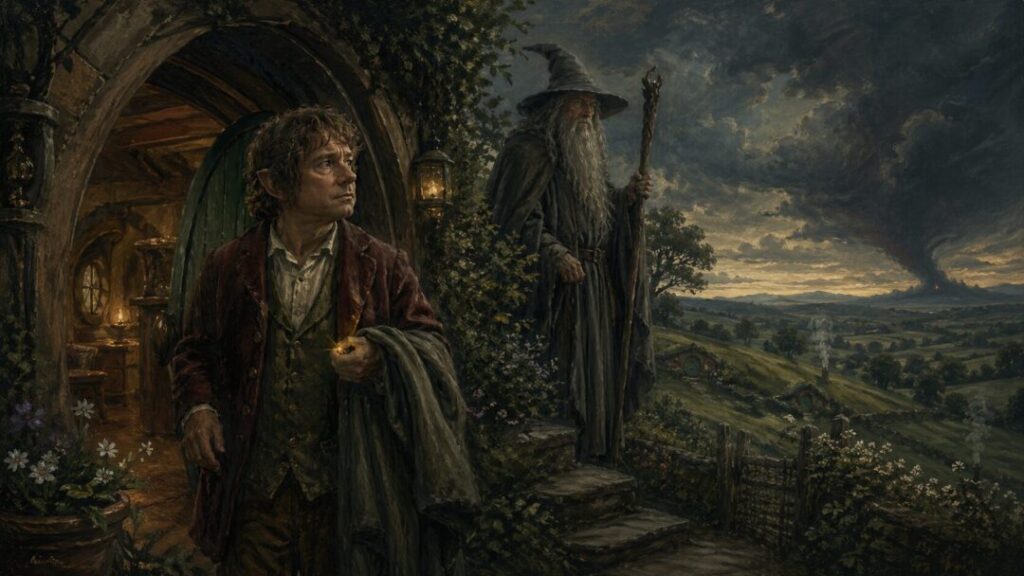
The most conservative possibility is that Gandalf would try to move the Ring quietly to Rivendell.
This would make sense.
Elrond’s house was a refuge of knowledge and counsel. Bilbo already had a connection to Rivendell from the Quest of Erebor. The road would still be dangerous, but the full hunt of the Ringwraiths had not yet begun in the form we see in 3018.
If Bilbo could be persuaded to leave the Shire, the Ring might be removed from the most vulnerable place before Saruman’s agents fully understood what Gandalf was hiding.
But this would not solve the real problem.
Rivendell could shelter the Ring for a time.
It could not be its final answer.
Elrond himself later says that the Ring cannot simply be hidden or kept. The only true victory is its destruction.
So even if Gandalf brought Bilbo and the Ring to Rivendell in 2953, the question would still remain:
Who would carry it to Mordor?
The Missing Fellowship
This is where the early timeline becomes strange.
Many of the figures we associate with the Quest are not yet ready, not yet born, or not yet in the right place.
Frodo does not exist yet.
Sam does not exist yet.
Merry and Pippin do not exist yet.
Boromir does not exist yet.
Aragorn is young by the reckoning of his life, though already entering the path of his true identity and long labors.
Legolas and Gimli exist, of course, but the particular union of peoples formed at the Council of Elrond has not yet come into being. The later Fellowship is not just a tactical group. It is the result of a very specific historical moment: the free peoples recognizing, at last, that their separate roads have converged.
In 2953, that moment has not arrived.
A quest could still be attempted. But it would not be Frodo’s quest.
It might be smaller, more secretive, and possibly more desperate.
And here the story becomes almost darker than the original.
Because an earlier quest might have fewer enemies hunting it openly — but it might also have fewer providential bonds holding it together.
Would Sauron Know?
One of Gandalf’s greatest advantages in 2953 would be that Sauron does not yet appear to know where the Ring is.
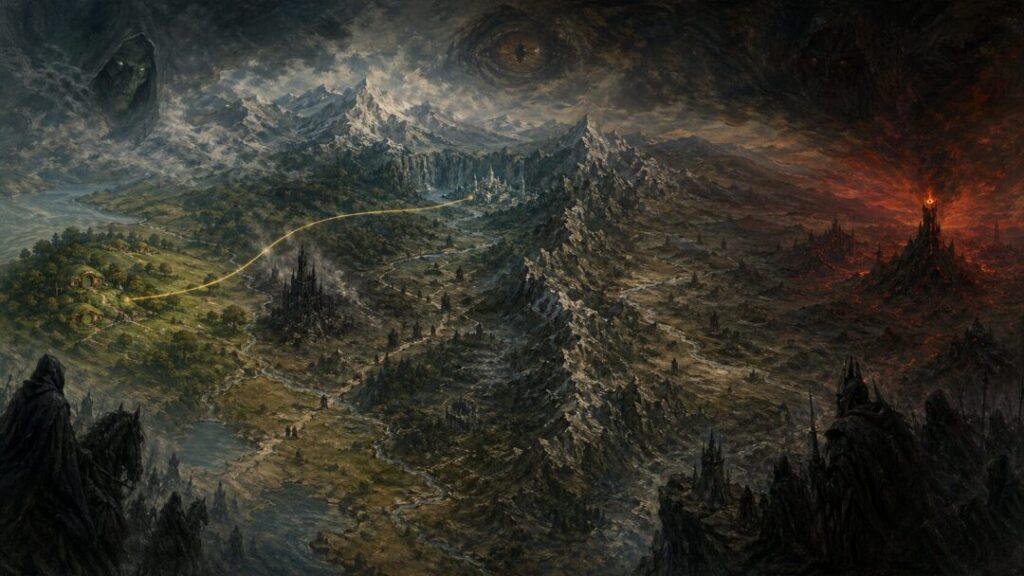
In the known story, Sauron eventually learns crucial words from Gollum: “Shire” and “Baggins.” That knowledge drives the hunt that reaches the borders of the Shire.
But in 2953, that has not yet happened.
This means the Ring could perhaps be moved before Mordor understands its location.
That is the best argument for the earlier discovery being a genuine advantage.
Yet Sauron was not inactive.
He had returned openly to Mordor. Barad-dûr was rising again. His servants were gathering. The Nazgûl were still a terror in the world, even if they had not yet been sent openly to the Shire.
So the road to Mount Doom would not be easy.
The Ring might begin the journey under less direct pursuit, but Mordor itself was still the place of Sauron’s strength. The closer the Ring came to its master, the greater its peril would become.
The Most Likely Change
The most likely change is not that the War of the Ring becomes easy.
It is that everything happens more quietly and more dangerously.
Gandalf would probably avoid revealing the full truth to Saruman. He might confide in Elrond. He might seek counsel from Galadriel, though any such step would still need to be guarded. He would almost certainly try to remove Bilbo and the Ring from the Shire before Saruman’s interest sharpened.
Bilbo might become the first and central bearer of the earlier crisis.
That is the great difference.
The emotional center of the story would not be Frodo inheriting a burden from Bilbo.
It would be Bilbo being forced to understand what he had carried home from the dark.
The little ring that helped him escape goblins, spiders, and unwanted visitors would suddenly become the fate of the world.
And Bilbo, who once won it through riddles and pity, would have to face the truth that his adventure had never really ended.
Why This Earlier Discovery Might Still Fail
There is one uncomfortable possibility.
Learning the truth in 2953 might make things worse.
If Saruman discovers that Gandalf knows, his betrayal may quicken.
If Bilbo is pressed too hard, the Ring may tighten its hold.
If the Ring is moved openly, servants of Sauron or spies of Saruman may begin to close in.
If the Wise argue over what to do, the delay may become deadly.
The original timeline is full of suffering, but it also contains strange mercies.
Bilbo gives up the Ring.
Frodo inherits it.
Sam goes with him.
Gollum survives because Bilbo once spared him.
And in the end, the Ring is destroyed not by strength of will alone, but through a chain of pity, failure, endurance, and providence.
An earlier discovery could preserve some of those elements.
But it could also remove others.
No Sam.
No Frodo shaped by years of quiet preparation.
No Fellowship formed by the gathered crisis of the age.
No exact path that brings Gollum to the Cracks of Doom.
And without Gollum, the ending we know cannot happen.
That does not mean all hope is lost. It means the hope would take another form — one the texts never reveal.
The Real Answer
So what if Gandalf learned in T.A. 2953 that Bilbo’s Ring was the One Ring?
Middle-earth might gain time.
But it would lose certainty.
Gandalf would know the truth decades earlier, before Sauron knew the Shire, before Frodo was born, before the final war had taken shape. That would be a real advantage.
Yet the danger inside the Wise would be greater than it first appeared. Saruman’s lie at the White Council means the secret could not safely travel through the very channels meant to defend the world.
That is what makes this version so fascinating.
The Ring would not first endanger Frodo.
It would endanger trust.
Trust between Gandalf and Saruman.
Trust within the White Council.
Trust in whether wisdom itself could remain uncorrupted when the object of ultimate power had been found.
In the known story, Gandalf discovers the truth late, but not too late.
In 2953, he might discover it early.
And that might be the more dangerous thing.
Because the One Ring was never only dangerous when Sauron knew where it was.
It was dangerous the moment anyone did.
Sources & Notes
- J.R.R. Tolkien, The Lord of the Rings, Appendix B, “The Tale of Years” — sets the relevant chronology: Bilbo finds the Ring in 2941, Sauron returns openly to Mordor in 2951, and the last White Council meets in 2953.
- J.R.R. Tolkien, The Fellowship of the Ring, Book I, Chapter 2, “The Shadow of the Past” — Gandalf’s later proof of the Ring, his warning that he dare not take it, and the danger of using it even from good motives.
- J.R.R. Tolkien, The Fellowship of the Ring, Book II, Chapter 2, “The Council of Elrond” — Elrond’s council treats hiding or wielding the Ring as no final answer and centers the choice on its destruction in Orodruin.
- J.R.R. Tolkien, Unfinished Tales, “The Hunt for the Ring” — gives the background of Saruman’s growing interest in the Shire, his agents, and the danger of Gandalf’s Shire connection being watched.
- J.R.R. Tolkien, The Silmarillion, “Of the Rings of Power and the Third Age” — summarizes the White Council, Saruman’s Ring-lore, and the larger Third Age setting behind Sauron’s return and the Wise’s counsels.