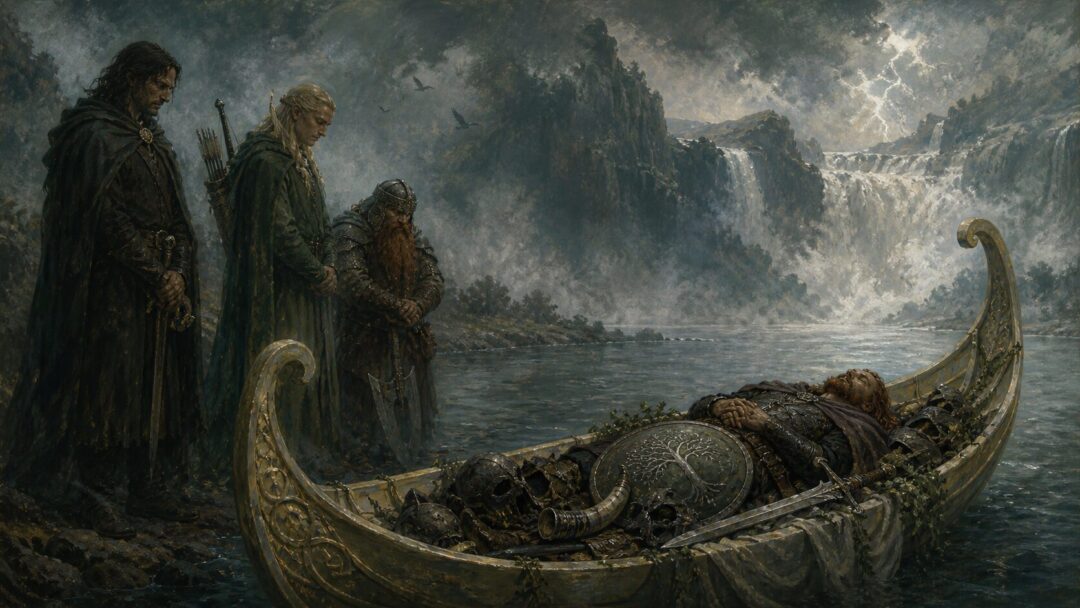
It is one of the quietest images in the story, and one of the easiest to miss.
Boromir has fallen.
The Fellowship is broken. Merry and Pippin have been taken. Frodo and Sam have crossed the river alone. The company that left Rivendell with hope, secrecy, and a shared purpose has shattered on the slopes of Amon Hen.
And beside Boromir’s body, Aragorn does something that feels almost ceremonial.
He takes Boromir’s bracers.
At least, that is the version many people remember.
The moment is powerful because it says almost nothing aloud. Aragorn does not make a grand speech about legacy. He does not explain what the gesture means. He simply carries something of Boromir with him.
But there is an important detail that changes the whole question.
In the book, Aragorn does not take Boromir’s bracers.
That image belongs to the adaptations, not to the written text. And yet it feels so emotionally true to the story that it has become one of the most discussed visual symbols around Boromir’s death.
So the real question is not only, “Why did Aragorn take them?”
The deeper question is this:
Why does that invented gesture fit the canon so well?
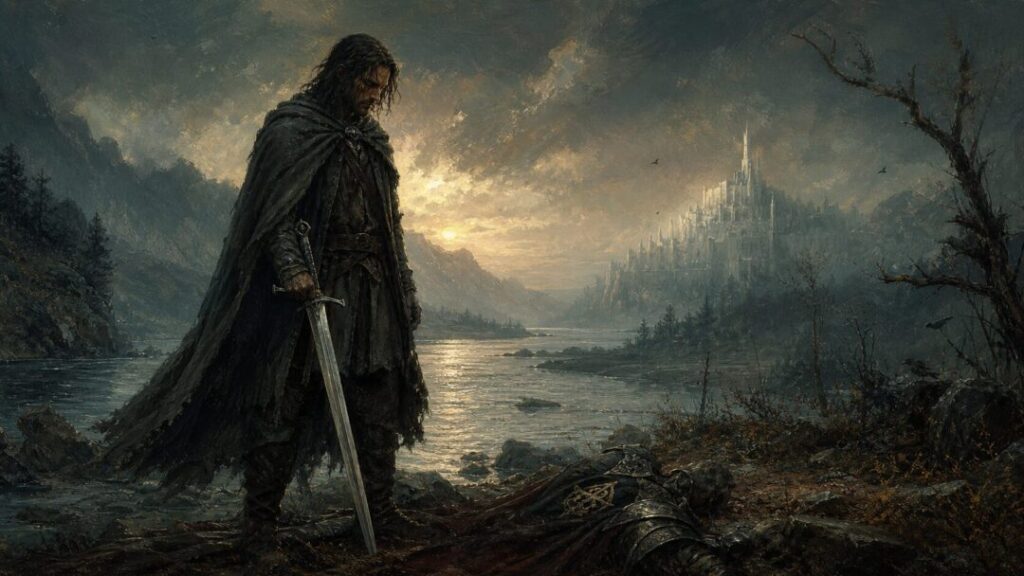
The Bracers Are Not in the Book
In The Lord of the Rings, Boromir’s death is described with great restraint.
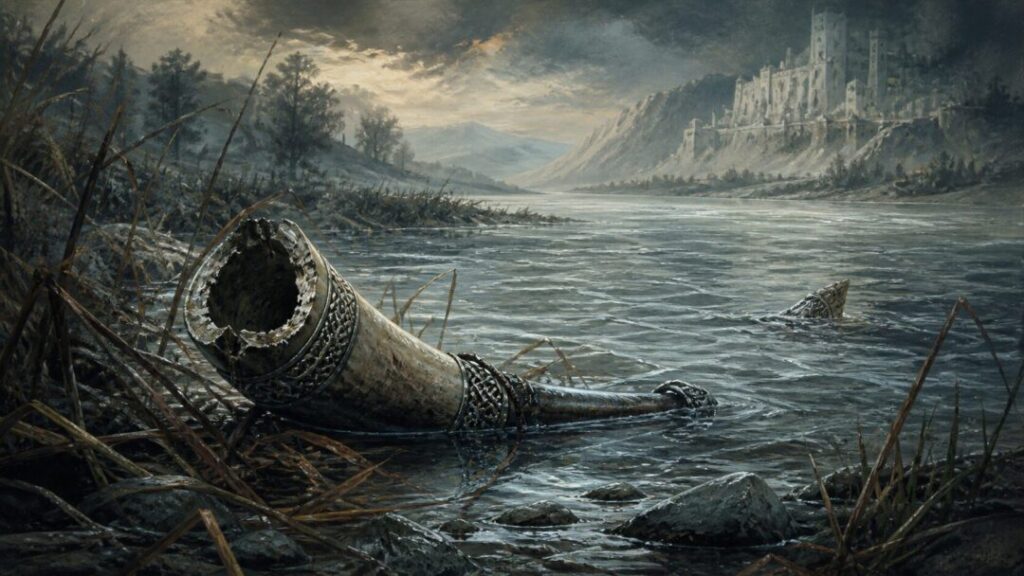
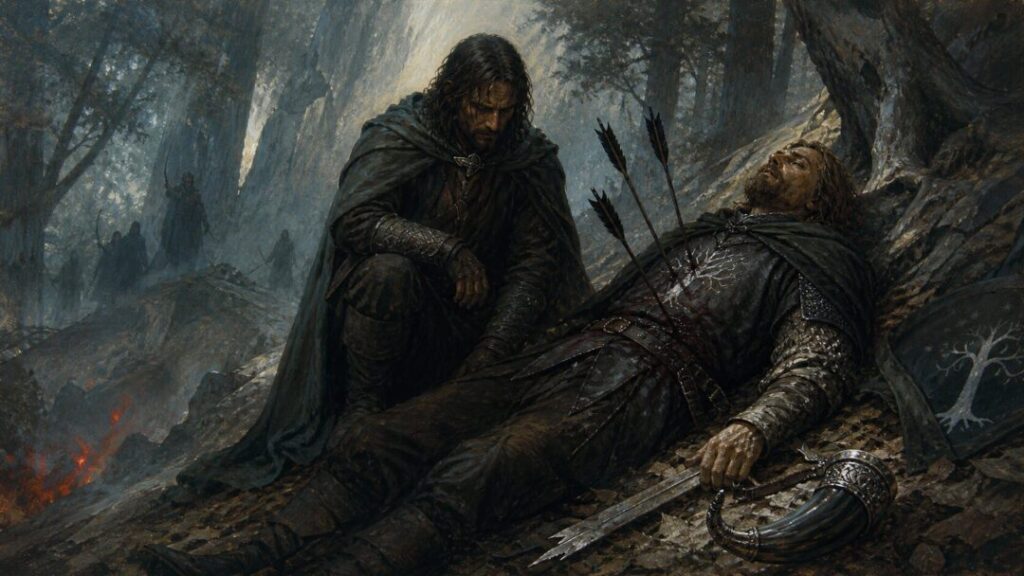
Aragorn finds him beneath Amon Hen, pierced by many arrows. Boromir’s sword is still in his hand, but broken near the hilt. His horn, the great horn of Gondor, is cloven in two.
Boromir is not presented as a perfect hero.
He has just tried to take the Ring from Frodo.
That failure matters. The Ring worked upon his fear, his pride, and his desperate love for Gondor. Boromir wanted power, but not for mere cruelty or vanity. He wanted a weapon to save his people.
That does not excuse what he did.
But it explains why his fall is tragic rather than simple.
When Aragorn reaches him, Boromir confesses. He tells Aragorn that he tried to take the Ring. He says he has paid. He says the little ones have been taken. And he believes he has failed.
Aragorn does not argue with the facts.
He does something more important.
He refuses to let Boromir’s last word about himself be failure.
Boromir’s True Final Victory
Boromir falls to the Ring, but he does not remain fallen.
That distinction is essential.
After his attempt to seize the Ring, Boromir returns to himself. He defends Merry and Pippin against the Orcs. He blows his horn. He fights until he can fight no longer.
The text does not require us to pretend he never failed.
Instead, it shows him making what amends he can.
His last stand does not undo his temptation, but it reveals that the Ring did not wholly possess him. Boromir’s final act is not grasping. It is protection.
This is why Aragorn’s words matter so deeply.
He tells Boromir that few have gained such a victory.
That is not empty comfort.
In the moral world of Middle-earth, victory is not always measured by survival, conquest, or visible success. Sometimes victory is refusing to let evil have the last claim on you.
Boromir cannot save Merry and Pippin from capture.
He cannot undo what he said to Frodo.
He cannot return to Minas Tirith.
But he can die defending the helpless instead of pursuing the Ring.
And that is the victory Aragorn recognizes.
What Aragorn Actually Takes From Boromir
Since the bracers are not in the book, Aragorn does not literally take them in the canonical scene.
But he does take something far heavier.
He takes Boromir’s burden.
Boromir’s last concern is Gondor. He asks Aragorn to save Minas Tirith because he believes he himself has failed. This plea is not random. Throughout the story, Boromir has been the voice of Gondor’s desperation.
He comes to Rivendell from a city under shadow.
He knows Mordor is rising.
He knows his people have stood for generations as a shield against the East.
And he does not understand why the Ring should be destroyed when, to his mind, it might be used against the Enemy.
Boromir is wrong about the Ring.
But he is not wrong to love Gondor.
That is what makes his end so painful. His love is real. His courage is real. His loyalty is real. But the Ring twists those things toward domination.
So when Aragorn promises him that Minas Tirith will not fall, the promise is not merely kind.
It is a turning point.
Aragorn has long carried the claim of Isildur’s heir. But here, beside Boromir’s body, the claim becomes personal. It is no longer an abstract inheritance or a distant kingship.
It becomes a promise made to a dying man of Gondor.
Why the Bracers Work as a Symbol
This is why the adaptation choice feels so powerful.
The bracers give visible shape to an invisible transfer.
Boromir was the son of the Steward of Gondor. He was not the king, but he was one of the chief defenders of the realm. His body, his gear, his horn, and his bearing all connect him to Minas Tirith.
For Aragorn to wear something associated with Boromir suggests more than remembrance.
It suggests acceptance.
Not of Boromir’s claim, because Boromir had none to kingship.
Not of Boromir’s failure, because Aragorn does not inherit that.
But of Boromir’s love for Gondor.
The gesture says, without words, that Aragorn will carry what Boromir could no longer carry.
This is especially fitting because Aragorn’s path after Amon Hen leads him away from Frodo. He chooses to pursue Merry and Pippin, not because the Ring no longer matters, but because the living still matter.
That choice echoes Boromir’s final act.
Boromir died defending the hobbits.
Aragorn continues by trying to rescue them.
The bracers, then, become a kind of silent oath. They are not needed for the plot. They do not give Aragorn strength. They do not change his lineage.
They remind us what kind of king he must become.
The Book Uses a Different Symbol
The written story does not need the bracers because it has another symbol at the center of Boromir’s death.
The horn.
Boromir’s horn is one of the most important objects associated with him. It is the horn of Gondor, and he carries it as a sign of his house and people. When he blows it at Amon Hen, he is not merely calling for aid. He is sounding the voice of Gondor in its last desperate defense.
But the horn is broken.
That image is devastating.
Boromir’s sword is broken.
His horn is cloven.
The Fellowship is broken.
The line between personal tragedy and the fate of kingdoms becomes very thin.
When Aragorn, Legolas, and Gimli prepare Boromir’s funeral boat, they place with him his weapons and tokens. They do not strip him of his identity. They send him away as Boromir of Gondor.
This is important.
In the book, Boromir is not reduced to his mistake.
His body is honored. His courage is remembered. His enemies’ weapons are placed at his feet, showing the cost he exacted in his last defense.
Then Aragorn and Legolas sing the lament for Boromir.
The story allows him dignity.
Not innocence.
Dignity.
Aragorn’s Mercy Matters
Aragorn’s response to Boromir is one of the clearest signs of the king he will become.
He could have condemned him.
He could have treated Boromir’s confession as proof that Men are too weak for the great struggle. He could have allowed Boromir to die believing that his last chapter was only shame.
Instead, Aragorn gives him truth and mercy together.
He does not say the failure never happened.
He says Boromir has conquered in the end.
This distinction is deeply important. Mercy in Middle-earth is not blindness. It does not pretend evil is harmless. It does not erase consequences.
But it refuses despair.
Aragorn sees Boromir whole: proud, brave, fearful, tempted, repentant, and redeemed in his final stand.
That is why the bracers, though not canonical in the book, work emotionally. They represent remembrance without denial. Aragorn does not carry Boromir because Boromir was flawless.
He carries him because Boromir was worth remembering.
Boromir and Aragorn Were Not Rivals in the Simple Sense
It is tempting to read Boromir and Aragorn as opposites.
Boromir is the proud warrior of Gondor.
Aragorn is the hidden king.
Boromir is tempted by the Ring.
Aragorn resists it.
Boromir doubts the road to Mordor.
Aragorn ultimately helps make that road possible.
But the story is more subtle than that.
Boromir and Aragorn are both men tied to Gondor. Both are warriors. Both understand the long war against Sauron. Both carry the burden of a kingdom under threat.
Their difference is not that one loves Gondor and the other does not.
Their difference is how that love is governed.
Boromir’s love becomes desperate. He wants to save Gondor by taking hold of power.
Aragorn’s love must become sacrificial. He will save Gondor not by claiming the Ring, but by rejecting it, serving others, and walking toward a kingship that demands humility before glory.
This is why Boromir’s death matters so much to Aragorn’s arc.
Boromir shows what can happen when the desire to defend becomes entangled with the desire to possess.
Aragorn must become something else.
A Promise Beside the Dead
When Aragorn tells Boromir that Minas Tirith will not fall, he is speaking more than comfort.
He is making a vow.
At that moment, nothing about the future looks certain. Frodo is gone. The Ring is moving toward Mordor with only Sam beside him. Merry and Pippin have been captured. Saruman’s servants are running west. The remaining Three Hunters have no clear knowledge of what has happened or what they can still save.
And yet Aragorn speaks as if hope is still possible.
That is one of the defining features of his character.
He does not possess certainty.
He chooses fidelity.
The promise to Boromir becomes part of that fidelity. Aragorn will not let Gondor be merely the city Boromir failed to save. He will go on to become the king who helps restore it.
The bracers, in the adaptation, make that promise visible on his body.
Every time he wears them afterward, the viewer is reminded that Aragorn’s kingship is not only about bloodline.
It is also about memory, obligation, and grief.
Why This Moment Stays With People
The reason people remember the bracers is not because they are explained.
It is because they are not.
They work like many of the strongest symbols in Middle-earth: quietly, almost beneath the surface.
A broken sword.
A white tree.
A grey cloak.
A cloven horn.
A small hand reaching for mercy when power would be easier.
The bracers belong to that same emotional language, even though they are not from the book. They are a visual interpretation of a canonical truth: Aragorn does not leave Boromir behind as a failure.
He carries the meaning of Boromir’s last moments forward.
That is why the gesture feels right.
Not because the book says he did it.
But because the book gives him every reason to.
What Aragorn Really Took
So why did Aragorn take Boromir’s bracers?
In the strictest lore sense, he did not.
But in the symbolic sense, the answer is clear.
He took them as a sign of honor.
He took them as a reminder of Boromir’s courage.
He took them as a visible form of the promise he made beside Boromir’s body.
Most of all, he took them because Boromir’s story was not allowed to end with the Ring.
Boromir fell, but he also repented.
He failed, but he also defended.
He died, but not before giving Aragorn one final charge: save Minas Tirith.
The book gives that charge in words.
The adaptation gives it in leather and silence.
Both point toward the same truth.
Aragorn did not take Boromir’s place.
He took up Boromir’s unfinished hope.
Sources & Notes
- J.R.R. Tolkien, The Lord of the Rings, Book II, Chapter 10, “The Breaking of the Fellowship” — Boromir tries to take the Ring from Frodo, then comes back to himself in grief after the madness passes.
- J.R.R. Tolkien, The Lord of the Rings, Book III, Chapter 1, “The Departure of Boromir” — Aragorn hears Boromir’s confession, names his final stand a victory, and promises that Minas Tirith shall not fall.
- J.R.R. Tolkien, The Lord of the Rings, Book III, Chapter 1, “The Departure of Boromir” — Boromir is laid in the funeral boat with his sword, horn, shield, and the weapons of his slain enemies, preserving his dignity as a man of Gondor.
- J.R.R. Tolkien, The Lord of the Rings, Book II, Chapter 2, “The Council of Elrond” — Boromir speaks from Gondor’s long war and argues that the Ring should be used against Sauron, giving context for both his temptation and his love of Minas Tirith.
- The Lord of the Rings: The Fellowship of the Ring, extended edition, dir. Peter Jackson — the bracer gesture is a film-adaptation symbol rather than a detail from Tolkien’s prose.