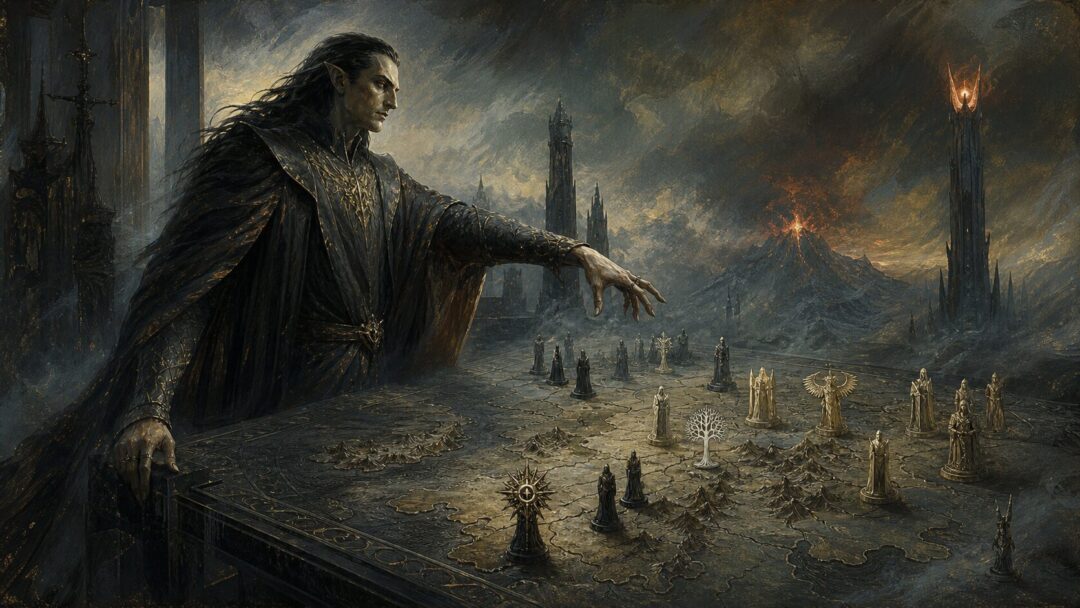
Most people think Sauron wanted to destroy Middle-earth.
But that is not quite right.
Destruction followed him. Ruin spread wherever his power reached. Mordor became a land of ash, fear, slavery, and smoke. His servants burned, hunted, tortured, and enslaved. His victory would have been catastrophic for every free people in Middle-earth.
Yet destruction was not the deepest shape of his desire.
Sauron did not want a world reduced to nothing.
He wanted a world reduced to obedience.
That distinction matters.
Morgoth, the first Dark Lord, was the greater rebel. His hatred went down into the roots of the world. He envied creation itself and sought to mar what he could not wholly possess. Sauron, though his evil became immense, was not simply another Morgoth in smaller form.
His path was different.
The texts present Sauron as a being originally associated with order, craft, and planning. His fall did not begin as a love of chaos. It grew from a desire to arrange, command, and dominate. Over time, order ceased to be a good that served others and became something he demanded from them.
And that is where the real answer begins.
Sauron did not merely hope to rule Middle-earth.
He hoped to become the single will behind it.
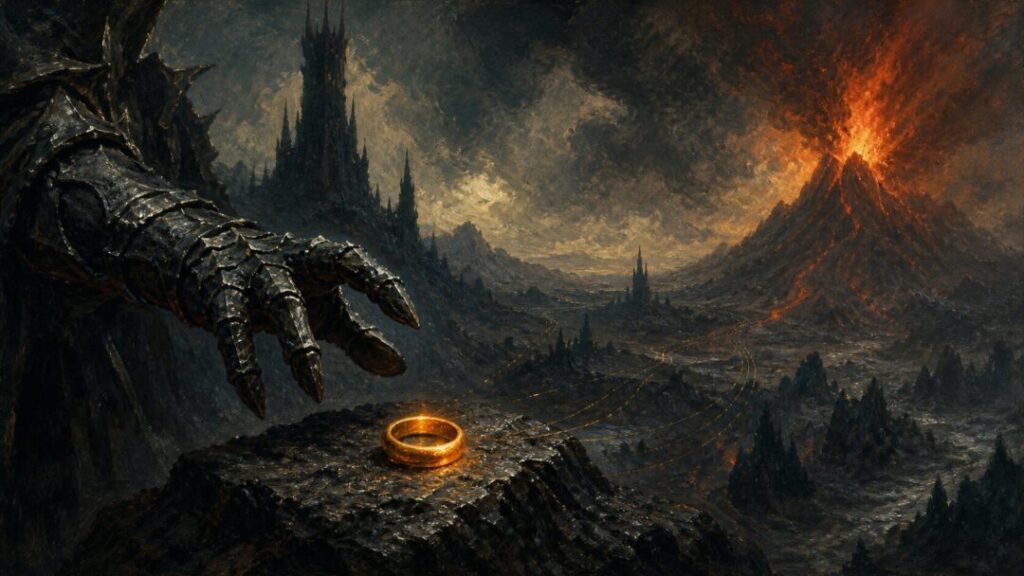
Sauron Was Not Trying to Be Morgoth Again
It is easy to treat Sauron as Morgoth’s successor in a simple way.
Morgoth was the first Dark Lord.
Sauron became the second.
Therefore Sauron must have wanted the same thing.
But the legendarium draws a sharper distinction.
Morgoth’s evil was cosmic rebellion. He wanted to possess, corrupt, and ultimately bend the created world away from its intended harmony. His pride was directed against the very order of existence.
Sauron inherited much from him, but he did not begin with the same kind of hatred.
Sauron was a Maia, a spirit of great power, originally connected with the works of Aulë, the Vala most associated with craft and making. That background matters because it gives shape to Sauron’s later corruption. His evil is not random savagery. It is technical, organized, calculating, and administrative.
He wants systems.
He wants hierarchy.
He wants obedience.
Where Morgoth often appears as a destroyer of beauty because he cannot bear anything outside himself, Sauron is more like a tyrant who believes the world would be improved if every independent will were removed from the equation.
That does not make him less evil.
It may make him more frightening.
Because Sauron’s evil can disguise itself as efficiency, peace, and restoration.
The Dangerous Dream of Order
After Morgoth’s defeat at the end of the First Age, Sauron was not immediately presented as a mindless force of darkness.
The texts connected with this period suggest something more subtle. Sauron had the opportunity to repent. He did not fully submit to judgment, and he remained in Middle-earth. His early motives in the Second Age are described, in one important account, as beginning with the reorganization and rehabilitation of a ruined world.
That must be handled carefully.
This does not mean Sauron was secretly good in the Second Age. It does not excuse him. It does not make him misunderstood in the modern romantic sense.
It means his evil did not need to announce itself first as evil.
He could look upon a broken Middle-earth after the wars against Morgoth and see disorder, waste, weakness, and delay. He could imagine himself as the one being strong enough and wise enough to set everything right.
But for Sauron, “setting things right” meant removing freedom.
The world was not to be healed by mercy.
It was to be corrected by control.
That is the central pattern of his fall. Order, severed from humility and love, becomes domination. Planning becomes tyranny. Strength becomes ownership.
And eventually, Sauron does not merely want Middle-earth to be ordered.
He wants it ordered around himself.
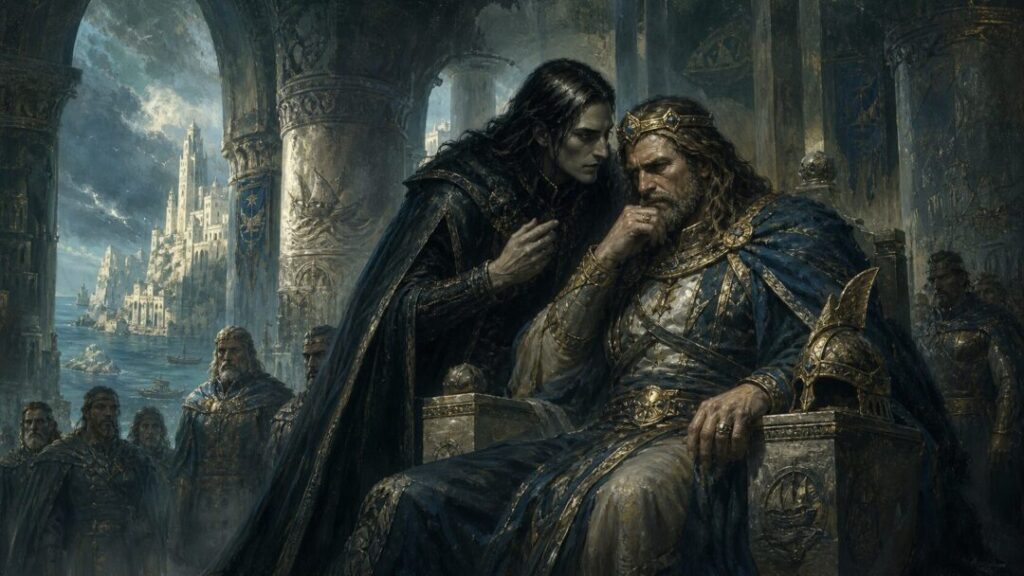
The Ring Was His Vision Made Visible
This is why the One Ring is so important.
The Ring is not just a magical object. It is Sauron’s philosophy forged into a thing.
The Ring’s purpose was to rule the other Rings. Through it, Sauron meant to bring their bearers under his power. When he made it, he poured much of his own strength and will into it. That is why its destruction meant his final downfall.
The Ring was not simply an aid to conquest.
It was the mechanism of conquest.
Sauron did not want only to defeat the Elves, Dwarves, and Men in battle. He wanted to reach the powers by which their realms endured. He wanted the hidden rulers, preservers, kings, and lords of Middle-earth bound to him from within.
This is why the Elves immediately perceived his intent when he put on the One. The plan failed in its first and greatest aim because the Elven bearers took off their Rings and hid them. But the design reveals the kind of future Sauron wanted.
Not a battlefield victory.
Not merely tribute.
Not even ordinary empire.
He wanted a world where every lesser power functioned beneath his own.
The Ring’s verse says it plainly: one Ring to rule, find, bring, and bind.
That is Sauron’s dream in miniature.
Why “Lord of the World” Matters
In the Second Age, Sauron’s ambition became openly royal and even blasphemous.
He claimed titles such as Lord of the World. In the period before the Downfall of Númenor, his power in Middle-earth had become vast enough that Ar-Pharazôn, the last king of Númenor, came against him because he would not endure such a rival claim.
This detail is crucial.
Sauron was not content to be a hidden sorcerer.
He was not content to be a regional warlord in Mordor.
He was not content to be the master of Orcs.
He claimed a universal title.
“Lord of the World” is not the language of one king among many. It is the language of total supremacy. It implies that every throne, realm, people, and power belongs beneath him.
And later commentary makes the implication still darker: Sauron desired to be a God-King and would have demanded divine honour if victorious.
That does not mean he could truly become God in the theology of Middle-earth. He could not. He was a created being, not the Creator.
But he could demand worship.
He could set himself up as the object of fear, reverence, obedience, and absolute earthly power.
That is the answer to the question.
Sauron hoped to become the false god of a conquered world.
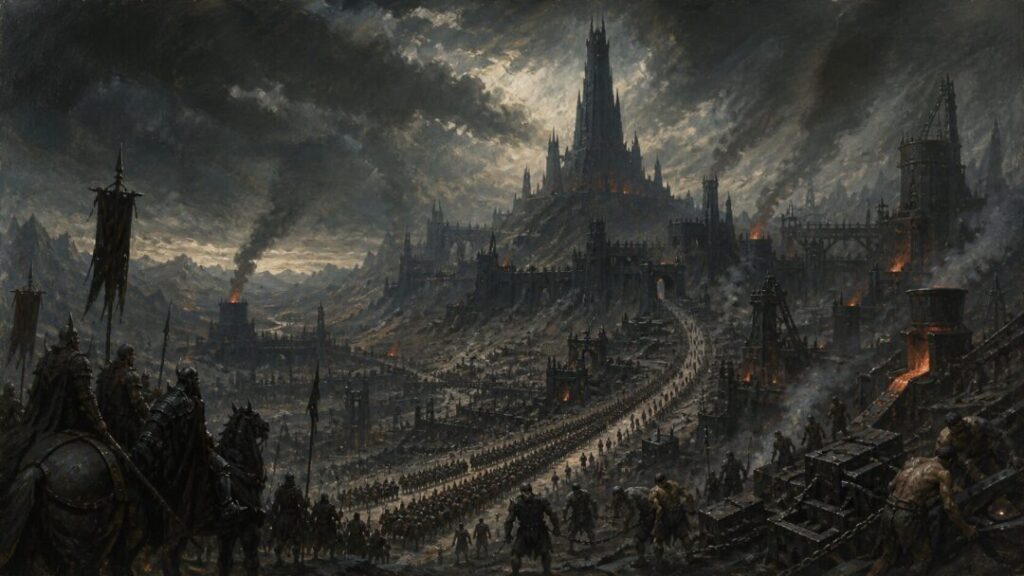
Númenor Shows the Shape of His Victory
Númenor reveals something terrifying about Sauron’s method.
When Ar-Pharazôn came with overwhelming force, Sauron did not defeat him in open battle. He submitted, was taken to Númenor, and then rose through counsel, manipulation, and spiritual corruption.
This matters because it shows that Sauron’s highest weapon was not always military strength.
It was the corruption of desire.
In Númenor, he exploited fear of death, pride, resentment, and the longing for forbidden immortality. He turned the king and many of the Númenóreans away from the old reverence of the One and toward darkness. He did not merely advise political rebellion. He helped twist the religious imagination of a people.
That is more than conquest.
That is spiritual capture.
Sauron’s dream was not complete if people merely paid taxes to him or feared his armies. He wanted their hopes, fears, loyalties, and worship redirected. He wanted to stand between rational creatures and the truth above him.
This is why his desire to be a God-King is so important.
It explains Númenor.
It explains the Ring.
It explains Mordor.
It explains why his rule would have been worse than ordinary tyranny.
He did not only want subjects.
He wanted souls bent toward him.
Mordor Was Not the Goal — It Was the Model
Mordor can make Sauron seem like a lord of ruin only.
Ash plains.
Forges.
Armies.
Slaves.
The Dark Tower.
But Mordor was not simply what Sauron wanted everywhere in a physical sense. The texts do not say that he wished to turn every land into another Gorgoroth. That would be too crude a claim.
What Mordor shows is the structure of his rule.
Everything serves the center.
Everything is organized around the will of the Dark Lord.
No freedom exists except as a tool.
No beauty has value unless it can be possessed, weaponized, or mocked.
No creature matters except in relation to usefulness.
Mordor is Sauron’s order without mercy.
And that is why it is so lifeless.
A world under Sauron might still have fields, roads, cities, mines, harbors, and kings in some places. But all of them would exist beneath one shadow. Their variety would be tolerated only as long as it served him.
The horror is not that Sauron would make every place look identical.
The horror is that every place would mean the same thing.
His.
Why He Feared the Free Peoples
Sauron’s fear in the War of the Ring is also revealing.
He does not imagine that anyone would try to destroy the Ring. His mind turns instead toward the possibility that a powerful enemy might claim it and use it against him.
This is not merely a tactical mistake.
It exposes his worldview.
Sauron understands power as possession. He assumes that anyone with the Ring would eventually seek mastery, because that is what he would do. The idea of renouncing absolute power is almost invisible to him.
That blindness is central to his defeat.
The Wise do not overcome him by becoming a greater Sauron. Frodo does not march to Mount Doom as a new lord of command. The Ring is destroyed through pity, endurance, failure, mercy, and providence — through things Sauron cannot properly measure.
He can understand armies.
He can understand fear.
He can understand ambition.
He can understand treachery.
But he cannot understand the strength of refusing dominion.
That is why the smallest people in the story become the crack in his design.
What Sauron Would Have Become
So what did Sauron hope to become?
Not Morgoth reborn in full.
Not merely king of Mordor.
Not only emperor of Middle-earth.
He hoped to become the unquestioned master of all wills within his reach.
A God-King in desire, though never truly divine.
A Lord of the World in ambition, though never rightful.
A ruler whose authority would extend beyond law into worship, beyond armies into thought, beyond fear into the very structure of civilization.
The One Ring was the crown of that ambition.
It was Sauron’s attempt to make domination permanent, invisible, and absolute.
And that is why the War of the Ring is not only a war against conquest. It is a war against a world where freedom itself would become impossible.
The Real Terror of Sauron
The most frightening thing about Sauron is not that he loved destruction.
It is that he could present domination as order.
He could take the desire for peace and twist it into obedience. He could take the fear of death and turn it into worship of darkness. He could take craft, knowledge, and preservation and bend them toward control.
Sauron’s final dream was a Middle-earth where nothing was allowed to exist for its own sake.
No Shire quietly growing.
No Elven realm preserving beauty freely.
No kingdom of Men ruling under its own law.
No Dwarven halls pursuing their own craft.
No wandering, no refusal, no hidden road beyond his sight.
Only one will.
One throne.
One command.
One shadow over all.
That is what Sauron hoped to become.
And that is why the Ring had to be destroyed, not used.
Because to use it, even against him, was to accept the shape of his dream.
Sources & Notes
- J.R.R. Tolkien, Letter 131 — Tolkien distinguishes Sauron from Morgoth: Sauron began with a love of order and planning, but turned that impulse into domination and the rule of other wills.
- J.R.R. Tolkien, The Silmarillion, “Valaquenta: Of the Enemies” — Sauron is named as a Maia of Aulë who became Morgoth’s greatest servant, connecting his corruption with craft, organization, and power rather than mere chaos.
- J.R.R. Tolkien, The Silmarillion, “Of the Rings of Power and the Third Age” — after Morgoth’s fall Sauron lingers in Middle-earth, assumes fair form, and seeks to order and control the peoples through the Rings.
- J.R.R. Tolkien, The Lord of the Rings, Book I, Chapter 2, “The Shadow of the Past” — the Ring-rhyme and Gandalf’s explanation set out the One Ring’s purpose: to rule, find, bring, and bind the other Rings and their bearers.
- J.R.R. Tolkien, The Silmarillion, “Akallabêth” — Sauron’s rise in Númenor shows his preferred method: becoming the hidden will behind a kingdom, reshaping worship, policy, and fear around himself.