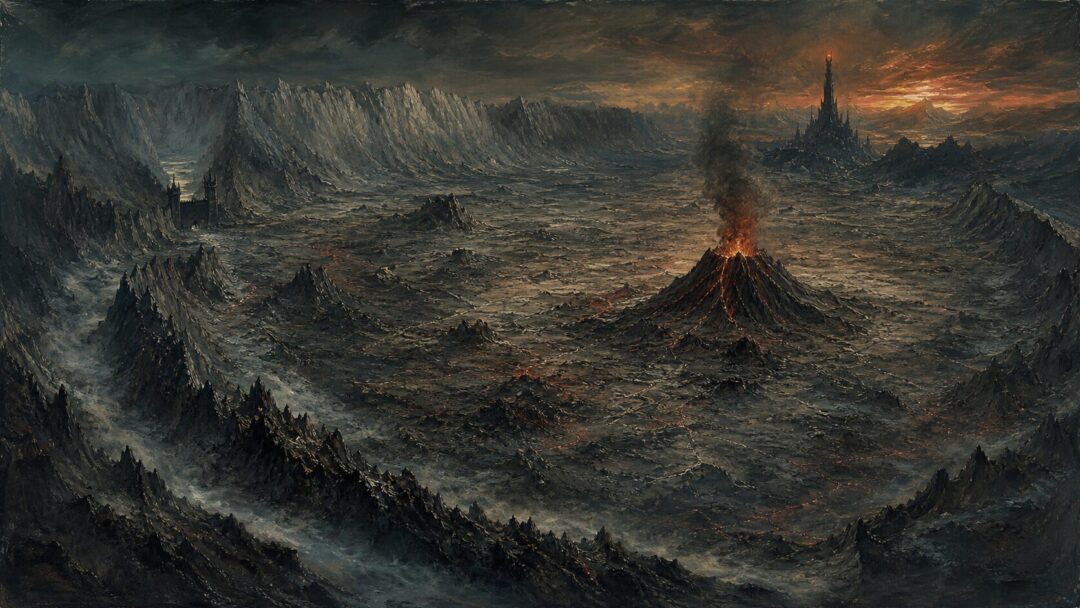
Mordor looks like a land that should not exist by accident.
On the map, it seems almost too perfect. A dark country sealed behind enormous mountain walls. To the north rise the Ered Lithui, the Ash Mountains. To the west and south stand the Ephel Dúath, the Mountains of Shadow. In the northwestern corner, where those ranges nearly meet, lies the terrible entrance of Udûn and the Morannon, the Black Gate.
It feels designed.
Not just defended. Designed.
That is why many readers eventually ask the same question:
Were the mountains around Mordor natural?
Or were they made?
The tempting answer is simple: Sauron must have created them. Mordor is his realm, his fortress, his place of power. The mountains surround it so perfectly that they seem like the walls of a gigantic stronghold.
But the texts do not say that.
And that silence is important.
Because the truth is more subtle, and in some ways more disturbing. Mordor may not be an artificial fortress built from nothing by Sauron. It may be something older: a wounded region of the world that Sauron found, understood, and turned into the heart of his power.
Mordor Is a Fortress — But Not Necessarily a Built One
By the late Third Age, Mordor is one of the most defensible lands in Middle-earth.
Its geography does much of Sauron’s work for him. The western and southern sides are guarded by the Ephel Dúath. The northern side is guarded by the Ered Lithui. These ranges do not merely decorate the border. They shape the entire military reality of the War of the Ring.
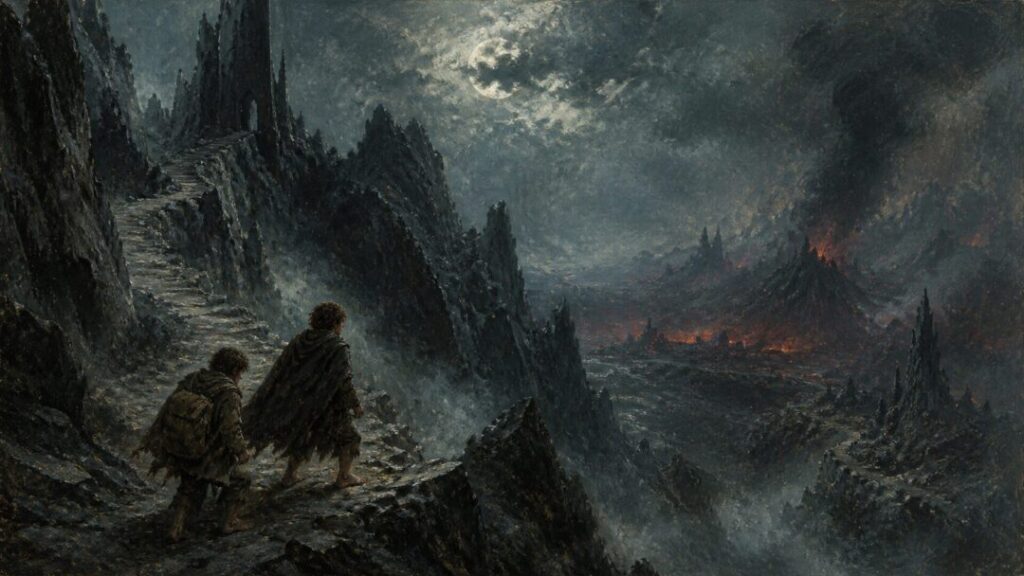
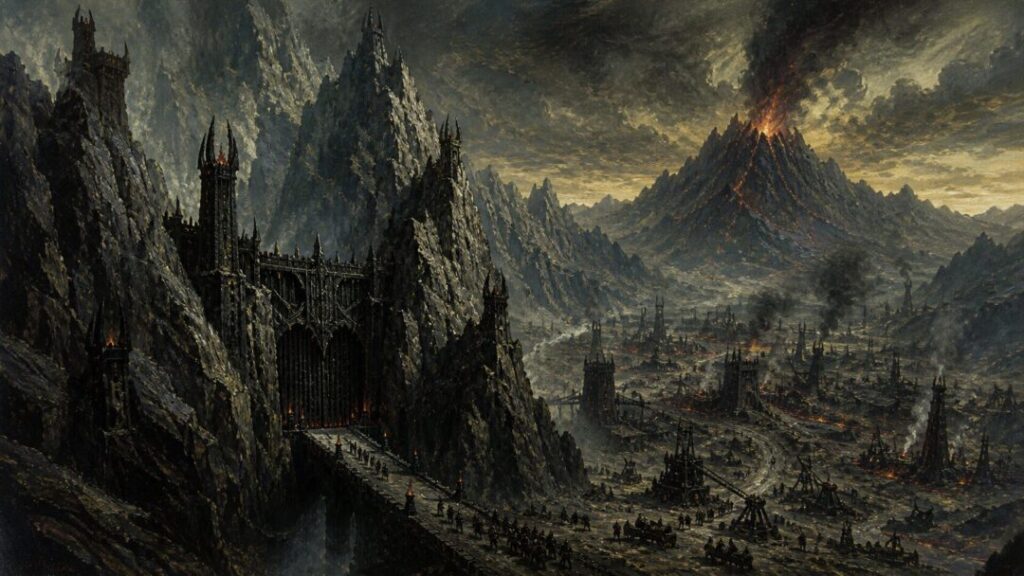
Large armies cannot simply march into Mordor wherever they choose. The main entrance is through the northwestern gap at the Morannon, where Sauron builds the Black Gate and the Towers of the Teeth. Other routes exist, but they are narrow, dangerous, and difficult.
The Morgul Pass leads from Minas Morgul into Mordor. Nearby is Cirith Ungol, the pass above Shelob’s lair, reached by the Straight Stair and the Winding Stair. These are not roads for comfortable travel. They are desperate ways through a hostile mountain wall.
So yes, Mordor functions like a fortress.
But that does not mean the mountains were constructed like fortress walls.
The distinction matters. Sauron fortifies Mordor. He does not, in the known texts, create Mordor’s mountain ranges.
What the Texts Actually Say
The canon gives us strong information about Mordor’s geography, but very little direct explanation of how its mountain borders came to be.
The Ered Lithui are the Ash Mountains, forming Mordor’s northern boundary. They are described as barren, rugged, and ash-grey. The Ephel Dúath form the western and southern boundary, effectively sealing Mordor from three sides when joined with the northern range.
This much is clear.
What is not clearly stated is that Sauron made them.
Sauron’s works are repeatedly described elsewhere: Barad-dûr, the rebuilding of his power, the Black Gate, fortresses, roads, war-machines, slave-worked fields, and the ordering of Mordor into a military and industrial realm. But the mountain ranges themselves are treated as features of the land.
That does not prove they are ordinary in origin. It only means we should not assign them to Sauron without evidence.
The texts are careful about power. When a great being makes or raises something important, the story often tells us. When it does not, we should be cautious.
The Clue Beneath Everything: Mount Doom
The most important piece of the puzzle is not the mountain wall.
It is the volcano inside it.
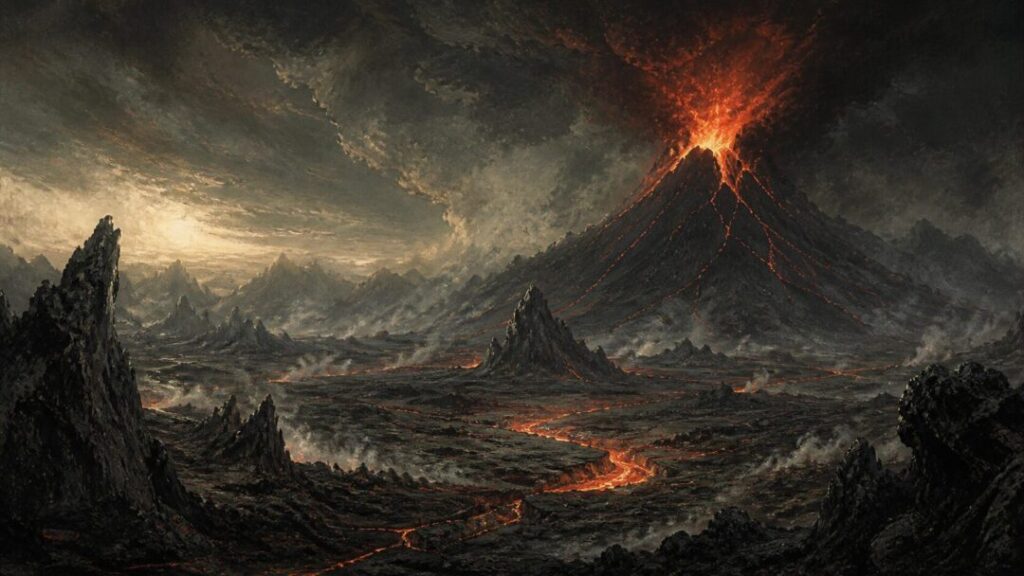
Orodruin, Mount Doom, is the fiery heart of Mordor. Sauron chooses Mordor because of it. He forges the One Ring there because the fire of Orodruin is uniquely tied to his power. When the Ring is destroyed, it is destroyed in the same fire where it was made.
But Orodruin is not presented as Sauron’s creation.
Later Tolkien material connects Mount Doom to Melkor’s ancient destructive works in the First Age. This is a crucial distinction. Sauron uses Orodruin. He depends on it. He binds his own greatest work to it.
But the fire is older than his kingdom.
That means Mordor was not merely a blank piece of land that Sauron turned evil. It already contained a volcanic power connected with the deep ruin of the world.
This does not automatically prove that Melkor made the surrounding mountain ranges. The texts do not state that clearly. But it does mean Mordor’s darkness cannot be explained only by Sauron’s later occupation.
The land had a history before him.
And that history matters.
Sauron Did Not Need to Build the Trap
One of Sauron’s greatest strengths is not raw creation.
It is domination.
He takes what exists and bends it toward his purposes. He does this with peoples, kingdoms, languages, fear, industry, and memory. Mordor’s geography fits this pattern perfectly.
A lesser mind might look at Mordor and see wasteland.
Sauron looked at it and saw a fortress.
The mountain walls already limited invasion. The northwestern gap could be sealed. The passes could be watched. The inner plains could hold armies. The volcanic mountain could serve as the site of his greatest forging. The land of Núrn in the south could be used to feed his forces through the labor of slaves.
None of that requires Sauron to have created the mountains.
It only requires him to recognize what the land already offered.
This is very much in keeping with his character. Sauron is not primarily a maker of living beauty or natural abundance. He is an organizer, a planner, a tyrant of order. Mordor becomes terrifying because its natural defenses are absorbed into his will.
The mountains may have been there before him.
But under him, they become part of a machine.
Natural Does Not Mean Innocent in Middle-earth
Modern readers often divide things into two categories: natural and artificial.
If Mordor’s mountains are natural, we imagine they must simply be normal geology. If they are artificial, we imagine some dark power raised them deliberately.
Middle-earth does not work so cleanly.
The world itself has been wounded. Its lands bear the marks of ancient conflict. Seas have been made by catastrophe. Mountains can be associated with divine or destructive acts. Whole regions are changed by wars far older than the War of the Ring.
So “natural” is a complicated word.
The mountains around Mordor may be natural in the sense that they are part of the geography of Arda, not built stone by stone by Sauron. But that does not make them innocent, ordinary, or untouched by evil.
If Orodruin is linked to Melkor’s ancient ruinous works, then Mordor stands on a deeper foundation of disorder. It is not just Sauron’s land. It is a place where the old damage of the world becomes useful to him.
That is darker than simple construction.
A wall built by Sauron could be knocked down.
A wounded landscape is harder to cleanse.
What About Melkor?
This is where we have to be careful.
It is tempting to say: Melkor made all the mountains of Mordor.
But the texts do not clearly say that.
What we can say is narrower and more accurate: Mount Doom is connected in later writings with Melkor’s ancient works, and Mordor’s landscape appears already suited to darkness before Sauron fully establishes himself there. The surrounding ranges may belong to the same ancient shaping or upheaval, but that remains interpretation, not stated fact.
This distinction is important.
Melkor is responsible for much of the marring of Arda. His violence changes the world at its deepest levels. But not every dark or dangerous place can automatically be assigned to a specific act of his unless the texts say so.
So the best answer is not “Melkor definitely built the mountain walls.”
The better answer is:
Sauron did not make them, as far as the texts tell us. Orodruin’s origin points further back, to Melkor’s marring of the world. The surrounding mountains may be part of that older damaged geography, but the exact origin of the ranges is not directly explained.
That is less dramatic.
It is also more faithful.
Why Mordor Feels Unnatural
Even if the mountains were not artificially created, Mordor still feels unnatural for a reason.
Its geography is almost too useful to evil.
The mountain walls isolate it. The Black Gate controls the major entrance. The inner lands allow Sauron to hide armies, build forges, and command from Barad-dûr. The volcanic heart of the land gives him the fire in which the Ring can be made and unmade.
Mordor is not just a country Sauron occupies.
It becomes an extension of his strategy.
That is why the map feels so disturbing. The land itself seems to cooperate with tyranny. But the deeper horror is that Sauron may not have needed to reshape the world to get this. He only needed to settle in a place where the world was already scarred.
Mordor is not evil because mountains exist around it.
It is evil because ancient fire, barren walls, military design, and Sauron’s will all converge there.
The Mountains as Moral Geography
Middle-earth often uses landscape as more than background.
Rivendell is hidden refuge. Lothlórien is preserved memory. Fangorn is old, watchful, and uneasy. The Dead Marshes remember ancient slaughter. Mordor is the landscape of domination.
The mountains around Mordor matter because they make evil seem enclosed and concentrated. They turn the land into a bowl of shadow. They separate it from Gondor, Ithilien, and the freer lands beyond. They make the journey inward feel like a descent into the center of a wound.
Frodo and Sam do not merely cross a border.
They pass through a barrier that feels spiritual as well as physical.
Cirith Ungol is not just a mountain pass. It is a threshold. Beyond it, the world changes. Air, light, water, hope — everything becomes less generous. The mountains mark that transition.
This is why the question of their origin matters.
If Sauron built them, Mordor is a constructed prison.
If they are older, Mordor is something worse: a prison Sauron found waiting.
So Are They Natural?
The most lore-accurate answer is:
Yes, probably — but not in a simple modern sense.
The Ered Lithui and Ephel Dúath are presented as mountain ranges of Middle-earth’s geography, not as structures Sauron built. There is no clear statement in the main narrative that Sauron created them. His known works are fortifications and strongholds within and around that geography.
At the same time, Mordor is not an ordinary land. Mount Doom is older than Sauron’s rule and is tied to Melkor’s ancient marring of the world. That makes it reasonable to see Mordor as a region shaped, at least in part, by deep primordial violence.
But we should not go beyond the evidence.
The texts do not explicitly tell us who raised the Ash Mountains or the Mountains of Shadow. They do not give a geological history of Mordor’s walls. They leave the question partly open.
And perhaps that is fitting.
Mordor is frightening because it sits between categories. It is natural, but corrupted. Ancient, but weaponized. Geographic, but symbolic. Sauron did not need to invent its darkness from nothing.
He only needed to inhabit it.
The More Disturbing Answer
The mountains surrounding Mordor are not simply “evil walls.”
They are the borders of a land where older damage and later tyranny meet.
Sauron’s genius was not that he created Mordor’s shape. It was that he understood it. He took a land of fire, ash, shadow, and isolation, and made it the center of his war against the West.
That makes Mordor more unsettling, not less.
Because if the mountains were merely built by Sauron, then their meaning would end with him.
But if they belong to the older marring of the world, then Mordor is not just the Dark Lord’s fortress.
It is one of the places where the world itself still bears the memory of its first breaking.
And Sauron, in the end, was not the beginning of that shadow.
He was its heir.
Sources & Notes
- J.R.R. Tolkien, The Lord of the Rings, Book VI, Chapter 2, “The Land of Shadow” — Frodo and Sam’s entry into Mordor presents the Ephel Dúath, Morgai, ash, thirst, and inner desolation as the lived geography of the Dark Land.
- J.R.R. Tolkien, The Lord of the Rings, Book IV, Chapter 8, “The Stairs of Cirith Ungol” — the Morgul-road, Straight Stair, Winding Stair, and pass of Cirith Ungol show Mordor’s western mountains functioning as a dangerous barrier rather than an ordinary road.
- J.R.R. Tolkien, The Lord of the Rings, Book V, Chapter 10, “The Black Gate Opens” — the Morannon and Towers of the Teeth show Sauron fortifying the northwestern gap in Mordor’s natural mountain defenses.
- J.R.R. Tolkien, The Silmarillion, “Of the Rings of Power and the Third Age” — Sauron chooses Mordor, builds Barad-dûr, forges the One Ring in Orodruin, and makes the land the center of his power.
- J.R.R. Tolkien, The Peoples of Middle-earth, “Last Writings” — identifies Orodruin as a relic of Morgoth’s ancient destructive works, supporting the article’s distinction between Sauron’s later use of Mordor and older damage in the world.