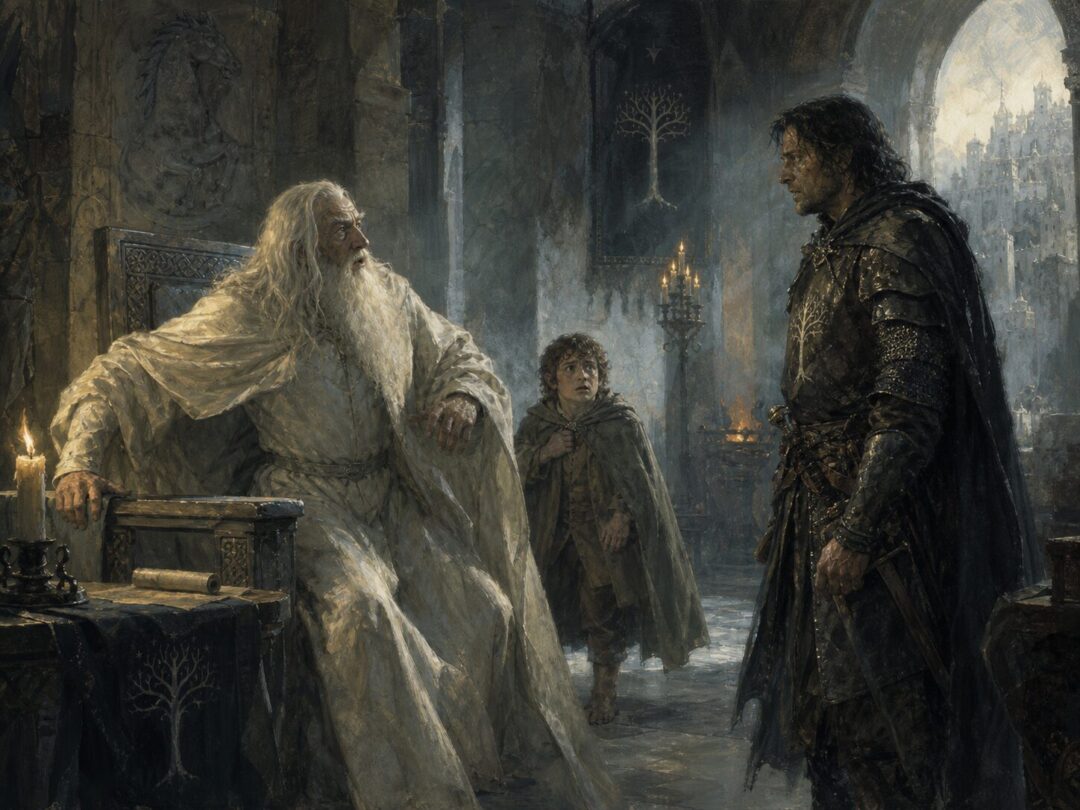
When Faramir reaches Minas Tirith, he brings news that should have comforted Gandalf.
Frodo is alive.
Sam is with him.
The Ring has not been taken by the Enemy.
For a moment, that alone should matter. Against all likelihood, the Quest has continued past the breaking of the Fellowship, past the Emyn Muil, past the Dead Marshes, and even past the Black Gate. Two hobbits are still moving toward Mordor.
But then Faramir names the road.
Cirith Ungol.
And Gandalf’s reaction is immediate.
He springs up. He demands the time. He asks when Faramir parted from them and when they would reach the accursed valley. Pippin sees something deeply unsettling: Gandalf himself is troubled, even afraid.
That reaction can seem strange at first.
After all, what did Gandalf expect? Frodo and Sam had to enter Mordor somehow. The Black Gate was impossible. They had no army, no guide from Gondor, and no open road into the land of Sauron. If they had found another way, should that not have been good news?
But Gandalf is not surprised simply because they are going into Mordor.
He is shaken because of which road they are taking—and who is leading them there.
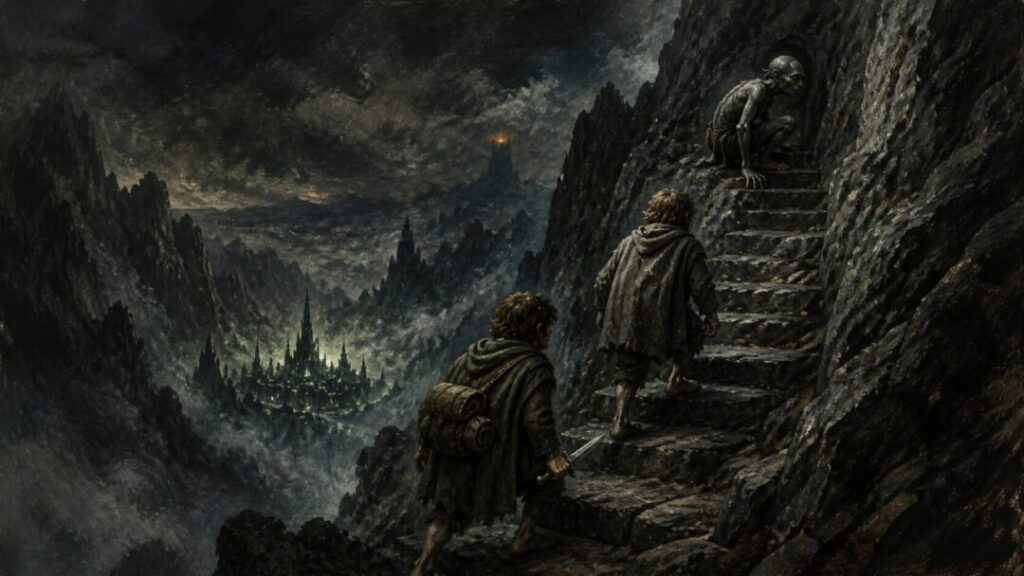
Cirith Ungol Was Not Just Another Pass
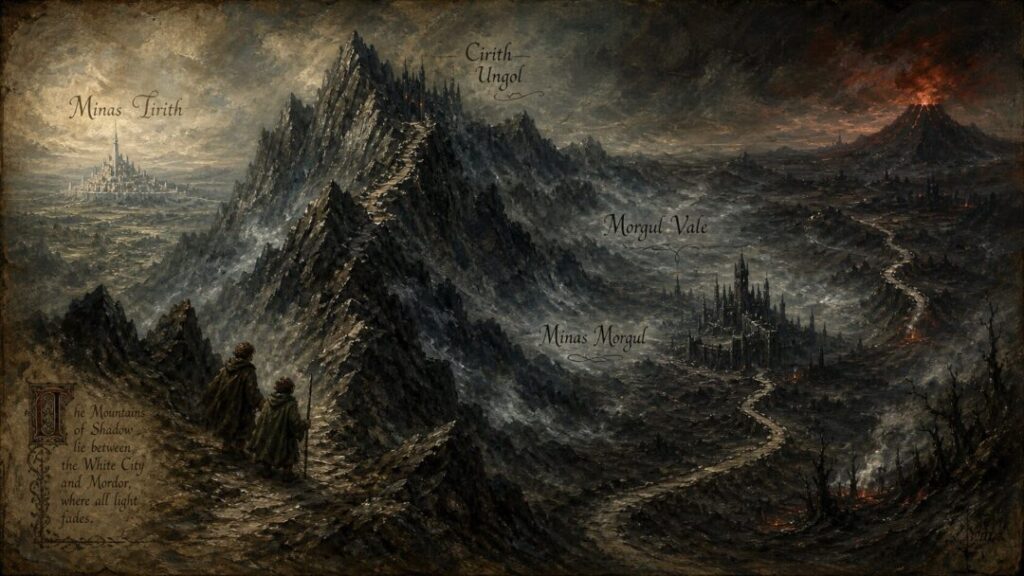
Cirith Ungol was a pass through the Ephel Dúath, the Mountains of Shadow on Mordor’s western border. It lay above the Morgul Vale, near Minas Morgul, the city once known as Minas Ithil before it fell under the power of the Nazgûl.
That already makes the route terrifying.
This was not a forgotten shepherd’s track or a hidden path known only to harmless wanderers. It was a way into Mordor near one of the most dreadful places in the Third Age. Minas Morgul was the city of the Ringwraiths. Its valley was filled with horror, corruption, and watchfulness.
But the name Cirith Ungol carries its own warning.
It means the Cleft of the Spider.
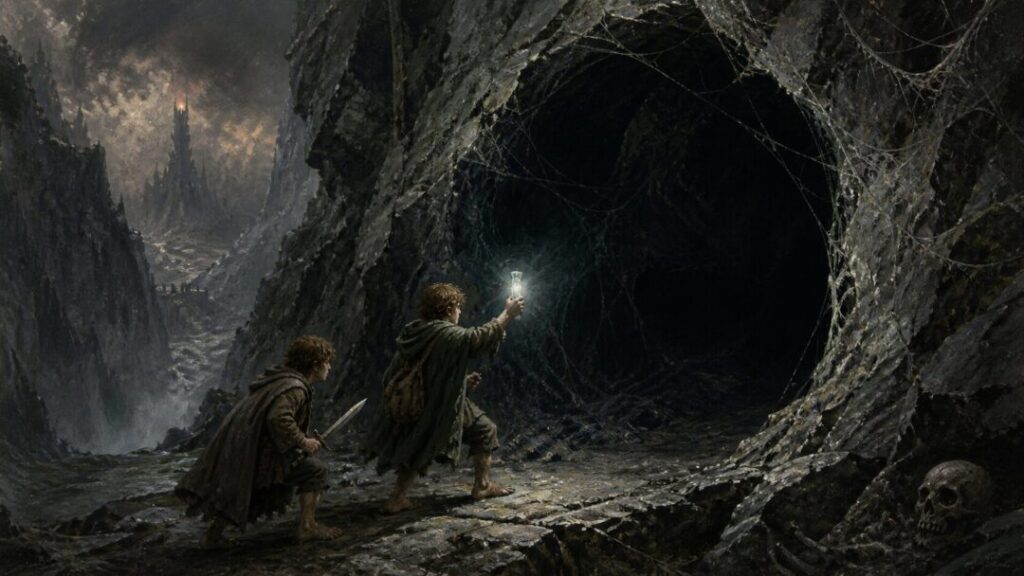
The story later reveals why. The pass is bound to Shelob’s lair, a black and mazelike tunnel in the mountains. Frodo and Sam do not merely climb a dangerous stair. They are led into the hunting-place of an ancient devouring creature who has haunted that region since before Sauron’s return to Mordor in the Third Age.
Gandalf does not pause in Minas Tirith to explain all of this.
That silence matters.
He does not give Pippin a lecture on the geography of Mordor. He does not calmly list the hazards. He reacts like someone who knows the name is enough.
Cirith Ungol is not only dangerous.
It is a place where hope can vanish without a sound.
Faramir Had Already Feared the Road
Gandalf is not the only one disturbed by the route.
Faramir had warned Frodo against it.
When Frodo and Sam are in Ithilien, Faramir learns that Gollum is guiding them toward the pass. Faramir does not claim perfect knowledge of what dwells there. His knowledge is cautious, fragmentary, and based on the dread traditions of Gondor. But he knows enough to be deeply uneasy.
He tells Frodo that people of Gondor do not go that way. He speaks of some dark terror in the passes above Minas Morgul. He does not present Cirith Ungol as a bold but reasonable option. He treats it as a road of ill rumor.
That is important because it shows that the danger of the pass is not hidden only from the Wise.
Even the men who guard Ithilien know something is wrong there.
Faramir does not know everything. The text does not make him an expert on Shelob. But he recognizes that Gollum’s chosen road is dreadful. He warns Frodo as far as he can.
Frodo still goes.
Not because he is reckless. Not because he trusts the place. But because the choices before him have narrowed almost to nothing.
The Black Gate is impossible. The Enemy’s land must be entered. Gollum knows another way.
And so Frodo accepts the road that remains.
Gandalf’s Fear Was About Gollum Too
The deepest part of Gandalf’s reaction is not only the pass.
It is Gollum.
Gandalf had long believed that Gollum still had some role to play before the end. That idea goes back to his conversations with Frodo in the Shire, when he says that Gollum may yet have a part to play, for good or ill. Gandalf does not know exactly how. He does not pretend to control it. But he senses that Gollum’s fate is tied to the Ring’s fate.
By the time Faramir gives his report, that old intuition has become immediate.
Gollum has found Frodo.
Gollum is guiding Frodo.
And now Gollum is leading him to Cirith Ungol.
That combination is what makes Gandalf’s heart almost fail.
Gollum is not merely a pitiful creature in this moment. He is a guide with hidden knowledge, private hunger, and a long history with dark places. The text later confirms that he intends treachery. He leads Frodo and Sam toward Shelob hoping to remove them and recover the Ring for himself.
Gandalf does not know every detail of that plan in Minas Tirith.
The text does not say he knows exactly what Gollum has promised, imagined, or intended. But he fears treachery at once. That fear is not random. It is based on what he knows of Gollum’s divided nature and on the dreadful significance of the road.
Cirith Ungol makes Gollum’s guidance look less like help.
It looks like a trap.
Why Gandalf Asks About the Time
One of the most revealing parts of the scene is Gandalf’s first question.
He does not ask, “Why would they go there?”
Not at first.
He asks about the time.
When did Faramir part from them? When would they reach the Morgul Vale?
This shows that Gandalf’s fear is practical as well as spiritual. He is trying to measure whether Frodo and Sam have already reached the danger. He is calculating distance, timing, and the movement of events.
At that same moment, Gondor is under the shadow of Sauron’s assault. The darkness has spread. War is coming openly. Minas Tirith is preparing for siege. The great moves of the Enemy are no longer hidden.
For a terrible instant, Gandalf seems to fear that Frodo’s approach to Cirith Ungol may be connected with the sudden darkness or the Enemy’s timing.
Faramir answers that the assault must have been planned before the hobbits left his keeping. This matters. It prevents a false conclusion. Sauron’s war did not begin because Frodo approached the pass.
But the timing is still dreadful.
Frodo and Sam are moving toward one of the worst places in Mordor at the very hour when Sauron’s strength is breaking against Gondor.
No one can go after them.
No rescue can be sent.
No message can reach them.
That is why Gandalf asks for the time. He is not merely frightened by a name. He is realizing how little time may remain.
Did Gandalf Know About Shelob?
The safest answer is this:
Gandalf clearly knew Cirith Ungol was a place of terrible danger, but the text does not give us a full inventory of exactly what he knew or when he learned it.
The name itself points toward the Spider. The pass is later revealed to contain Shelob’s lair. Gandalf’s refusal to speak of Cirith Ungol that night suggests that the matter is too dark, too urgent, or too painful to explain casually to Pippin.
But the story does not have Gandalf say, “I know Shelob is there.”
So we should be careful.
It is reasonable to read Gandalf’s fear as including knowledge, rumor, or suspicion of the horror associated with the pass. It is also reasonable to say he recognizes Cirith Ungol as a place of ancient evil and likely treachery. But claiming that he knew every detail of Shelob’s role would go beyond what the scene directly states.
What matters is not whether Gandalf knows the entire trap.
What matters is that he knows enough.
The pass. The Morgul Vale. Gollum. The Ring. The timing.
Together, they form a pattern he cannot ignore.
Gandalf Had No Safe Plan for Mordor
There is another misunderstanding hidden in the question.
When people ask why Gandalf was surprised, they sometimes assume he must have had a better route in mind.
But the story never gives us a clear alternate road that Gandalf expected Frodo to take.
The Council of Elrond chooses the goal, not a fully mapped path to the Fire. The Fellowship sets out with guidance as far as it can be given, but the Quest is always uncertain. Even before the Fellowship breaks, Gandalf does not unfold a complete plan for entering Mordor and crossing Gorgoroth.
That uncertainty is essential.
The Quest is not a military operation with reliable stages. It is a desperate errand built on secrecy, endurance, mercy, and providence. Frodo’s road cannot be fully planned by the Wise because the very success of the Quest depends on moving beneath Sauron’s expectations.
So Gandalf’s reaction is not the shock of a strategist whose neat plan has been disrupted.
It is the fear of someone who knows there may never have been a safe way—and now sees that the way chosen is one of the darkest imaginable.
“Why That Way?”
Later, Gandalf wonders why Frodo has gone by that road.
That question is not ignorance in a simple sense. It is grief, fear, and recognition all at once.
Why that way?
Because the Black Gate was shut.
Because Gollum knew another path.
Because Frodo had sworn to continue.
Because mercy had spared Gollum.
Because the whole fate of the Ring had entered a region where wisdom could no longer command the outcome.
This is the terrible beauty of the moment. Gandalf is wise enough to see the danger, but not powerful enough to prevent it. He can understand the pattern, but he cannot step into it. He can fear Gollum’s treachery, but he also remembers that a traitor may betray himself and do good he did not intend.
That is one of the deepest truths in the War of the Ring.
Evil is real. Treachery is real. Gollum means harm.
And yet harm can be turned.
Not by pretending evil is good, but by allowing for a providence beyond the designs of the powerful.
Gandalf’s Surprise Is Really a Moment of Helplessness
Gandalf is often the figure who explains things.
He knows old histories. He recognizes ancient powers. He understands the Ring better than almost anyone in Middle-earth. When others are confused, Gandalf often sees farther.
But at this moment, seeing farther only makes the pain worse.
He understands enough to be afraid.
He understands enough to know no help can come.
He understands enough to recognize that the Quest has passed beyond the reach of armies, councils, and even wizards.
Frodo and Sam are not just walking into Mordor.
They are walking into a place where every visible hope may fail.
And the only remaining hope is the kind Gandalf has trusted from the beginning: pity, endurance, and the strange possibility that evil may overreach itself.
Why the Scene Matters
Gandalf’s reaction to Cirith Ungol is not a small moment of surprise.
It is one of the clearest signs of how desperate the Quest has become.
The Wise cannot manage it anymore.
Gondor cannot protect it.
Faramir can only warn and let Frodo go.
Gandalf can only listen, tremble, calculate the time, and fear treachery.
Yet he does not abandon hope completely.
That is the key.
Cirith Ungol horrifies him because he knows what kind of road it is. But Gollum’s presence, dreadful as it is, also belongs to a pattern Gandalf has never dismissed. Gollum may intend evil. He may lead Frodo into darkness. He may betray him.
But even a traitor may betray himself.
That is why Gandalf’s fear does not cancel the Quest.
It reveals what the Quest has become.
Not a march of strength into Mordor.
Not a clever road chosen by the Wise.
But a final passage through terror, pity, and chance, where the fate of the world depends on two hobbits, a treacherous guide, and a mercy shown long before anyone understood its cost.
Gandalf is surprised by Cirith Ungol because he hears, in that name, almost everything that could go wrong.
And still, hidden inside that fear, is the one thing Sauron cannot see.
The road to ruin may also be the road by which the Ring is finally undone.
Sources & Notes
- J.R.R. Tolkien, The Lord of the Rings, Book V, Chapter 4, “The Siege of Gondor” — Faramir tells Gandalf that Frodo is going by Cirith Ungol; Gandalf springs up, asks the time, and fears that Gollum may prove treacherous.
- J.R.R. Tolkien, The Lord of the Rings, Book IV, Chapter 6, “The Forbidden Pool” — Faramir warns Frodo against the pass of Cirith Ungol and speaks from Gondor’s dread traditions rather than full knowledge.
- J.R.R. Tolkien, The Lord of the Rings, Book IV, Chapter 3, “The Black Gate Is Closed” — shows why Frodo and Sam cannot enter Mordor by the Morannon and why Gollum’s secret way becomes tempting.
- J.R.R. Tolkien, The Lord of the Rings, Book IV, Chapters 8–9, “The Stairs of Cirith Ungol” and “Shelob’s Lair” — reveal the pass, the Morgul road, and Gollum’s plan to lead the hobbits to Shelob.
- J.R.R. Tolkien, The Lord of the Rings, Book I, Chapter 2, “The Shadow of the Past” — Gandalf’s warning that Gollum may still have a part to play, for good or ill, underpins the article’s providence-and-pity reading.