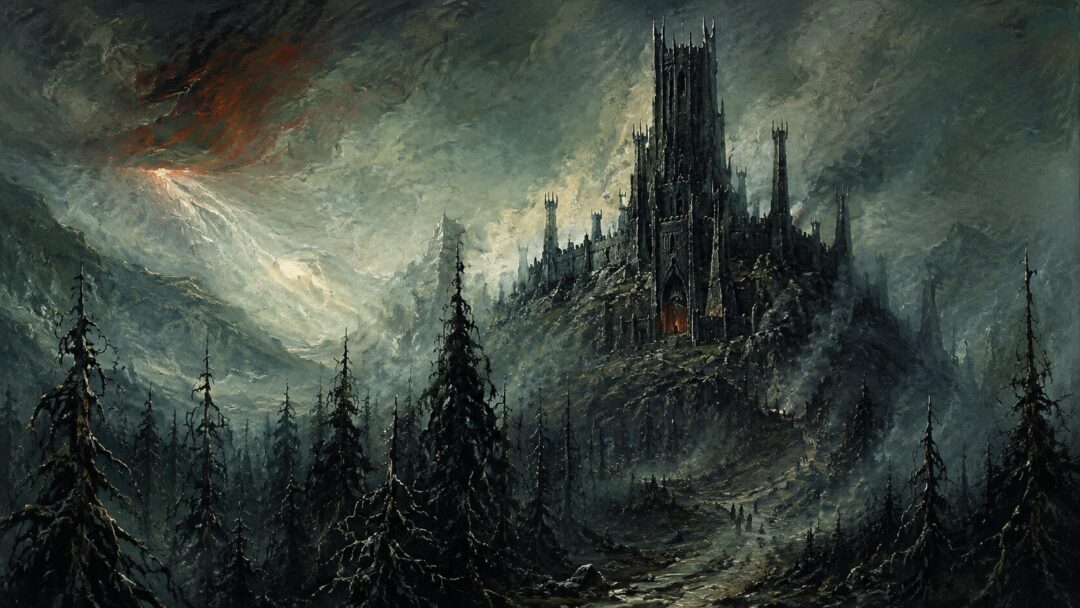
Most people hear the word “Necromancer” and think they already understand it.
A dark lord.
A forbidden art.
An army of corpses pulled from the earth.
So when Sauron is called “the Necromancer,” it is easy to imagine him as a kind of grave-sorcerer, raising the dead in the manner of later fantasy stories.
But Middle-earth is more precise than that.
The name does not simply mean that Sauron commands skeletons or summons dead bodies to war. The texts never present him doing that in any straightforward way. There is no scene where he opens graves and sends an army of corpses marching through Mirkwood.
And yet the title is still deeply fitting.
In fact, once the older meaning of the name is understood, “the Necromancer” becomes one of the most chilling titles Sauron ever bears.
Because it points not only to death.
It points to domination beyond death.
The Name First Appears as a Rumor
In The Hobbit, the Necromancer is not introduced with a full explanation.
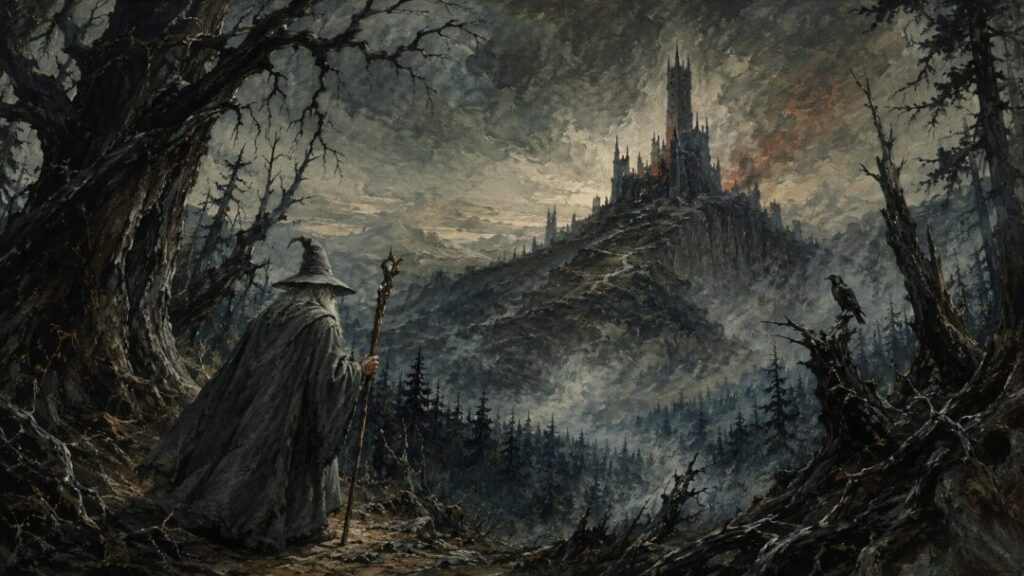
He is a shadowy presence in the south of Mirkwood. Gandalf speaks of dangerous lands connected to him. Later, we learn that Gandalf had been away at a council of the Wise, and that they had driven the Necromancer from his dark hold.
At that point in the story, the name is mysterious.
The Necromancer is not yet openly named as Sauron. The reader is not given a grand history of the Second Age, the Rings of Power, or the Last Alliance. He is simply a dark power haunting the edges of the adventure.
That matters.
Bilbo’s story is not centered on Sauron, but Sauron’s shadow is already there. While Thorin’s company is concerned with trolls, goblins, spiders, Elves, and a dragon, a far older evil is quietly gathering strength in the background.
The name “Necromancer” belongs to that hidden phase.
Not the Sauron of Barad-dûr.
Not the Sauron openly ruling Mordor.
Not the Eye whose servants march beneath banners of war.
This is Sauron before the open declaration.
Sauron as rumor.
Sauron as sorcery.
Sauron as a shadow in the forest.
Dol Guldur Was the Perfect Place for That Name
The Necromancer’s stronghold was Dol Guldur, in southern Mirkwood.
The name Dol Guldur means “Hill of Sorcery,” which already tells us how the place was understood. This was not merely a fortress. It was associated with dark arts, secrecy, fear, and corruption.
Before the shadow came, the forest had been Greenwood the Great. But as the evil presence grew, the forest became darkened and feared, and it came to be known as Mirkwood.
The texts do not describe every detail of what Sauron did there. That restraint is important. Dol Guldur is frightening partly because so much is left unseen.
We know enough to understand its role.
It was a hiding place.
It was a place of gathering strength.
It was a northern stronghold from which Sauron could watch, wait, and influence events without openly revealing himself.
And for a long time, the Wise were not certain who its master truly was.
That uncertainty is exactly why “the Necromancer” works as a title. It conceals more than it explains. It names the terror people feel without yet naming the being behind it.
They do not say, at first, “Sauron has returned.”
They say something worse in another way:
There is a sorcerer in the forest.
Gandalf Discovered the Truth
The mystery did not remain forever.
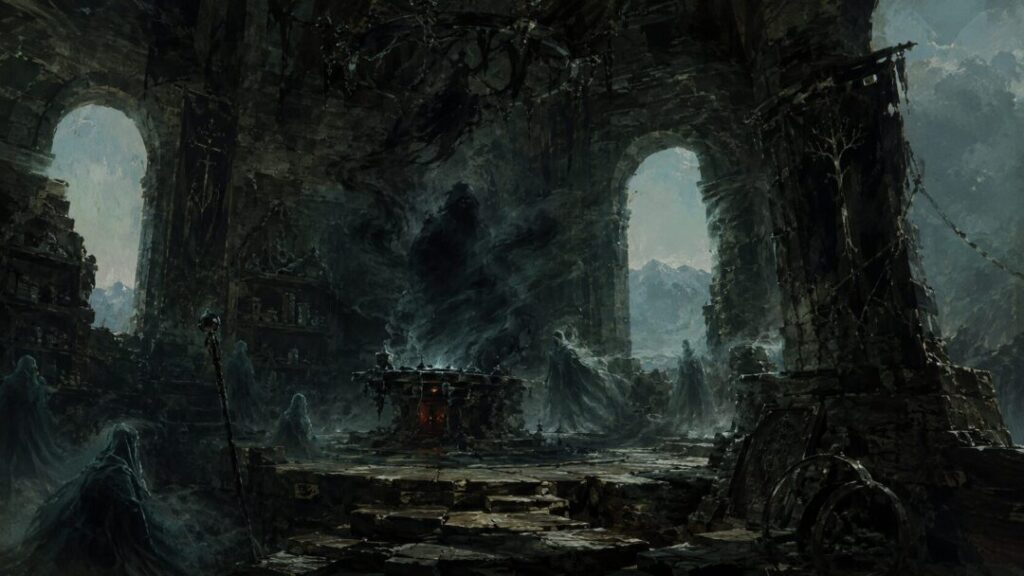
Gandalf entered Dol Guldur more than once. The first time, the hidden power withdrew, avoiding discovery. Later, Gandalf returned and learned that the master of Dol Guldur was indeed Sauron.
This is one of the key points.
The Necromancer was not a lesser sorcerer.
He was not one of the Nazgûl.
He was not some independent dark magician of Mirkwood.
He was Sauron himself, slowly rebuilding power after the loss of the One Ring and the defeat at the end of the Second Age.
But Sauron was not yet ready to declare himself openly. His return to Mordor, his rebuilding of Barad-dûr, and his open claim as the Dark Lord came later.
So the title “Necromancer” belongs to a particular moment in his history.
It is the name of Sauron before the mask is removed.
But Did Sauron Raise the Dead?
This is where the common misunderstanding begins.
In many modern fantasy settings, a necromancer is someone who animates corpses. That is not the clearest fit for Sauron in the texts.
There is no direct account of Sauron raising dead bodies into an undead army.
Middle-earth does contain spirits, wraiths, phantoms, barrow-wights, the Dead Men of Dunharrow, and other beings connected to death or the Unseen. But the texts are careful about what they show, and they do not give Sauron a simple “corpse army” scene.
So if we want to be lore-accurate, we have to say this carefully:
Sauron is called the Necromancer not because the books show him raising skeletons, but because his power is deeply bound to sorcery, shadows, phantoms, fear, and the domination of beings caught between the seen and unseen worlds.
That is more subtle.
It is also more disturbing.
Sauron Was a Master of Shadows and Phantoms
Long before the Third Age, Sauron was already associated with dreadful sorcery.
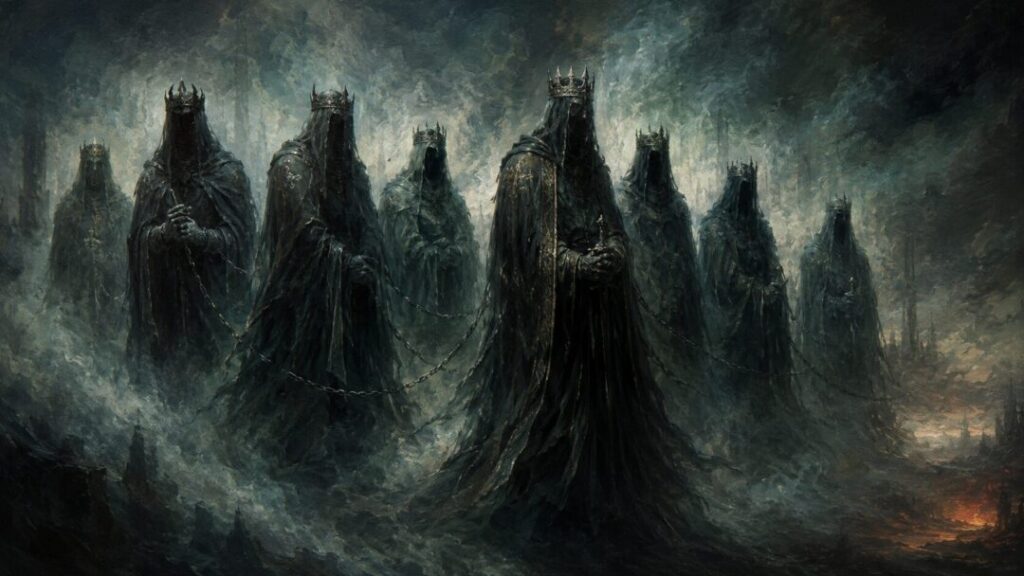
In the Elder Days, he is described as a sorcerer of terrible power and a master of shadows and phantoms. That phrase is one of the most important clues to the title “Necromancer.”
Sauron’s evil is not merely physical.
He does not rule only by armies, towers, and weapons. He rules by deception, terror, illusion, spiritual pressure, and the twisting of wills.
He corrupts.
He dominates.
He ensnares.
His power reaches into the inner life of beings. It does not simply destroy the body. It seeks to master the will.
That is why “Necromancer” fits him even without a scene of graveyards opening.
In Middle-earth, the deepest horror is often not death itself.
It is the refusal to let created things remain free, whole, and rightly ordered.
Sauron’s sorcery is the art of possession in the broadest sense: turning others into instruments of his own will.
The Ringwraiths Are the Clearest Example
The Nazgûl are not dead men in the ordinary sense.
They were once mortal Men who received the Nine Rings. Through those Rings, they gained power and long life, but they also faded. Over time, they became invisible to mortal eyes and were drawn into the wraith-world, enslaved to Sauron through the power of the One Ring.
This is perhaps the strongest reason the title “Necromancer” feels so fitting.
Sauron did not simply kill these Men.
He made them endure.
He stretched them beyond mortal life, hollowed them out, and bound them to himself. They became not living kings in any natural sense, and not dead in the peaceful sense either.
They became Ringwraiths.
That is worse than an army of corpses.
A corpse has ended.
A wraith remains.
The Nazgûl show Sauron’s true horror: he does not only conquer kingdoms. He can take the fear of death, the hunger for power, the desire to endure, and turn those things into chains.
The Nine are not proof that Sauron practiced necromancy in the simplistic “raising zombies” sense.
They are proof that his dominion reaches into the borderland between life, death, spirit, and shadow.
Necromancy in Middle-earth Is a Spiritual Crime
There is another important distinction.
In Middle-earth, death is not merely biological. The fate of spirits matters. The dead are not simply raw material to be used.
Attempts to summon, command, or manipulate spirits are treated as dangerous and wicked. The idea of calling on the dead, especially in order to master them or force them into service, belongs to the same moral world as Sauron’s other crimes.
This is why the title “Necromancer” carries such weight.
It does not need to mean that Sauron dug up bodies.
It means that his sorcery was associated with the forbidden handling of spirits, shadows, and phantoms. It places him in opposition to the natural order of life and death.
Sauron’s deepest desire was control.
Control over kingdoms.
Control over wills.
Control over fear.
Control over the very powers that should remain beyond the grasp of domination.
That is what makes him the Necromancer.
The Name Also Protected His Secret
There is a practical reason for the title as well.
For many years, Sauron’s identity was not openly known.
Calling him “the Necromancer” allowed the peoples of Middle-earth to speak of the danger without fully understanding it. It was a name for the evil they could sense, but not yet explain.
This is important because Sauron’s return was not immediate and obvious.
After his defeat at the end of the Second Age, he needed time to take shape again, gather strength, and prepare. Dol Guldur allowed him to work from concealment.
The Wise feared that the Necromancer might be Sauron, but certainty came later.
So the title is both accurate and incomplete.
It describes what people perceived: dark sorcery in Mirkwood.
But it hides the larger truth: the ancient enemy had returned.
Why Not Simply Call Him Sauron?
Because names carry knowledge.
To say “Sauron” is to understand the scale of the danger. It recalls the Rings of Power, Númenor, the Last Alliance, Mordor, and the long wars of the Second Age.
But “the Necromancer” is different.
It is local.
It is whispered.
It belongs to fear before certainty.
That makes it narratively powerful. The name lets the shadow enter the story before the full darkness is revealed.
In The Hobbit, Bilbo does not need to know the entire history of Sauron for the name to work. He only needs to know that there is something dreadful in the south of Mirkwood—something even Gandalf treats seriously.
The reader feels the edge of a larger world.
Later, when the truth is revealed, the old name becomes more frightening, not less.
Because now we understand that the “Necromancer” was never a side-threat.
He was the Dark Lord returning.
The Title Reveals Sauron’s Real Nature
Sauron is often imagined as a distant tyrant, a flaming Eye, or the lord of vast armies.
But “the Necromancer” reminds us that his power is older and stranger than military force.
He is not merely a warlord.
He is a sorcerer.
He is a deceiver.
He is a maker of wraiths.
He is a master of shadows and phantoms.
His ultimate weapon is not death.
It is enslavement.
That is why the title is so unsettling. Death, in Middle-earth, is not always the worst fate. There are things worse than dying: fading, being bound, losing oneself, becoming an extension of another will.
The Ringwraiths embody that terror.
They are what happens when Sauron’s promise of power succeeds.
What the Name Really Means
So why is Sauron called “the Necromancer”?
Because in the Third Age, while hidden in Dol Guldur, he was known not as the Dark Lord openly returned, but as a mysterious sorcerer whose power was associated with shadows, phantoms, and dread.
Because his ancient arts were not merely political or military, but spiritual.
Because his greatest servants, the Ringwraiths, show his ability to draw mortal beings away from natural life and into a state of enslaved, death-like existence.
And because his evil always reaches beyond conquest.
Sauron does not only want subjects.
He wants possession.
The title “Necromancer” is not a mistake, and it is not just an early placeholder for a villain whose identity had not yet been revealed. Within the world of Middle-earth, it names a real part of what Sauron is.
He is the enemy who does not merely kill.
He binds.
He twists.
He shadows.
He makes wills into instruments.
And that is why the name is so much darker than it first appears.
The Necromancer is not frightening because he raises the dead.
He is frightening because he refuses to let anything truly be free.
Sources & Notes
- J.R.R. Tolkien, The Hobbit, Chapter 7, “Queer Lodgings” — Gandalf’s warning about the Necromancer in southern Mirkwood establishes the name first as rumor and hidden menace rather than open Sauron lore.
- J.R.R. Tolkien, The Lord of the Rings, Appendix B, “The Tale of Years” — the Third Age chronology traces the Wise discovering Dol Guldur, Gandalf learning that its master is Sauron, and the White Council driving him out.
- J.R.R. Tolkien, The Silmarillion, “Of the Rings of Power and the Third Age” — Sauron’s secret return at Dol Guldur as the Necromancer explains why the title belongs to his concealed rebuilding of power.
- J.R.R. Tolkien, The Silmarillion, “Of Beren and Lúthien” — Sauron is described as a sorcerer of dreadful power and master of shadows and phantoms, supporting the article’s emphasis on sorcery rather than simple corpse-raising.
- J.R.R. Tolkien, The Lord of the Rings, Book I, Chapter 2, “The Shadow of the Past” — Gandalf’s account of the Nine becoming Ringwraiths shows Sauron’s power to prolong, fade, and enslave mortal lives through the Rings.
- J.R.R. Tolkien, Morgoth’s Ring, “Laws and Customs among the Eldar” — Tolkien treats necromancy as the perilous summoning or manipulation of houseless spirits, a useful backdrop for Sauron’s crimes against the freedom of wills.