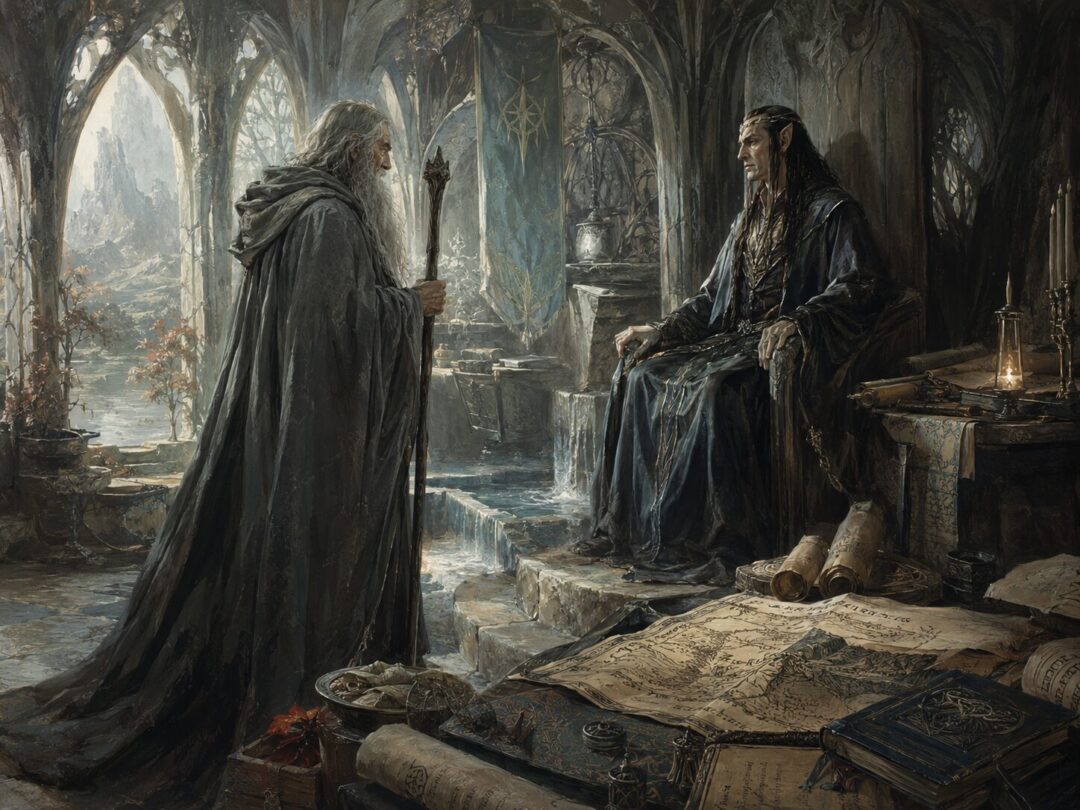
At first glance, Gandalf’s respect for Galadriel and Elrond seems easy to explain.
They are ancient.
They are wise.
They are powerful.
They rule two of the greatest remaining Elven refuges in Middle-earth.
But that answer is too simple.
Because Gandalf is not merely an old wanderer with a staff. He is one of the Istari, sent into Middle-earth in the form of an old man, but belonging by nature to a higher order of being than Elves or Men. The texts identify him, in his true identity, as Olórin, one of the Maiar.
So the question becomes stranger.
If Gandalf is, by nature, greater than any Elf, why does he so often treat Galadriel and Elrond with such deep respect?
Why does he move through Rivendell and Lothlórien not as a superior power, but as a guest, counselor, and friend?
The answer is not that Gandalf forgets what he is.
It is that he understands exactly what he was sent to be.
Gandalf Was Not Sent to Rule
The first key to Gandalf’s reverence is his mission.
The Wizards were not sent to Middle-earth to dominate Sauron by force. They were sent to oppose him by counsel, encouragement, and the awakening of resistance among the peoples of Middle-earth. Their task was not to seize authority, build kingdoms, or replace the rulers of Elves and Men.
This matters because it explains Gandalf’s entire posture.
He does not come to Rivendell as a lord demanding obedience.
He does not enter Lothlórien as a master of hidden powers.
He works through trust.
He advises.
He warns.
He kindles courage.
He helps others do what they must do.
That is why his respect for Elrond and Galadriel is not politeness. It is part of the moral structure of his role. Gandalf’s wisdom shows itself precisely in his refusal to treat his power as a license to command.
Saruman fails in almost the opposite way.
Saruman wants order under his own mind. Gandalf seeks cooperation among free peoples. Saruman studies the devices of the Enemy and grows drawn toward mastery. Gandalf resists mastery, even when authority is offered to him.
That difference explains much of why Galadriel trusted him.
Galadriel Saw What Others Missed
When the White Council was formed, Galadriel wanted Gandalf to be its head.
This is one of the clearest signs of the regard between them.
But Gandalf refused the position. He did not want a fixed office or the burden of command. Saruman became head instead.
That moment is easy to overlook, but it reveals something important. Galadriel, one of the greatest of the Eldar remaining in Middle-earth, recognized Gandalf’s wisdom and wanted him to lead the Wise.
Gandalf, in turn, did not grasp at that honor.
Their relationship is built on mutual recognition, not hierarchy.
Galadriel sees Gandalf’s true worth. Gandalf sees hers.
And what he sees in her is not merely beauty or majesty. Galadriel is one of the few remaining figures in Middle-earth whose memory reaches back into the Elder Days. She was born in the Undying Lands before the Exile of the Noldor and endured the long griefs of the ages that followed.
By the end of the Third Age, very few in Middle-earth carry that kind of memory.
Galadriel is not simply old.
She is a living witness to the deep history of the Elves: their glory, their pride, their losses, and their long struggle against the Shadow.
Gandalf understands the weight of that.
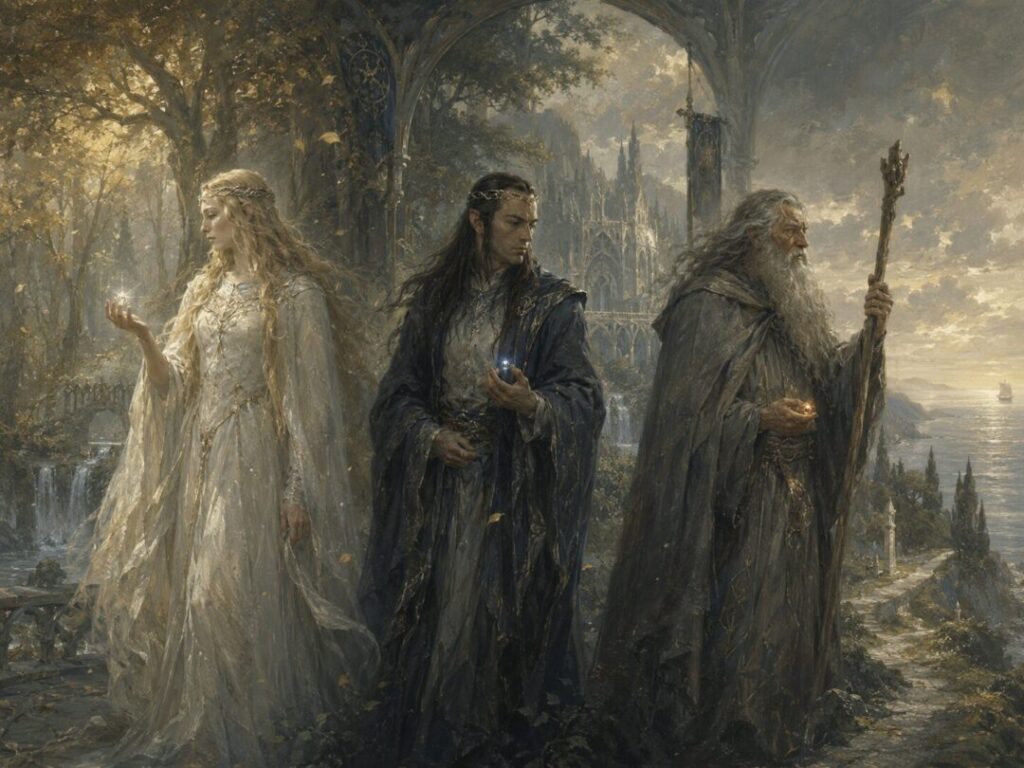
Elrond Is More Than the Lord of Rivendell
Elrond’s authority is quieter than Galadriel’s, but no less profound.
He is often remembered as the wise lord of Rivendell, the keeper of a hidden house of healing, lore, and counsel. But his place in the history of Middle-earth is much deeper than that.
Elrond was born at the end of the First Age, descended from both Elves and Men. Through him converge some of the greatest houses and tragedies of the Elder Days. He is the brother of Elros, who became the first king of Númenor. He served as herald to Gil-galad, the last High King of the Noldor in Middle-earth, and he was present in the age of the Last Alliance against Sauron.
So when Gandalf comes to Rivendell, he is not entering the home of a decorative Elven lord.
He is entering one of the last centers of memory and wisdom left in the world.
Rivendell is not powerful in the way Mordor is powerful. It does not conquer or threaten. Its strength lies in preservation: lore, healing, counsel, and refuge.
That is why the Council of Elrond could happen there.
Not because Elrond had worldly dominion over all the guests who came, but because Rivendell was one of the few places where the free peoples could gather under wisdom rather than ambition.
Gandalf respects Elrond because Elrond has spent ages doing one of the hardest things in Middle-earth:
holding a place of peace open while history darkens around it.
The Three Rings Change Everything
There is another reason Gandalf’s reverence for Galadriel and Elrond feels so deep.
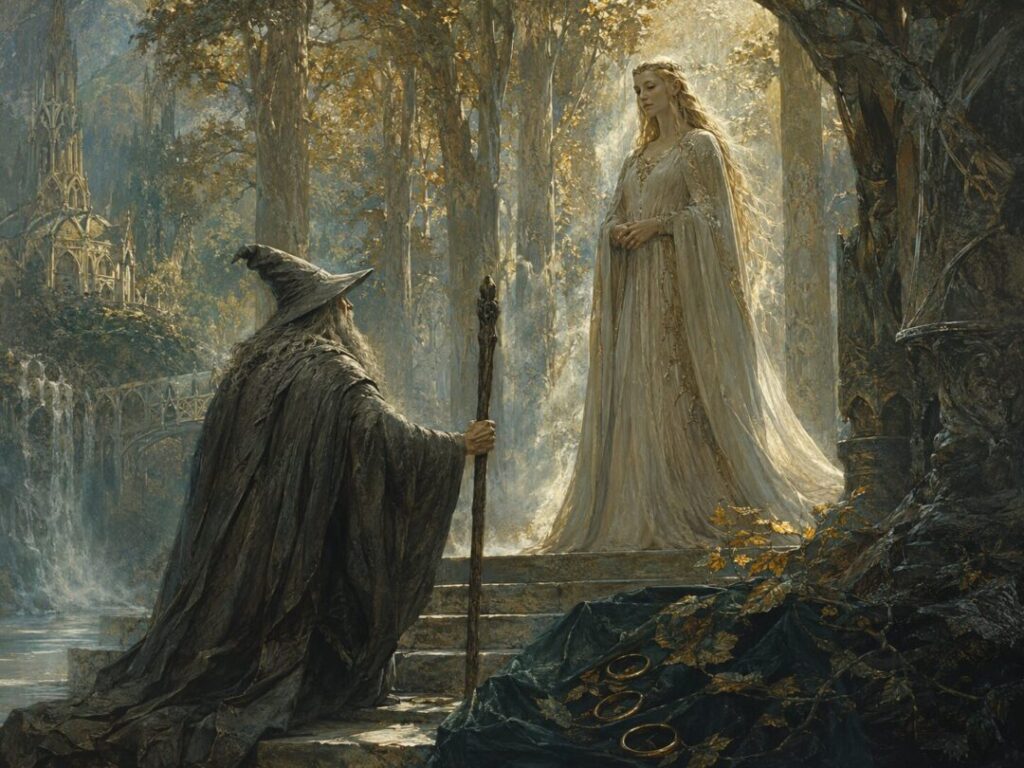
All three are Keepers of the Three Rings.
Galadriel bears Nenya, the Ring of Adamant.
Elrond bears Vilya, the Ring of Sapphire.
Gandalf bears Narya, the Ring of Fire.
This does not make them identical, and the texts do not give us a neat list of exact powers for each Ring. We should be careful not to invent details beyond what is stated or strongly implied.
But the broader role of the Three is clear.
They were not made as weapons of conquest. They were associated with preservation, resistance to decay, and the sustaining of beauty and memory in a world growing weary.
That is crucial.
Galadriel’s Lothlórien and Elrond’s Rivendell are not merely beautiful because Elves enjoy beautiful places. They are refuges against time, loss, and the spreading Shadow. The Three Rings are deeply connected to that work of preservation.
And Gandalf knows this from the inside.
He too carries one of the Three.
Narya was given to him by Círdan, who perceived that Gandalf would need it for the heavy labor before him. Its purpose is connected with kindling hearts and resisting weariness.
So Gandalf’s reverence for Galadriel and Elrond is not the awe of an outsider.
It is the respect of one bearer for others who carry a related burden.
They are not simply rulers.
They are guardians of what remains.
Galadriel’s Power Is Not the Same as Sauron’s
One of the most important scenes for understanding Galadriel comes when Frodo offers her the One Ring.
Her refusal is not casual.
She imagines what she might become if she took it: a queen, beautiful and terrible, worshiped and feared. Then she rejects the temptation and says she will diminish, go into the West, and remain Galadriel.
This moment reveals why Gandalf’s respect for her is so meaningful.
Galadriel is not innocent of ambition. The texts do not present her as a simple, untouched figure who never desired greatness. Her greatness lies partly in the fact that she can recognize the temptation and refuse it.
That is very different from Saruman.
Saruman rationalizes domination. Galadriel sees its horror.
Gandalf reveres her not because she is incapable of temptation, but because she has the strength to reject mastery when it is placed directly before her.
That distinction is essential.
In Middle-earth, power is most dangerous when it justifies itself as wisdom. Galadriel understands that danger. Gandalf understands it too. Their reverence for one another rests on that shared knowledge.
Elrond’s Wisdom Is Rooted in Loss
Elrond’s greatness is different.
He is not presented with the same dramatic temptation scene as Galadriel. His wisdom is steadier, more restrained, and often marked by grief.
At the Council, Elrond speaks as one who remembers Sauron’s earlier defeat and knows that victory can still leave danger unresolved. He remembers Isildur taking the Ring when it should have been destroyed. He understands that the present crisis is not an isolated accident, but the return of an old unfinished wound.
That memory gives weight to his counsel.
Elrond does not speak as a strategist guessing at distant history. He speaks as someone whose life has passed through it.
This is part of why Gandalf honors him.
Gandalf brings knowledge gathered through long wandering and investigation. Elrond brings the memory of ages, the lore of the Eldar, and the authority of one who has seen kingdoms rise and fall.
Their wisdoms are different, but complementary.
Gandalf is movement.
Elrond is refuge.
Gandalf stirs the road.
Elrond preserves the house where roads can meet.
Neither replaces the other.
Reverence Does Not Mean Inferiority
This is where many misunderstandings begin.
Gandalf’s respect for Galadriel and Elrond does not mean he is weaker than they are in some simple ranking of power.
Middle-earth does not work well when reduced to power charts.
Gandalf’s true nature is greater than his appearance suggests. Galadriel is among the greatest of the Eldar. Elrond is one of the wisest figures remaining in Middle-earth. All three have different histories, different roles, and different kinds of authority.
The important point is not who would “win” in some imagined contest.
The important point is that Gandalf does not think in those terms.
That is precisely why he is wise.
He recognizes greatness without needing to dominate it. He accepts counsel without feeling diminished. He honors memory, endurance, and sacrifice because those things matter more than raw force.
This is one of the quiet moral patterns of The Lord of the Rings.
The greatest characters are often those who refuse to make themselves the center.
Gandalf Needed Them
There is also a practical truth here.
Gandalf could not defeat Sauron alone.
That is not a weakness in the story. It is the point.
The defeat of Sauron required the endurance of Elven realms, the courage of Hobbits, the return of the King, the loyalty of friends, the pity shown to Gollum, the counsel of the Wise, and the free choices of many people who could have failed.
Elrond and Galadriel are essential to that pattern.
Elrond’s house shelters the Ring-bearer, hosts the Council, and sends forth the Fellowship. Galadriel’s realm gives rest, testing, gifts, and hope after the disaster in Moria. Neither realm destroys the Ring. Neither ruler claims the central victory.
But without them, the road becomes almost impossible to imagine.
Gandalf knows this.
He reveres them because their part in the struggle is not ornamental. It is foundational.
The Respect Is Mutual
The deepest answer is that Gandalf does not merely revere Galadriel and Elrond.
They revere him too.
Galadriel wished him to lead the White Council. Elrond trusts his counsel at the most dangerous moment in the Third Age. Both understand that Gandalf’s wandering, humble, often frustrating ways conceal a wisdom more faithful than Saruman’s brilliance.
This mutual respect is one of the quiet beauties of the story.
The Wise are not wise because they always agree. They are wise because, at their best, they can recognize the limits of their own role.
Galadriel cannot take the Ring.
Elrond cannot command the Ring-bearer’s road to success.
Gandalf cannot carry the Ring to Mordor by force of will.
Each must do only what is given to them to do.
And each must trust others to do the rest.
The Final Proof Comes at the Grey Havens
The full meaning of their relationship becomes clearest at the end.
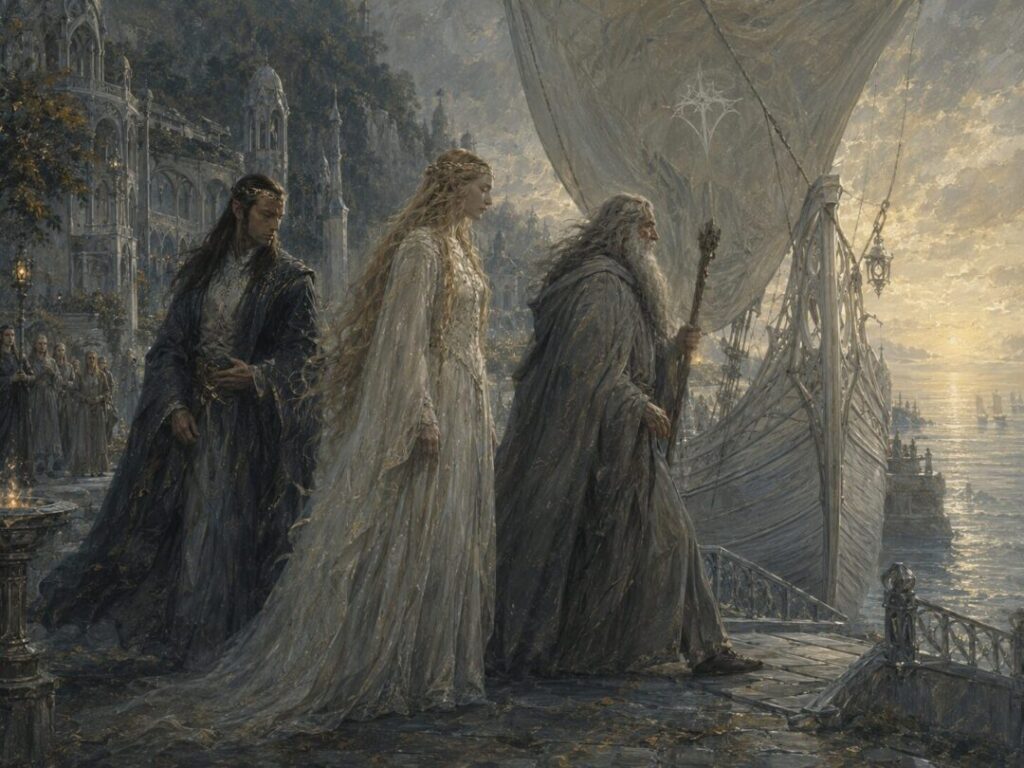
When the War of the Ring is over, the Keepers of the Three depart together: Gandalf, Elrond, and Galadriel.
That final image matters.
They do not remain as rulers of a renewed Middle-earth. They do not use victory to establish a new age of Elven power. The power of the Three has ended with the destruction of the One Ring. The age they preserved is passing away.
So they leave.
This is the hidden sorrow behind Gandalf’s reverence.
He knows that Galadriel and Elrond are not merely powerful allies in a war. They are among the last guardians of a fading world. Their greatness belongs to an age that is ending, and their victory means accepting that end.
That is why his respect feels so deep.
He is honoring not only who they are, but what they have carried.
Memory.
Weariness.
Resistance.
Beauty preserved against decay.
Power refused when domination would have been easier.
Why Gandalf Honors Them
Gandalf shows reverence for Galadriel and Elrond because he sees them truly.
He sees Galadriel not as a distant queen of golden woods, but as one who has endured the long grief of the Eldar and still refuses the Ring when it offers her worship and command.
He sees Elrond not merely as the lord of a hidden valley, but as a keeper of memory, counsel, and healing in a world repeatedly wounded by the same Shadow.
And he sees both as fellow Keepers of the Three: not conquerors, not saviors by force, but guardians holding back the dark long enough for a smaller, humbler hope to pass through.
Gandalf’s reverence is not about rank.
It is about recognition.
He honors them because they have power and do not become tyrants.
Because they have memory and do not surrender to despair.
Because they preserve beauty without pretending they can keep it forever.
And perhaps that is the most important part.
In Middle-earth, the greatest wisdom is rarely shown by those who demand reverence.
It is shown by those who know when to give it.
Sources & Notes
- J.R.R. Tolkien, Unfinished Tales, “The Istari” — identifies Gandalf as Olórin of the Maiar and explains the Wizards' mission as counsel and encouragement rather than rule by force.
- J.R.R. Tolkien, The Silmarillion, “Of the Rings of Power and the Third Age” — gives the history of the Three Rings, the White Council, and Galadriel's desire that Gandalf lead it.
- J.R.R. Tolkien, The Lord of the Rings, Book II, Chapter 2, “The Council of Elrond” — presents Elrond's long memory of Sauron, Isildur, and the Last Alliance as the setting for his counsel.
- J.R.R. Tolkien, The Lord of the Rings, Book II, Chapter 7, “The Mirror of Galadriel” — shows Galadriel's temptation by the One Ring and her refusal of domination.
- J.R.R. Tolkien, The Lord of the Rings, Book VI, Chapter 9, “The Grey Havens” — shows Gandalf, Elrond, and Galadriel departing together as the Keepers of the Three after the Ring's destruction.