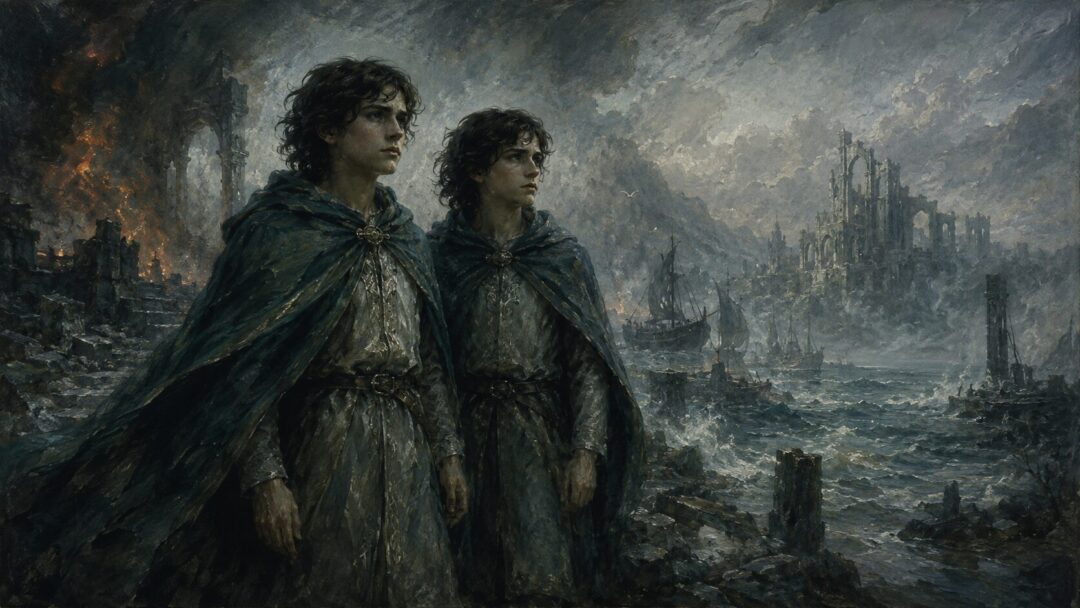
Most readers meet Elrond as an Elf-lord.
That is how he feels from the moment the story enters Rivendell. He is wise, ancient, grave, and beautiful in the way of the Elder People. His house is filled with song and memory. His words carry the weight of ages. He remembers the Elder Days, the fall of kingdoms, the Last Alliance, and the long defeat of Sauron.
So it is natural to think of him as simply an Elf.
But that answer is too easy.
Elrond is never just “an Elf” in the plainest sense. His most important title is not Lord of Rivendell, though he is that. It is not healer, loremaster, or master of the Last Homely House. It is the title that sits at the center of his identity:
Elrond Half-elven.
That title is not decorative.
It is the key to his whole story.
The First Clue Is in Rivendell
When Bilbo first reaches the hidden valley in The Hobbit, Elrond is not introduced as a normal Elf of the woodland realms. The description is more unusual.
He is the chief of those who still had both Elves and heroes of the North for ancestors.
That is a careful phrase.
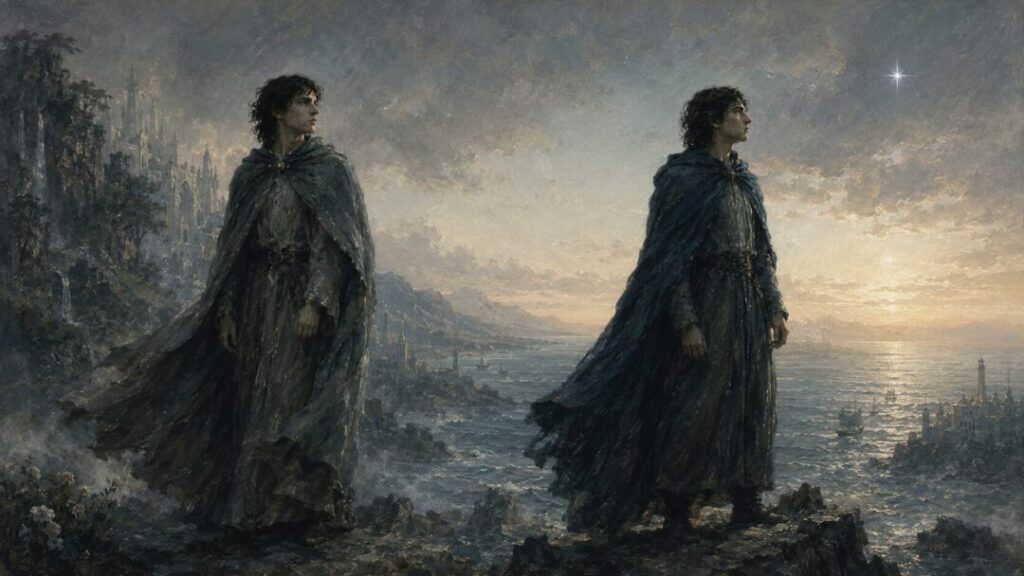
It does not place Elrond in a single category. It places him at a meeting point. His house is Elvish, but his ancestry reaches into the great houses of Men as well. Even before the deeper history is explained, the story quietly tells us that Elrond belongs to more than one world.
By the time of The Lord of the Rings, the name becomes explicit.
Elrond is Half-elven.
Not half in a casual sense. Not merely because of distant ancestry. Elrond stands in one of the rarest lines in Middle-earth: the line where the fates of Elves and Men met, mingled, and were divided again.
That distinction matters because Elves and Men are not just different peoples. They have different destinies.
Elves are bound to the life of Arda. Their spirits remain within the world as long as the world lasts. Men are given another fate: death, and departure beyond the circles of the world. The texts do not treat this as a small biological difference. It is one of the deepest divisions in creation.
Elrond was born directly into that divide.
Elrond’s Parents Were Already Between Worlds
Elrond’s father was Eärendil.
His mother was Elwing.
Both carried mixed ancestry from the great unions of Elves and Men in the First Age. Through Eärendil came the line of Tuor, a Man, and Idril, an Elf of Gondolin. Through Elwing came the line of Beren, a Man, and Lúthien, daughter of an Elf-king and Melian the Maia.
This means Elrond’s ancestry is not a simple matter of “one Elf parent and one human parent.” It is older and more layered than that.
He descends from the two great unions that joined the Elder Children and the Followers. He carries the memory of Gondolin and Doriath, of mortal courage and Elvish sorrow, of doomed kingdoms and impossible hopes.
That is why Elrond is not merely a character with mixed blood.
He is the living inheritance of the First Age.
His family history gathers together some of the most important threads in Middle-earth before the War of the Ring ever begins. Beren and Lúthien. Tuor and Idril. Eärendil and Elwing. The Silmaril. The fall of Beleriand. The plea before the Powers of the West.
By the time Elrond is born, his existence already carries a question the world itself must answer:
To which fate does he belong?
The Choice of the Half-elven
Elrond was not simply assigned an Elvish destiny at birth.
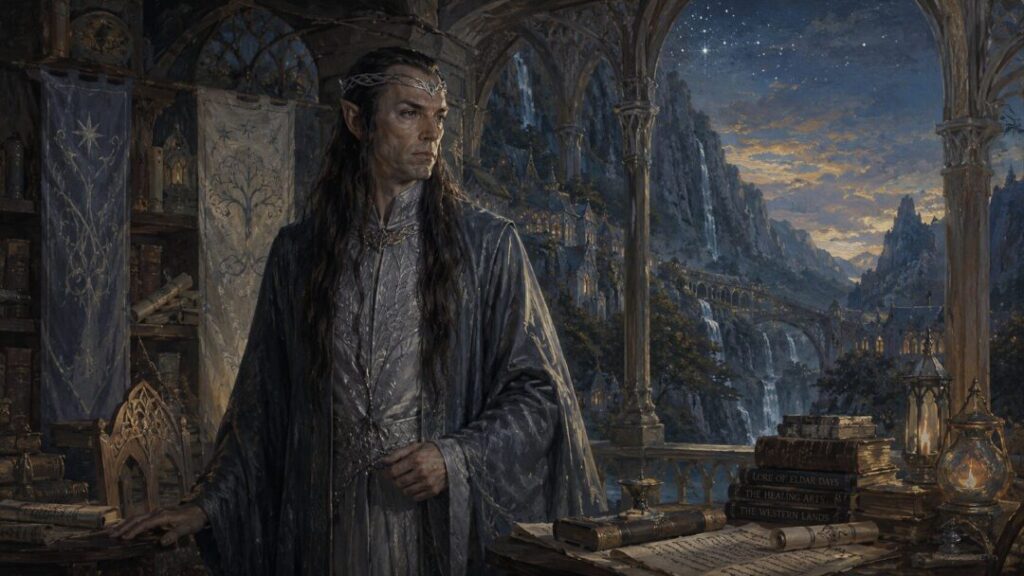
After the War of Wrath, the choice of kindred was given to Eärendil, Elwing, and their line. Elrond and his brother Elros were allowed to be counted either among the Elves or among Men.
This is the crucial point.
Elrond became Elven by choice.
His brother did not.
Elros chose the fate of Men. He became mortal, though with a life far longer than ordinary Men, and became the first king of Númenor. From him came the royal line that would eventually lead, through many generations, to Aragorn.
Elrond chose the fate of the Elves.
The two brothers therefore became the great split in the Half-elven line. One remained with the Firstborn. The other passed into the history of Men.
That division is easy to state, but difficult to feel.
Elrond did not merely choose a different homeland or allegiance. He chose a different doom from his brother. Elros would age, rule, die, and leave the world. Elrond would remain. He would remember.
This is one of the quiet tragedies beneath Elrond’s dignity.
His wisdom is not abstract. It is made of survival.
So Was He “Always” an Elf?
The safest answer is no.
Elrond was not born as a simple Elf in the way Legolas was born an Elf, or Galadriel was born an Elf. He was born Half-elven, into a line uniquely permitted to choose between the kindreds.
After that choice, he was counted among the Elves.
So by the time we meet him in the later Third Age, Elrond truly belongs to the Elven kindred. He has lived through ages. He is mighty among Elves and Men. He bears one of the Three Rings. He rules Imladris as an Elvish refuge and place of counsel.
But that does not erase what he was born as.
In fact, it explains him.
Elrond is Elven, but not simply Elvish. He is a bridge. His house shelters Dúnedain heirs. His counsel reaches Men, Hobbits, Dwarves, and Elves. His memory stretches back to the Elder Days, but his descendants remain tied to the fate of Men.
He is not less Elvish because he is Half-elven.
He is more complicated than that.
Elros Is the Shadow Beside Elrond
To understand Elrond, you have to keep Elros near him.
Elros is not just a piece of backstory. He is the path Elrond did not take.
One brother chose the immortal fate of the Firstborn. The other chose the Gift of Men. From one came Rivendell, memory, preservation, and long resistance against Sauron. From the other came Númenor, kingship, mortality, glory, downfall, and eventually the line of Elendil and Aragorn.
This gives Elrond’s role in The Lord of the Rings a deeper emotional weight.
When Aragorn comes to Rivendell, he is not just a foster-son from a noble human line. He is a distant descendant of Elros. He belongs to the mortal branch of Elrond’s own divided family.
That makes Elrond’s care for the heirs of Isildur more than political wisdom.
It is also family memory.
The texts do not overstate this. They do not turn Elrond into a sentimental figure. He remains restrained, grave, and careful. But the pattern is there: Elrond preserves the line that came from the brother who chose mortality.
He guards the future of Men while belonging to the Elves.
That is not a contradiction.
It is exactly who he is.
Arwen Repeats the Ancient Choice
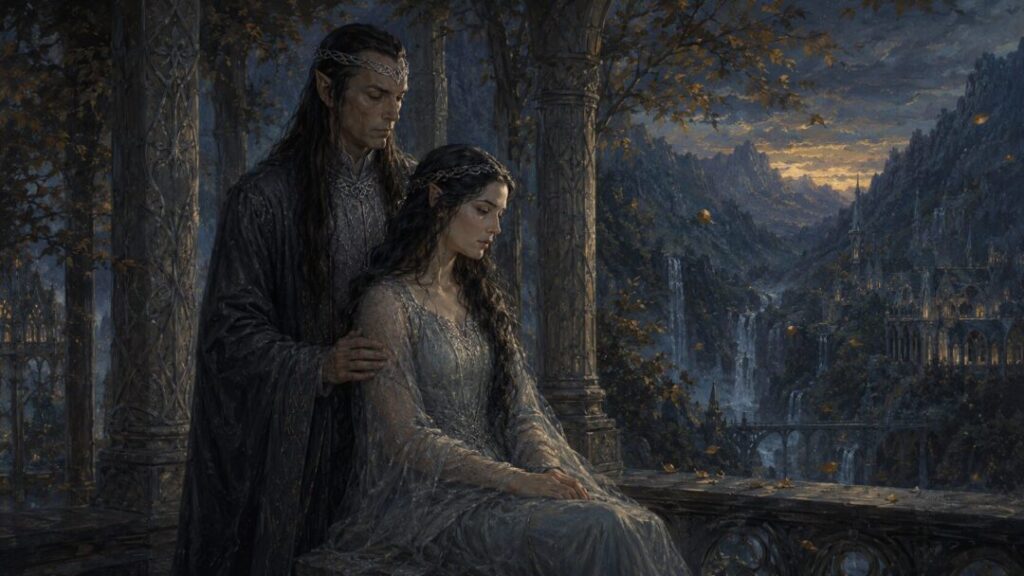
The deepest echo of Elrond’s choice comes through Arwen.
Arwen, his daughter, also stands within the Half-elven line. Her fate becomes bound to Aragorn, descendant of Elros. Their union reunites the long-sundered branches of the family: the line of Elrond and the line of Elros.
But this reunion comes with grief.
Arwen chooses mortality.
This does not mean she becomes less noble or less herself. It means she accepts the fate of Men and gives up the Elvish destiny that would otherwise take her West. For Elrond, this is not an abstract theological matter. It is the loss of his daughter beyond the circles of the world.
Here the cost of Elrond’s own choice becomes clearer.
Because he chose the fate of Elves, he must endure the kind of parting Elves fear most: not merely separation by distance, but separation by doom. Arwen’s choice means that she and Elrond will not share the same final destiny within the world.
This is why Elrond’s story is so quiet and so devastating.
He chose to be counted among the Elves.
But the mortal fate never stopped moving through his house.
Rivendell Is a House of Memory
Rivendell is often imagined as a peaceful refuge, and it is. It is a place of healing, counsel, song, and preservation.
But it is also a house built around memory.
Elrond remembers what others cannot. He remembers the Elder Days. He remembers the Last Alliance. He remembers Isildur’s refusal to destroy the Ring. He remembers defeat, victory, and the strange bitterness of victories that do not fully heal the world.
This is why Elrond is so suited to preside over the Council.
He is not merely wise because he has studied much. He is wise because his life touches nearly every strand of the story. Elves, Men, Númenor, the line of kings, the wars against Sauron, the old griefs of Beleriand—all of them meet in him.
Rivendell is not just an Elvish house.
It is the place where the divided histories of Middle-earth are held together for a little while longer.
And that is why Elrond’s identity matters so much.
If he were simply an Elf-lord, his role would still be important. But as Half-elven, he becomes something more: a living threshold between ages, peoples, and destinies.
Why the Mistake Is So Easy to Make
It is easy to call Elrond an Elf because, by the Third Age, he has chosen and lived the Elven fate for thousands of years.
The world around him recognizes him as one of the great Elven-wise. He is counted among the chief enemies of Sauron. He remains in Middle-earth long after Elros and the kings of Númenor have passed into memory. He departs at last with the bearers of the Three Rings, when the time of the Elves is ending.
So the mistake is understandable.
But it still flattens him.
Calling Elrond “an Elf” is not exactly false, if we mean the fate he chose and the people among whom he was counted. But calling him “just an Elf” misses the entire wound at the center of his story.
Elrond is what happens when the two great kindreds meet and the world demands a choice.
He is not uncertain because the lore is vague.
He is complex because the lore is precise.
The Answer Hidden in His Name
Elrond Half-elven was not always simply an Elf.
He was born at the crossing of Elves and Men. He inherited both histories. He and Elros were given a choice, and Elrond chose the fate of the Firstborn.
That choice made him one of the Elves.
But it did not make him untouched by Men.
His brother’s line became the kings of Númenor. His foster-son Aragorn came from that same mortal line. His daughter Arwen chose mortality. Again and again, the fate Elrond did not choose returned to his house, his heart, and his final sorrow.
So the real answer is not just that Elrond became an Elf.
It is that Elrond became an Elf while never ceasing to be Half-elven.
That is why he feels so ancient, so sorrowful, and so necessary.
He is not simply the lord of Rivendell.
He is the memory of a choice that divided a family, shaped kingdoms, and echoed all the way to the end of the Third Age.
Sources & Notes
- J.R.R. Tolkien, The Hobbit, “A Short Rest” — introduces Elrond of Rivendell as a figure whose ancestry joins Elves with the heroes of the North.
- J.R.R. Tolkien, The Silmarillion, “Of the Voyage of Eärendil and the War of Wrath” — gives the choice granted to Eärendil, Elwing, Elrond, and Elros, and distinguishes Elrond’s Elven fate from Elros’s mortal one.
- J.R.R. Tolkien, The Lord of the Rings, Appendix A, “Annals of the Kings and Rulers: Númenor” — traces Elros as first King of Númenor and the royal line that ultimately leads to Aragorn.
- J.R.R. Tolkien, The Lord of the Rings, Book II, Chapter 2, “The Council of Elrond” — presents Elrond as ancient witness and counselor, remembering the Last Alliance, Isildur, and the long history of the Ring.
- J.R.R. Tolkien, The Lord of the Rings, Appendix A, “The Tale of Aragorn and Arwen” — shows Arwen’s choice of mortality and the renewed meeting of Elrond’s and Elros’s lines.