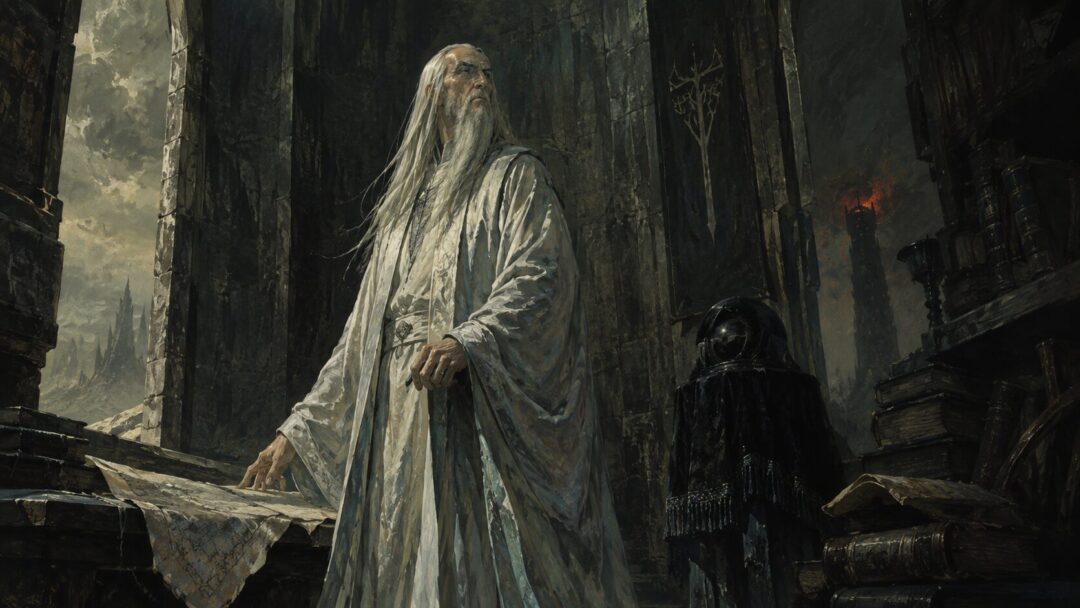
Saruman’s betrayal is often treated as a simple turn to evil.
He was proud.
He wanted power.
He joined Sauron.
He was destroyed.
That summary is not wrong, but it is too small.
Because Saruman was not an ignorant servant of darkness. He was not deceived in the same way as a frightened Man of the East or a corrupted captain seeking reward. Saruman belonged to a higher order of being. He was one of the Istari, sent into Middle-earth in the Third Age to oppose Sauron, not to serve him.
He knew what Sauron was.
He knew the Ring was dangerous.
He knew there were powers in the West beyond the reach of Mordor.
So the question becomes deeply unsettling:
Why would Saruman ally himself with Sauron if he knew that such rebellion could end in judgment?
The answer is not that Saruman simply forgot the truth.
It is that he convinced himself he could outthink it.
Saruman Was Not Truly Loyal to Sauron
The first thing to understand is that Saruman’s “alliance” with Sauron was never simple loyalty.
In The Lord of the Rings, Saruman does not appear as a devoted worshipper of the Dark Lord. He is not like the Nazgûl, enslaved to Sauron through the Nine Rings. He is not merely a captain taking orders from Barad-dûr. His relationship with Sauron is more dangerous because it is double-minded.
Saruman speaks as though alliance with Sauron is inevitable. When Gandalf comes to Orthanc, Saruman argues that the old world is changing and that the Wise must choose how to survive the coming order. He presents submission, or apparent submission, as wisdom.
But his own actions reveal another intention.
He searches for the One Ring.
He studies Ring-lore.
He makes Isengard into a power of its own.
He declares himself “Saruman Ring-maker.”
The texts never show Saruman planning to remain Sauron’s servant forever. His deeper hope appears to be that he can use Sauron’s rise, find the Ring, and eventually become the ruling power himself.
This is crucial.
Saruman does not ally with Sauron because he believes Sauron is rightful lord of Middle-earth.
He allies with Sauron because he believes Sauron is useful.
That is already a sign of his blindness.
He Thought Evil Could Be Managed
Saruman’s fall begins long before open war.
He had studied the devices and arts of the Enemy. At first, this knowledge was useful. The Wise were able to understand something of Sauron’s methods because Saruman had devoted himself to such study.
But in Middle-earth, knowledge of evil is never morally neutral when it becomes fascination.
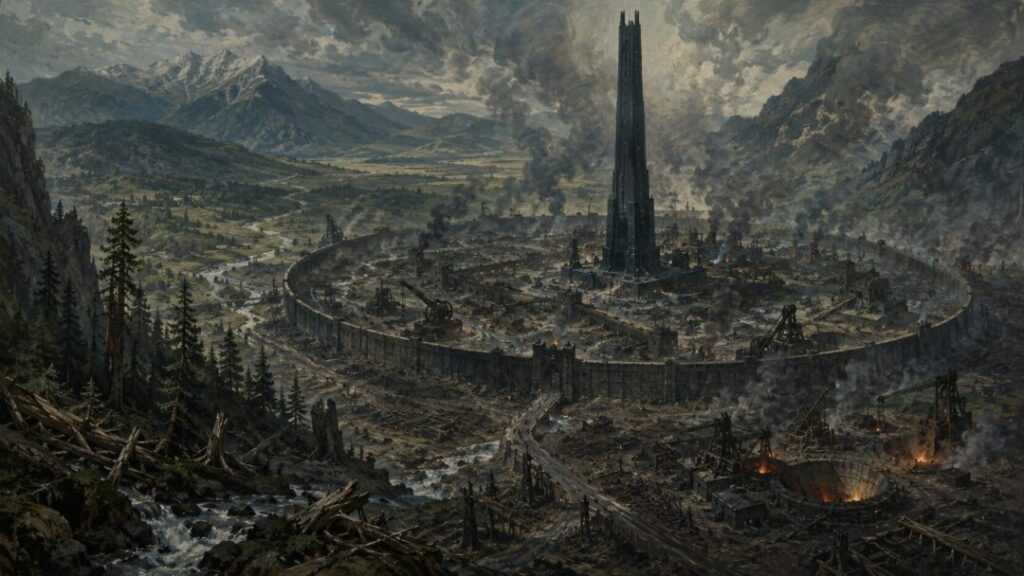
Saruman does not merely learn about Sauron in order to resist him. Over time, he begins to imitate him. Isengard becomes a lesser image of Mordor: ordered, industrial, armed, stripped of living beauty, and bent toward domination.
Treebeard says Saruman has “a mind of metal and wheels.” That phrase matters because it describes more than machinery. It describes a soul that has begun to see the world as something to be arranged, broken, improved, and controlled.
Saruman’s great error is not that he thinks Sauron is good.
He knows Sauron is evil.
His error is that he thinks evil can be used safely by someone wiser than its servants.
He believes he can stand close to the Shadow without becoming part of it. He believes he can borrow its methods without sharing its fate. He believes that because his mind is subtle, he will remain master of what smaller beings cannot handle.
That is exactly the kind of pride the Ring itself feeds.
The Ring Changed the Shape of His Desire
Saruman’s desire for the One Ring is central to his betrayal.
The Ring was not simply a weapon. It was made by Sauron to dominate the wills of others. Its whole nature was mastery. Anyone who sought to use it against Sauron would be drawn into the same pattern: command, control, coercion, and rule.
Saruman, more than most, should have understood this.
He had studied the Rings of Power. He knew enough to fear the Ring, and enough to desire it. That combination is deadly.
When he calls himself “Ring-maker,” the text does not explain exactly what he has made or how powerful it is. We should be careful here. The story does not prove that Saruman created a Great Ring like those of the Elves, Dwarves, or Men. What matters is that Saruman presents himself as one who has entered that forbidden field of craft and domination.
He wants to rival Sauron on Sauron’s own ground.
That is why his alliance is so unstable. Saruman is not trying to serve the Ring’s maker. He is trying to become the kind of lord who could take the Ring and wield it.
Whether he admitted this fully to himself is another question. The texts do not give us every private thought in Saruman’s mind. But his actions strongly imply that his cooperation with Sauron was a strategy, not devotion.
He intended betrayal from within the betrayal.
Did Saruman Know Eru Would Punish Him?
This is where the question needs careful phrasing.
The texts do not give us a scene where Saruman says, “I know Eru will punish me, but I will rebel anyway.” That exact inner calculation is never stated.
Saruman certainly knew far more about the order of the world than ordinary mortals did. As one of the Istari, he came from beyond Middle-earth and served a mission ultimately rooted in the authority of the West. He would not have been ignorant of the moral structure of creation.
But the story does not present his fall as someone calmly accepting divine punishment.
It presents his fall as self-deception.
Saruman’s mind bends around his desire. He reinterprets betrayal as prudence. He reinterprets domination as order. He reinterprets humility as weakness. He reinterprets patience as failure.
That is how evil often works in Middle-earth.
Characters do not always choose darkness while naming it darkness. They rename it first.
Saruman does not need to deny the existence of judgment. He only needs to convince himself that his case is different.
Perhaps he tells himself the West has failed.
Perhaps he tells himself Sauron’s victory is inevitable.
Perhaps he tells himself that only by seizing power can anything be saved.
Perhaps he tells himself that punishment belongs to fools who are caught.
Those are interpretations, not direct statements from the text. But they fit the pattern of his words and actions.
Saruman’s tragedy is not ignorance.
It is the corruption of wisdom into excuse.

He Mistook Providence for Weakness
One of the great differences between Gandalf and Saruman is trust.
Gandalf does not know every outcome. He does not control every piece on the board. He works through courage, pity, patience, and free choice. He advises rather than enslaves. He helps others become more themselves.
Saruman cannot bear that kind of uncertainty.
To him, the Free Peoples look weak. Rohan is divided. Gondor is besieged. The Elves are fading. The Ring has been lost for ages, and then found in the hands of small, obscure Hobbits. From Saruman’s point of view, the whole resistance to Sauron may have seemed absurdly fragile.
So he chooses the logic of power.
If the world is to be saved, it must be managed.
If people will not act wisely, they must be directed.
If Sauron cannot be defeated openly, then his tools must be taken and used against him.
But Middle-earth repeatedly rejects that logic.
The Ring is destroyed not by a greater tyrant, but through endurance, mercy, pity, and providence. Saruman cannot understand this because he has lost the ability to value what cannot be controlled.
He thinks the world is governed by force.
He is wrong.
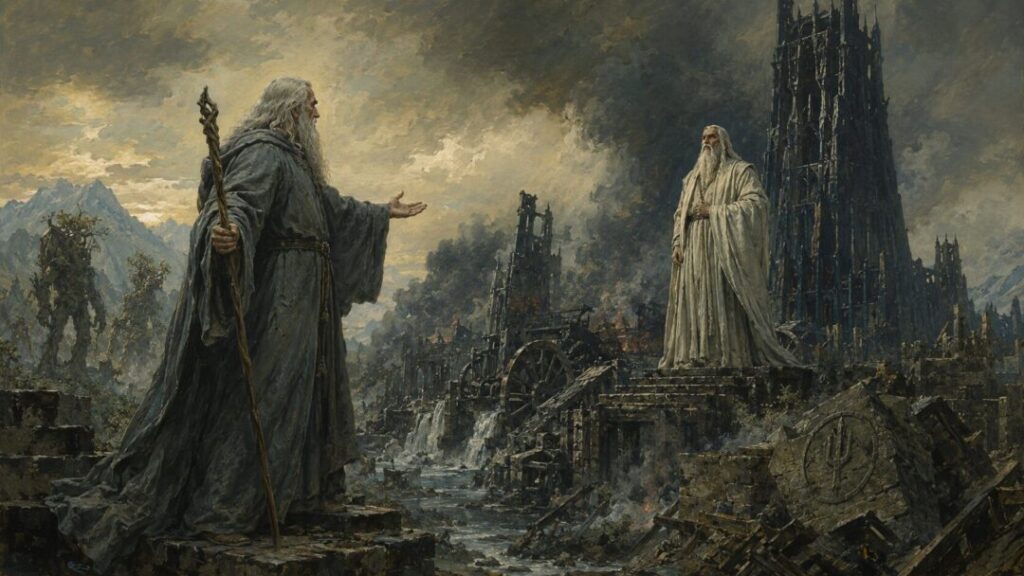
Gandalf Offered Him a Way Back
After Isengard falls, Gandalf does something remarkable.
He offers Saruman a chance to leave Orthanc and help repair what he has done. Saruman refuses.
This moment is essential because it shows that Saruman’s ruin is not merely the result of one bad alliance. Even after his plans collapse, he clings to pride. He would rather remain diminished and bitter than accept mercy from Gandalf.
That refusal reveals the depth of his fall.
Punishment is not simply imposed from outside. Saruman has become the kind of person who cannot receive restoration because restoration would require humility.
He would have to admit that Gandalf was right.
He would have to admit that his wisdom became folly.
He would have to accept help from those he despised.
He cannot do it.
So he goes lower.
Not from Orthanc to repentance, but from Orthanc to the Shire.
The Shire Shows What Saruman Became
Saruman’s final evil in the Shire is not grand. It is petty, spiteful, and ugly.
That matters.
By then, he is no longer a great power threatening kingdoms. He is “Sharkey,” a fallen schemer ruining a small land because he can. His malice has shrunk, but it has not softened.
This is one of the most revealing parts of his story.
Saruman once claimed to be wise enough to guide the future of Middle-earth. In the end, he takes pleasure in damaging the home of Hobbits who had done him no great harm. His fall moves from cosmic ambition to personal spite.
That is not a contradiction.
It is exposure.
The desire to dominate great realms and the desire to spoil a small garden come from the same root: hatred of anything free, humble, and beyond one’s control.
Saruman wanted to order the world.
When he could not, he tried to wound it.
The Cold Wind from the West
Saruman’s death is one of the most haunting moments in The Lord of the Rings.
After Wormtongue kills him, a grey mist rises from his body. It takes a shape like a pale figure and looks toward the West. Then a cold wind comes from the West, and the shape bends away and dissolves.
The text does not give a long explanation.
It does not say exactly what Saruman experiences afterward. It does not provide a formal sentence of judgment. We should not add details the story does not give.
But the image is unmistakably severe.
Saruman looks westward, toward the direction associated with the Undying Lands and the powers he once served. No welcome comes. No return is shown. The wind rejects him, and his form dissolves.
This is not the death of an ordinary Man. Saruman was a Maia embodied as one of the Istari. His end is therefore strange and spiritual, but the text remains deliberately restrained.
What we can say is this: the story presents his final state as exclusion, not restoration.
He who abandoned his mission cannot simply reclaim its shelter at the end.
Why He Did It Anyway
So why did Saruman ally with Sauron if he knew there would be consequences?
Because he did not think like a humble servant facing judgment.
He thought like a strategist.
He believed the old resistance had failed. He believed Sauron’s victory was likely. He believed the Ring could change everything. He believed his own wisdom set him apart from lesser beings. He believed he could use evil without being mastered by it.
And beneath all of that, he believed in control more than obedience.
That is the heart of Saruman’s fall.
He does not deny power.
He does not flee from power.
He tries to seize it, refine it, and redirect it through himself.
But in Middle-earth, no one can master evil by becoming more like it. The attempt does not purify the tool. It corrupts the user.
Saruman thought he was playing a deeper game than Sauron.
In truth, he had already accepted Sauron’s rules.
Saruman’s Real Punishment
Saruman’s punishment is not only what happens after death.
It begins earlier.
He loses wisdom.
He loses trust.
He loses the White.
He loses Isengard.
He loses his voice’s authority.
He loses the chance to repent.
He loses even the dignity of his malice.
By the time the cold wind comes, the judgment has already been unfolding for a long time.
That is why his story is so tragic. Saruman was not made small. He made himself small, choice by choice, excuse by excuse, calculation by calculation.
He began as one sent to resist Sauron.
He ended as a bitter shadow in a wounded Shire.
And the most frightening part is that he did not fall by loving darkness for its own sake.
He fell by persuading himself that he was wise enough to use it.
Sources & Notes
- J.R.R. Tolkien, The Lord of the Rings, Book II, Chapter 2, “The Council of Elrond” — Gandalf’s account of Orthanc shows Saruman urging alliance with the rising Power while secretly styling himself “Ring-maker.”
- J.R.R. Tolkien, The Lord of the Rings, Book III, Chapter 4, “Treebeard” — Treebeard’s “mind of metal and wheels” description supports the article’s reading of Saruman’s imitation of Sauron’s industrial, dominating methods.
- J.R.R. Tolkien, The Lord of the Rings, Book III, Chapter 10, “The Voice of Saruman” — after Isengard falls, Gandalf offers Saruman a path away from ruin, but Saruman’s pride rejects mercy and repentance.
- J.R.R. Tolkien, The Lord of the Rings, Book VI, Chapter 8, “The Scouring of the Shire” — Saruman’s spite in the Shire and the cold wind from the West after his death ground the article’s restrained reading of judgment and exclusion.
- J.R.R. Tolkien, Unfinished Tales, “The Istari” — the account of the Wizards’ mission explains Saruman’s original purpose as one sent to oppose Sauron, making his calculated turn toward domination especially grave.
- J.R.R. Tolkien, The Letters of J.R.R. Tolkien, Letter 131 — Tolkien’s contrast between Sauron’s will to order and dominate and the free resistance to him clarifies why Saruman’s strategy accepts Sauron’s rules rather than defeating them.