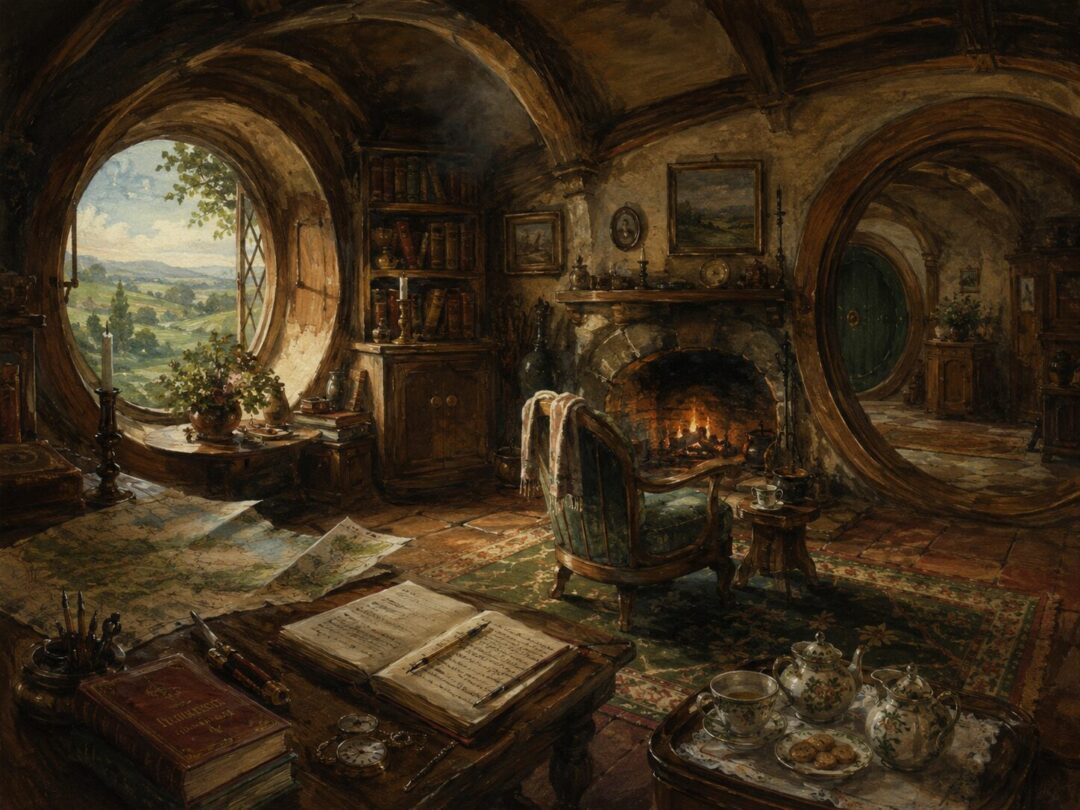
Bilbo Baggins and Frodo Baggins are two of the most important hobbits in the history of Middle-earth.
They are both Ring-bearers.
They both live at Bag End.
They both step far outside the ordinary life of the Shire.
And neither of them ever marries.
At first, this seems like a small detail. The story is not built around romance. Bilbo’s tale is a quest of treasure, dragons, riddles, and homecoming. Frodo’s is a darker road of burden, mercy, endurance, and loss.
But in the Shire, marriage is not a small thing.
Hobbit life is rooted in family, inheritance, gardens, meals, birthdays, local memory, and the passing of names from one generation to another. The appendices preserve hobbit genealogies with great care. Families matter. Children matter. Homes and names matter.
So when both Bilbo and Frodo remain unmarried, the pattern is worth noticing.
Not because there is a hidden romance the text asks us to decode.
Not because the Ring gives a simple answer.
But because both lives show something unusual: the Bagginses of Bag End become detached from the ordinary future of the Shire.
And that detachment begins before most readers expect.
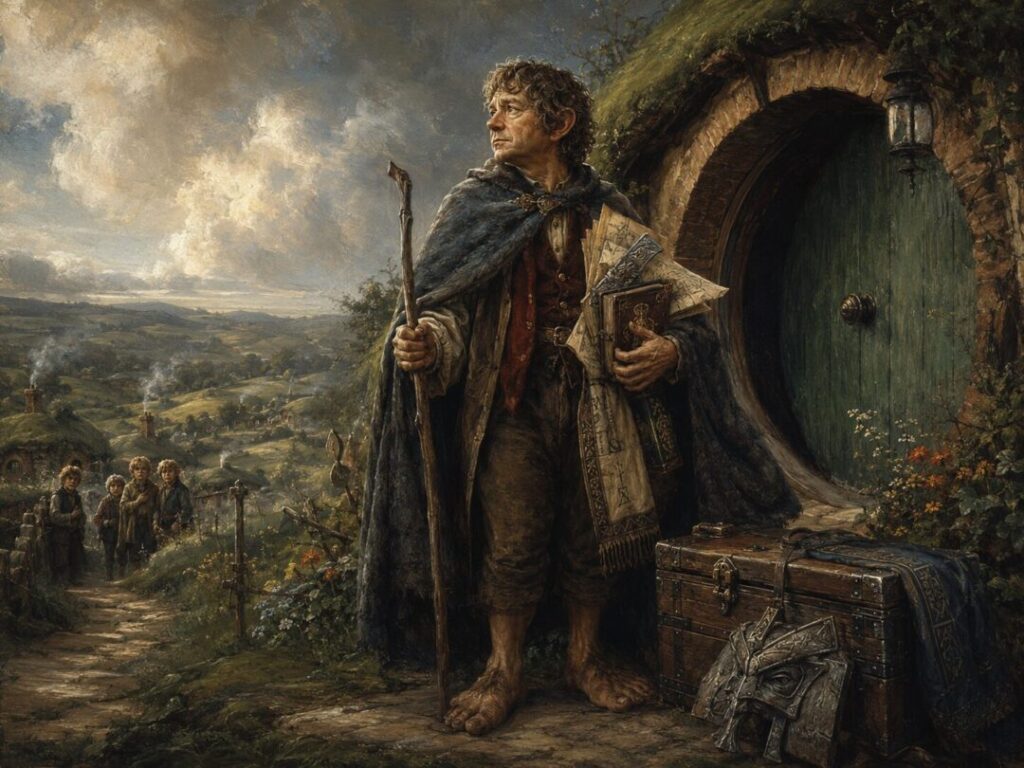
The Text Never Gives One Direct Answer
The most important thing to say first is also the most easily ignored:
The texts never directly state why Bilbo or Frodo never married.
There is no scene where Bilbo explains that he rejected marriage. There is no passage where Frodo says he once hoped for a wife and children. There is no confirmed statement that the Ring made either of them incapable of marrying.
So any answer has to be careful.
The safest explanation is not a single hidden rule, but a pattern shown through their lives. Bilbo and Frodo both become separated from the expected path of respectable hobbit society. But they do so in different ways.
Bilbo is already an unusual bachelor before the Ring.
Frodo becomes a wounded Ring-bearer who cannot fully return after the quest.
Those two facts matter.
Because they mean the Ring cannot be the whole answer.
Bilbo Was Already Unmarried Before the Ring
Bilbo’s bachelorhood begins before Gollum, before the riddle-game, and before the One Ring enters his pocket.
At the beginning of The Hobbit, Bilbo is a comfortable, respectable hobbit living alone in Bag End. He is not presented as lonely or tragic. He has a home, wealth, habits, food, manners, and a deep love of peace and predictability.
He appears settled.
But he is also unattached.
This matters because it prevents an easy explanation. The Ring did not prevent Bilbo from marrying in his youth. He was already unmarried when Gandalf and Thorin’s company arrived at his door.
The text does not tell us why.
It may simply be part of Bilbo’s character. He is domestic, but not especially family-building. He loves comfort, but not necessarily the conventional life expected of a wealthy hobbit. He is respectable enough to be a Baggins, but there is Tookish restlessness in him too.
The adventure does not create that restlessness.
It wakes it.
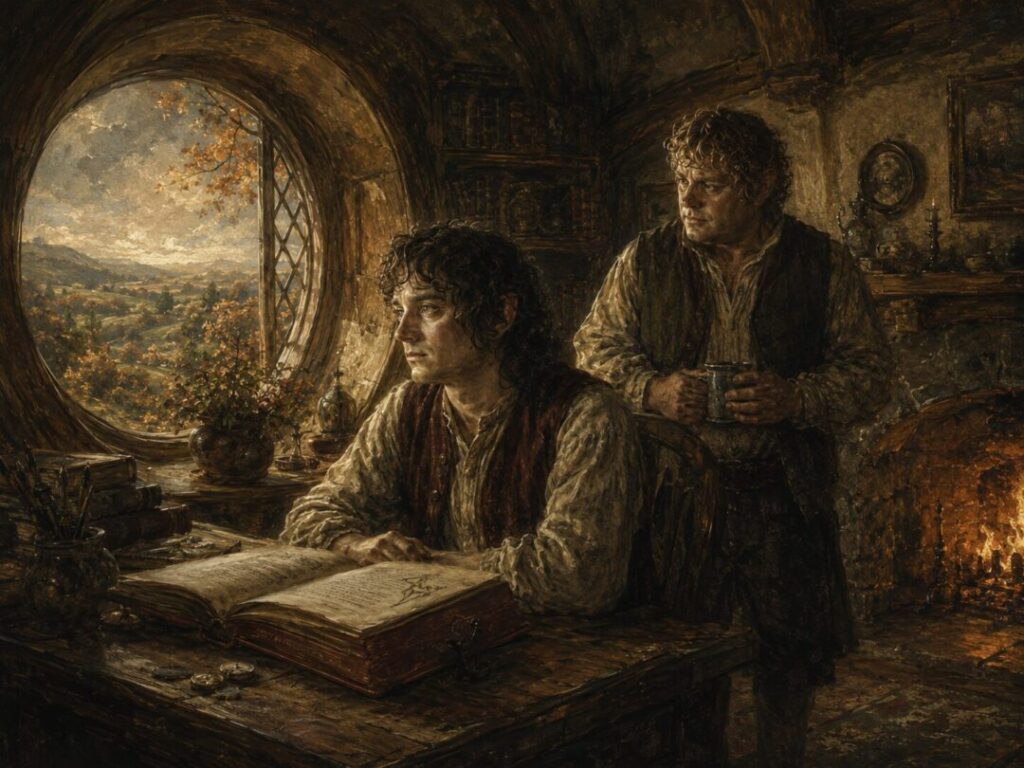
The Adventure Made Bilbo Stranger to the Shire
When Bilbo returns from his journey, he comes back changed.
He has spoken with Elves. He has travelled with Dwarves. He has faced spiders, goblins, wolves, and a dragon. He has seen treasure under the Mountain and war before the Lonely Mountain. He has also found the Ring, though he does not yet understand what it truly is.
To the Shire, he becomes odd.
The respectable Baggins who once seemed predictable is now associated with adventures, strange visitors, songs, maps, and stories from far beyond Hobbiton. He remains generous. He remains beloved by some. But he is no longer quite inside ordinary hobbit life.
That is the key.
Marriage in the Shire would have meant deeper rooting: household, children, family alliances, local respectability, and the continuation of the Baggins name through ordinary means.
Bilbo takes another path.
He adopts Frodo as his heir.
That choice is deeply important. It shows that Bilbo does not reject affection, family, or legacy. He is not cold. He is not loveless. But his household becomes a chosen line of memory rather than a conventional family line.
Bag End will pass on.
But not through Bilbo’s children.
It passes through Frodo.
Frodo’s Case Is Different
Frodo also remains unmarried, but his story is not the same as Bilbo’s.
Before the War of the Ring, Frodo lives for many years at Bag End after Bilbo’s departure. He is Bilbo’s heir, and he inherits not only the house but the Ring. For a long time, he does not know what it is.
The text does not give Frodo a courtship or a stated desire to marry. It also does not state that he avoids marriage because of the Ring during those years.
Again, caution matters.
But after the quest, Frodo’s unmarried life becomes much easier to understand.
He does not return from Mordor as a hobbit ready to resume the future he once might have had. He returns wounded in body and spirit. The Morgul-knife wound troubles him. Shelob’s sting leaves its memory. The burden of the Ring does not simply vanish from his inner life when the Ring is destroyed.
The Shire is healed.
Frodo is not.
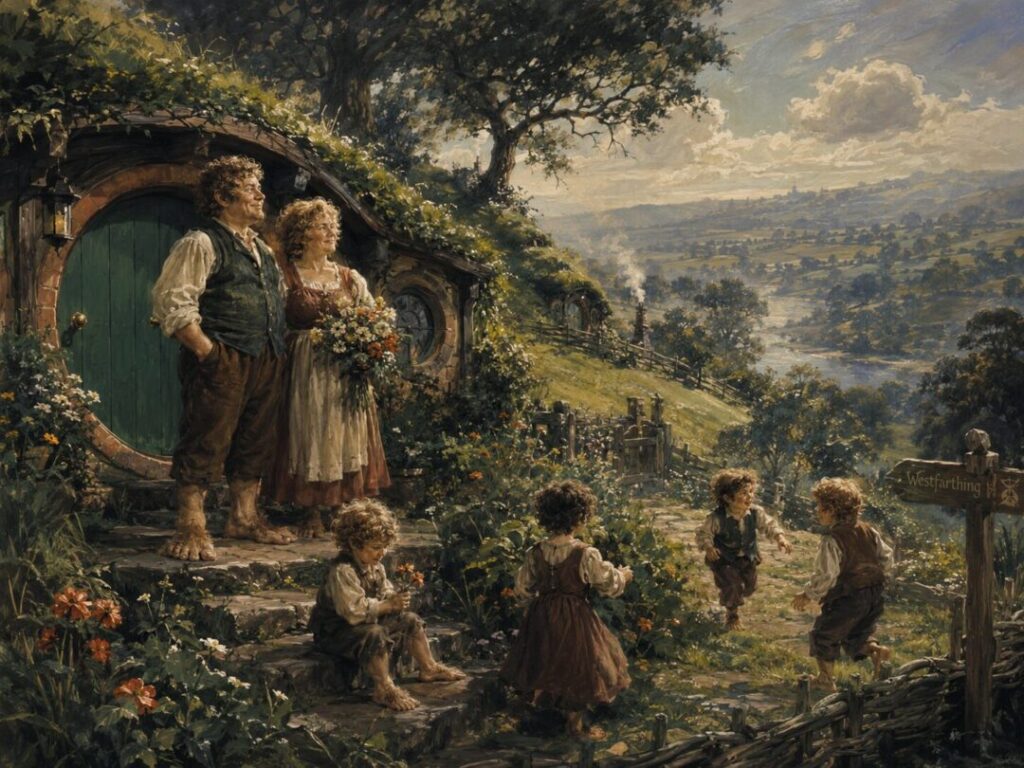
“Saved, But Not for Me”
Near the end of The Lord of the Rings, Frodo tells Sam that he has been too deeply hurt. He tried to save the Shire, and it has been saved, but not for him.
That sentence is the heart of Frodo’s ending.
It also explains why imagining Frodo settling into ordinary hobbit life after the quest feels wrong. The Shire’s future belongs to Sam, Rose, their children, and the generations that come after them. Frodo helped preserve that future, but he cannot fully enter it.
This is not because he lacks love.
It is because he has given too much.
Frodo’s life after the quest turns toward memory, writing, and departure. He helps preserve the story. He leaves Bag End to Sam. He prepares, quietly, to go where healing may be possible.
Marriage would have symbolized remaining.
Frodo’s story moves toward leaving.
Sam Shows the Life Frodo Cannot Enter
Samwise Gamgee is essential to this question because he shows what a restored hobbit life looks like.
Sam returns from the quest and marries Rose Cotton. He becomes a husband, father, gardener, and later a leader in the Shire. His life is not small or lesser because it is domestic. In many ways, it is the very thing the quest was fought to save.
Sam’s marriage is not merely a happy ending.
It is a sign that the Shire’s living future continues.
That makes Frodo’s path more painful. Frodo does not despise that future. He blesses it. He gives Bag End to Sam. He recognizes that Sam has Rose, Elanor, and children still to come.
Frodo’s renunciation is not bitterness.
It is surrender.
He gives the Shire back to those who can live in it.
Bilbo Leaves Ordinary Life by Wonder
Bilbo’s unmarried life is best understood through wonder.
He is drawn out of the Shire by adventure. He returns changed, but not ruined. He becomes a teller of tales, a preserver of songs, a friend of Elves and Dwarves, and eventually a resident of Rivendell.
His life bends away from ordinary hobbit expectations because he has glimpsed a wider world.
That does not make him superior to other hobbits.
It makes him displaced.
Bilbo can love the Shire and still no longer fit entirely inside it. He can enjoy food, birthdays, jokes, and comfort while also longing for mountains, Elvish songs, and old stories.
His unmarried state fits that pattern. It is not explained as a wound. It is part of his oddness, independence, and freedom from the normal shape of hobbit respectability.
Bilbo’s life makes room for adventure, memory, and Frodo.
Frodo Leaves Ordinary Life by Sacrifice
Frodo’s unmarried life is darker.
He does not simply become eccentric. He becomes unable to remain whole in the world he saved.
This is why the Ring still matters, though not as a simple explanation for everything. The Ring did not make Bilbo unmarried before The Hobbit. The Ring is not stated to have prevented Frodo from marrying in his younger years.
But the Ring defines what happens to both of them in the end.
Bilbo, as a former Ring-bearer, is permitted to sail West.
Frodo, as the Ring-bearer who carried the burden to the Fire, also sails West.
Their final departure places their lives outside the normal endings of hobbits. Most hobbits remain in family memory, local history, and the soil of the Shire. Bilbo and Frodo pass beyond the map.
Not into immortality.
Not into triumph.
But into healing and release.
Bag End Is the Clue
Bag End quietly tells the whole story.
Bilbo lives there alone, then brings Frodo in as heir.
Frodo lives there after Bilbo leaves, then eventually gives it to Sam.
Sam brings into Bag End what Bilbo and Frodo did not: marriage, children, continuity, and the restored life of the Shire.
That movement is beautiful.
Bag End passes from the bachelor adventurer, to the wounded Ring-bearer, to the gardener with a family. It moves from treasure and secrecy, to sacrifice and memory, to renewal.
This does not mean Bilbo and Frodo failed by not marrying.
Quite the opposite.
Their unmarried lives make space for another kind of legacy.
Bilbo preserves wonder.
Frodo preserves the Shire.
Sam inhabits the future they helped make possible.
The Real Answer
So why did neither Bilbo nor Frodo ever marry?
The lore-accurate answer is that the texts never give one explicit reason.
But they do show us enough to speak carefully.
Bilbo never marries because, even before the Ring, he is written as an independent and unusual hobbit. After his adventure, he becomes even more detached from ordinary Shire expectations. He forms a family line through adoption rather than marriage, making Frodo his heir and passing on Bag End, the Ring, and the burden of memory.
Frodo never marries because his story does not move toward settlement. Whatever future he might once have imagined, the quest leaves him too deeply hurt. The Shire is saved, but not for him. His role is not to build the next generation there, but to preserve the memory of what happened and then depart.
Bilbo’s bachelorhood belongs to adventure.
Frodo’s belongs to sacrifice.
And between them stands Sam, who receives Bag End not as a treasure hoard, but as a home.
That is why the question matters.
Bilbo and Frodo do not marry, but their lives are not empty. They are filled with other forms of love: friendship, mercy, adoption, loyalty, memory, and the willingness to give up what others may keep.
In the end, the Shire does have marriages, children, gardens, laughter, and full pantries again.
It has them because Bilbo once spared Gollum.
Because Frodo carried the Ring.
And because both Bagginses, in different ways, stepped outside the ordinary life of the Shire so that others could remain within it.
Sources & Notes
- J.R.R. Tolkien, The Hobbit, Chapter 1, “An Unexpected Party” — introduces Bilbo as the comfortable master of Bag End before the Ring enters his story, already living outside a conventional married household.
- J.R.R. Tolkien, The Fellowship of the Ring, Book I, Chapter 1, “A Long-expected Party” — shows Bilbo’s post-adventure oddity in the Shire and his choice to adopt Frodo as heir rather than pass Bag End to children of his own.
- J.R.R. Tolkien, The Fellowship of the Ring, Book I, Chapter 2, “The Shadow of the Past” — establishes Frodo’s inheritance of Bag End and the Ring, while Gandalf explains Bilbo’s long possession and the burden now passing to Frodo.
- J.R.R. Tolkien, The Return of the King, Book VI, Chapter 9, “The Grey Havens” — Frodo tells Sam that the Shire has been saved “but not for me,” gives Bag End to Sam, and departs over Sea with Bilbo for healing.
- J.R.R. Tolkien, The Lord of the Rings, Appendix C, “Family Trees” — preserves the hobbit genealogical pattern around the Bagginses and Gamgees, underlining Sam and Rose’s family continuity beside Bilbo and Frodo’s childless line.