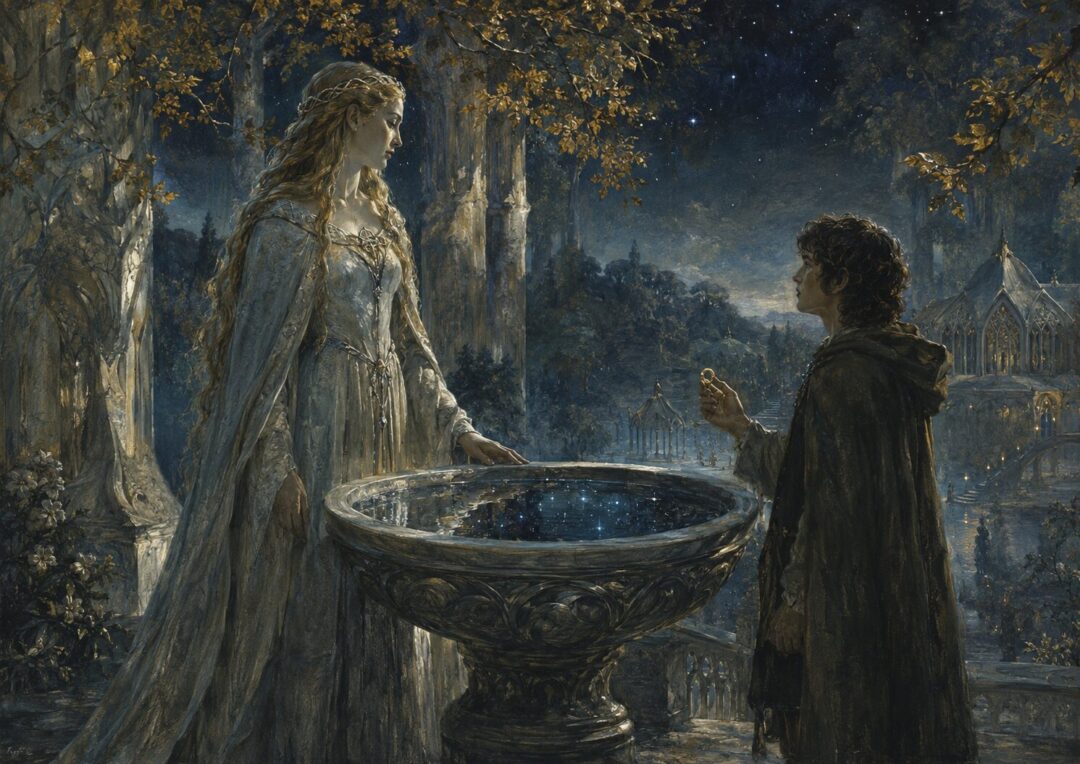
When Frodo offers the One Ring to Galadriel, the fate of Middle-earth pauses in a way that feels almost impossible.
The Ring has passed through fear, pity, secrecy, betrayal, and desperate hope. It has already tested Gandalf. It has already begun to work on Boromir. It has weighed on Frodo from the moment he understood what it truly was.
And then, in Lothlórien, Frodo offers it to one of the oldest and most powerful beings left in Middle-earth.
Galadriel does not dismiss the offer.
She does not say the Ring has no hold on her.
She does not pretend she is above temptation.
Instead, she admits the truth. Her heart has greatly desired what Frodo offers.
That confession is the key to the entire scene.
Because when Galadriel says, “I will diminish, and go into the West, and remain Galadriel,” she is not merely announcing that she will become weaker. She is choosing what kind of weakness she will accept.
And what kind of power she will refuse.
The Test Was Not Whether She Wanted the Ring
One of the most important details in this scene is that Galadriel does want the Ring.
Not in a crude or simple way. She is not like Gollum, consumed by possession. She is not like Boromir, imagining the Ring as a weapon for military victory. She is far wiser than that.
But wisdom does not make temptation vanish.
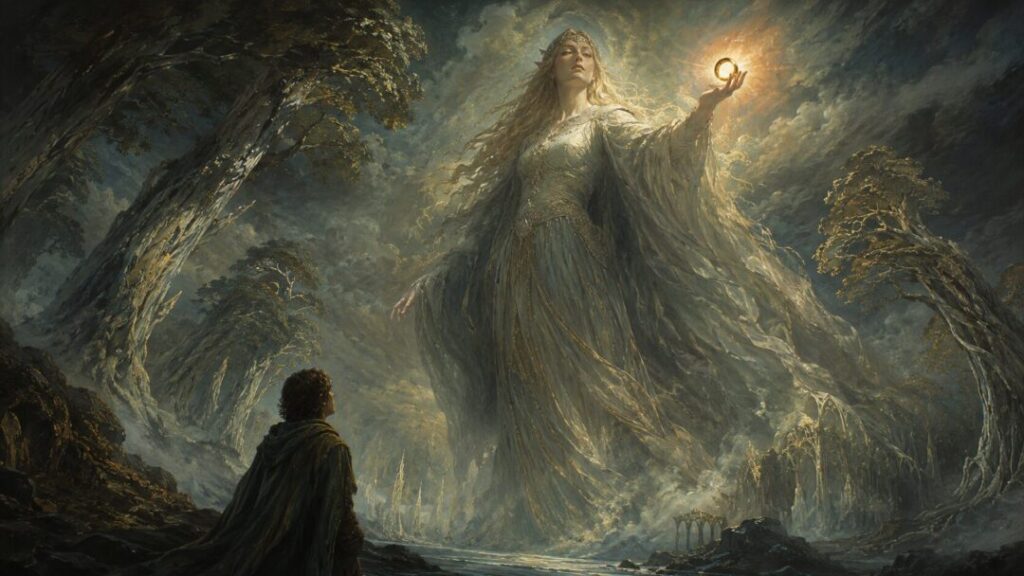
Galadriel understands what the Ring could offer her. She could use it to overthrow Sauron. She could become a ruler of overwhelming beauty and terror. She could force the world into a shape that seemed, at first, healed.
That is why the moment is so dangerous.
The Ring does not only tempt the cruel. It tempts the noble by offering them the power to do good without restraint.
Galadriel sees this clearly. She knows that her reign would not remain pure simply because her intentions began well. The Ring was made for domination. Anyone who tried to use it would have to enter the logic of domination.
That is why her rejection matters.
She passes the test not because she never desired power.
She passes because she desires it and still refuses it.
What “Diminish” Means First
The first meaning of “diminish” is tied directly to the fate of the Elven Rings.
Galadriel bears Nenya, the Ring of Adamant. It is one of the Three Rings of the Elves, made by Celebrimbor and not touched by Sauron. Yet the Three are still bound to the fate of the One. If the One is destroyed, their power will fail.
Galadriel says this plainly to Frodo.
If his Quest succeeds, the power of the Elves will be diminished. Lothlórien will fade. Time will sweep over it. The Elves must either depart into the West or dwindle slowly in Middle-earth, becoming a people forgotten by the world.
This is not a vague sadness.
It is the cost of victory.
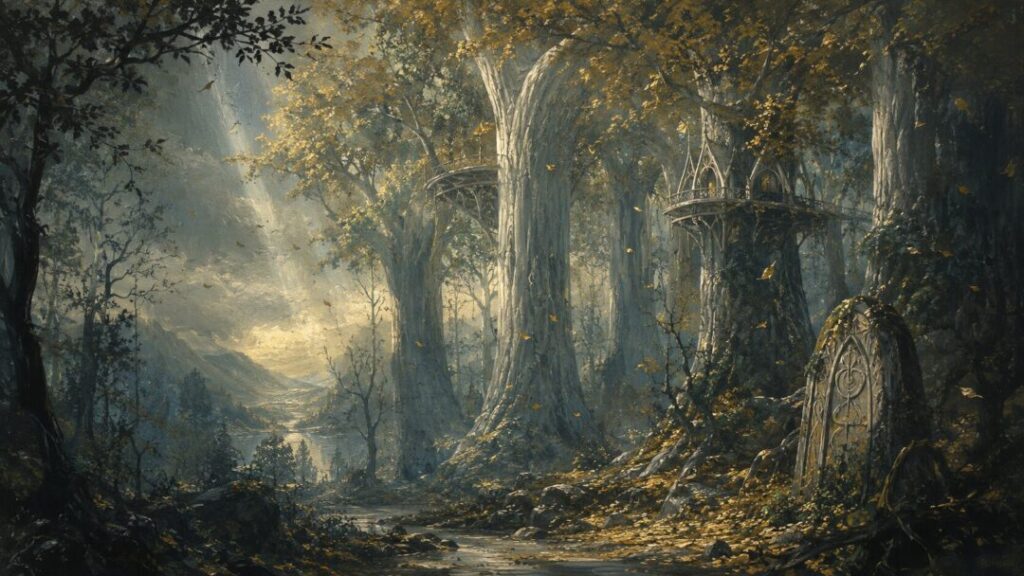
Lothlórien is not simply a forest kingdom. It is one of the last places in Middle-earth where the Elder Days still seem close. The land feels unstained, preserved, almost outside ordinary time. That condition is connected with Galadriel’s power and with Nenya.
So when Galadriel says she will diminish, she is accepting the loss of that preserved world.
She is accepting that her own realm cannot survive unchanged.
She is accepting that the beauty she has guarded for centuries must pass away.
The Choice Hidden Inside the Choice
Frodo’s offer gives Galadriel a terrible alternative.
If she refuses the Ring and Frodo succeeds, Lórien fades.
If she refuses the Ring and Frodo fails, Sauron conquers.
If she takes the Ring, she may overthrow Sauron—but only by becoming a ruler shaped by the Ring’s own nature.
This is why the scene is not simply about humility.
It is about relinquishment.
Galadriel is not choosing between power and no power. She already has power. She is choosing between preserving her world by force and allowing it to end according to a larger necessity.
That is much harder.
It is one thing to reject power when power has nothing to do with what you love.
It is another thing to reject power when it appears to be the only way to save what you love.
Galadriel’s temptation is not selfish in the shallow sense. She does not merely want a throne for its own sake. The texts suggest that she has long been associated with rule, wisdom, preservation, and resistance to Sauron. Her desire is bound up with the fate of her people and her land.
But that makes the temptation more dangerous, not less.
The Ring could turn love of beauty into control.
It could turn guardianship into mastery.
It could turn preservation into tyranny.
“Remain Galadriel” Is the Heart of the Line
The most overlooked part of the sentence is not “diminish.”
It is “remain Galadriel.”
That phrase tells us what is truly at stake.
If Galadriel took the Ring, she would gain power, but she would lose herself. She might still look radiant. She might still speak of healing. She might still defeat Sauron. But she would no longer be simply Galadriel.
She would become something else.
That is why her vision of herself as a Queen is so terrifying. It is not ugly. It is magnificent. It is not openly monstrous. It is beautiful enough to be worshipped.
But the result would still be despair.
The Ring’s danger is not that it makes everyone immediately grotesque. Its deeper danger is that it offers a corrupted version of what the bearer already desires.
For Galadriel, that means greatness, rule, preservation, and the power to command love.
To “remain Galadriel” means refusing to become the false version of herself that the Ring reveals.
It means accepting a smaller future rather than a corrupted glory.
The West Is Not an Escape From Loss
Galadriel also says she will go into the West.
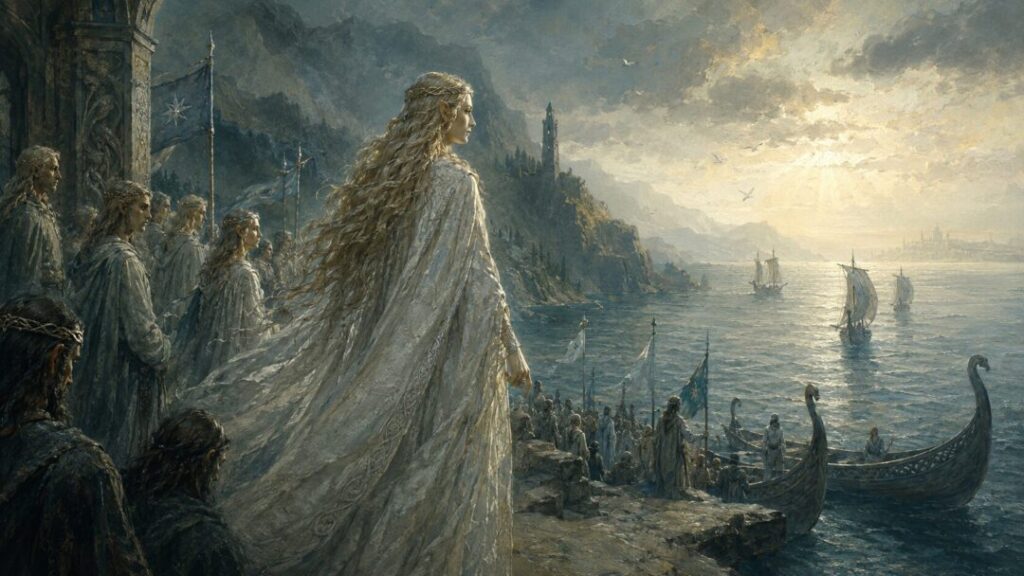
This points toward the departure of the Elves from Middle-earth and the end of the Third Age. But it should not be read as a simple happy ending.
Going West does not mean Galadriel keeps Lórien. It does not mean Middle-earth remains as it was. It does not reverse the fading of the Elven realms.
It means departure.
It means the long story of the High Elves in Middle-earth is closing.
Galadriel’s leaving is therefore both release and loss. She will not remain as the Lady of the Golden Wood. She will not continue preserving Lórien against time. Her age of direct power in Middle-earth will end.
That is part of the diminishment.
She is not destroyed.
She is not humiliated.
But she becomes less in the history of Middle-earth because that history is passing beyond her.
The Fourth Age belongs increasingly to Men. The great Elven powers withdraw. The old light recedes.
Galadriel accepts this.
The Fading of Lórien Makes the Line Tragic
Many readers focus on the personal meaning of Galadriel’s words, but the line is also political and historical.
Her diminishment is tied to Lórien itself.
When the One Ring is destroyed, the Three lose their power. Without that power, the preserved quality of Lórien cannot endure in the same way. The Golden Wood may still exist for a time, but it is no longer what it was under Galadriel’s protection.
This gives the scene its sorrow.
The Quest is necessary. Sauron must be defeated. The Ring must be destroyed.
But the destruction of evil does not preserve everything good.
Some beautiful things are lost because they belonged to an age that is ending.
Galadriel understands this before the victory comes. She sees that Frodo’s success will bring salvation to Middle-earth, but also the end of the world she has guarded.
And she chooses that end anyway.
Why She Laughs
Galadriel’s laughter after the temptation passes is easy to misunderstand.
It is not mockery.
It is not relief in a simple sense.
It feels more like the release of someone who has seen the full shape of the danger and stepped back from it.
The imagined Queen vanishes. The overwhelming light fades. Galadriel becomes herself again.
That return to herself is the victory.
For a moment, the Ring has shown her a path in which she could become greater than ever before. But that greatness would be false. It would devour the very person it claimed to exalt.
So when she says she will diminish, she is not speaking in defeat.
She is naming the price of staying true.
A Victory That Looks Like Loss
This is what makes Galadriel’s moment so powerful.
In most stories, passing the test would mean gaining something. A crown. A weapon. A restored kingdom. A visible triumph.
Galadriel gains none of that.
She passes the test by consenting to lose.
She loses the possibility of ruling through the Ring.
She loses the continued preservation of Lórien.
She loses her place as one of the great powers shaping Middle-earth from within it.
And yet this is precisely why the moment is a victory.
The Ring offers increase. Galadriel chooses diminishment.
The Ring offers mastery. Galadriel chooses departure.
The Ring offers a grander self. Galadriel chooses to remain herself.
What Galadriel Really Gives Up
Galadriel gives up more than a weapon.
She gives up the dream of controlling the outcome.
That is the deeper meaning of the scene.
She cannot save Lórien unchanged. She cannot defeat Sauron by becoming another absolute power. She cannot keep the Elder Days alive forever in Middle-earth. She cannot preserve beauty by bending the world to her will.
All she can do is refuse evil, aid the Quest, and accept the cost.
That cost is enormous.
But it is also the only path by which she remains Galadriel.
Not Queen of a conquered world.
Not a radiant tyrant.
Not a savior remade by the logic of the Ring.
Galadriel.
Diminished, yes.
But herself.
Why the Line Still Matters
Galadriel’s words are heartbreaking because they reveal a truth at the center of Middle-earth.
Not every good thing can be saved.
Not every victory restores what was lost.
Sometimes the defeat of evil requires the passing of an age.
And sometimes the greatest act of strength is not to seize the power that could preserve what you love, but to let that power go before it turns love into possession.
That is what Galadriel means when she says she will diminish.
She will become less powerful in Middle-earth.
Her realm will fade.
Her age will pass.
But she will not become the thing the Ring wants her to become.
She will go into the West.
And she will remain Galadriel.
Sources & Notes
- J.R.R. Tolkien, The Lord of the Rings, Book II, ch. 7 “The Mirror of Galadriel”: Frodo offers Galadriel the One Ring; she imagines becoming a terrible queen, rejects it, and says she will “diminish, and go into the West, and remain Galadriel.”
- J.R.R. Tolkien, The Lord of the Rings, Book II, ch. 7 “The Mirror of Galadriel”: Galadriel explains that if Frodo succeeds the Three Rings will fail, Lórien will fade, and the Elves must pass away or depart.
- J.R.R. Tolkien, The Silmarillion, “Of the Rings of Power and the Third Age”: the Three Elven Rings preserve beauty against time, but after the One Ring is destroyed their power ends and the bearers leave Middle-earth.
- J.R.R. Tolkien, Unfinished Tales, “The History of Galadriel and Celeborn”: Galadriel’s long desire for a realm and her rule in Lórien give context for why the Ring’s promise of preservation and command is a real temptation.
- J.R.R. Tolkien, The Letters of J.R.R. Tolkien, Letter 131: Tolkien describes the Elves’ preservation of memory and beauty as bound up with the Three Rings, and their fading/departure as part of the victory over Sauron.