Most people remember Frodo Baggins as the one who destroyed the Ring.
That is understandable.
He carried it farther than anyone else could have. He endured terror, hunger, wounds, betrayal, despair, and the crushing nearness of Sauron’s power. He walked into Mordor when the great and wise had no strength left to offer him. Without Frodo, the Ring would never have reached the Fire.
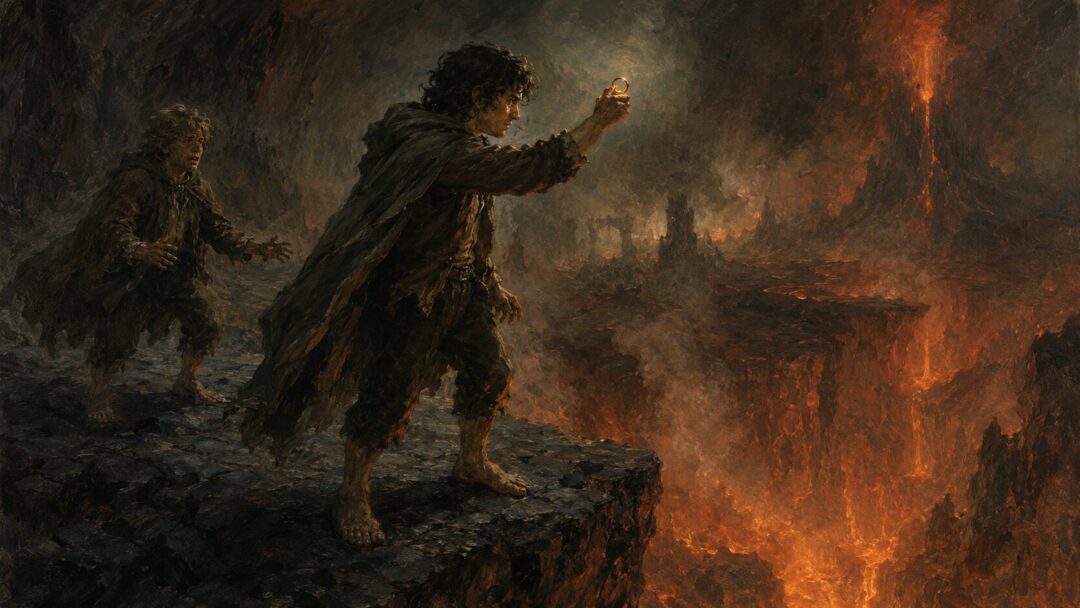
And yet, at the final moment, Frodo does not destroy it.
He claims it.
This is one of the most unsettling moments in The Lord of the Rings because it seems, at first, to break the shape of the story. The hero reaches the end. The world waits on his choice. The final act of courage is placed before him.
And he cannot do it.
But this is not an accident in the story. It is not a betrayal of Frodo’s character. It is the point where the moral structure of the entire tale becomes visible.
Frodo fails in one sense.
But not in the simplest sense.
And certainly not in the way many readers first imagine.
Frodo Does Not Throw the Ring Away
At the Cracks of Doom, Frodo stands in the only place where the One Ring can be unmade.
This matters because the Ring is not vulnerable anywhere else. It was forged in the fire of Orodruin, and only there can it be destroyed. The whole Quest exists because there is no other clean solution.
The Wise cannot use it safely.
They cannot hide it forever.
They cannot give it to Tom Bombadil and forget the war.
They cannot defeat Sauron by mastering his own weapon without becoming corrupted by the very power they mean to oppose.
So the Ring must be taken into Mordor and cast into the Fire.
Frodo gets it there.
Then, at the threshold of victory, he says he will not do what he came to do. He takes the Ring as his own and puts it on.
That is the shock.
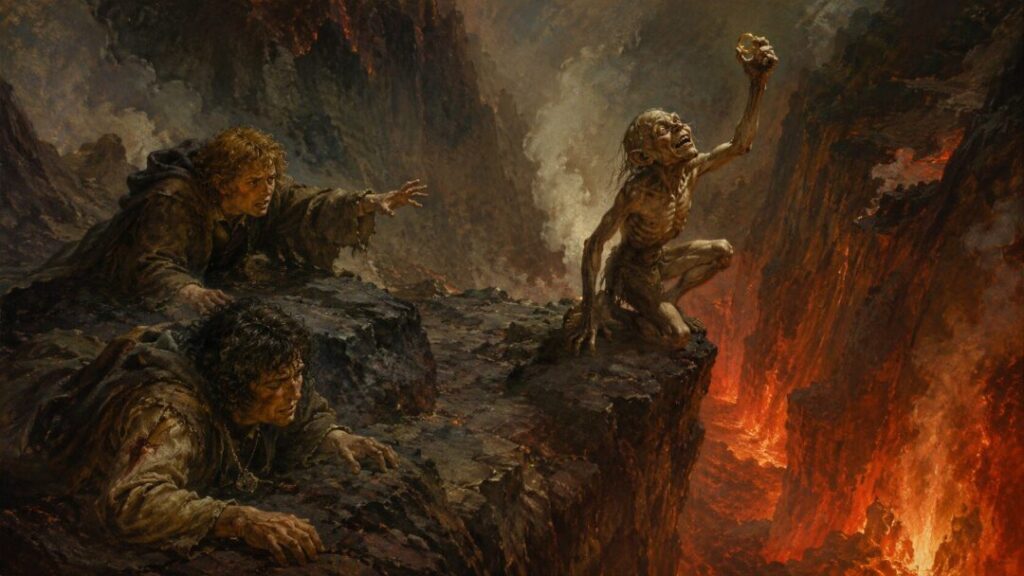
The Quest succeeds, but not because Frodo completes the final act by deliberate choice. Gollum attacks him, bites the Ring from his hand, and falls into the Fire with it.
The world is saved.
But the Ring-bearer does not save it by a perfect final act of will.
That distinction matters.
The Ring Was Strongest at the End
Frodo’s failure cannot be understood as ordinary temptation.
The Ring was not merely a beautiful object that Frodo wanted to keep. It was the ruling Ring of Sauron, made to dominate and bind. Its power was not static. It worked differently depending on the bearer, the situation, and the nearness of its master and its place of making.
By the end, Frodo is not standing in a peaceful room in Bag End, deciding whether to give up a trinket.
He is in Mordor.
He is starving.
He is exhausted.
He has been wounded by a Morgul-knife, stung by Shelob, tormented by the burden of the Ring, and hunted through a land shaped by the Enemy’s will.
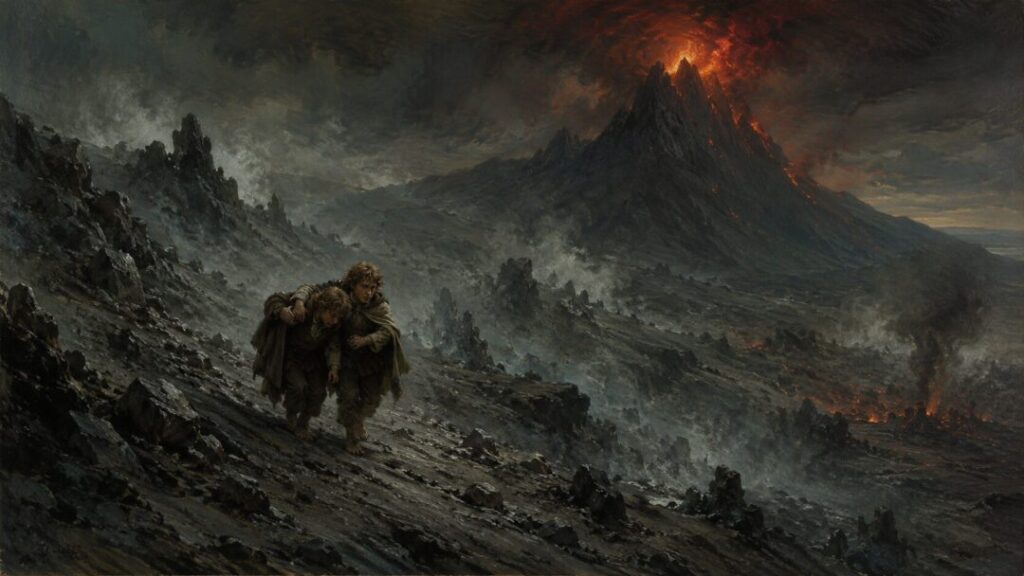
The text presents him as nearly spent before he ever reaches the mountain. Sam has to carry him for part of the ascent. Frodo’s body and mind are being pushed beyond ordinary endurance.
This is why the final moment is so important.
The Ring’s pressure is at its greatest exactly when Frodo’s strength is at its lowest.
A simple reading says: Frodo should have been stronger.
A deeper reading asks: stronger than what?
Stronger than Sauron’s Ring, at the place of its forging, after months of torment, while already broken by hunger, terror, and pain?
The story does not treat that as a fair contest.
This Was Not a Moral Failure
The most important distinction is between failure and blame.
Frodo does fail to cast the Ring into the Fire. That cannot be softened away. He reaches the end and does not do the thing he intended to do.
But the story does not present this as a moral collapse in the ordinary sense.
Frodo does not begin the Quest out of pride. He does not seek power. He does not carry the Ring because he believes himself great. At the Council of Elrond, he offers himself because the burden must be taken, and because no better answer has appeared.
His courage is humble.
That humility matters.
Frodo’s task is not the task of a warrior trying to win glory. It is the task of someone who knows he is not enough and goes anyway.
That is why his breaking point should not be judged as if he simply changed his mind at the end.
He gives everything he has.
The Ring takes him beyond what he has.
There is a kind of failure that comes from selfishness, cowardice, or betrayal. Frodo’s failure is not that. It is closer to a body collapsing after carrying too much weight.
The will breaks because the burden has become unbearable.
Why the Story Needed Frodo to Fail
If Frodo had thrown the Ring into the Fire by sheer moral strength, The Lord of the Rings would become a very different story.
It would still be moving.
It would still be heroic.
But it would suggest that evil can be defeated if only the good person is strong enough at the final moment.
Middle-earth is more severe than that.
Again and again, the story shows that power is dangerous even to the wise. Gandalf refuses the Ring. Galadriel refuses it. Aragorn does not take it. Boromir falls under its temptation. Faramir’s resistance is remarkable precisely because it is not normal.
The Ring is not conquered by someone becoming spiritually invincible.
It is brought to the place where it can be destroyed by someone who spends himself completely.
Then the final turn comes from elsewhere.
That is crucial.
The destruction of the Ring is not a celebration of perfect strength. It is a revelation that even the best strength has limits.
And beyond those limits, something else has been moving through the story all along.
The Chain of Mercy
Gollum is the key.
Not because he is noble at the end.
Not because he repents at the final moment.
The text does not give us that.
Gollum seizes the Ring, rejoices, and falls. His role in the destruction of the Ring comes through desire, not through a clean act of redemption.
But he is only there because of mercy.
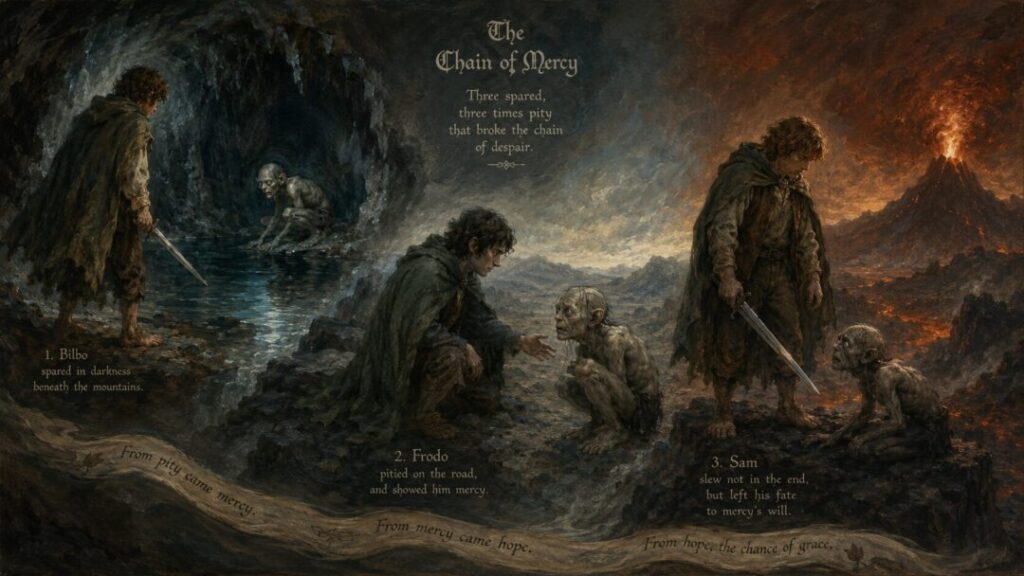
Bilbo once had the chance to kill him under the Misty Mountains and did not.
Gandalf later tells Frodo that Bilbo’s pity may rule the fate of many.
Frodo himself comes to pity Gollum. He sees something of what the Ring has done to him and recognizes, more and more, that Gollum is not merely a monster outside himself. He is a warning of what the Ring does to anyone who is possessed by it.
Sam also has a chance to kill Gollum near the end and does not.
Not every act of pity in this chain is easy. Some are reluctant. Some are mixed with disgust, fear, or anger. But they matter.
The Ring is destroyed because Gollum is alive at the one moment when Frodo can no longer surrender it.
That does not make Gollum the hero.
It means mercy has consequences that no one can fully foresee.
Frodo and Gollum Are Bound Together
One of the darkest parts of Frodo’s journey is that he begins to understand Gollum from the inside.
At first, Gollum is a threat. Then he becomes a guide. Then he becomes a mirror.
Frodo never becomes Gollum, but the connection between them grows stronger because both have borne the Ring. Frodo understands, more than Sam can, what it means to be drawn toward it, to need it, to hate it and desire it at the same time.
That is why Frodo’s pity is not sentimental.
It is not simple kindness toward a harmless creature.
Gollum is dangerous. He betrays them. He leads them toward Shelob. He is capable of malice, deceit, and violence.
But Frodo sees that destroying Gollum would not undo the evil of the Ring. It would only remove one of its victims.
This is not the same as excusing Gollum.
The story never asks us to pretend he is innocent.
It asks us to see that pity can be morally necessary even when the person pitied remains dangerous.
That is a harder idea than simple forgiveness.
And it is one of the reasons the ending is so powerful.
Sam’s Strength Was Not the Same as Frodo’s
Sam is essential to the Quest.
Without Sam, Frodo does not reach Mount Doom. Sam carries him, protects him, feeds him, and refuses despair when Frodo has almost no strength left. In many ways, Sam is the practical hero of the final road.
But Sam also does not bear the Ring in the same way Frodo does.
He carries it briefly after Shelob’s attack, and even then it tempts him. The vision it offers him is shaped according to his own nature: not a dark throne like Sauron’s, but a vast garden ordered by his will. Sam rejects this, and his humility helps him resist.
But he does not carry it for months.
He does not bear it from the Shire to Mordor as Frodo does.
This difference matters because it prevents a false comparison. Sam’s courage is real, but his burden is not identical. Frodo’s breaking point cannot be measured against Sam’s momentary resistance as though they faced the same trial.
Sam helps Frodo go farther than Frodo could go alone.
Frodo carries the Ring farther than Sam was ever asked to carry it.
Both are necessary.
Neither replaces the other.
The Victory Is Not Clean
The destruction of the Ring is not a neat heroic triumph.
It is violent, strange, and morally unsettling.
Frodo claims the Ring.
Gollum attacks him.
The Ring is taken with Frodo’s finger.
Gollum rejoices.
Then he falls.
This is not the kind of ending that allows anyone to stand proudly over evil and say, “I defeated it by my own strength.”
That is exactly why it fits Middle-earth.
The victory over Sauron is real, but it is not clean in the way legends often pretend victories are clean. It comes through endurance, mercy, suffering, providence, and the unintended consequences of choices made long before.
Bilbo’s pity in the dark matters.
Frodo’s pity on the road matters.
Sam’s last restraint matters.
Gollum’s obsession matters.
Even Frodo’s failure matters, because he has brought the Ring to the only place where failure can be redeemed.
That is the deeper design of the ending.
Not that Frodo was strong enough to master the Ring.
But that he was faithful enough to bring it to the place where mercy could finish what strength could not.
Frodo Could Not Simply Return Unchanged
This also explains why Frodo’s story does not end happily in the ordinary sense.
The Shire is saved.
Sauron is overthrown.
The King returns.
The hobbits come home.
But Frodo is not healed by victory.
His wounds remain. The Morgul wound, Shelob’s sting, the bite, and the long burden of the Ring continue to mark him. He has saved the Shire, but he cannot fully live in the peace he helped preserve.
This is not a contradiction.
It is part of the same truth.
Frodo’s endurance had a cost. The Quest did not make him greater in a triumphant, worldly sense. It emptied him. He gave so much that Middle-earth could no longer restore what had been spent.
That is why his departure over the Sea is not an escape from responsibility.
It is a mercy.
The world he saved goes on, but he cannot simply step back into it as if the Ring had been only an adventure.
So Why Did Frodo Fail?
Frodo fails because the Ring is finally too much for him.
But that answer is only the beginning.
He fails because the story refuses to pretend that even the pure-hearted can defeat absolute evil by willpower alone.
He fails because Middle-earth’s deepest victories do not come from domination, even domination used for good.
He fails because mercy, not mastery, has been quietly preparing the way from the beginning.
And he fails because the Ring can only be destroyed in a way that proves the Ring’s own philosophy false.
The Ring promises control.
It promises ownership.
It promises that the will strong enough to command will win.
But at the end, the Ring is not defeated by a stronger claimant.
It is destroyed through pity, endurance, weakness, and a final turn that no one could fully command.
That is why Frodo’s failure is not a stain on the story.
It is the heart of it.
The Hero Who Spent Everything
Frodo does not stand at the Fire as a flawless conqueror.
He stands there as someone who has given all he had and reached the end of himself.
That is why the ending still hurts.
It should hurt.
Frodo wanted to complete the Quest. He intended to go as far as he could. And he did.
The tragedy is that “as far as he could” was not the same as perfect success.
The grace of the story is that it was enough.
Frodo brought the Ring to the Fire.
Mercy brought Gollum there too.
And in that terrible meeting of broken wills, the Ring was unmade.
So the question is not simply, “Why did Frodo fail?”
The better question is:
What kind of story lets its hero fail, and still calls him faithful?
Middle-earth’s answer is quiet, but unmistakable.
The world was not saved because Frodo was untouched by evil.
It was saved because he carried the burden until he could carry it no more—and because the mercy shown along the way endured beyond his strength.
Sources & Notes
- J.R.R. Tolkien, The Lord of the Rings, Book VI, Chapter 3, “Mount Doom” — Frodo’s exhaustion, his claim on the Ring at the Fire, and Gollum’s fall with it.
- J.R.R. Tolkien, The Lord of the Rings, Book I, Chapter 2, “The Shadow of the Past” — Gandalf’s warning about the Ring and his teaching that Bilbo’s pity for Gollum may shape the fate of many.
- J.R.R. Tolkien, The Lord of the Rings, Book II, Chapter 2, “The Council of Elrond” — the Ring must be taken to Orodruin, and Frodo freely accepts the burden.
- J.R.R. Tolkien, The Lord of the Rings, Book VI, Chapter 1, “The Tower of Cirith Ungol” — Sam’s brief Ring-bearing and temptation, useful for distinguishing his trial from Frodo’s long burden.
- J.R.R. Tolkien, The Lord of the Rings, Book VI, Chapter 9, “The Grey Havens” — Frodo’s unhealed wounds and departure after the Quest.
- J.R.R. Tolkien, The Letters of J.R.R. Tolkien, Letter 246 — Tolkien’s own reflection on Frodo’s failure at the Cracks of Doom and why it should not be judged as simple moral collapse.