When Gandalf falls from the Bridge of Khazad-dûm, the Fellowship believes the matter is finished.
The whip of the Balrog catches him. He slips into the abyss. His final command is not an explanation, but an order: fly.
And so they do.
Aragorn leads them out of Moria. Legolas and Gimli are shaken. The Hobbits are devastated. Even before they reach the Golden Wood, Gandalf’s absence has become the wound at the center of the Company.
Then they come to Lothlórien.
And there, before Galadriel and Celeborn, the question returns.
Where is Gandalf?
At first glance, it is tempting to imagine that Galadriel already knows the answer. She is one of the greatest of the Eldar remaining in Middle-earth. She bears Nenya, one of the Three Rings. She has the Mirror. She has wisdom, foresight, and a depth of perception that often seems beyond ordinary sight.
But the text is much more careful than that.
Galadriel does not immediately reveal that Gandalf has survived.
In fact, she says almost the opposite.
Galadriel Could Not See Him
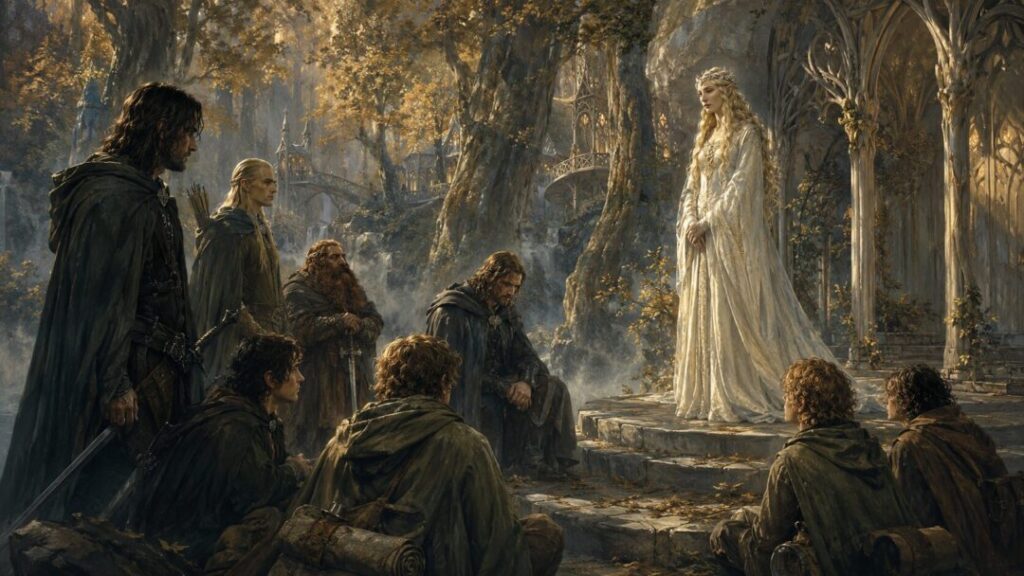
When the Fellowship tells the tale of Moria, Galadriel says that Gandalf did not pass the borders of Lórien. She had desired to speak with him again, but she could not see him from afar unless he came within the fences of her land.
Then comes the crucial detail.
A grey mist lay about him.
His ways were hidden from her.
That line matters because it prevents an easy answer. Galadriel is not treated as someone who simply knows all things. Her sight is great, but it has limits. There are places and persons hidden even from her.
And Gandalf, after the fall in Moria, is one of them.
So if the question is, “Did Galadriel know immediately that Gandalf had survived the Balrog?” the safest lore-accurate answer is no.
The texts do not say that.
What they say is more mysterious: at first, she could not see him.
Whatever was happening to Gandalf after his fall was veiled.
Gandalf Had Not Merely Escaped
Part of the confusion comes from the word “survived.”
Gandalf did not survive the Balrog in the ordinary sense.
He pursued the Balrog from the depths beneath Moria to the Endless Stair, and at last to the peak of Zirak-zigil. There, he cast down his enemy. The Balrog fell and broke the mountain-side.
Then darkness took Gandalf.
His own later account makes clear that this was not a simple escape from danger. He passed out of thought and time. He was sent back, naked, until his task was done.
That distinction is important.
Galadriel was not trying to detect a wounded wizard hiding somewhere in the mountains. Gandalf’s condition had passed beyond ordinary life and ordinary death. The grey mist around him was not just geographical uncertainty.
The story implies something deeper was happening.
His path was hidden because Gandalf himself was passing through a mystery greater than the sight of the Wise in Middle-earth.
The Mirror Does Not Give Simple Answers
The Mirror of Galadriel is often brought into this question, and for good reason.
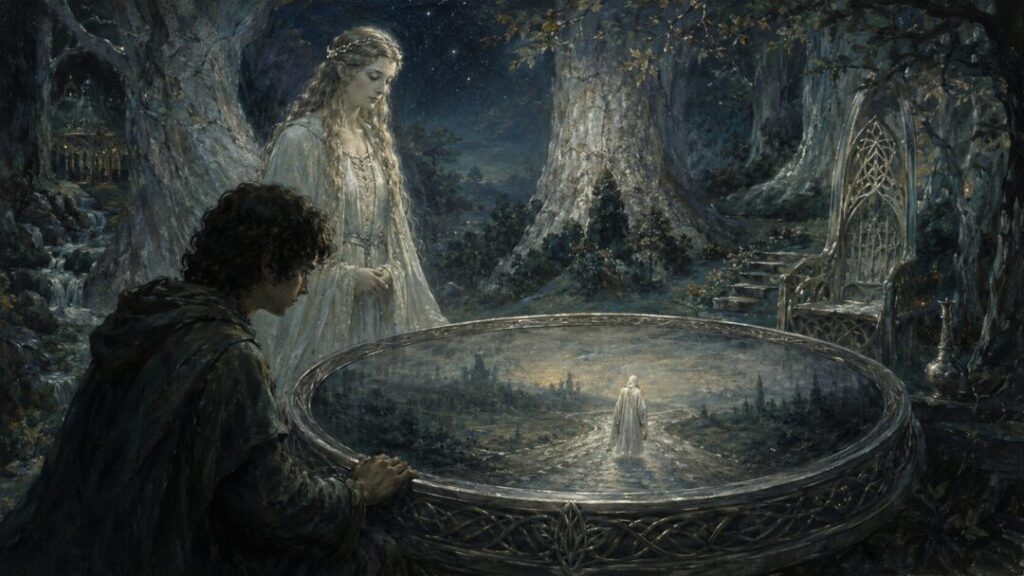
Galadriel tells Frodo and Sam that the Mirror may show things that were, things that are, and things that may yet be. But she also warns them that the visions are not always easy to understand. Some things shown may never come to pass unless the viewer turns aside from the path to prevent them.
This means the Mirror is powerful, but not simple.
It is not a spyglass. It does not behave like a map. It does not answer questions cleanly.
Still, one moment is hard to ignore.
When Frodo looks into the Mirror, he sees a long grey road. A figure comes down it, and Frodo thinks of Gandalf. But the figure is clothed in white, not grey. Its head is bowed, and Frodo cannot see the face before it passes from view.
The text never states that this is Gandalf.
But the implication is strong.
Frodo sees a figure who resembles the wizard he believes dead, yet now appears in white. Later, Gandalf will indeed return as the White Rider.
This vision does not prove that Galadriel saw the same thing. The Mirror shows visions to Frodo and Sam, and the text does not say what Galadriel herself saw, or whether she had already looked for Gandalf in it.
But it gives us a very important possibility.
Around the time Gandalf returned to life, the Mirror was capable of showing an image that pointed toward his return.
The Timing Is the Key
The timeline makes the mystery even sharper.
The Fellowship mourns Gandalf in Lórien. Frodo and Sam look into the Mirror. The Company leaves Lórien soon after. And then, while the remaining members of the Fellowship continue down the Anduin, Gandalf is found by Gwaihir and carried to Lothlórien.
This is the central clue.
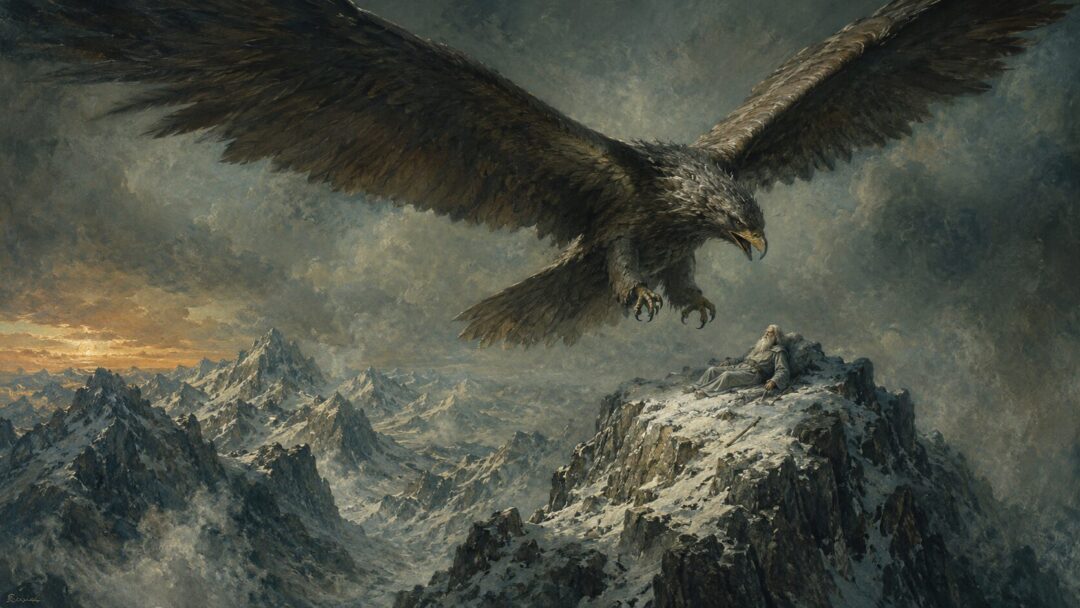
When Gwaihir finds Gandalf on the mountain-top, Gandalf asks to be carried to Lothlórien. Gwaihir answers that this was already the command of Lady Galadriel, who had sent him to look for Gandalf.
So Galadriel did not merely receive Gandalf after his return.
She acted before he arrived.
She sent Gwaihir to search.
That means that at some point after her earlier statement that she could not see Gandalf, something changed. Either the grey mist was lifted, or some sign reached her, or her perception revealed enough for her to act.
The text does not tell us exactly which.
And that silence is important.
What Galadriel Probably Knew
The most lore-safe answer is this:
Galadriel did not know clearly at first. But after Gandalf was sent back, she became aware enough to send Gwaihir to look for him.
That is not the same as saying she understood everything.
She may not have known the full nature of Gandalf’s return. She may not have known the exact meaning of what had happened beyond thought and time. She may not have known all that Gandalf himself would later reveal.
But she knew enough.
Enough to send the Windlord.
Enough to direct aid toward the mountain.
Enough to receive Gandalf in Lórien, where he was healed, clothed in white, and prepared to return to the war.
This fits the way Galadriel is written. Her wisdom is profound, but not absolute. She perceives patterns others miss. She reads hearts. She understands danger. She can act on signs that would be meaningless to lesser minds.
But she is not omniscient.
The story is stronger because of that.
Nenya Is Not the Answer by Itself
It is also tempting to say that Galadriel knew because of Nenya.
But the text never states that Nenya allowed her to locate Gandalf after Moria.
Nenya preserved and protected Lórien. It was associated with concealment, preservation, and resistance to decay. Galadriel’s realm is deeply shaped by it. But using Nenya as a simple explanation for long-distance detection goes beyond what the texts explicitly say.
So Nenya may belong to the larger picture of Galadriel’s power.
But it should not be treated as the direct answer.
The safer reading is that Galadriel’s own wisdom, foresight, the Mirror, and the lifting of the mist around Gandalf may all be part of the mystery. The exact mechanism is not stated.
And because it is not stated, it should remain carefully phrased.
Why Gwaihir Matters
Gwaihir’s role is easy to pass over, but it is essential.
The Great Eagles are not ordinary birds. They are intelligent, free, and powerful beings. They do not function as servants who can be casually ordered about. Yet Gwaihir is connected to the Wise and appears at decisive moments in the War of the Ring.
He had already rescued Gandalf from Orthanc after being sent as a messenger. Later, he comes again at Galadriel’s request.
That detail tells us that Galadriel did not simply hope Gandalf would return.
She took action.
She sent one of the only beings who could reach the peak quickly, search from the air, and carry Gandalf away if he was found.
This is not random luck. It is one of the quiet interventions of the Wise.
But it is also not overexplained.
No council is shown. No message is quoted. No scene shows Galadriel looking into the Mirror and saying, “He lives.”
The story leaves only the result.
Gwaihir was sent.
Gandalf was found.
Why Galadriel’s Ignorance Matters
There is a deeper reason the story does not make Galadriel certain from the beginning.
If she already knew Gandalf would return, the grief in Lórien would be hollow. The Fellowship’s loss would become a misunderstanding. Aragorn’s burden would feel temporary. The shadow over the Company would be softened too soon.
But that is not how the story works.
Gandalf’s fall is a real loss.
The Fellowship truly goes on without him.
Galadriel’s inability to see him confirms that the event is not merely hidden from the Hobbits or the reader. It is hidden even from one of the greatest powers left in Middle-earth.
That makes Gandalf’s return more astonishing.
It does not come because someone planned it neatly. It comes because Gandalf’s task was not finished, and because a power beyond the normal sight of Middle-earth sent him back.
Galadriel’s greatness is shown not because she knew everything.
It is shown because, once the hidden thing became visible enough, she acted.
The White Figure in the Mirror
Frodo’s vision remains one of the most haunting clues.
A figure like Gandalf appears, but in white. The face is not seen. The vision passes away before certainty can be reached.
This is exactly how the mystery works.
Not certainty.
Not explanation.
A glimpse.
The Mirror does not tell Frodo, “Gandalf will return.” It gives him an image that he cannot fully understand until later. It shows the truth in a form that is still veiled.
That may also be how Galadriel’s knowledge should be understood.
Not as simple information.
As perception through mist.
A sign. A change. A movement in the hidden pattern of events.
Enough to send Gwaihir.
Not enough to remove the mystery.
So How Did She Know?
The most accurate answer is also the most restrained.
Galadriel did not clearly know at first that Gandalf had survived. She explicitly says she could not see him from afar, because a grey mist was about him and his ways were hidden.
After Gandalf was sent back, that concealment seems to have changed.
At some point, Galadriel perceived enough to send Gwaihir to look for him. The text does not say whether this came through the Mirror, foresight, direct perception, or some combination of her powers and wisdom. Frodo’s vision of a white-clad figure resembling Gandalf shows that such a glimpse was possible, but it does not prove exactly what Galadriel saw.
So the honest answer is this:
Galadriel knew because Gandalf was no longer wholly hidden.
But she did not know in the simple, all-seeing way people often imagine.
She knew as the Wise often know in Middle-earth—partly, perilously, through signs, shadows, and sudden openings in the dark.
And that makes the moment more powerful.
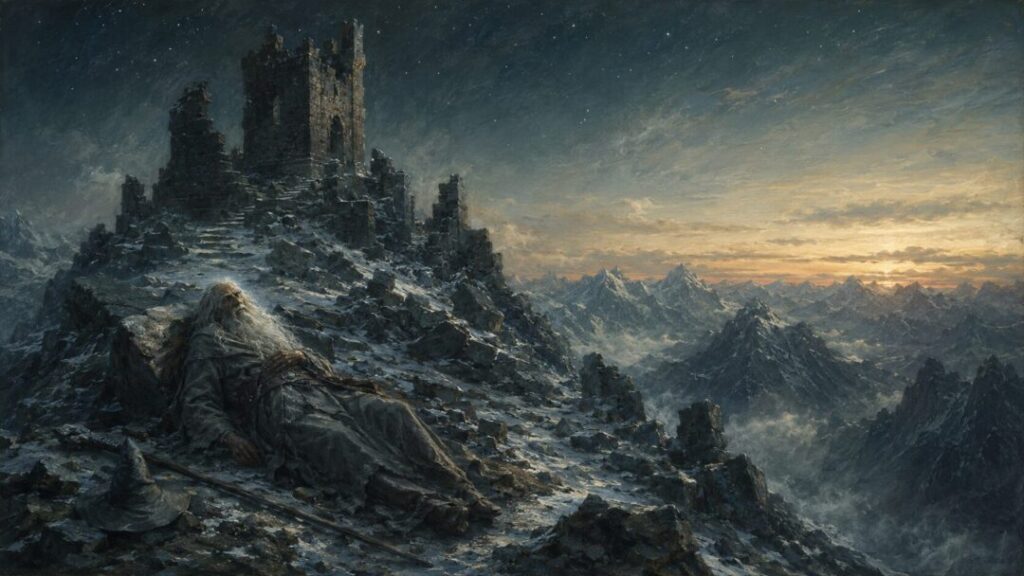
Because somewhere above the world, on the hard peak of Zirak-zigil, Gandalf lay returned to life, too weak to descend, clothed in no glory yet, forgotten by nearly all.
But not entirely.
In Lórien, the mist had shifted.
And Galadriel sent the Eagle.
Sources & Notes
- J.R.R. Tolkien, The Lord of the Rings, Book II, Chapter 7, “The Mirror of Galadriel” — Galadriel says Gandalf did not pass into Lórien and that a grey mist was about him; his ways were hidden from her.
- J.R.R. Tolkien, The Lord of the Rings, Book II, Chapter 7, “The Mirror of Galadriel” — Galadriel explains that the Mirror may show past, present, or possible future, while Frodo glimpses a white-clad figure like Gandalf.
- J.R.R. Tolkien, The Lord of the Rings, Book III, Chapter 5, “The White Rider” — Gandalf recounts the battle from Moria to Zirak-zigil, his passage “out of thought and time,” and his return.
- J.R.R. Tolkien, The Lord of the Rings, Book III, Chapter 5, “The White Rider” — Gandalf says Gwaihir found him on the mountain because Galadriel had sent the Eagle to seek him.