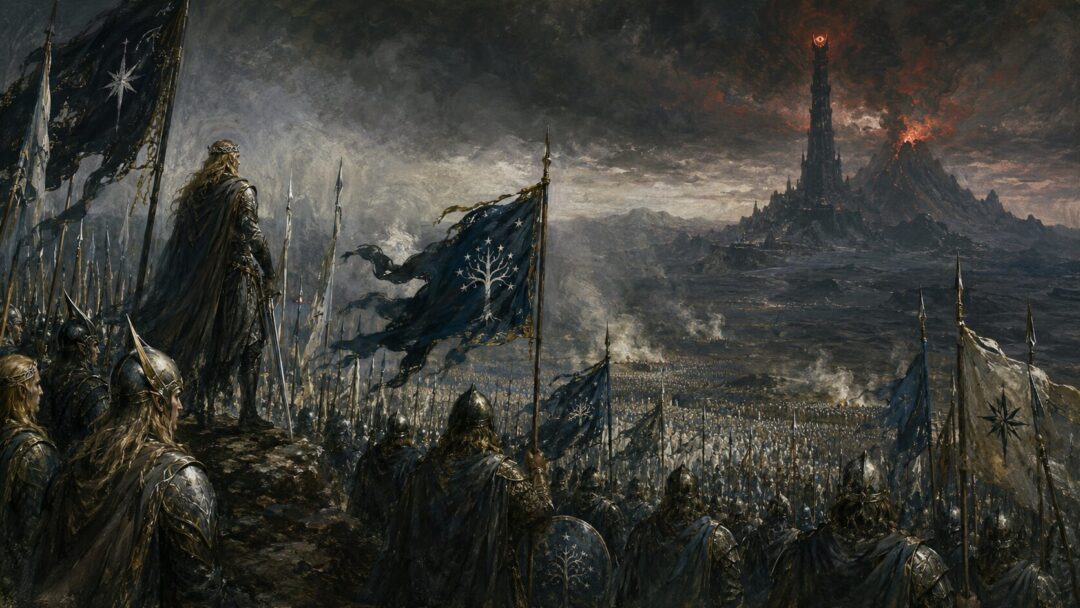
At first glance, the Last Alliance looks like the kind of victory that should have ended the darkness for good.
Sauron was defeated. His armies were broken. Barad-dûr fell. The Second Age ended with the greatest union of Elves and Men standing over the ruin of the Dark Lord’s power.
It feels, for a moment, final.
And yet the whole history of the Third Age proves that it was not.
The Ring survived. The Nazgûl returned. Mordor rose again. Sauron, though formless and weakened, was not gone beyond recall. The victory that should have cleansed Middle-earth became instead a long delay before the same Shadow returned in another form.
So why did the Last Alliance not end evil forever?
The easy answer is Isildur.
But that answer is too small.
Isildur’s choice matters deeply. The texts make that clear. Yet the failure to end evil was not only the failure of one man standing beside the fires of Mount Doom. It was also a sign of something far larger: Sauron could be overthrown by war, but the roots of evil in Middle-earth ran deeper than Sauron’s body, deeper than Mordor’s armies, and deeper even than the Second Age itself.
The Last Alliance won a real victory.
But it was not the kind of victory that could heal the world.
The Last Alliance Truly Did Defeat Sauron
Before looking at what the Last Alliance failed to do, it is important to see what it actually accomplished.
This was not a symbolic victory. It was not a minor setback for Sauron. The Last Alliance broke his military power at the end of the Second Age.
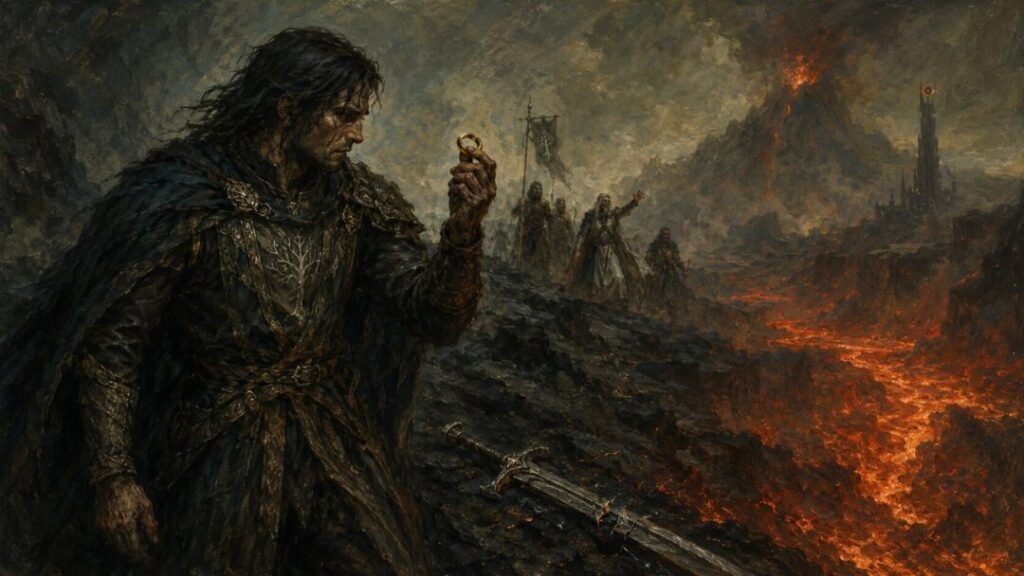
Gil-galad, High King of the Elves in Middle-earth, and Elendil, High King of the Dúnedain, joined their strength against Mordor. Their forces fought Sauron’s armies on the Dagorlad and then besieged Barad-dûr for years. Anárion, Elendil’s son, was slain during the siege. At the end, Sauron himself came forth.
The confrontation was terrible.
Gil-galad and Elendil both died in the struggle. Elendil’s sword, Narsil, broke beneath him. Yet Sauron too was overthrown, and Isildur cut the One Ring from his hand.
That point matters.
The Last Alliance did not merely inconvenience Sauron. It destroyed the form in which he had worked such evil. It ended his open rule in Mordor. It brought the Second Age to its close.
For many in Middle-earth, it must have looked like the world had been saved.
And in one sense, it had.
But the victory had a hidden weakness.
Sauron had placed too much of himself into something that still remained.
The Ring Was Not a Trophy
The central mistake at the end of the Last Alliance was not simply that Isildur kept a dangerous object.
It was that the object was the foundation of Sauron’s continued threat.
The One Ring was not merely a weapon Sauron carried. It was made by him to rule the other Rings of Power, and into it he had put a great part of his own power. That made the Ring more than a symbol of his kingship. It was bound to his ability to dominate, endure, and return.
When Isildur took it, Sauron was robbed of it.
But the Ring was not destroyed.
That distinction shapes the entire Third Age.
Sauron could be cast down while the Ring remained, but he could not be finally reduced to nothing while the Ring still existed. The texts are careful here. Sauron after the Last Alliance was weakened, disembodied, and unable for a long time to take shape again. But his survival was still possible because the Ring endured.
This is why Elrond and Círdan urged Isildur to destroy it.
They understood, at least enough, that the victory was incomplete while the Ring remained. The war had brought them to the one place in the world where Sauron’s greatest work could be undone.
And there, at the edge of final victory, the Ring passed into another hand.
Isildur’s Choice Was Tragic, Not Simple
It is easy to reduce Isildur to a fool.
That is not how the texts ask us to read him.
Isildur was not a servant of Sauron. He was not a petty thief grabbing treasure from a battlefield. He was the son of Elendil, survivor of Númenor’s downfall, heir of a people who had lost almost everything. At the end of the war, his father and brother were dead. His house had paid for victory in blood.
When he claimed the Ring, he named it weregild for his father and brother.
That does not make the choice wise.
But it makes it human.
The Ring did not need Isildur to worship Sauron. It did not need him to understand its full nature. It only needed him to claim it. Grief, pride, inheritance, memory, and justice could all become openings.
This is one of the darker truths about the Ring.
It rarely begins by asking someone to do evil for evil’s sake. It works through desires that can look understandable from the inside. Boromir wants to defend Gondor. Galadriel imagines what she could become if she took it. Frodo, at the end, cannot willingly cast it away. Even Sam, briefly, sees visions of using its power to turn the world into a garden.
Isildur’s claim belongs to that same pattern.
The Ring survived because it found a place in the wound left by victory.
The Last Alliance Defeated Sauron’s Body, Not His Design
The war ended Sauron’s immediate dominion.
It did not undo what he had already made.
This is why the aftermath is so unsettling. Barad-dûr could be thrown down, but its foundations remained as long as the Ring existed. Sauron’s armies could be scattered, but the structures of fear, corruption, and servitude he had built did not vanish from the world in a single moment.
The Ring itself was his design continuing without him.
That is the terrible brilliance of it.
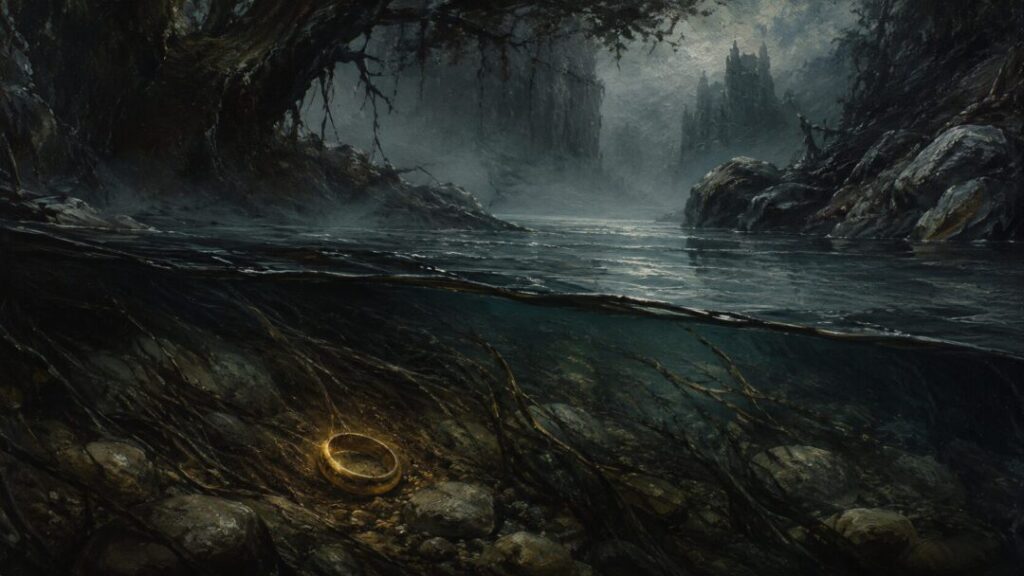
Even when Sauron was unable to act openly, the Ring preserved the possibility of his return. It betrayed Isildur in the Anduin. It vanished for long years. It came to Sméagol. It passed to Bilbo. It remained hidden, but not harmless.
The Third Age is therefore not the story of evil beginning again from nothing.
It is the story of an unfinished evil slowly finding its way back to power.
The Last Alliance cut down the tree.
But the root remained alive.
Evil Was Older Than Sauron
There is an even deeper reason the Last Alliance could not end evil forever.
Sauron was not the beginning of evil in Arda.
Before he was the Dark Lord of Mordor, Sauron had been the servant of Morgoth. The evil that scarred the world did not originate with him. He inherited, continued, and reshaped it. His methods were his own, but the darkness he served was older.
That matters because it changes what the Last Alliance was capable of doing.
An army can overthrow a tyrant. It can break a fortress. It can scatter servants. It can end a reign.
But it cannot remove every wound left in the world by ages of corruption.
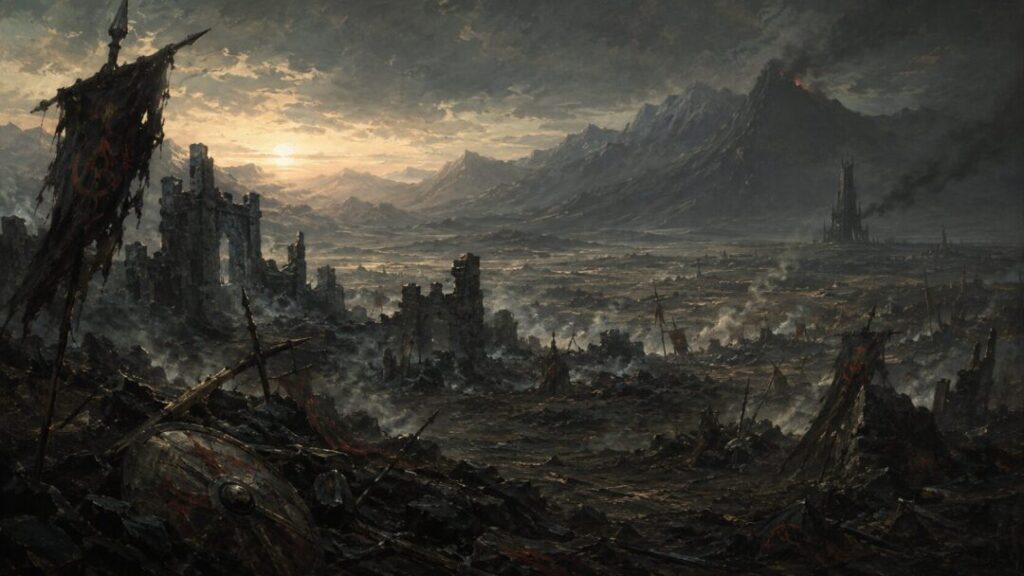
The Orcs did not exist only because Sauron stood in Mordor. Cruelty, fear, domination, pride, and the desire to possess did not vanish when his body fell. The peoples of Middle-earth were still capable of failure. The world was still marked by what had come before.
This does not make the Last Alliance meaningless.
It makes its victory more tragic.
It defeated the Dark Lord of its age, but it could not return Arda to innocence.
The Third Age Was Built on an Unfinished Victory
The beginning of the Third Age is often remembered as the aftermath of victory.
But it is also the aftermath of incompletion.
The great leaders of the Alliance were gone. Gil-galad had no successor as High King of the Noldor in Middle-earth. Elendil was dead. The friendship of Elves and Men had achieved something extraordinary, but the world that followed was already diminished.
The Elves would continue to fade.
The kingdoms of Men would endure, but not without decline.
The Watchful Peace would come later, and after it, darker things would stir again. The Nazgûl would return. Angmar would rise against the North. Mordor would not remain empty forever. Sauron would eventually take shape again in the world, first hidden, then revealed.
This does not mean the Last Alliance failed.
It means its success was temporary because its central danger was not destroyed.
The Ring had passed out of history, but not out of existence.
Middle-earth was living on borrowed time.
Why the Ring Had to Be Destroyed by the Small, Not the Great
There is a strange contrast between the end of the Second Age and the end of the Third.
At the end of the Second Age, the greatest military alliance of Elves and Men defeats Sauron, reaches Mount Doom, and still does not end the Ring.
At the end of the Third Age, no great army destroys it.
A small company sets out in secrecy. The Ring is carried not by a king, not by an Elf-lord, not by a warrior seeking glory, but by a Hobbit. Even then, Frodo does not finally cast it away by strength of will. At the last moment, he claims it. The Ring is destroyed only through the tangled result of mercy, pity, Gollum’s obsession, and providence.
That contrast is not accidental.
Power could bring the West to the gates of Mordor.
Power could defeat armies.
Power could even overthrow Sauron’s body.
But power could not master the Ring.
The Ring was designed to answer power with temptation. The greater the claim, the more dangerous the bearer. Kings, captains, and the Wise all understood, in different ways, that using the Ring would mean falling into the logic of Sauron himself.
The Last Alliance came close to ending evil by force.
The War of the Ring ends only when the Ring is unmade, not used, claimed, or preserved.
The Victory Was Real, But Not Final
The Last Alliance did not end evil forever because it was fighting something that could not be ended by battle alone.
It defeated Sauron’s armies.
It overthrew Sauron’s body.
It brought the Second Age to an end.
But it did not destroy the Ring. It did not erase the older corruption of Arda. It did not remove the weakness of hearts that the Ring could exploit. It did not heal every wound left by Morgoth, Númenor, and Sauron’s long dominion.
That is why the ending of the Second Age feels so powerful.
It is both triumph and warning.
The greatest warriors of the age won the greatest war of their time, and still the decisive act remained undone. The battlefield was not enough. The siege was not enough. Even the overthrow of Sauron was not enough.
Because evil in Middle-earth is not only an enemy outside the gates.
It is also the desire to possess what should be surrendered.
The Darker Meaning of Isildur’s Bane
The name “Isildur’s Bane” is often treated as a label for the Ring because it led to Isildur’s death.
But it means more than that.
The Ring was his bane because it turned victory into danger. It took the ending of a war and made it the beginning of another long shadow. It transformed a moment of triumph into a hidden wound carried into the next age.
Isildur did not intend to preserve Sauron.
But by preserving the Ring, he preserved the condition of Sauron’s return.
That is the tragedy.
Not that the Last Alliance achieved nothing.
But that it achieved almost everything.
It came to the very edge of final deliverance. It paid the price in kings, blood, and years of war. It brought the Enemy down.
And then, at the last moment, the smallest remaining thing became the most dangerous thing in the world.
Why This Matters
The Last Alliance did not end evil forever because Middle-earth is not a world where evil can be solved by one victory.
Even a righteous war cannot cleanse every corruption.
Even a defeated tyrant can leave behind a design.
Even the heroic can be wounded by grief, pride, and possession.
That is why the end of the Second Age is not simply a failure. It is a warning about the limits of strength. The Last Alliance shows the highest power of Elves and Men united in courage, sacrifice, and endurance.
But the Ring reveals the one thing that power could not do.
It could not let go.
The final victory had to wait for another age, another road, and another kind of courage.
Not the courage to defeat Sauron in combat.
The courage to carry his Ring without using it.
The courage to pity what deserved judgment.
The courage to keep going when victory no longer looked glorious.
The Last Alliance ended Sauron’s reign.
But it did not end evil forever.
Because the deepest evil was never only standing in Mordor.
Some of it was still waiting in the Ring.
And some of it was waiting in the hearts of those who believed they had already won.
Sources & Notes
- J.R.R. Tolkien, The Silmarillion, ‘Of the Rings of Power and the Third Age’ — the Last Alliance, the siege of Barad-dûr, Sauron’s overthrow, and Isildur cutting the One Ring from his hand.
- J.R.R. Tolkien, The Lord of the Rings, Book II, Chapter 2, ‘The Council of Elrond’ — Elrond’s account of urging Isildur to destroy the Ring and Isildur claiming it instead as weregild.
- J.R.R. Tolkien, The Lord of the Rings, Book I, Chapter 2, ‘The Shadow of the Past’ — Gandalf’s explanation that Sauron’s power endured while the One Ring remained, and that the Ring could only be unmade in Orodruin.
- J.R.R. Tolkien, The Silmarillion, ‘Of the Rings of Power and the Third Age’ — Barad-dûr’s foundations endured because they were made with the power of the Ring, and Sauron slowly returned in the Third Age.
- J.R.R. Tolkien, The Silmarillion, ‘Valaquenta’ and ‘Of the Enemies’ — Sauron as Morgoth’s greatest servant, showing that the evil behind the Third Age shadow was older than Sauron’s reign in Mordor.
- J.R.R. Tolkien, Letter 131 — Tolkien’s summary of Sauron’s motive of ordering and dominating Middle-earth, useful background for the article’s interpretation of power, possession, and the Ring.