At first glance, Denethor’s death looks like a failure of rescue.
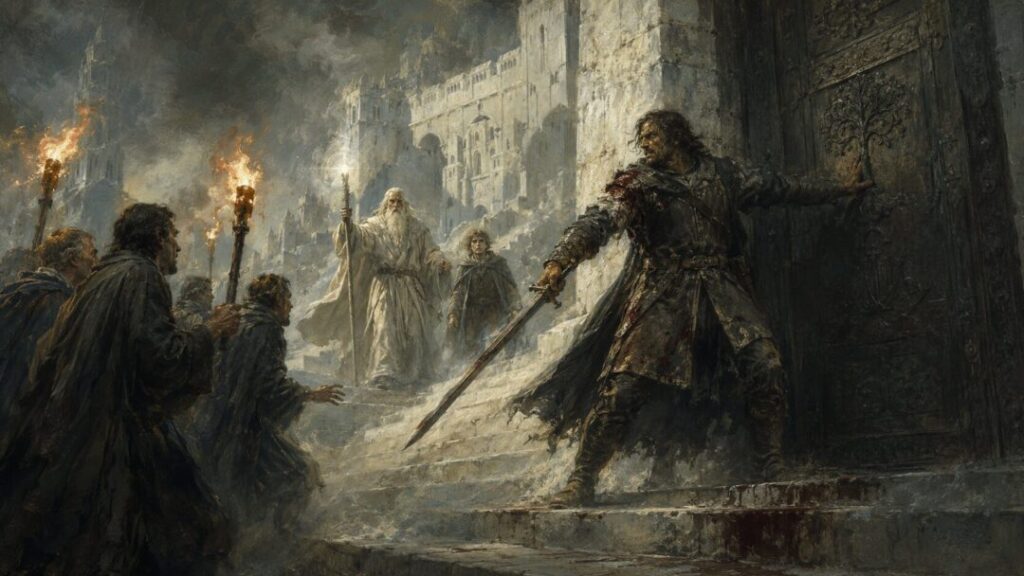
Gandalf arrives at the House of the Stewards. Faramir is still alive. The servants have prepared the pyre. Beregond has held the door with his sword. Pippin has done the only thing he could do: he has run for help.
And then Gandalf comes.
For a moment, it seems as if the pattern of the story should repeat itself. Gandalf has brought Théoden back from a shadowed mind. He has faced the Balrog. He has returned from death. He has stood before the gate of Minas Tirith while the Lord of the Nazgûl entered.
Surely, if anyone can pull Denethor back from despair, it should be him.
But he cannot.
He saves Faramir. He rebukes Denethor. He breaks the Steward’s command over death.
Yet Denethor himself is not saved.
That is not because Gandalf is weak. It is because Denethor’s fall is not the same kind of fall as Théoden’s. Denethor is not merely enchanted, poisoned by a counselor, or confused by false words. His despair has grown from grief, pride, knowledge, and a terrible misuse of vision.
Gandalf can oppose Sauron.
He can reveal truth.
He can command, warn, and rescue.
What he cannot do is force Denethor to hope.
Denethor Was Not a Simple Madman
The easiest version of this scene is also the least interesting one.
Denethor sees terrible things, loses his mind, and burns himself.
But the text gives us something more difficult.
Denethor is not presented as a foolish ruler. He is stern, proud, suspicious, and often cruel in judgment, especially toward Faramir. But he is also intelligent, disciplined, and formidable. He has long governed Gondor under the pressure of Mordor. He understands war. He understands the weakness of the West. He knows more than many around him.
That is part of the tragedy.
Denethor does not fall because he knows nothing.
He falls because he knows too much in the wrong way.
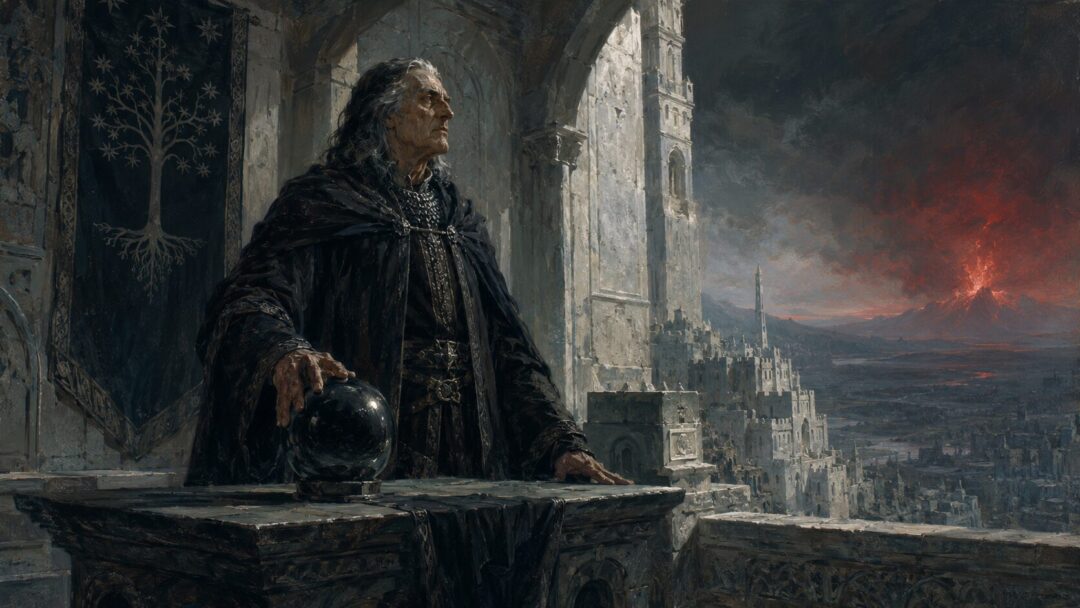
He has seen Mordor’s strength. He has measured the armies gathering against him. He has looked through the Anor-stone, the palantír of Minas Tirith, and through it he has perceived things that most men could never have borne.
The danger is not that every vision is false.
The danger is that truth can be arranged into despair.
Sauron does not need Denethor to believe childish lies. He only needs him to see the war without providence, without mercy, without the hidden movement of hope.
That is a far more subtle defeat.
The Palantír Did Not Simply “Control” Him
One of the most common misunderstandings about Denethor is that Sauron controls him through the palantír.
The texts are more careful than that.
Denethor had a rightful claim to use the Anor-stone as Ruling Steward of Gondor. He was also a man of great will. Unlike Saruman, he is not described as simply ensnared and made into Sauron’s servant.
In fact, this makes his fall more frightening.
Denethor resisted domination. He was not weak-minded. He did not bow to Sauron or become his agent. He hated Sauron.
But hatred is not the same as hope.
The palantír became dangerous because Sauron could shape what Denethor was allowed to perceive. Denethor could see real things, but not the whole meaning of them. He could see strength in Mordor, but not the small road into Mordor. He could see ships coming up the Anduin, but not yet understand that Aragorn had taken them. He could see the vastness of the Enemy, but not the hidden weakness at the center of Sauron’s power.
And Denethor was exactly the sort of man who would trust what his own strength had won.
That is the trap.
Sauron does not have to put chains on Denethor’s mind. He only has to feed Denethor’s certainty.
Grief Made the Vision Worse
Denethor’s despair does not begin on the pyre.
It has roots.
He has lost Boromir, the son he loved openly and preferred. The broken horn of Gondor has come back to Minas Tirith. Faramir, the son who remains, has long lived under his father’s disappointment. And when Faramir is carried back from the retreat, gravely wounded and fevered, Denethor’s last personal hope collapses.
This matters because Denethor’s public despair and private grief become inseparable.
He is not only watching Gondor fall.
He is watching his house end.
Boromir is dead. Faramir appears to be dying. The line of Stewards seems to be closing in fire. And beyond that, Aragorn is approaching: not merely a captain from the North, but the returning heir of the kings.
To Gandalf, Aragorn’s coming is hope.
To Denethor, it is loss.
Not because Denethor loves Sauron, but because he cannot imagine a future in which Gondor is saved and his own authority is diminished. He wants the world preserved as it was: Gondor ruled by its Steward, Boromir alive, Faramir obedient, the old order intact.
But the War of the Ring does not save the old order.
It ends it.
And Denethor cannot accept that kind of salvation.
Gandalf’s Power Has a Boundary
This is where Gandalf’s failure becomes clearer.
Gandalf is not sent into Middle-earth to rule the wills of Men and Elves. His task is to counsel, kindle resistance, unite the Free Peoples, and oppose Sauron without becoming another Sauron in white robes.
That distinction is essential.
Gandalf can command in moments of crisis. He can break a sword from Denethor’s hand. He can take Faramir from the pyre. He can rebuke the Steward and declare that Denethor has no authority to order the hour of his son’s death.
But he cannot seize Denethor’s soul and rearrange it.
He cannot make Denethor humble.
He cannot make him accept Aragorn.
He cannot make him believe that victory may come through something small, hidden, and beyond his control.
That kind of coercion would belong to the logic of the Enemy.
Sauron dominates. Gandalf summons.
Sauron bends wills. Gandalf calls them back to themselves.
That is why Gandalf can restore Théoden when Théoden is being smothered by the influence of Wormtongue and Saruman. Théoden still has a self that can answer. He can stand. He can choose. He can ride.
Denethor, by the time Gandalf reaches him, is still choosing.
That is the horror.
Denethor Rejects the Hope Offered to Him
When Gandalf confronts Denethor, the Steward does not speak like a man who has merely misunderstood the situation.
He speaks like a man who has judged it.
He believes the West has failed. He believes Sauron’s victory is inevitable. He believes the coming of Aragorn would mean his own displacement even if Minas Tirith survives. He refuses to be a dotard chamberlain to an upstart.
Those are not random ravings.
They reveal the shape of his despair.
Denethor’s deepest wound is not only fear of Mordor. It is the loss of mastery. He can endure hardship if he remains the one who sees, commands, judges, and rules. What he cannot endure is a future he did not author.
This is why the palantír is so dangerous for him.
It gives him knowledge without surrender.
It lets him look farther than other men.
It confirms his sense that he alone understands the true scale of the war.
And then, at the last, it shows him a world in which all his strength is not enough.
For a humbler man, that might have become the beginning of trust.
For Denethor, it becomes annihilation.
Faramir Is Saved Because Faramir Has Not Chosen Despair
The contrast with Faramir is quiet but crucial.
Faramir is wounded, fevered, and near death. He cannot save himself. But he has not chosen the fire. He has not consented to Denethor’s judgment. He is being carried into death by another man’s despair.
So Gandalf can intervene.
He can remove Faramir from the pyre because Denethor has no rightful authority to burn the living. Faramir’s body can be rescued. His wound can be brought to the Houses of Healing. His life can be preserved until the hands of the king reveal Aragorn for what he is.
Faramir’s healing belongs to one of the most beautiful reversals in the Minas Tirith chapters.
Denethor rejects the returning king.
Faramir is healed by him.
The father sees Aragorn as a threat to the Stewardship.
The son awakens into a world where the King has come, and he will later serve him freely.
That is not accidental. The story places two responses to the end of the old order side by side.
Denethor clutches authority until it becomes a pyre.
Faramir lives to surrender authority without losing honor.
The Black Ships Were the Final Cruelty
One of the sharpest details in Denethor’s despair is his reference to the black ships.
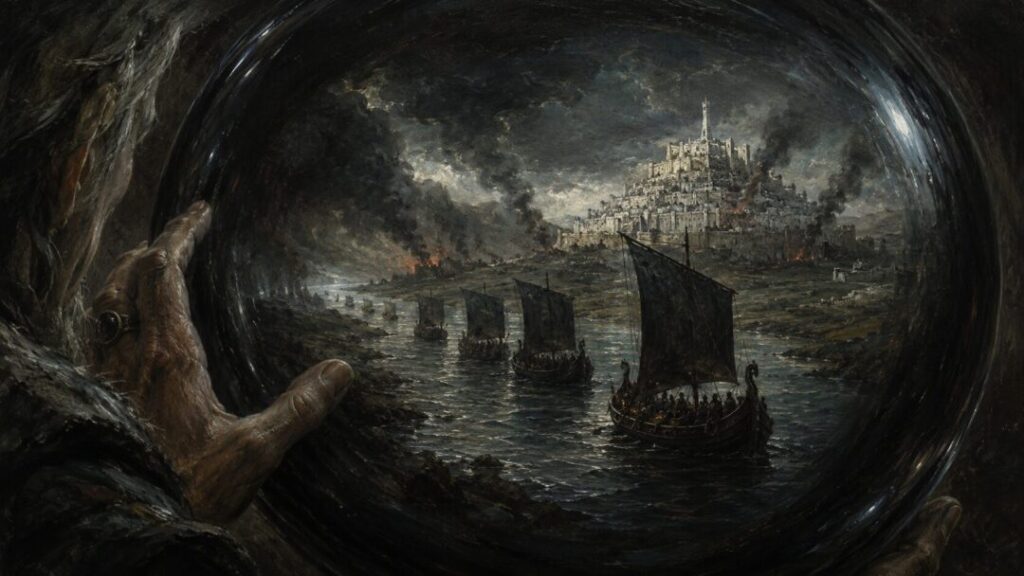
Through the palantír, he has seen the Corsair ships coming up the Anduin. To him, this confirms final defeat. Gondor is attacked from the east, and now from the south. Rohan may not be enough. The city is encircled by doom.
But the reader later understands what Denethor does not.
The ships are not bringing the Enemy’s reinforcements.
They are bringing Aragorn.
This is the perfect example of Sauron’s method with Denethor. The vision is not necessarily false. The ships are real. Their approach is real. The danger they once represented was real.
But Denethor reads the sign before the story is complete.
He sees the shape of doom where hope is hidden.
And because he trusts the palantír more than he trusts Gandalf, he accepts the incomplete vision as final truth.
That is one of the central lessons of the scene.
Despair is not always ignorance.
Sometimes despair is a true fact worshiped too soon.
Why Gandalf Walks Away With Faramir
After Denethor’s death, Gandalf does not remain to mourn him at length.
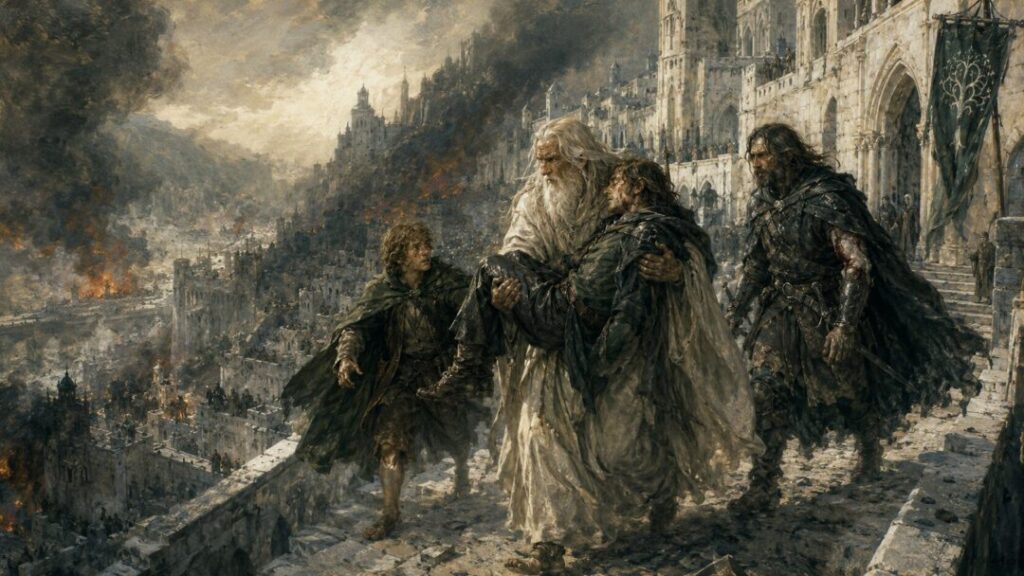
He carries Faramir away.
That may seem cold, but it is deeply consistent with the moral structure of the moment. Gandalf cannot save the man who has finally refused him. He can still save the man whom despair tried to consume.
The city is still under siege. The battle is still raging. The Lord of the Nazgûl has not yet fallen. The Houses of Healing still wait.
Gandalf’s task is not to undo every tragedy.
It is to preserve every living hope that can still be preserved.
Denethor’s death is terrible, but it is not allowed to become the final meaning of the chapter. Almost immediately, the story turns toward another cry from the battlefield, another reversal, another sign that Denethor’s vision was not complete.
The Witch-king falls.
The darkness breaks.
The wind changes.
Everything Denethor believed was inevitable begins to come undone.
But he is no longer alive to see it.
The Tragedy of Denethor
Denethor could not be saved by Gandalf because his despair was not simply placed upon him from outside.
It was cultivated in him.
Sauron exploited it. The palantír sharpened it. Grief deepened it. Pride defended it. But Denethor finally embraced it as judgment.
He looked at the world and decided that if he could not preserve it on his own terms, then it was not worth receiving on any other terms.
That is why his end feels so different from Boromir’s.
Boromir falls, but repents.
Théoden weakens, but rises.
Faramir suffers, but is healed.
Denethor sees, understands much, resists domination, and still chooses ruin.
The most frightening thing about him is not that Sauron breaks a weak man.
It is that Sauron helps a strong man become certain of the wrong ending.
The Hope Gandalf Could Not Force
Gandalf’s presence at the pyre shows us the limit of even holy wisdom in Middle-earth.
He can stand against darkness.
He can expose lies.
He can call the proud to turn back.
He can rescue the innocent from another man’s madness.
But he cannot make hope compulsory.
And that is why Denethor’s death remains one of the most devastating moments in The Lord of the Rings. It is not the death of a fool. It is the death of a man who had enough strength to resist Sauron, but not enough humility to trust anything beyond his own sight.
Gandalf could save Faramir from the fire.
He could not save Denethor from the conclusion Denethor had chosen.
That is the tragedy.
Not that no help came.
But that when help came, Denethor had already decided it was too late.
Sources & Notes
- J.R.R. Tolkien, The Lord of the Rings, Book V, Chapter 7, “The Pyre of Denethor” — gives Denethor’s palantír-shaped despair, his refusal of Gandalf’s counsel, and Gandalf’s rescue of Faramir from the pyre.
- J.R.R. Tolkien, Unfinished Tales, “The Palantíri” — explains Denethor’s lawful but perilous use of the Anor-stone and how Sauron could bend what was seen toward despair without simply making Denethor his servant.
- J.R.R. Tolkien, The Lord of the Rings, Book III, Chapter 6, “The King of the Golden Hall” — contrasts Théoden’s recovery under Gandalf with Denethor’s later refusal, showing that Gandalf summons a will back rather than overriding it.
- J.R.R. Tolkien, Unfinished Tales, “The Istari” — frames Gandalf’s mission as counsel and encouragement against Sauron, not domination of the wills or governments of Elves and Men.
- J.R.R. Tolkien, The Lord of the Rings, Book V, Chapter 8, “The Houses of Healing” — completes the contrast by having Aragorn heal Faramir, the son Denethor tried to take into death, after Denethor rejects the returning king.