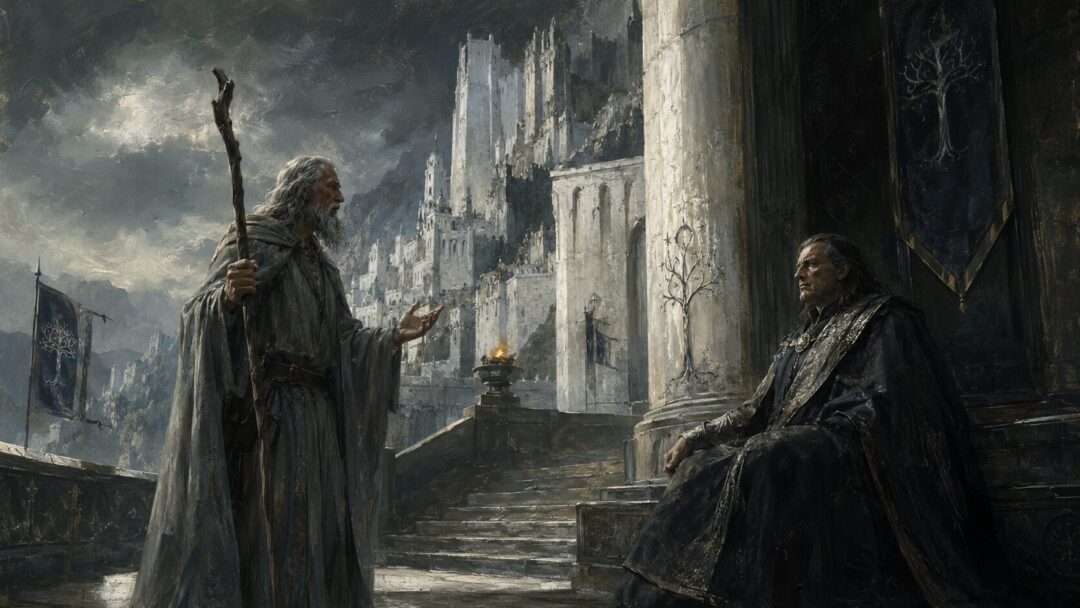
At first glance, Gandalf looks like the one person who should have ruled Middle-earth.
He is ancient. He is wise. He sees more clearly than kings, stewards, captains, and councils. He knows the danger of Sauron long before most of the world is willing to face it. He moves between kingdoms, speaks with Elves, counsels Dwarves, guides Hobbits, confronts Nazgûl, and stands before the darkness without bending.
If Middle-earth needed a ruler strong enough to oppose Sauron, Gandalf seems like the obvious answer.
And yet the story refuses that answer completely.
Gandalf never takes a throne. He never claims a realm. He never becomes lord of Gondor, Rohan, the Shire, Rivendell, or any kingdom great or small. Even when leaders fail, he does not replace them. Even when he is the wisest person in the room, he does not turn wisdom into ownership.
That is not an accident.
It is the center of what he was sent to do.
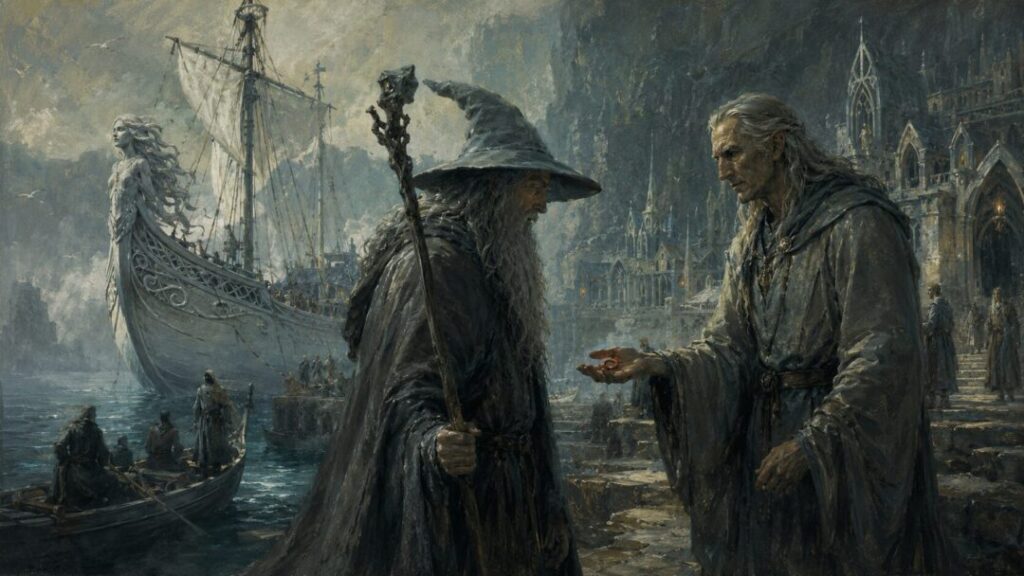
Gandalf Was Sent as a Guide, Not a King
The Wizards, or Istari, were not ordinary wanderers.
The texts identify them as emissaries from the West, sent into Middle-earth during the Third Age to oppose the rising shadow of Sauron. Their mission was real, and their authority was not merely personal. Gandalf was not simply a clever old man with good instincts. He belonged to an order sent for a purpose.
But that purpose came with limits.
The Istari were not sent to conquer Sauron by becoming a greater version of him. They were not meant to seize armies, dominate rulers, or impose victory from above. Their work was to advise, persuade, strengthen, and unite those who still had the will to resist.
That distinction changes everything.
Gandalf’s power was not meant to replace the courage of Middle-earth. It was meant to awaken it.
This is why he spends so much of the story doing things that look small beside the size of the war. He pushes Bilbo out of comfort. He draws Thorin’s company toward a larger purpose than treasure. He warns Frodo. He labors to bring Aragorn, Théoden, Denethor, Elrond, and others into the same struggle.
He does not build an empire.
He builds resistance.
The Temptation of Rule
The obvious objection is that Gandalf would have ruled well.
That may be true.
The texts give us no reason to think Gandalf desired tyranny. He is compassionate, patient, and deeply concerned with the freedom and dignity of others. He does not resemble Sauron in intention.
But Middle-earth is not only concerned with intention.
Again and again, the story asks what power does to the one who holds it, even when that power is first taken up for good reasons.
The One Ring makes this danger visible. The Ring does not tempt people only by offering cruelty. It tempts them by offering the ability to fix the world. Boromir imagines using it to defend Gondor. Galadriel imagines what she might become if she accepted it. Even Gandalf refuses the Ring because he knows he would be tempted to use it from pity, and through him it would wield a power too great and terrible to imagine safely.
That same moral logic sits behind Gandalf’s larger mission.
If the answer to Sauron were simply “put a wiser power in control,” then the struggle would remain trapped inside Sauron’s own idea of the world.
Sauron wants order through domination.
Gandalf’s mission is to make domination unnecessary.
“The Rule of No Realm Is Mine”
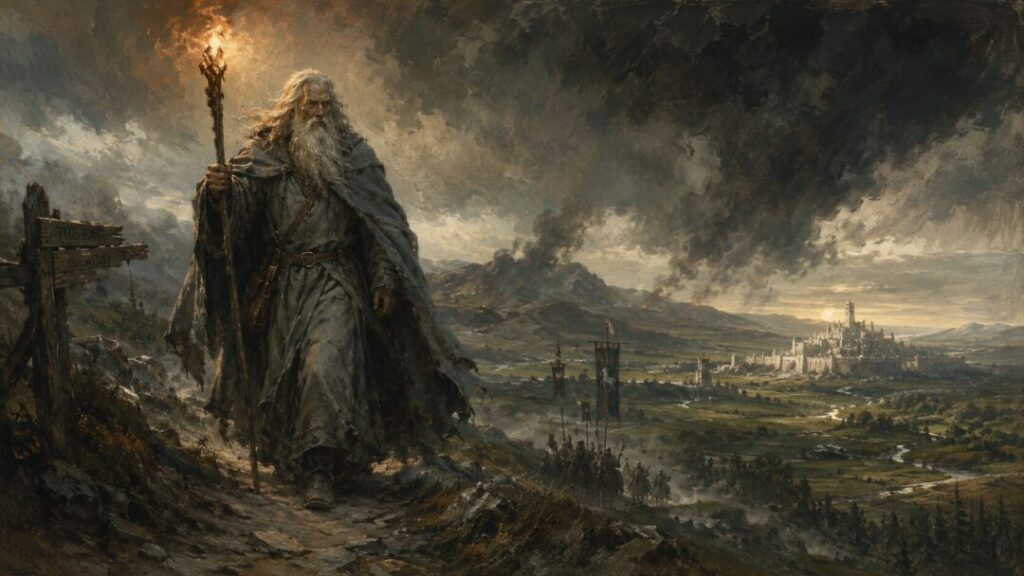
The clearest statement comes in Gondor.
When Gandalf speaks to Denethor, he does not claim authority over the city. He does not say that the Steward has failed and that he will now take command as ruler. He does not use the crisis as an opening to seize power.
Instead, he says that the rule of no realm is his, neither Gondor nor any other, great or small.
That line is easy to pass over because the war is pressing around it. Minas Tirith is under threat. Denethor is collapsing inward. Sauron’s armies are moving. There is no time for abstract philosophy.
But Gandalf’s answer matters precisely because of the pressure.
This is the moment when rule might seem justified. A weak steward, a dying city, a hidden king not yet revealed, and an enemy at the gate. If Gandalf were ever going to take control “for the greater good,” this would be the hour.
He refuses.
Not because he does not care what happens to Gondor. He cares intensely. He says that all worthy things in peril are his care. But care is not the same as possession.
That is the difference Denethor cannot understand.
Denethor thinks in terms of rule, succession, control, and loss. Gandalf thinks in terms of stewardship. His task is to preserve what can still grow, not to make it his.
Why the Free Peoples Had to Act for Themselves
This is one of the most important patterns in the War of the Ring.
The victory does not come because a higher power descends and fixes Middle-earth.
It comes through the courage of those who live there.
Frodo carries the Ring. Sam remains faithful. Aragorn accepts the burden of kingship. Théoden rides out of despair. Éowyn stands where she was not expected to stand. Faramir resists the temptation that overcame Boromir. Merry and Pippin become far more than comic wanderers from the Shire.
Gandalf is essential to all of this.
But he is not a replacement for any of it.
He can point, warn, kindle, and command in moments of battle. Yet the moral weight of the story falls on the choices of the peoples of Middle-earth themselves. They are not puppets moved by a divine strategist. They are agents whose courage matters because it is truly theirs.
That is why Gandalf ruling Middle-earth would not merely be politically strange.
It would break the moral structure of the story.
Middle-earth cannot be saved by being overruled.
Saruman Shows the Perverted Version
Saruman is the shadow-answer to the question.
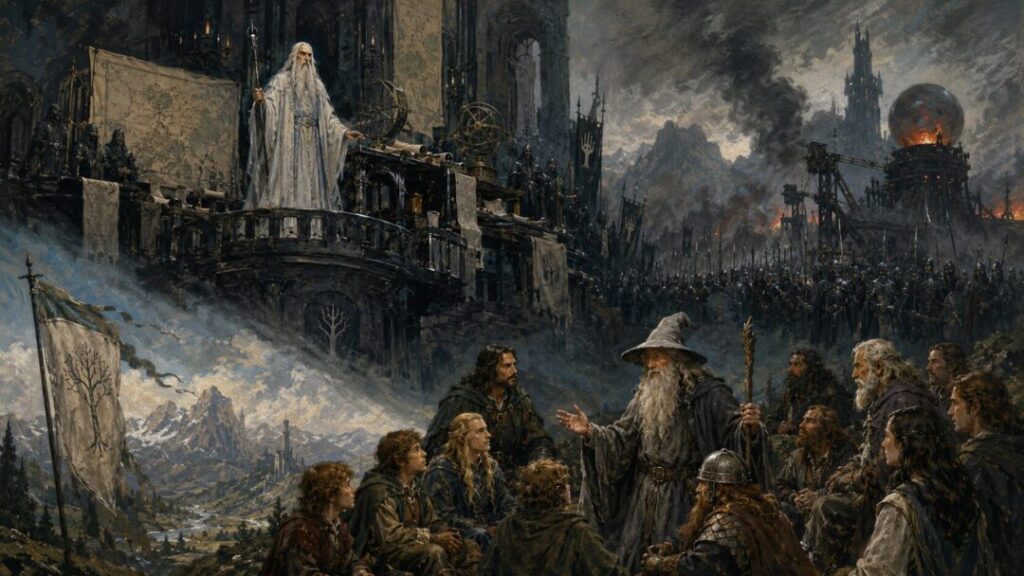
He too was one of the Wise. He too was sent with a mission against Sauron. He too possessed knowledge, authority, and persuasive power. But Saruman’s fall shows what happens when counsel becomes control.
He stops trying to awaken resistance and begins trying to manage outcomes. He gathers power to himself. He breeds armies. He bends others to his voice. He imagines that the Wise should direct history from above, using force and craft to reshape the world.
He does not begin as Sauron.
But he starts moving according to Sauron’s logic.
That is why Saruman is so important to understanding Gandalf. He is not merely a rival wizard. He is a warning about what the Istari could become if they abandoned the humility of their mission.
Gandalf’s refusal to rule is not weakness beside Saruman’s ambition.
It is the thing that keeps him faithful.
Narya and the Fire That Does Not Dominate
There is another clue in the Ring Gandalf bears.
Círdan gives Gandalf Narya, the Ring of Fire. But its significance is not that Gandalf becomes a lord of fire in some crude sense. The important idea attached to Narya is the rekindling of hearts in a world growing cold.
That fits Gandalf perfectly.
His fire is not the fire of conquest. It is the fire of courage.
He does not use it to make others kneel. He uses his presence, wisdom, and hope to help others stand. At his best, Gandalf does not make people smaller in the face of his greatness. He makes them more fully themselves.
That is why he is so often found among the unlikely.
Hobbits, especially, reveal the nature of his mission. Gandalf sees strength where the great do not think to look. He does not choose Frodo and Sam because they can be controlled like pieces on a board. He trusts them because small hands may act freely where the mighty would be corrupted by power.
A ruler gathers power upward.
Gandalf sends courage outward.
Why He Could Command in Battle but Not Rule the World
This does not mean Gandalf never gives orders.
He clearly does. In moments of crisis, he commands, rebukes, and leads. At Helm’s Deep, Minas Tirith, and during the desperate movements of the war, Gandalf acts with authority.
But temporary command in service of resistance is not the same as dominion.
The distinction matters. Gandalf can organize defense without claiming permanent sovereignty. He can guide a council without owning its members. He can challenge Denethor without making himself king. He can help bring Aragorn to his rightful place without becoming the power behind the throne.
His authority is real, but it is bounded by purpose.
Once the task is done, he leaves.
That departure is one of the strongest proofs of what he was. Gandalf does not remain in Middle-earth to supervise the Fourth Age. He does not become a guardian-ruler over Men. When Sauron is overthrown and the Ring is destroyed, his work is finished.
The world must now belong to those whose age has come.
Aragorn Had to Rule Because Gandalf Could Not
This also explains why Aragorn matters so much.
Aragorn is not simply the political solution Gandalf arranges. He is the rightful king returning to a realm of Men. His authority belongs within the history and destiny of Middle-earth itself. He is not an outside power sent to govern the Children of Ilúvatar. He is one of them.
Gandalf can help reveal the king.
He cannot become the king.
That difference is essential.
Aragorn’s rule represents restoration from within the world. Gandalf’s rule would have represented guardianship from beyond it. Even if benevolent, it would have kept Middle-earth under the hand of a power not meant to possess it.
The Fourth Age is not the age of Gandalf.
It is the age of Men.
His success is measured by the fact that he is no longer needed.
The Real Reason Gandalf Was Not Sent to Rule
So the answer is not simply that Gandalf was too humble.
It is deeper than that.
Gandalf was not sent to rule Middle-earth because ruling Middle-earth was not the cure for Sauron. The cure was not a better master. It was the awakening of free peoples who could resist mastery itself.
His mission required restraint.
He had to be strong enough to confront evil, but humble enough not to replace it. Wise enough to guide kings, but obedient enough not to become one. Powerful enough to inspire hope, but careful enough not to possess the hearts he kindled.
That is why Gandalf is so different from the usual fantasy image of the hidden great power.
He is not the secret king.
He is not the final weapon.
He is not the lord who saves the world by taking command.
He is the steward who helps others become brave enough to do what only they can do.
And when the war is over, he does the most Gandalf-like thing possible.
He lets Middle-earth go.
Sources & Notes
- J.R.R. Tolkien, Unfinished Tales, “The Istari” — states that the Wizards were sent to counsel and encourage resistance to Sauron, not to match him with open power or rule Elves and Men by force.
- J.R.R. Tolkien, The Lord of the Rings, Book I, Chapter 2, “The Shadow of the Past” — Gandalf refuses the Ring because he would try to use it from pity, making his goodness a route to terrible power.
- J.R.R. Tolkien, The Lord of the Rings, Book V, Chapter 4, “The Siege of Gondor” — Gandalf tells Denethor that “the rule of no realm is mine,” while claiming care for all worthy things in peril.
- J.R.R. Tolkien, The Silmarillion, “Of the Rings of Power and the Third Age” — recounts Círdan entrusting Narya to Mithrandir to support him in weariness and rekindle hearts against the growing cold.
- J.R.R. Tolkien, The Lord of the Rings, Book VI, Chapter 5, “The Steward and the King” — places Aragorn’s restored kingship after Sauron’s fall, showing Gandalf as guide to renewal rather than ruler in Men’s stead.