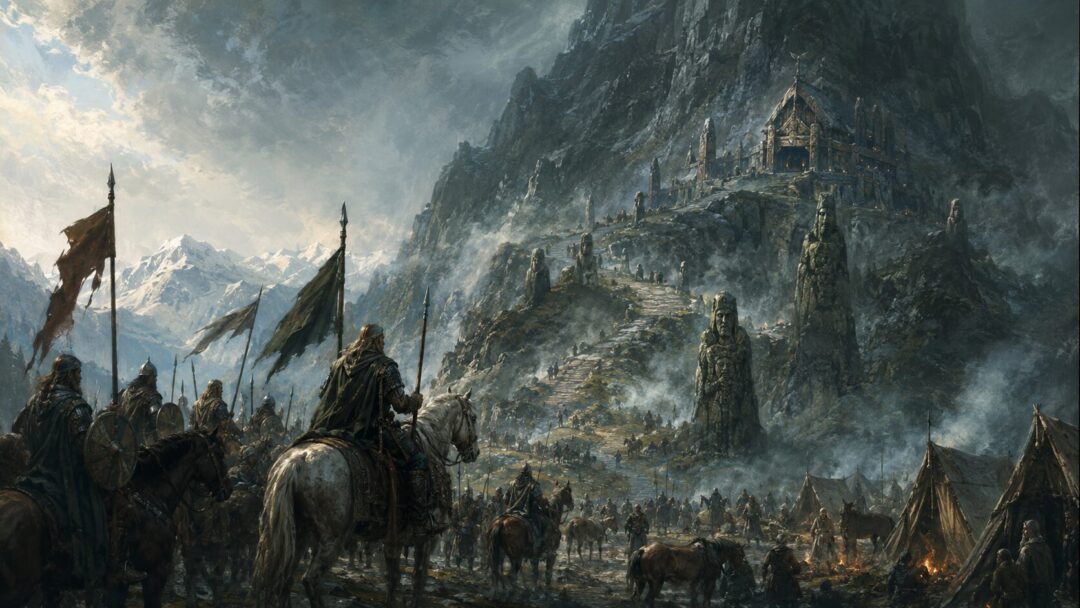
The beacons of Gondor were already burning, but Rohan did not ride at once.
That is the uncomfortable tension behind the Muster at Dunharrow. Minas Tirith was under threat. Sauron’s war was moving faster than any kingdom of Men could comfortably answer. Gandalf had already gone ahead with Pippin. Aragorn had left Théoden’s road and turned toward the haunted mountain. And still the Riders of Rohan gathered, counted, waited, and prepared beneath the shadow of Dunharrow.
At first glance, it can look like delay. Why not ride straight for Gondor? Why pause in the mountains when every hour mattered?
But the text presents Dunharrow as far more than a logistical stop. It is a place where Rohan’s military duty, political survival, ancient fear, and moral identity all converge. The muster is not simply about assembling horsemen. It is about whether a battered kingdom can still act as a kingdom when the end of the age seems to be closing around it.
Dunharrow Was a Refuge Before It Was a War Camp
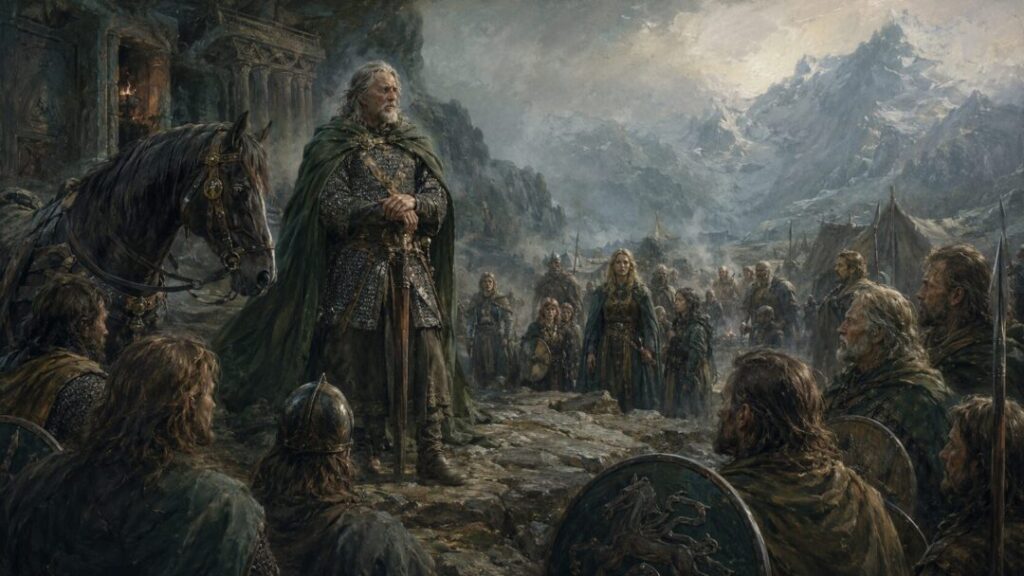
Dunharrow is not introduced as an ordinary military field. It is a hidden hold in the White Mountains, reached by a steep road and associated with older, stranger things than the Rohirrim themselves. The road, the standing stones, and the shadow of the Haunted Mountain make the place feel inherited rather than built by the present people of Rohan.
That matters. When Théoden comes to Dunharrow, he is not merely summoning soldiers. He is entering one of the deep refuges of his land. The people of Rohan have already begun to gather there because war has reached beyond the battlefield. Women, children, and the old must be sheltered while the riders go east. The muster therefore has a civilian dimension as well as a military one.
Rohan’s ride to Gondor is famous because of its charge on the Pelennor Fields. But before that charge can happen, the kingdom must decide what remains behind. Dunharrow allows the Rohirrim to separate those who can fight from those who must survive. It is a grim act of order in a collapsing world.
This makes the delay feel different. Théoden is not hesitating because he lacks courage. He is making sure that Rohan does not become only a weapon pointed at Minas Tirith. It must remain a people, a household, a realm with memory and continuity.
Théoden’s Choice Is Not Cowardice, but Kingship
One of the strongest contrasts in this part of the story is between Théoden’s renewed courage and the practical limits of that courage. After his healing at Edoras and his victory at Helm’s Deep, he is no longer the diminished king sitting under Wormtongue’s influence. Yet he is also not a reckless warlord.
A king cannot simply ride with whoever happens to be nearby. He must gather the strength of the Mark, appoint leadership, receive news, and decide how much of his people can be risked. The Muster at Dunharrow shows Théoden acting within the obligations of rule.
This is easy to miss because the story’s emotional momentum pushes toward Gondor. Readers feel the urgency of Minas Tirith. But within Rohan, the urgency is more complicated. The land has only just endured Saruman’s assault. The Westfold has suffered. The king’s son Théodred is dead. Théoden himself is old, recently restored, and surrounded by signs that the war is larger than any one king can master.
Dunharrow becomes the place where his courage is tested not by battle, but by responsibility. Riding too soon with too few could be brave and useless. Waiting too long could be prudent and fatal. The muster sits in that narrow space between impulse and duty.
The Numbers Reveal the Cost
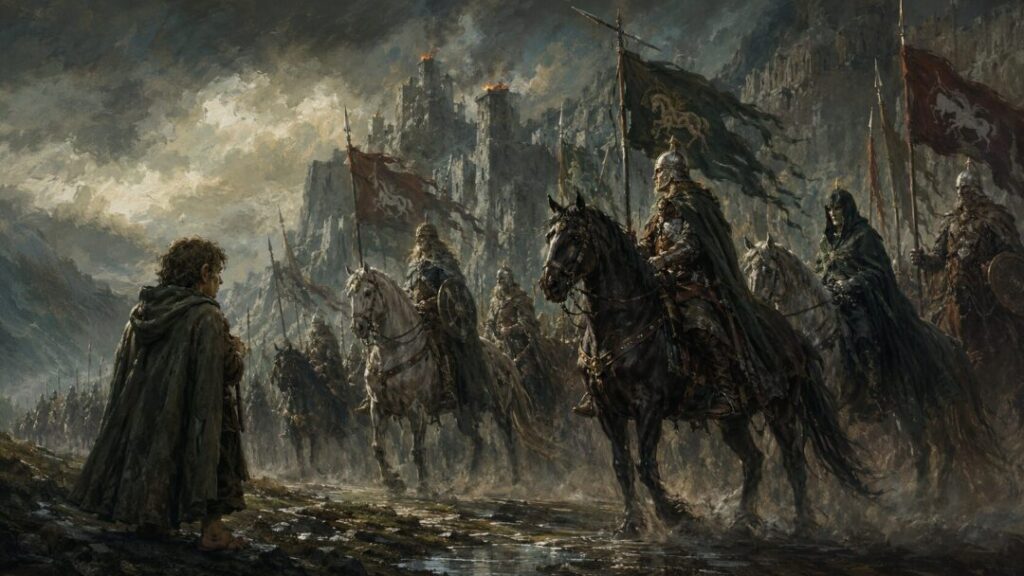
When Rohan finally rides, it does not ride with an unlimited host. The text makes clear that Théoden cannot bring the full strength he might have wished. The Riders who leave Dunharrow are a great force, but not the whole imagined power of Rohan. Some men must remain. Some are too far away. Some have already been lost or scattered in the wars that came before.
This is one reason the muster matters dramatically. It strips away the fantasy of perfect rescue. Gondor calls, and Rohan answers, but the answer is costly and incomplete. The ride is heroic precisely because it is not effortless.
The delay at Dunharrow therefore reveals the real condition of Rohan. This is not a fresh kingdom riding from peace into one glorious battle. It is a wounded realm mustering what it can after betrayal, invasion, grief, and exhaustion. The glory of the Pelennor is built on this earlier scene of limitation.
That is why the muster deepens Théoden’s later charge. When he cries out on the field before Minas Tirith, he is not leading an abstract cavalry force. He is leading the gathered remnant of a people who had to choose, almost overnight, whether to spend their remaining strength on another realm’s need.
Merry Shows What the Muster Costs Personally
Merry’s presence at Dunharrow turns the chapter inward. Through him, the muster becomes more than banners and spears. He is small, tired, and increasingly aware that great events may move forward without him. He has pledged himself to Théoden, but he is not treated as someone fit for the final ride.
That exclusion is not simple cruelty. From the perspective of the Rohirrim, Merry is a hobbit, a stranger, and physically unsuited to the long, punishing ride to Gondor. Théoden’s affection for him is real, but affection does not erase military necessity.
Still, Merry’s experience exposes the emotional cost of such necessity. In the middle of heroic preparation, someone loyal is being left behind. The muster sorts people into those who ride and those who wait, and that sorting wounds him.
This prepares one of the most important hidden turns of the story: Dernhelm’s offer to carry Merry secretly. The rider’s identity is later revealed as Éowyn, but at Dunharrow the moment already carries the weight of two excluded figures recognizing each other. Merry is barred because he seems too small. Éowyn is barred because she is a woman of the royal house expected to remain behind. Both are caught in the machinery of necessary war, and both find a way through it.
The muster, then, is not merely a delay before heroism. It is the pressure chamber that produces one of the great unexpected acts of the Pelennor.
Éowyn’s Silence Makes Dunharrow Tragic
Dunharrow is also Éowyn’s place of confinement. She is entrusted with rule over the people in the king’s absence, a serious responsibility and not an insult in itself. Yet the text also shows her despair. Her desire is not only to fight, but to escape a life that feels like waiting in a cage while others win renown or death.
This makes the muster morally complex. Rohan needs someone to remain. The people sheltering in the hills require leadership. Théoden’s decision has political sense. But for Éowyn, the command confirms the very fear that has been consuming her: that she will be left in the dark while others act.
Dunharrow therefore holds two truths at once. It is a wise refuge for the kingdom, and it is a prison to Éowyn’s spirit. The story does not require us to flatten either truth. The same act can be necessary and heartbreaking.
Her secret departure as Dernhelm is not presented as a simple rejection of duty. It is tangled with despair, courage, pride, and longing. Dunharrow is the place where those tensions become unbearable.
Aragorn’s Road Turns the Delay into a Crossroads
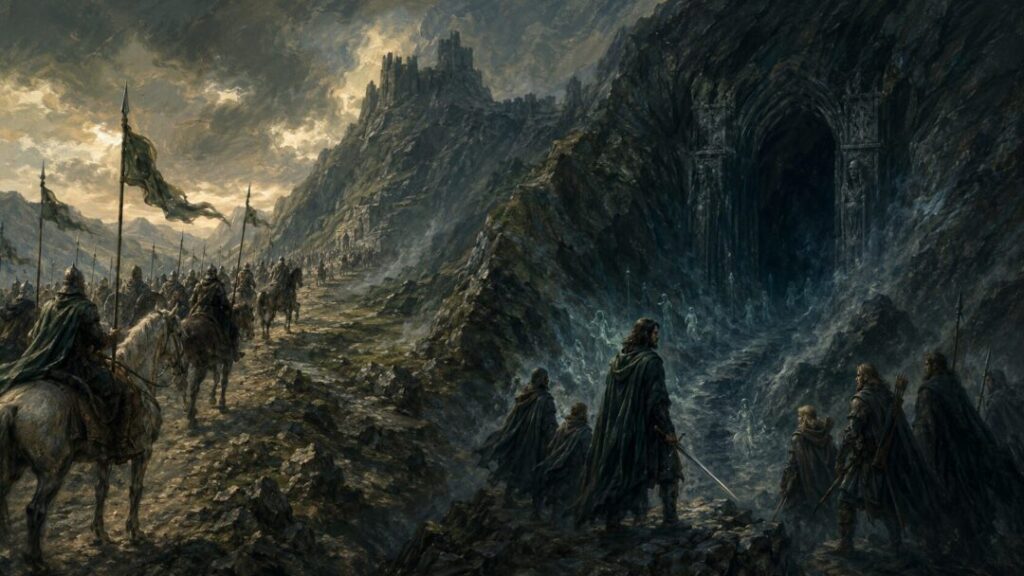
The Muster at Dunharrow is also inseparable from Aragorn’s decision to take the Paths of the Dead. The entrance lies near this haunted region, and Aragorn’s departure from the expected road changes the meaning of Théoden’s delay.
From Théoden’s perspective, Aragorn appears to be choosing a road of dread at the very moment Rohan is gathering for open war. The Rohirrim know the mountain by fear and legend. The Dead are not a tactical detail to them; they are a shadow on the edge of their world. Aragorn’s path is therefore almost incomprehensible within ordinary military reasoning.
This is where Dunharrow becomes a crossroads between two kinds of courage. Théoden represents visible courage: banners, riders, oaths, horns, and the open field. Aragorn represents hidden courage: a road under the mountain, a summons to the oathbreakers, and a victory that must happen out of sight before Gondor can be saved from the south.
Neither path cancels the other. Rohan’s muster is slow because embodied armies are slow. Aragorn’s road is swift because it moves through terror, prophecy, and ancient obligation. The story needs both. Gondor will not be saved by cavalry alone, nor by the Dead alone, nor by any single heroic gesture isolated from the rest.
Dunharrow is where these paths divide.
The Haunted Past Stands Beside the Living Oath
Dunharrow’s atmosphere is not accidental. The place is overshadowed by the Dead Men of the mountain, whose ancient oath to Isildur was broken. Near the muster of Rohan, the story places another people defined by oath: the Rohirrim, bound by their old alliance with Gondor.
The contrast is powerful. The Dead represent an oath refused and a duty deferred beyond death. Rohan represents an oath remembered, even when answering it may mean ruin.
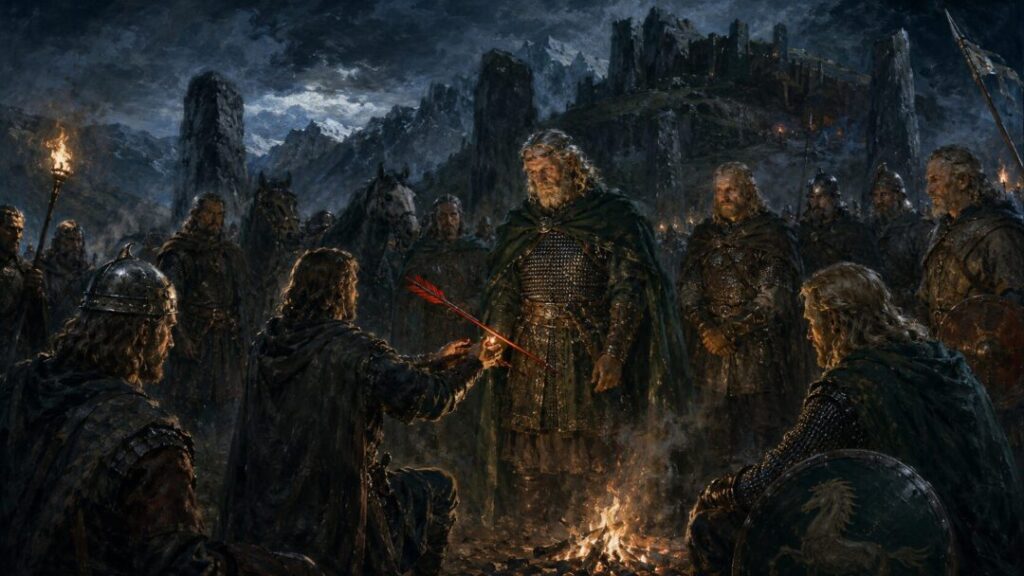
The Red Arrow of Gondor sharpens this contrast. It is not just a message. It is a symbol of need, alliance, and obligation. When it reaches Théoden, the question is no longer abstract. Gondor has called. Rohan must answer.
Seen this way, Dunharrow is not a pause in the plot. It is a moral threshold. On one side is the haunted mountain, where oathbreakers linger. On the other is the king of Rohan, preparing to ride because promises still matter. The living are being measured against the dead.
The Muster Preserves the Meaning of the Ride
If Rohan had simply appeared at the Pelennor without Dunharrow, the charge would still be exciting. But it would mean less.
Dunharrow shows the cost before the glory. It shows the civilians left behind, the king’s burden, Merry’s exclusion, Éowyn’s despair, Aragorn’s strange departure, and the ancient terror pressing against the present war. It makes the later arrival of the Rohirrim feel earned rather than convenient.
The ride from Dunharrow is not a random cavalry rescue. It is the answer of a people who have counted the cost and ridden anyway. Théoden knows he may be too late. He knows he cannot bring all he hoped. He knows the Shadow is already moving. Yet he goes.
That is why the muster is more than a military delay. It is the final gathering of Rohan’s identity before the kingdom spends itself in the service of a promise. The horns of the Rohirrim on the Pelennor are born in the silence of Dunharrow: among refugees, standing stones, haunted paths, and a king who chooses duty over safety.
The delay is the point. It lets us see that Rohan’s greatness is not speed alone, nor strength alone, but the willingness to remain faithful when courage must pass through fear, grief, and uncertainty before it can become song.
Sources & Notes
- J.R.R. Tolkien, The Lord of the Rings, Book V, Chapter 2, “The Passing of the Grey Company” — Dunharrow is shown as an ancient refuge under the Haunted Mountain, while Aragorn’s turn toward the Paths of the Dead makes the muster a crossroads of visible and hidden courage.
- J.R.R. Tolkien, The Lord of the Rings, Book V, Chapter 3, “The Muster of Rohan” — the Red Arrow reaches Théoden, the Rohirrim gather at Dunharrow, their numbers and timing are weighed, and Merry is told he cannot ride with the main host.
- J.R.R. Tolkien, The Lord of the Rings, Book V, Chapter 3, “The Muster of Rohan” — Éowyn is left to govern the people in the king’s absence, giving the muster both a practical civilian purpose and a personal note of confinement and grief.
- J.R.R. Tolkien, The Lord of the Rings, Book V, Chapter 5, “The Ride of the Rohirrim” — the long ride from the muster to the Pelennor shows Rohan answering Gondor’s need despite fear, weariness, and the chance of arriving too late.
- J.R.R. Tolkien, The Lord of the Rings, Appendix A, “The House of Eorl” — the oath-friendship between Gondor and Rohan gives Théoden’s answer to the Red Arrow its deeper political and moral weight.