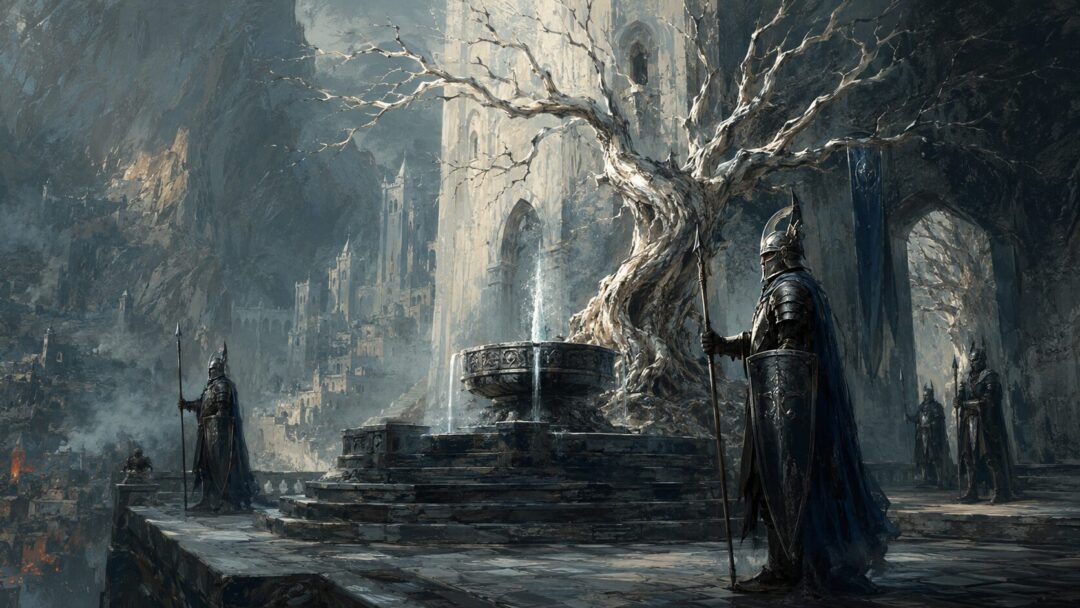
In the highest court of Minas Tirith, beside the fountain and beneath the White Tower, there stood a tree that should have made the city feel alive. Instead, when the War of the Ring drew near, it was withered, leafless, and dead.
To a casual eye, the White Tree might look like a royal emblem that had outlived its monarchy: an old national symbol preserved because Gondor was too proud, too traditional, or too sorrowful to remove it. But the deeper story is stranger and more powerful. The Tree was not merely decoration. It was a living memory of the Elder Days, a sign of Númenórean faithfulness, a witness to Gondor’s kingship, and finally a measure of whether hope in the line of Elendil had truly failed.
That is why its death mattered. And it is why its return was not just political pageantry when Aragorn became king.
It was the visible answer to a question Gondor had been asking for centuries: is the old light truly gone, or only hidden?
A Tree Older Than Gondor’s Kingdom
The White Tree of Gondor did not begin as a Gondorian invention. Its ancestry reaches back through Númenor and the Elves, and ultimately to the memory of Telperion, one of the Two Trees of Valinor. In the published mythology, the line passes through Galathilion, the tree made in the likeness of Telperion, then through Celeborn of Tol Eressëa, then Nimloth, the White Tree of Númenor, and finally to the White Trees of the kingdoms in exile. The important point is not that Gondor owned a beautiful tree. It inherited a living heirloom bound to the Blessed Realm, the Eldar, and Númenor’s earliest grace.
That lineage gives the Tree its emotional weight. Gondor was a kingdom of exiles. Its founders came out of the ruin of Númenor, carrying memory across the Sea into Middle-earth. The Tree stood as one of the clearest signs that not everything had been lost in the Downfall. Stone could be rebuilt. Laws could be renewed. Cities could be raised. But a living descendant of Nimloth was different. It was continuity in organic form: fragile, perishable, and yet capable of renewal.
This is why the Tree is never just “a symbol” in the shallow sense. A painted emblem can survive without faith. A carved sign can remain after everyone has forgotten what it means. But the White Tree had to live, flower, seed, and be tended. It demanded care from the people who claimed its inheritance.
Isildur’s Fruit and the Cost of Memory
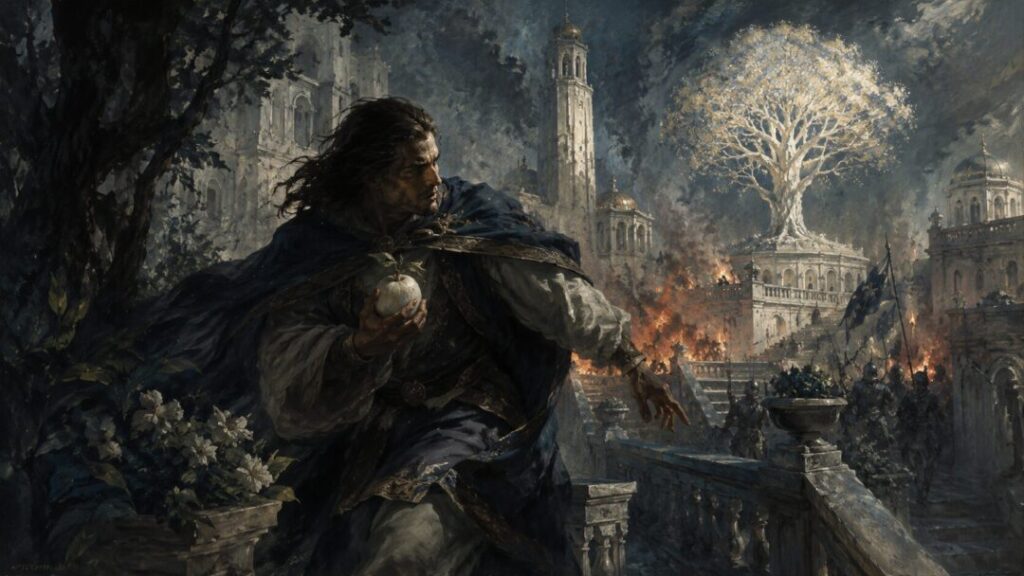
The survival of the Tree’s line depends on one of Isildur’s most important acts before he ever cuts the Ring from Sauron’s hand. In Númenor, when Sauron’s influence had turned the king and many of the people against the old friendship with the Eldar, Nimloth came under threat. Isildur rescued a fruit from the Tree before it was destroyed. The texts present this as a perilous act, and it matters because it shows Isildur not as a simple figure of failure, but as someone who once preserved hope at great cost.
That detail changes the meaning of the White Tree in Gondor. It is not merely royal property. It exists because someone risked himself to preserve a remnant of what Númenor was losing. The Tree therefore carries a memory of resistance: resistance to Sauron’s corruption, to forgetfulness, and to the temptation to sever the present from the sacred past.
This makes the later withered Tree in Minas Tirith even more tragic. The dead Tree is not just an old plant. It is the visible remnant of a rescue. It says: something was saved once. But can it be saved again?
Minas Ithil, Minas Anor, and the Tree of the Exiles
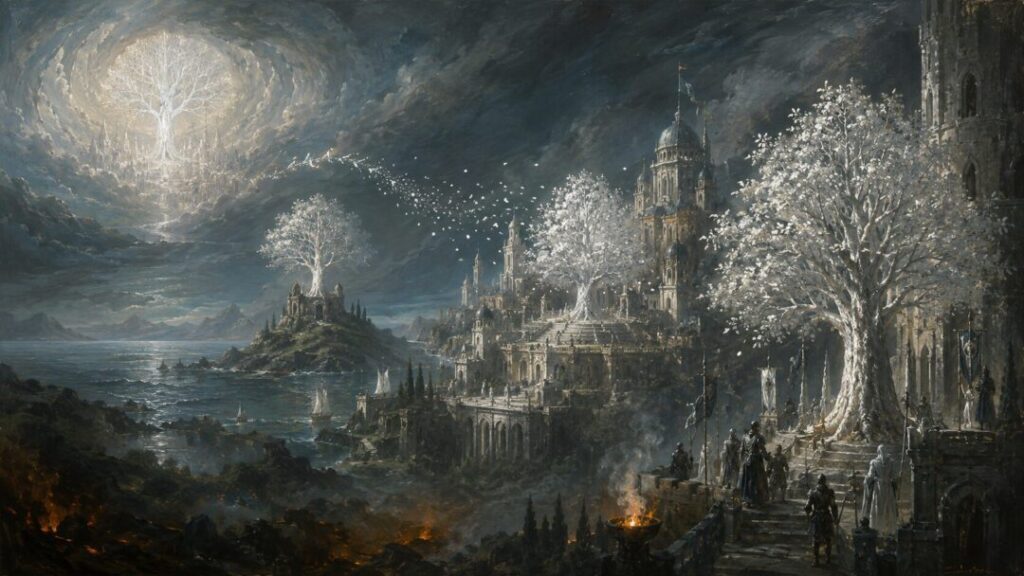
The early history of the White Tree in Gondor also shows how closely it was tied to the fortunes of the kingdom. A White Tree grew in Minas Ithil, Isildur’s city. When Sauron returned and captured Minas Ithil, Isildur escaped and carried a seedling away. That seedling was planted in Minas Anor, later Minas Tirith, in memory of Anárion. The Tree therefore became associated not only with Isildur’s line, but with the house and city of Anárion as well.
This matters because Gondor’s identity was not simple. Aragorn was the heir of Isildur, but Gondor had long been ruled by the line of Anárion, and after the last king, by Stewards who governed in the king’s name. The Tree stood in the court above the city through these changes. It was older than any Steward’s authority, older than the long habit of ruling without a king, and older than the despair that made many in Gondor assume the throne would remain empty forever.
In that sense, the Tree was quietly dangerous. It preserved a memory that the political order had not fulfilled. Gondor could function without a king. It could defend its walls, muster armies, and maintain ceremony. But the dead Tree in the court kept reminding the city that survival was not the same as restoration.
The Dead Tree and the Long Rule of the Stewards
The last living White Tree before Aragorn’s return died in the Third Age during the time of Steward Belecthor II. No seedling was found, and the dead Tree was left standing in the Court of the Fountain for 147 years, until the restoration of the kingship.
That choice is deeply revealing. Thorondir, Belecthor’s heir, did not simply remove the dead Tree and pretend nothing had happened. Gondor left it in place. This can be read as reverence, grief, stubbornness, or all three. The Stewards did not claim to be kings. Their very title preserved the idea that they ruled in trust, not in full replacement. The dead Tree suited that arrangement painfully well: the sign of kingship remained, but it no longer flowered.
It would be too strong to say that the Tree died because the Stewards ruled. The texts do not make that direct mechanical claim. But the narrative clearly invites a symbolic reading. The Tree’s death during the long kingless period becomes a visible expression of Gondor’s condition: noble, disciplined, ancient, but diminished.
The Tree was not removed because Gondor had not truly abandoned the old hope. Yet it remained dead because that hope had not yet been fulfilled.
Denethor’s City and the Burden of a Withered Sign
By the time of the War of the Ring, Minas Tirith is full of grandeur, but also full of strain. Its high walls, ordered ranks, and ancient titles cannot conceal the pressure of Mordor. The dead Tree belongs to that atmosphere. It is beautiful in memory, not in life.
For Denethor, the Tree’s presence is especially poignant. He is not a usurper in the simple sense; he is the lawful Steward of Gondor, a powerful and proud ruler carrying an almost unbearable defensive burden. Yet the dead Tree above his city silently testifies that his office is provisional. The Stewards guard the realm, but they cannot make the Tree flower. They preserve the form of Gondor, but they cannot restore its deepest sign of renewal.
That is one reason the White Tree is more than heraldry. Heraldry can be displayed by command. Life cannot. A Steward can raise banners, send messengers, command armies, and sit in the seat of rule. But he cannot will the line of Nimloth back into blossom.
The dead Tree therefore exposes the limit of human control. Gondor’s rulers can preserve memory, but they cannot manufacture grace.
The Hidden Sapling on Mindolluin
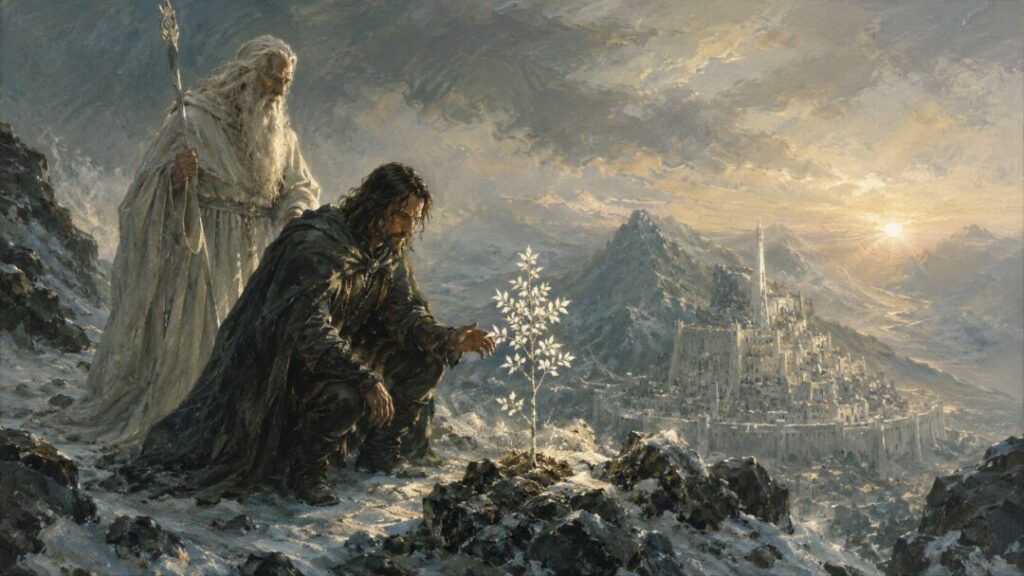
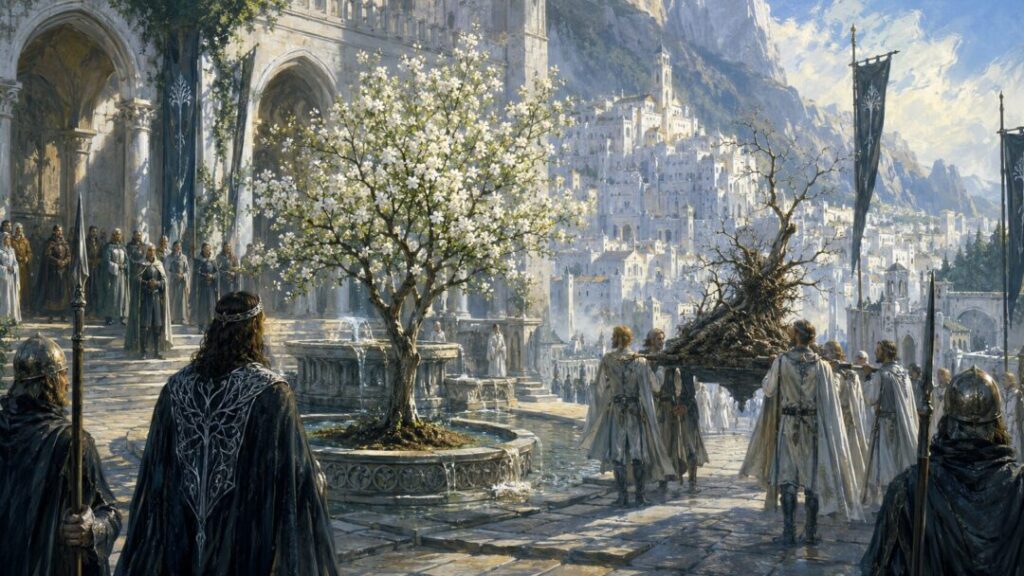
After Aragorn’s coronation, the renewal of the Tree does not come from the dead trunk in the court. It comes from a hidden sapling found on the slopes of Mindolluin, with Gandalf’s guidance. This is one of the most important details in the whole episode. The old Tree is not revived. A new living heir is discovered, already growing in a high and hidden place. Aragorn then brings it down and plants it in the Court of the Fountain; the withered Tree is laid to rest with honor.
The symbolism is precise. Gondor’s hope was not dead in the way its enemies might have thought. But neither was it recoverable by clinging forever to the corpse of the past. The old Tree had to be honored, then removed. The new Tree had to be found, recognized, and planted.
This is very close to Aragorn’s own story. He does not arrive as a king manufactured by Gondorian politics. He comes from the hidden line of the North, long preserved outside the sight of Minas Tirith. Like the sapling, he is both ancient and unexpected. The restoration of the king and the restoration of the Tree mirror one another without becoming a crude one-to-one magical rule.
The texts do not say that Aragorn’s legitimacy causes the sapling to exist. More carefully, the discovery of the sapling confirms the meaning of his return. The living sign and the returning king belong together.
Why the Tree Had to Be Living
The White Tree’s power lies in the fact that it is not merely an image of continuity. It is continuity. It descends from a real line of living things, through seed and sapling, across ruin, exile, plague, war, and long waiting.
That makes it vulnerable in a way a crown is not. A crown can be locked away. A sword can be reforged. A tower can be rebuilt stone by stone. A tree can die. It can fail to seed. It can be lost. It can be burned. Its survival depends on patience, humility, and care over generations.
This vulnerability is exactly what makes the White Tree so meaningful. Gondor’s highest symbol is not a weapon. It is not a throne. It is not even the city’s great tower. It is a tree: rooted, living, seasonal, and dependent on the mercy of time.
That choice says something profound about kingship in Middle-earth. True rule is not merely domination or administration. It is stewardship in the deepest sense: the keeping of life, memory, and hope until they can flower again.
More Than a Dead Symbol
So why was the White Tree of Gondor more than a dead symbol?
Because its death was not emptiness. It was testimony.
It testified that Gondor remembered Númenor, even in decline. It testified that the Stewards had preserved the king’s place without fully replacing him. It testified that the past could not simply be revived by pride, ceremony, or force. And when the hidden sapling was found, it testified that hope in Middle-earth often survives out of sight before it returns in glory.
The dead Tree in Minas Tirith was not a useless relic. It was a wound Gondor refused to cover. Its presence made the city’s longing visible. Its silence told the truth: the kingdom endured, but it was not whole.
When Aragorn planted the new White Tree, the meaning was not “the symbol is back.” It was deeper than that.
The line had lived. The memory had not failed. The king had returned. And in the court where death had stood for generations, something white and living flowered again.
Sources & Notes
- J.R.R. Tolkien, The Silmarillion, “Of Eldamar and the Princes of the Eldalië” — Galathilion is made in Tirion as the image of Telperion, beginning the line from which later White Trees descend.
- J.R.R. Tolkien, The Silmarillion, “Akallabêth” — Nimloth, the White Tree of Númenor, is traced to the Eldar’s gifts, and Isildur saves a fruit before Sauron’s corruption destroys it.
- J.R.R. Tolkien, The Lord of the Rings, Appendix A, “Annals of the Kings and Rulers: Gondor and the Heirs of Anárion” — the White Tree’s Gondorian line, its losses, and the long rule of the Stewards frame the Tree as a sign of kingship and memory.
- J.R.R. Tolkien, The Lord of the Rings, Book V, Chapter 1, “Minas Tirith” — Pippin sees the dead White Tree in the Court of the Fountain, preserved in the heart of the city under the Stewards.
- J.R.R. Tolkien, The Lord of the Rings, Book VI, Chapter 5, “The Steward and the King” — Gandalf leads Aragorn to the hidden sapling of the White Tree, which is planted in Minas Tirith as the kingship is restored.