The wound that the Shire could not see
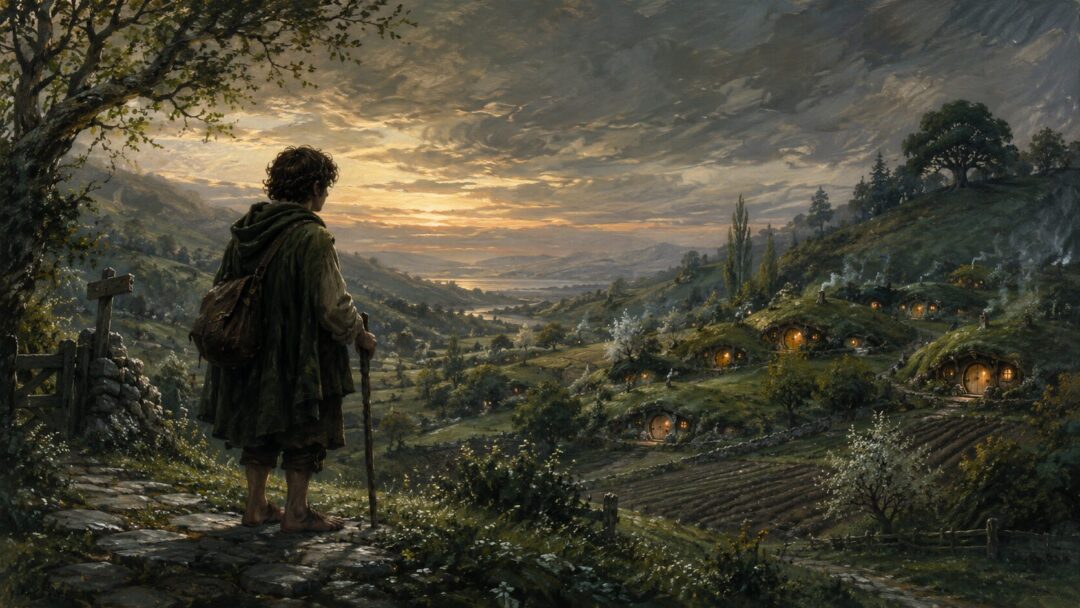
The Shire was saved. The Party Tree was replanted. The ruffians were driven out, the mills were set right, and Samwise Gamgee found the life that had waited for him: garden, hearth, marriage, children, and the slow blessedness of ordinary days. Yet Frodo Baggins, who had carried the heaviest burden, could not fully come home.
That is the quiet contradiction at the end of The Lord of the Rings. Frodo returns to the place he set out to save, but the saved place cannot save him. He is honored, loved, and surrounded by peace, yet peace does not enter him in the old way. The wound of Weathertop, the poison of Shelob, the loss of the Ring, and the long pressure of fear have left marks that ordinary restoration cannot reach. The texts do not present his departure as simple reward, escape, or death. It is something more delicate: a mercy offered because Middle-earth, even healed, is still the world in which Frodo was broken.
The crucial phrase comes from outside the narrative but clarifies the ending: Frodo was allowed to pass over Sea “to heal him — if that could be done, before he died.” That wording matters. It does not promise instant cure. It does not say Valinor made him immortal. It frames the West as a place where healing might be possible when Middle-earth no longer could provide it.
Frodo’s hurt was not only physical
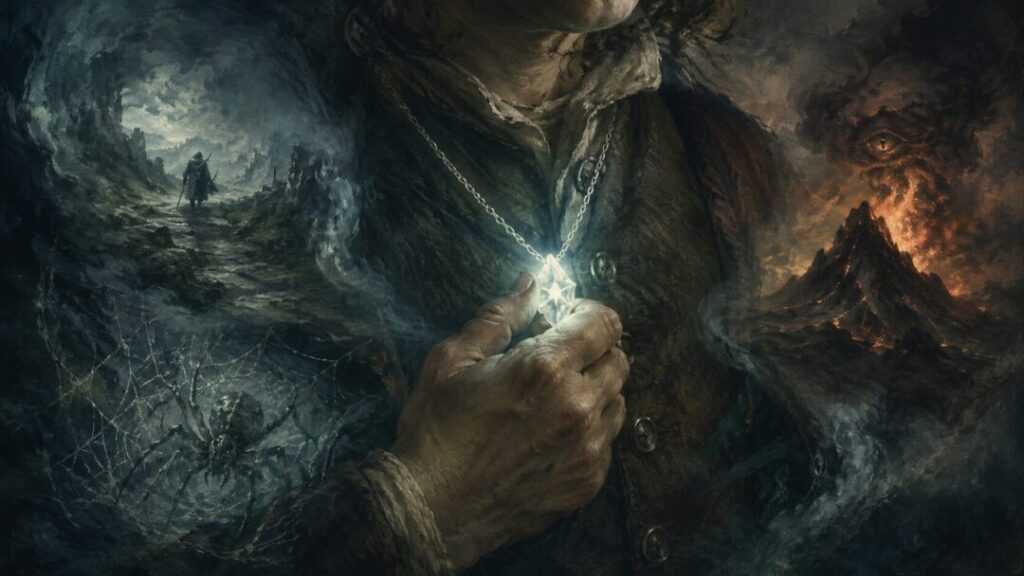
Frodo’s visible injuries are easy to name. At Weathertop, the Witch-king stabbed him with a Morgul-knife, a wound that nearly drew him into the wraith-world. Tolkien Gateway summarizes the danger of such wounds as more than ordinary injury: Frodo’s wound threatened to make him a wraith. Later, in Mordor, Shelob’s sting brought him close to death, and at the Crack of Doom Gollum bit off the finger that bore the Ring.
But the deeper hurt is harder to classify. Frodo’s suffering after the Quest is tied to memory, temptation, loss, and spiritual exhaustion. The Ring did not merely weigh on his body. It pressed upon his will. By the end, he had endured to the edge of his strength, and the destruction of the Ring came not because Frodo remained untouched, but because he had brought the Ring to the place where mercy and providence could complete what his own power could not.
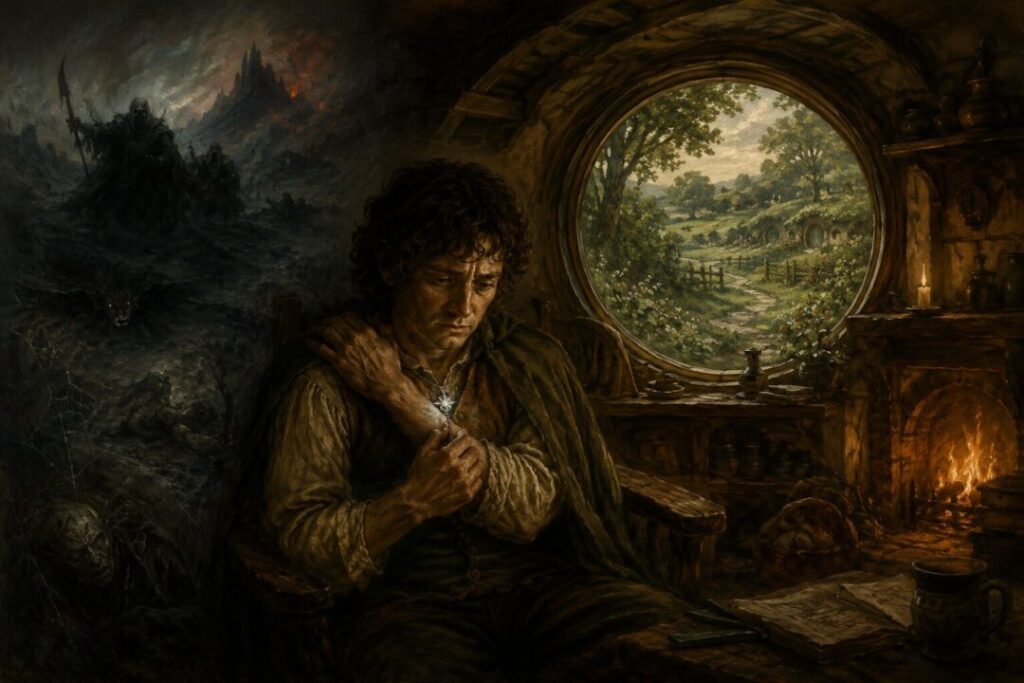
This is why his later sadness should not be reduced to one cause. The texts give us several wounds, and they overlap. His shoulder pains him. His old terror returns. The memory of darkness troubles him. He has lost something terrible, but also something that had possessed his mind. He helped save the world, yet the world’s gladness cannot undo what it cost him.
The anniversaries reveal the pattern
The Shire chapters after the War are sometimes remembered for their restoration, but Frodo’s calendar tells a more tragic story. His pain returns on meaningful dates. The anniversary of the Weathertop wound falls on October 6, and the anniversary connected with Shelob’s poisoning is March 13. Tolkien Gateway notes both Frodo’s October wound-date and his illness on March 13.
This is one of the most human details in the whole ending. Evil is defeated in history, but it returns in memory. Sauron is gone, yet Frodo’s body and mind still keep appointments with terror. Middle-earth can celebrate the victory on the Field of Cormallen, but Frodo must live with the private afterlife of the Quest.
That distinction is essential. The story does not say the Shire failed him morally. Sam, Merry, and Pippin love him. Aragorn honors him. Arwen gives him aid. The Shire itself becomes fruitful again. But none of this changes the fact that Frodo’s injury belongs to a depth beyond ordinary consolation. The world can be mended without every person in it being mended at once.
Arwen understood before the others did
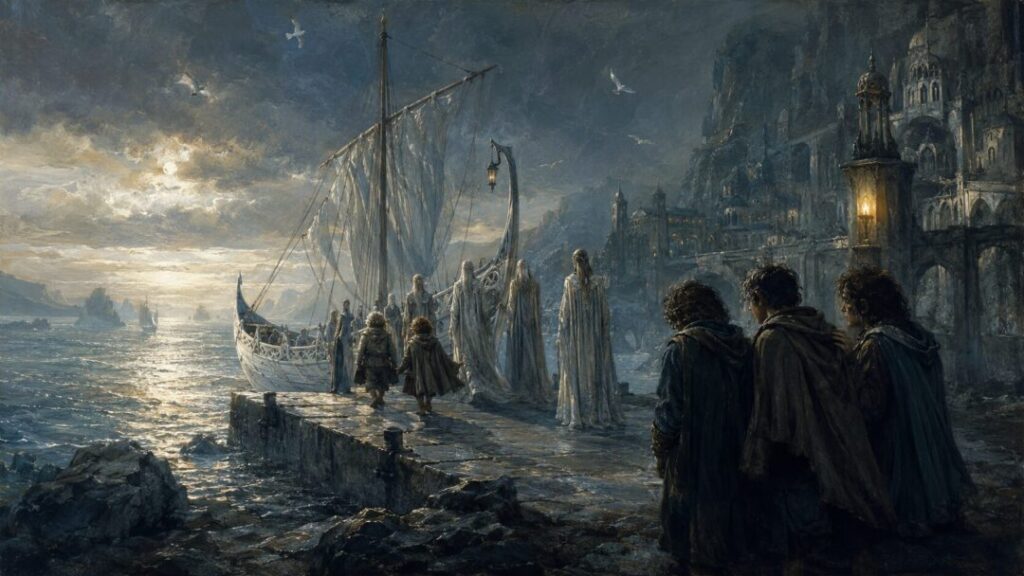
One of the most overlooked acts of mercy comes from Arwen. Before Frodo leaves Minas Tirith, she gives him a white gem on a silver chain and tells him it will bring aid when “the memory of the fear and the darkness” troubles him. The gift is not a cure, but it recognizes the nature of the wound: memory itself has become dangerous.
Arwen also gives Frodo something greater than a jewel. She makes room for him to take her place on the ship into the West. This is not presented as a general rule for heroes. It is a rare grace, bound to Frodo’s role as Ring-bearer and to Arwen’s own choice to remain in Middle-earth as mortal queen. Letter 154, as summarized by Tolkien Gateway, identifies Frodo’s passage as connected with Arwen’s express gift and treats such mortal journeys to Elvenhome as rare exceptions.
That exchange is deeply fitting. Arwen chooses the mortal fate for love of Aragorn. Frodo, a mortal wounded by the burden that made Aragorn’s kingdom possible, receives the possibility of healing among the deathless. Neither is escaping mortality. Both are accepting a sorrowful mercy appropriate to their path.
What Valinor could offer
So what could Valinor—or more cautiously, Aman and the Elvenhome reached by the Straight Road—heal in Frodo?
First, it could remove him from the field of his torment. Middle-earth was the place of the Ring’s making, hiding, carrying, and destruction. Even the Shire, innocent as it seemed, had become part of that history. Bag End had held the Ring. The roads had led outward into fear. Every familiar thing could remind Frodo of what had been lost or endured. The West offered distance: not forgetfulness exactly, but a realm outside the ordinary history of the lands he had saved.
Second, it could surround him with beings and places less marked by decay. The Undying Lands are associated with Aman, the Blessed Realm, and the dwelling of the Valar and the Eldar. Tolkien Gateway notes that Frodo and Bilbo were among the very few mortals permitted to set foot on the shores of the Undying Lands. For a soul worn thin by malice, such a place could be restorative not because it erased the past, but because it was not governed by the same wounds of Middle-earth.
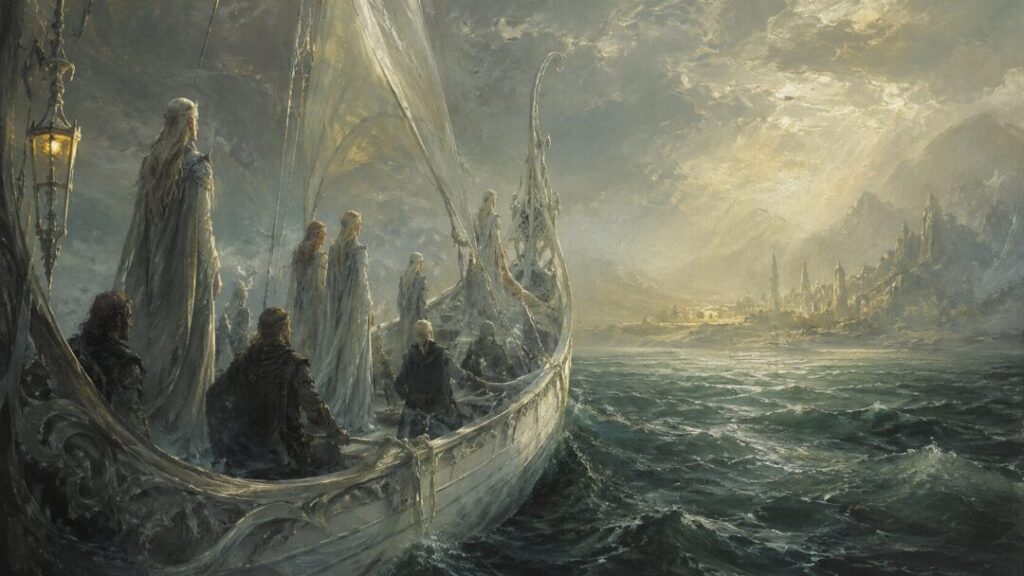
Third, it could give Frodo rest among those who understood the Ring’s cost. On the White Ship were not only Frodo and Bilbo, but also Elrond, Galadriel, and Gandalf, the Keepers of the Three Rings. These were not casual companions. They were figures whose own age was ending with the destruction of the One. Frodo did not sail into a vague paradise alone; he departed with others whose power, labor, and grief were also passing out of Middle-earth.
What Valinor could not offer
The most important correction is this: the Undying Lands did not make Frodo undying. The name refers to the deathless who dwell there, not to a magic that grants immortality to mortal visitors. Tolkien Gateway’s Aman entry preserves the point sharply: Frodo and other mortals could dwell in Aman only for a limited time, whether brief or long, and Frodo was allowed to pass over Sea for healing before death.
That limit makes the ending more poignant, not less. Frodo is not rewarded by being turned into an Elf. He remains himself: a hobbit, a Ring-bearer, a mortal creature whose life has been altered but not endlessly extended. The mercy is not escape from death. It is the chance to be made ready for it without the unhealed agony that Middle-earth could no longer relieve.
This also prevents a sentimental reading of the Grey Havens. Frodo’s departure is not simply “going to heaven,” nor is it merely a metaphor for dying. The story treats the sailing as a real departure within the mythology, but one that removes Frodo from the known circles of ordinary mortal life. To Sam, Merry, and Pippin, it is farewell. To Frodo, it is the only road left that might lead to peace.
Why Middle-earth could not heal him
Middle-earth could honor Frodo. It could remember him. It could give him friends, titles, songs, and a beloved home. But it could not give him back the Frodo who left Bag End.
That is the moral cost hidden beneath the victory. The War of the Ring is not a story where courage prevents all loss. Frodo saves the Shire, but not for himself in the way Sam can enjoy it. He preserves the possibility of ordinary life, yet he has become partly unsuited to ordinary life. His triumph is therefore sacrificial in the deepest sense: he wins a future that others can inhabit more fully than he can.
One reading is that Valinor could heal Frodo by giving him a place where his sacrifice no longer had to be translated into public usefulness. In the Shire, everyone must move forward. Fields must be planted. Families must grow. The Mayor must govern. The Party Tree must bloom. In the West, Frodo could cease being the person who must be “better now” because the world has been saved.
The texts never give us a detailed account of his days there. That silence is merciful. We are not shown a clinical recovery, a final speech, or a neat explanation of his inner life. We are given only the ship, the fading shore, and Sam returning home. Frodo’s healing, if it came, belongs beyond the edge of the story.
The final mercy of the West
What Valinor could heal in Frodo was not the fact that he was mortal, nor the fact that he had suffered. It could not undo Weathertop, Cirith Ungol, or Mount Doom. It could not make the Ring’s burden harmless in retrospect. It could not restore his finger, erase his memories, or return him unchanged to Bag End.
What it could offer was release from the place where every peace still contained an echo of the wound. It could offer beauty not shadowed by the Ring’s immediate history, companionship with the Wise, and time—however limited—for pain to be transformed into acceptance. It could offer a healing that Middle-earth, even renewed, was too marred and too familiar to give.
That is why Frodo’s ending hurts so much. He does not leave because he loves the Shire less. He leaves because he saved it at a cost the Shire cannot repay. His reward is not conquest, kingship, or immortality. It is permission to seek healing beyond the circles of the world he preserved for others.
And in that, the Grey Havens become one of the most honest endings in fantasy: evil can be overthrown, the garden can be replanted, and still the wounded may need a farther shore.
Sources & Notes
- J.R.R. Tolkien, The Lord of the Rings, Book I, Chapter 12, “Flight to the Ford” — gives the Morgul-knife wound at Weathertop and the danger that Frodo would be drawn into the wraith-world.
- J.R.R. Tolkien, The Lord of the Rings, Book IV, Chapter 8, “The Choices of Master Samwise” — shows Shelob’s sting and the near-death trauma that later echoes in Frodo’s post-Quest illness.
- J.R.R. Tolkien, The Lord of the Rings, Book VI, Chapter 3, “Mount Doom” — presents the final breaking-point of the Ring-burden, Frodo’s claim of the Ring, and the loss of his finger.
- J.R.R. Tolkien, The Lord of the Rings, Book VI, Chapter 9, “The Grey Havens” — records Frodo’s recurring illnesses, Arwen’s white gem and gift of passage, and the sailing from the Havens.
- J.R.R. Tolkien, The Silmarillion, “Akallabêth” — explains that the Undying Lands do not confer deathlessness on mortals, supporting the article’s distinction between healing and immortality.
- J.R.R. Tolkien, The Letters of J.R.R. Tolkien, Letter 246 — Tolkien states that Frodo was allowed to pass over Sea “to heal him — if that could be done, before he died,” while remaining mortal.