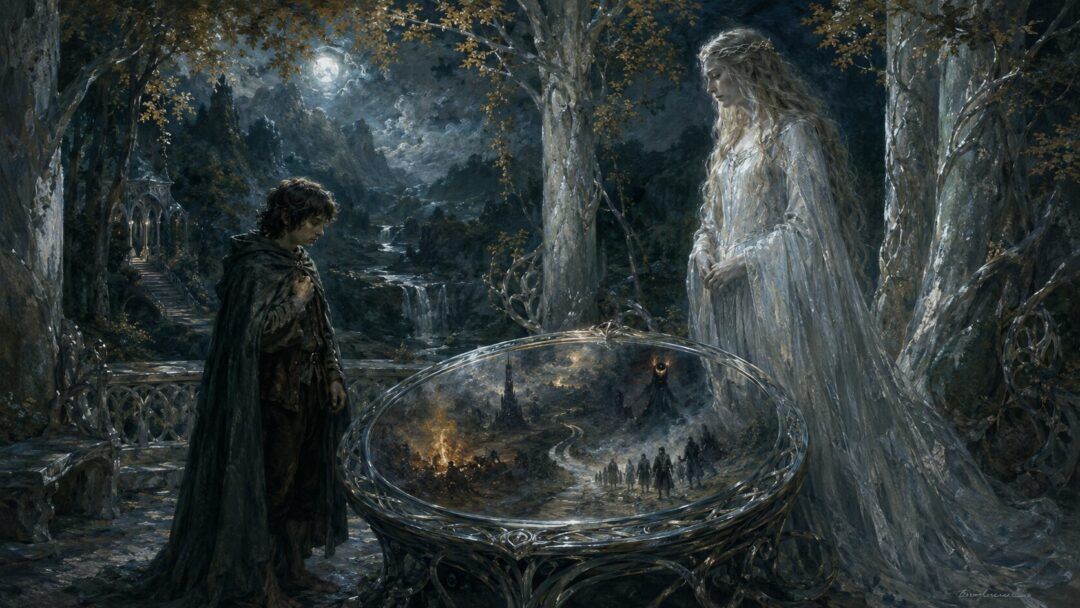
The most revealing moment between Galadriel and Frodo is not the vision in her Mirror, nor even the terrifying image of the Queen she might become if she took the One Ring. It is the smaller, quieter exchange afterward: Frodo, exhausted by what he has seen and by what he carries, offers her the Ring.
That offer is often remembered as Galadriel’s test. And it is. But it is also a test of Frodo’s loneliness. He has come to Lothlórien after losing Gandalf in Moria. The Company is shaken, Aragorn has not yet fully taken command, Boromir is already troubled by desire for the Ring, and Frodo has begun to understand that the burden cannot simply be shared in the way ordinary burdens can.
So did Galadriel know the One Ring would break him?
The safest answer is: not in exact detail. The texts do not show Galadriel foreseeing Frodo’s final failure at the Crack of Doom, nor his later inability to find peace in the Shire. But she clearly understands something that many others either do not know or cannot bear to say plainly: the Ring is not merely dangerous because Sauron wants it. It is dangerous because it isolates, tempts, consumes, and finally exceeds the strength of even the merciful.
Galadriel may not know every step of Frodo’s breaking. But she knows he is walking toward a burden that no one can master by simple courage.
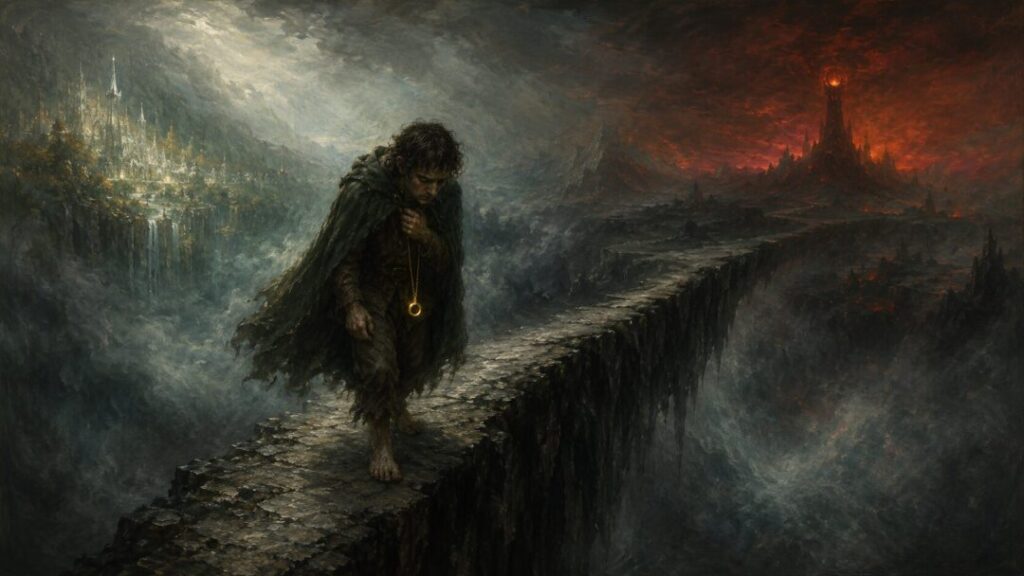
Galadriel Sees the Burden, Not the Ending
Galadriel is one of the few people Frodo meets who can look directly at the spiritual weight of the Quest without reducing it to strategy. At the Council of Elrond, the Ring is discussed as a military and cosmic crisis: it must be destroyed, it cannot be wielded safely, and Sauron must not regain it. In Lothlórien, the matter becomes more intimate.
Galadriel has already tested the hearts of the Fellowship. The text presents this not as mind-control, but as a piercing encounter in which each member feels offered what he most desires, along with the condition that he turn aside from the Quest. This is important because Galadriel is not ignorant of temptation. She understands that the Ring does not merely threaten from outside. It speaks through longing.
When Frodo offers her the Ring, she admits that she has greatly desired what he offers. Her refusal is therefore not casual wisdom. It is a renunciation. She knows enough about herself to know what the Ring would make of her: not a savior, but a ruler terrible in beauty and domination. In that moment, she understands Frodo better precisely because she understands temptation in herself.
Yet this does not mean she sees the entire future. The Mirror of Galadriel itself is uncertain. It shows things that were, things that are, and things that may yet be. Even Galadriel does not present it as a tool that gives simple, fixed knowledge. So any claim that she “knew” Frodo would claim the Ring at Mount Doom goes beyond what the text states.
What she does know is more frightening: the Ring is strong enough that no one should trust themselves with it.
“Do Not Try! It Would Destroy You”
One of Galadriel’s clearest warnings comes when Frodo asks why he cannot perceive the thoughts of other Ring-bearers while wearing the One Ring. Her answer is severe. She tells him that he has not tried, and warns him not to try, because it would destroy him.
This is one of the strongest textual clues for the question. Galadriel does not say merely that Sauron would find Frodo, though that is also a danger. She says the act itself would destroy him. Frodo has the Ring, but he does not possess the stature, training, or native power to wield it. More importantly, no one can wield it innocently. To attempt mastery would not make him heroic. It would consume him.
That warning does not necessarily mean Galadriel foresees Frodo’s final collapse. It means she understands the rule of the Ring: it cannot be used as a neutral instrument. The Ring magnifies desire, bends intention, and turns the will toward possession. Frodo’s safety lies not in becoming stronger in the ordinary sense, but in refusing the path of domination for as long as he can.
This is why his humility matters. Frodo is not chosen because he is powerful enough to defeat the Ring in a contest of wills. He is chosen, or rather accepts the burden, because he is small enough, merciful enough, and unambitious enough to carry it farther than the proud would likely manage.
But even that is not the same as being unbreakable.

The Difference Between Carrying and Mastering
The tragedy of Frodo’s Quest is that the task is both necessary and impossible in a humanly simple sense. Someone must carry the Ring to the fire where it was made. Yet the closer the Ring comes to the place of its making, the greater its pressure becomes. By the end, Frodo is not a triumphant warrior overcoming evil through superior strength. He is a person reduced almost entirely to endurance.
Galadriel seems to understand this distinction. She does not tell Frodo how to destroy the Ring. She does not offer a confident prophecy that he will succeed. She gives him shelter, honor, warning, and gifts. Her help is real, but it is not control.
This is consistent with the deeper moral pattern of the story. The Wise do not defeat Sauron by replacing him with another commanding will. Gandalf refuses the Ring. Elrond does not wield it. Galadriel refuses it. Aragorn does not seize it. The Ring is defeated not because someone proves strong enough to use it rightly, but because a chain of pity, restraint, loyalty, and providence carries it beyond the reach of domination.
Frodo’s role is therefore not to become invincible. It is to remain faithful long enough for mercy to matter.
Galadriel likely perceives this more clearly than most. She knows the Quest stands on a knife-edge. She knows that the future of Lothlórien itself is bound to the outcome: if the Ring is destroyed, the power of the Three Rings will fade, and her realm will diminish. If Sauron regains the Ring, everything will be lost. Her own future is tied to Frodo’s burden, yet she does not try to take it from him.
That restraint says much. She knows the Ring would ruin her. She knows it could destroy Frodo. Still, she allows the Quest to continue because there is no clean alternative.
Frodo Is Not Broken in One Moment
When people ask whether Galadriel knew the Ring would “break” Frodo, they often think of Mount Doom. There Frodo reaches the Crack of Doom and cannot cast the Ring away. He claims it. The Ring is destroyed only when Gollum takes it from him and falls into the fire.
But Frodo’s breaking is not limited to that moment. It begins long before and continues long after.
He is wounded by the Morgul-knife at Weathertop. He is pierced again by Shelob. He bears the Ring through fear, hunger, thirst, pursuit, and spiritual pressure. He watches the burden change his relationship with Sam and with Gollum. By the time he reaches the Mountain, his body and will have been worn down almost beyond recognition.
Later, after the victory, Frodo does not simply return to the Shire healed. The Shire is saved, but not for him in the same way. He suffers recurring pain and unrest. He eventually tells Sam that some wounds cannot be wholly cured in Middle-earth. His departure over the Sea is not a decorative reward; it is the final sign that the Quest has cost him a kind of ordinary life.
Did Galadriel know all of this? The text never says so. But she understands the kind of wound the Ring can inflict. She bears Nenya, one of the Three Rings, and though the Three are not made by Sauron, they are still bound to the fate of the One. She knows what it is to preserve, to resist decay, and to live under the shadow of loss. Her wisdom is not abstract. She is herself facing diminishment.
That gives her encounter with Frodo a tragic symmetry. Both are asked to give up something. Frodo must give up safety, peace, and finally the possibility of returning unchanged. Galadriel must give up the dream of ruling, preserving, and remaining in Middle-earth in power. She passes her test by refusing possession. Frodo passes most of his by continuing to carry what he cannot finally master.

What Galadriel Could Not Do for Him
There is a quiet cruelty in Frodo’s situation: those who understand the Ring best are the ones who must refuse to take it from him.
Galadriel can shelter him, but not spare him. She can warn him, but not walk the road in his place. She can give him the Phial, which later becomes a light in dark places, but she cannot give him a will immune to the Ring. Her power, great as it is, is not the answer to his burden. In fact, her power is exactly why she must not take it.
This is one of the overlooked moral rules of The Lord of the Rings. The greater the power, the greater the catastrophe if the Ring corrupts it. Galadriel knows this. Gandalf knows it. Elrond knows it. The Quest depends not on finding someone mighty enough to dominate the Ring, but on trusting someone who does not seek domination at all.
That does not make Frodo safe. It makes him suitable. And suitability is not the same as protection.
Galadriel’s gifts acknowledge this. The cloaks, the boats, the lembas, and the Phial do not remove suffering. They help the Company endure it. The Phial in particular does not destroy Shelob by itself, but it gives light when Frodo and Sam are nearly overcome by ancient darkness. Galadriel’s aid is therefore not a rescue from the Quest, but strength for the road within it.
She does not prevent Frodo from being broken. She helps him go far enough that his mercy, Sam’s loyalty, and Gollum’s desperate desire can converge at the end.
The Mercy Hidden Inside the Failure
Frodo’s final failure at the Crack of Doom is not treated as simple villainy. He does claim the Ring, and that fact should not be softened into something it is not. But the story also makes clear that his long mercy toward Gollum is essential to the Ring’s destruction. Gandalf had earlier warned that Bilbo’s pity might rule the fate of many. Frodo continues that pity, even when Gollum becomes treacherous and dangerous.
This matters for Galadriel’s role because she sees the Quest in moral, not merely military, terms. She does not give Frodo a weapon to overpower Sauron. She gives him light. She does not command him like a soldier. She honors him as a bearer of a burden. Her wisdom leaves room for the possibility that victory may come through endurance and mercy rather than mastery.
One reading, then, is that Galadriel does not need to know Frodo will break in order to understand the truth of his path. The Quest is not built on the assumption that Frodo will remain untouched. It is built on the hope that even a wounded, failing, diminished person may still be part of deliverance.
That is why Frodo’s breaking does not make his journey meaningless. It reveals the real cost of carrying evil without becoming its willing servant for as long as one can endure.
So Did She Know?
Galadriel did not explicitly know, in the texts, that Frodo would be broken in the precise ways he was: that he would claim the Ring at the Fire, that Gollum would be the immediate cause of its destruction, or that Frodo would later find no lasting rest in the Shire. To state that as certainty would go beyond the evidence.
But Galadriel did know the Ring could destroy him. She says as much when warning him not to try to use its powers. She knew the Ring worked through desire. She knew even the Wise were not safe. She knew the Quest stood on the edge of disaster. And she knew that taking the Ring from Frodo, even with noble intentions, would be the beginning of a worse ruin.
Her wisdom lies not in seeing every detail of the ending, but in refusing the false solution. She does not save Frodo from the burden. She refuses to become another lord of the Ring. She lets the small bearer continue, not because he is unbreakable, but because no other road remains.
In the end, Frodo is broken, but not wasted. Galadriel’s choice helps make that distinction possible. She sees enough to fear for him, enough to warn him, and enough to aid him. But she also sees that the fate of Middle-earth may depend on a kind of courage that looks, from the outside, painfully fragile.
Frodo does not survive the Quest unchanged. Galadriel likely never expected him to. The Ring was always too heavy for innocence to carry without loss.
And yet he carried it farther than power could.
Sources & Notes
- J.R.R. Tolkien, The Lord of the Rings, Book II, Chapter 7, “The Mirror of Galadriel” — Galadriel’s Mirror, Frodo’s offer of the Ring, her refusal, and her warning that trying to use the Ring’s power would destroy him.
- J.R.R. Tolkien, The Lord of the Rings, Book II, Chapter 2, “The Council of Elrond” — the Wise reject using the One Ring as a weapon and frame the Quest as destruction rather than mastery.
- J.R.R. Tolkien, The Lord of the Rings, Book VI, Chapter 3, “Mount Doom” — Frodo’s claim of the Ring at the Fire shows the burden exceeding even his long endurance.
- J.R.R. Tolkien, The Lord of the Rings, Book I, Chapter 2, “The Shadow of the Past” — Gandalf’s words about Bilbo’s pity and Gollum’s remaining part in the tale ground the mercy/providence thread.
- J.R.R. Tolkien, The Lord of the Rings, Book VI, Chapter 9, “The Grey Havens” — Frodo’s unrest and departure show that the Quest’s wounds are not wholly healed in the Shire.
- J.R.R. Tolkien, The Letters of J.R.R. Tolkien, Letter 246 — Tolkien’s own discussion of Frodo’s failure at the Sammath Naur and the overwhelming pressure of the Ring.