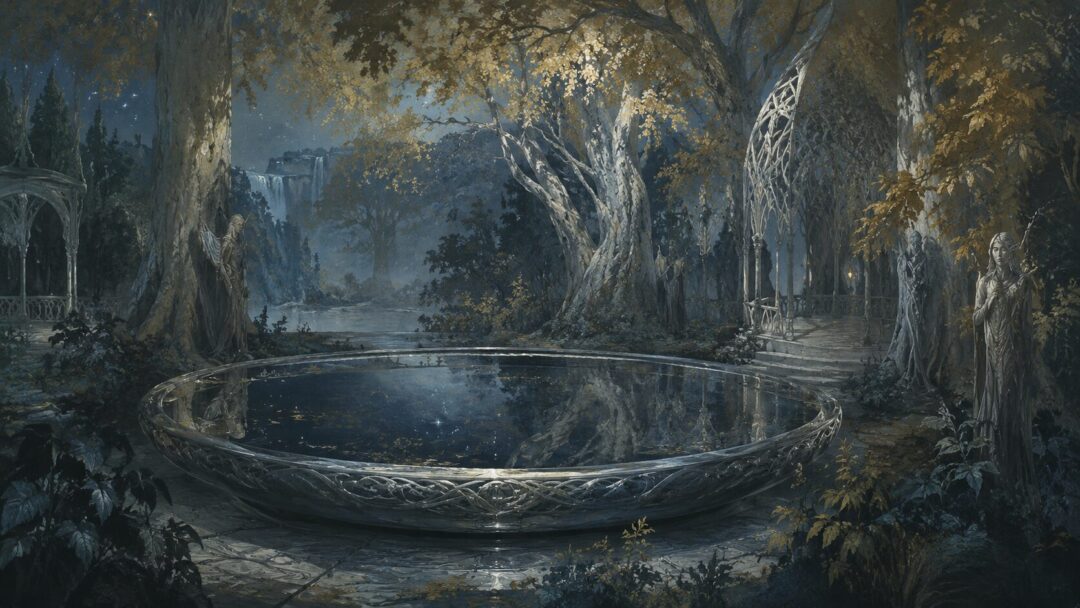
The Mirror of Galadriel is one of the strangest objects in The Lord of the Rings: a silver basin, filled with water, standing in a quiet garden in Lothlórien. It is not a weapon. It is not a throne. It does not command armies or break gates. Yet beside it, one of the oldest choices in Middle-earth is brought into the open: whether wisdom can refuse power when power finally comes within reach.
Frodo offers Galadriel the One Ring. For a moment, the Lady of Lórien imagines what she could become with it. Then she refuses.
Celeborn is not standing beside her in that garden. The text does not show him watching the offer, hearing her words, or reacting afterward. That matters. Any claim about his exact thoughts must remain interpretation. Yet the story gives enough surrounding evidence to suggest what Celeborn would have understood better than almost anyone else: Galadriel’s refusal was not only a private moral victory. It was the doom of their realm, the surrender of an ancient dream, and the beginning of the end of Lothlórien as they had known it.

Celeborn Is Absent From the Mirror — But Not From the Choice
The scene at the Mirror belongs chiefly to Galadriel, Frodo, and Sam. Galadriel brings the hobbits secretly to the basin after the Fellowship has already been received in Caras Galadhon. Celeborn is not described as present. He does not speak during Frodo’s offer, and the narrative gives no direct statement of what he later thought.
That silence should not be filled with invented drama. There is no canonical scene in which Celeborn confronts Galadriel about the Ring, blesses her refusal, or fears what she might have become. The texts do not give us that.
But Celeborn’s absence from the garden does not mean he was untouched by the meaning of her choice. He and Galadriel rule Lórien together. He knows the peril of the age, the shadow of Dol Guldur, the danger of the Fellowship’s road, and the fact that Sauron’s power is again reaching across Middle-earth. He also understands, as Galadriel does, that Lórien’s beauty is bound to a fading world.
So the question is not whether Celeborn saw the exact moment. The deeper question is what he, as Galadriel’s husband and co-ruler, would have understood about the consequences once that choice had been made.
The Choice Was Not Between Good and Evil in a Simple Sense
Galadriel’s temptation is powerful because she is not a petty villain reaching for domination. She is one of the Wise. She is ancient, perceptive, and already a guardian of beauty against decay. If she took the Ring, she could imagine herself using it to overthrow Sauron and preserve what would otherwise be lost.
That is what makes the temptation dangerous.
The Ring does not merely offer cruelty. It offers the possibility of correcting the world by force. In Galadriel’s case, the temptation is not gold, land, or ordinary kingship. It is the chance to become a queen of overwhelming beauty and terror, loved and feared, replacing the Dark Lord with another absolute will.
Her refusal shows that she understands the hidden law of the Ring: it cannot be used innocently. Even the desire to heal, preserve, or protect would be twisted into domination. The Ring would not simply give Galadriel more strength. It would magnify her will until no other will could remain free before it.
Celeborn, who has lived beside her for long ages, would have understood that this was not a small temptation. Galadriel was not refusing something irrelevant to her nature. She was refusing something that spoke directly to her deepest history: the desire for a realm, for beauty unmarred, for power sufficient to hold back loss.

Lórien Was Already a Defiance of Time
To understand what Celeborn understood, we must look at Lothlórien itself.
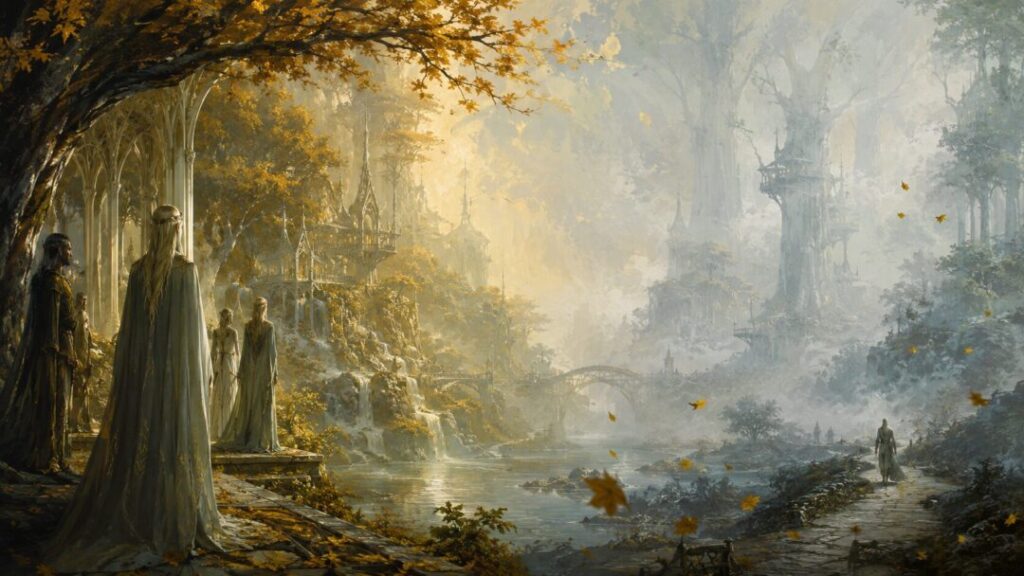
For the Fellowship, entering Lórien feels like stepping outside ordinary time. The land is golden, ancient, and strangely preserved. Its beauty is not merely political or military; it is almost spiritual. It offers the hobbits a glimpse of what the world might have been like if memory, beauty, and grief could be held in perfect balance.
But Lórien is not permanent.
Galadriel tells Frodo that if his quest succeeds, the power of the Three Rings will fail, and Lórien will fade. If he fails, then Sauron will recover the One, and all will be laid bare. In either case, the old guarded beauty cannot continue unchanged. Victory and defeat both bring loss, though not the same kind of loss.
Celeborn would have known this. He was not merely a lord enjoying a peaceful woodland court. He was one of the rulers responsible for preserving Lórien against the surrounding darkness. The realm he shared with Galadriel was not just a home; it was a long act of resistance.
Galadriel’s refusal of the One Ring therefore meant accepting that Lórien could not be saved by domination. It could only be allowed to pass, if the freedom of Middle-earth was to survive.
Celeborn’s Wisdom Is Quieter Than Galadriel’s
Celeborn is sometimes overlooked because Galadriel’s presence is so luminous. Yet the text does not present him as foolish. He is named among the wise, and he speaks with authority in Lórien. His first reaction to the news of Moria and Gandalf’s fall is stern, especially toward the Dwarves, but Galadriel corrects him with a wider understanding of Gandalf’s purpose. Celeborn accepts the correction and does not persist in resentment.
That moment is important. It shows a difference in emphasis, not a simple contrast between wisdom and ignorance. Celeborn is deeply concerned with the safety of his land and people. Galadriel sees further into the pattern of events. Their rule contains both: guarded strength and far-seeing perception.
At the Mirror, Galadriel faces a test no one else can take for her. But Celeborn’s kind of wisdom would recognize the practical and political cost of the answer. He would understand what her refusal means for borders, defenses, people, trees, songs, and memory. Where Galadriel speaks the great spiritual truth — “I will diminish” — Celeborn would understand the earthly weight of that diminishing.
Not because he is lesser, but because he is also a lord of a living people.
Galadriel Refused the Ring, and Celeborn Had to Live With the Aftermath
One of the most poignant details comes after the War of the Ring. Galadriel passes over the Sea, but Celeborn does not immediately go with her. The appendices indicate that he remained in Middle-earth for a time, later dwelling in Rivendell, and that no record tells when he finally sought the Grey Havens.
This separation should be handled carefully. The text does not say Celeborn opposed Galadriel’s departure, resented her choice, or lacked the desire to go West. It simply records that their paths did not immediately move together after the end of the Third Age.
Still, narratively, the detail is haunting. Galadriel’s test at the Mirror leads toward departure. By refusing the Ring, she becomes able to pass into the West, but that also means leaving behind the land she had preserved and, for a time, the husband with whom she had ruled it.
Celeborn’s understanding, then, may have included something even more painful than the fading of Lórien. He would have understood that Galadriel’s victory over temptation did not restore their old life. It ended it.
The Ring’s destruction saves Middle-earth from Sauron, but it does not save everything beautiful from passing away. That is one of the central sorrows of the story.
The Mirror Shows Possible Futures, But Galadriel Chooses the Unseen One
The Mirror itself does not give simple prophecy. Galadriel warns that it shows things that were, things that are, and things that yet may be. Some visions may never come to pass unless those who see them turn aside from their path to prevent them.
This makes the Mirror a fitting place for her test. It is an object of vision, but not of control. It reveals without granting mastery. It shows that knowledge of possible futures can become a burden, especially when one is tempted to force the future into a desired shape.
Galadriel’s refusal of the Ring is, in part, a refusal to seize the future. She will not become the one will that decides the fate of all others. She accepts uncertainty, diminishment, and loss rather than preserve beauty by tyranny.
Celeborn, who governs a threatened realm, would have understood how hard that is. Rulers are often tempted not only by conquest but by protection. The desire to keep one’s people safe can become the first step toward controlling everything around them. Galadriel rejects that path.

What He Understood About Her
Celeborn would have understood that Galadriel’s choice was not a sudden change of heart. It was the revelation of what her long wisdom had become.
She had desired, in ancient days, a realm of her own. The histories of Galadriel’s earlier life are complex and not always presented in one simple version, but the broad pattern is clear enough: she was mighty, proud, and unwilling to be merely passive in the great affairs of the world. By the end of the Third Age, that greatness has been refined through sorrow, vigilance, and restraint.
At the Mirror, she is offered the possibility of fulfilling every old desire in its most dangerous form. A realm? She could have all realms. Preservation? She could freeze the world beneath her command. Reverence? She could become an object of worship and dread.
Instead, she remains Galadriel.
Celeborn, more than the hobbits, would understand the depth of that sentence. To Frodo and Sam, the moment is awe-inspiring and frightening. To Celeborn, it would be bound to ages of memory. He would know what she had refused, not merely in abstract moral terms, but in relation to who she had been, what she had wanted, and what they had built together.
The Love Beneath the Renunciation
The text never sentimentalizes Celeborn and Galadriel’s marriage. They do not speak in the language of ordinary romance. They are ancient, formal, and remote from the hobbits’ point of view. Yet their shared rule carries a quiet intimacy: two beings who have endured long ages together and now face the ending of the world they helped preserve.
What did Celeborn understand about Galadriel’s choice? Not that she had simply passed a test and earned a reward. Not that Lórien would now be safe. Not that the future would become easier.
He understood, or at least the story strongly implies he was capable of understanding, that she had chosen freedom over possession, humility over magnificence, and the uncertain healing of Middle-earth over the certain glorification of herself.
And he would have understood the cost.
Galadriel’s refusal at the Mirror is often remembered as a triumph, and it is one. But it is a triumph shaped like a farewell. By rejecting the Ring, she saves herself from becoming a tyrant, helps preserve the hope of the Quest, and accepts the fading of the power by which Lórien has endured.
Celeborn’s tragedy is quieter. He does not stand in the garden. He does not speak the great words. But he remains one of the people who must live in the world made by that refusal — a world saved from darkness, yet emptied of much that was fairest.
That may be the deepest thing he understood: Galadriel’s choice was right not because it spared them grief, but because it accepted grief without turning it into domination.
Sources & Notes
- J.R.R. Tolkien, The Lord of the Rings, Book II, Chapter 7, “The Mirror of Galadriel” — the Lórien council, Celeborn’s concern after Moria, Galadriel’s Mirror, and her refusal of Frodo’s offer of the One Ring.
- J.R.R. Tolkien, The Silmarillion, “Of the Rings of Power and the Third Age” — explains the Three Rings’ preservation of Elven realms and why their works would fade after the One Ring was destroyed.
- J.R.R. Tolkien, The Lord of the Rings, Appendix B, “The Tale of Years” — records Galadriel’s departure over Sea and Celeborn’s later remaining in Middle-earth, with no recorded date for his final sailing.
- J.R.R. Tolkien, Unfinished Tales, “The History of Galadriel and Celeborn” — gives the complex traditions around Galadriel’s earlier pride, power, and desire for a realm of her own.
- J.R.R. Tolkien, The Letters of J.R.R. Tolkien, Letter 131 — Tolkien’s own account of the Rings as instruments bound up with preservation, power, and the peril of domination, useful context for Galadriel’s temptation.