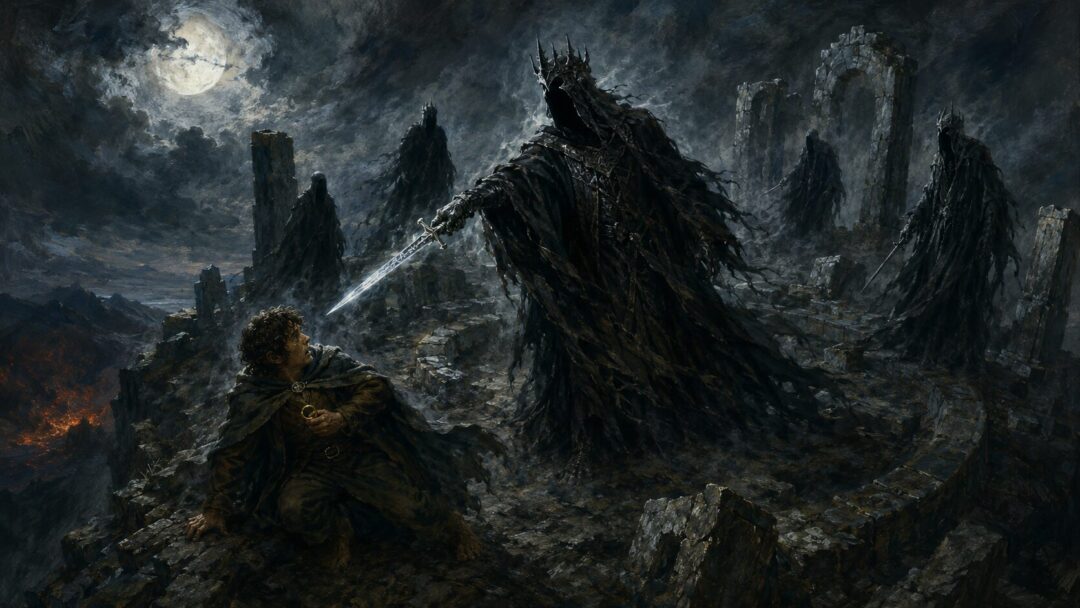
A small knife on Weathertop nearly achieved what armies, spies, and terror had not yet done: it almost delivered the Ring-bearer into the power of the Enemy without dragging him all the way to Mordor.
The attack at Amon Sûl is easy to remember as a wound. Frodo is stabbed, Strider finds athelas, the hobbits flee toward Rivendell, and Elrond heals him. But the Morgul-knife was not simply a poisoned blade. It was an instrument of transformation. Its purpose was not merely to kill Frodo, but to move him out of the living world and into the shadowed condition of a wraith, where the will of Sauron could dominate him.
That makes the wound one of the most frightening moments in The Lord of the Rings. The danger is not death alone. It is capture of the self.
The Knife Was Aimed at the Heart, Not the Shoulder
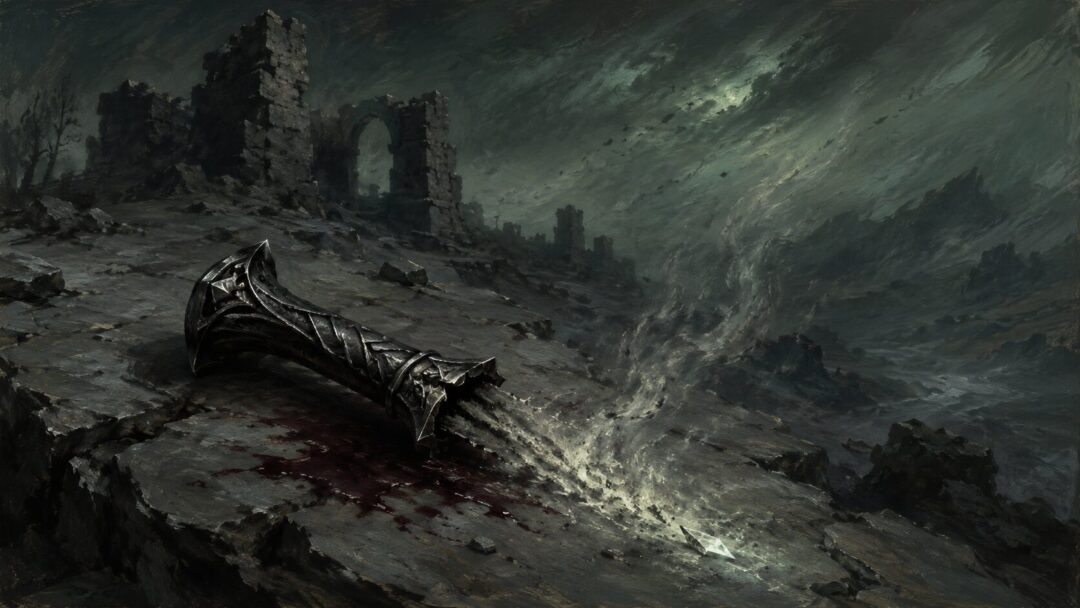
On Weathertop, the Lord of the Nazgûl wounds Frodo with a Morgul-knife. Frodo survives partly because the blow does not fully land as intended. The texts make clear that the blade’s true purpose was to pierce his heart. Gandalf later explains that the Riders tried to do exactly that, and that the remaining fragment in the wound would have worked inward until Frodo became a wraith under the Dark Lord’s command.
This matters because the shoulder wound is not the whole injury. The visible cut is only the entrance. The real attack continues afterward, hidden inside Frodo’s body. The knife breaks, and a splinter remains. That splinter is not inert metal. It moves inward, toward the heart, carrying the evil purpose of the weapon with it.
The Witch-king does not need to stand over Frodo and finish the work. The wound itself becomes a kind of delayed trap. Frodo can be carried away from Weathertop, but the attack goes with him.
The Blade Was Trying to Pull Frodo Into the Wraith-world
The Nazgûl are not merely invisible men. They exist in a terrible condition between life and death, bound to Sauron through the Rings given to mortal Men. They have faded from ordinary sight and become servants of the unseen domination of the Dark Lord.
The Morgul-knife appears designed to force something similar onto its victim. Gandalf’s explanation is conservative but chilling: Frodo would have become a wraith, though weaker than the Nine, and would have fallen under Sauron’s rule. The knife was therefore not just poisoning flesh. It was attempting to alter Frodo’s state of being.
This is why Frodo’s symptoms are so strange. He becomes cold. His pain deepens. He begins to see the Black Riders more clearly in their terrible forms, especially near the Ford of Bruinen. The closer he comes to collapse, the more the unseen world presses upon him.
One careful reading is that the wound is dragging Frodo toward the same realm in which the Ringwraiths chiefly exist. Tolkien never turns this into a mechanical rulebook, but the story strongly implies that the Morgul-fragment is making Frodo “fade.” He is not simply getting weaker; he is becoming less fully present among the living.
Wearing the Ring Made the Moment More Terrible
At Weathertop, Frodo puts on the One Ring. This is not a small detail. When he wears it, he does not merely become invisible to his companions. He enters more directly into the world of the unseen. There he perceives the Nazgûl not as vague black shapes but in their more dreadful reality.
The text does not explicitly say, “The Ring made the Morgul-knife more effective.” That should not be stated as fact. But the sequence is deeply suggestive. Frodo, wearing the Ring, is more exposed to the Ringwraiths’ world. The Witch-king can reach him in a moment when Frodo has been drawn closer to their condition.
Even so, Frodo is not passive. He strikes at the Rider’s feet, cries out against him, and invokes Elbereth. His resistance matters. The wound lands, but not as intended. The heart is missed. The Enemy’s plan is delayed.
That delay is the difference between Frodo reaching Rivendell and being lost.
Strider Could Treat the Pain, But Not Remove the Curse
After the attack, Strider uses athelas, the healing herb also called kingsfoil. This is a crucial act of knowledge and mercy. It eases Frodo’s suffering and helps preserve him long enough to continue the journey. But Strider cannot fully heal the wound in the wild.
That limitation is important. The Morgul-knife belongs to a class of evil that ordinary battlefield medicine cannot answer. Strider understands enough to recognize the danger, and his use of athelas shows both his hidden lineage and his healing wisdom. But the fragment remains beyond his power to remove there.
The story turns, then, into a race between two movements: Frodo’s body being carried toward Rivendell, and the splinter moving inward toward his heart.
The fear is quiet but relentless. The Riders do not need to win every skirmish. Time is on their side, because the wound itself is still obeying them.
The Ford Shows How Close Frodo Came
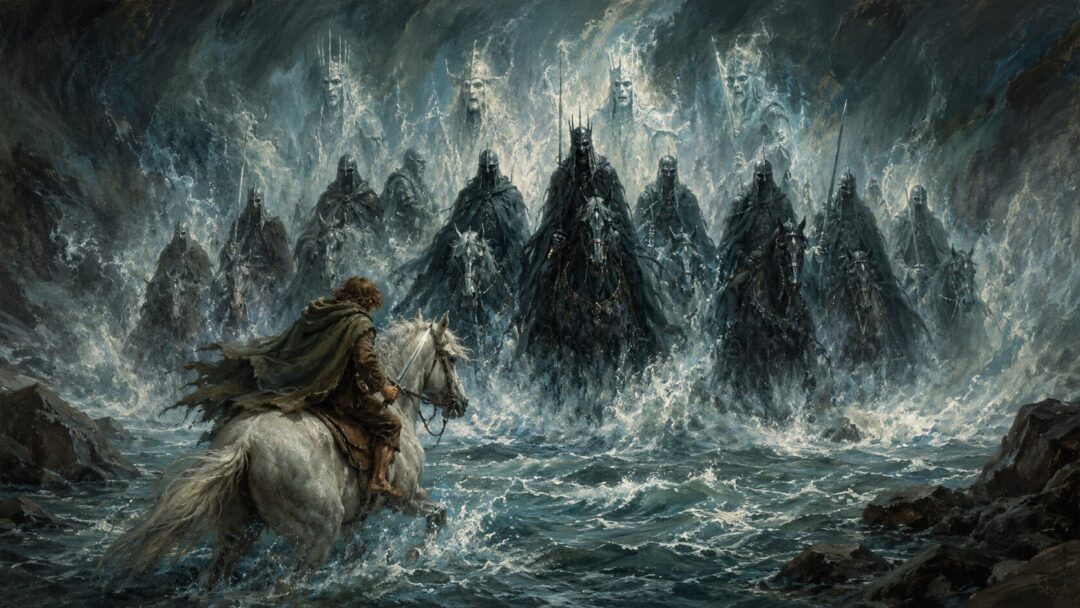
By the time Frodo reaches the Ford of Bruinen, he is nearly spent. He can still defy the Riders, but his strength is failing. The scene is often remembered for the flood that sweeps the Nazgûl away, yet Frodo’s condition is just as important as the river’s power.
He sees the Riders with terrible clarity. Their command presses on him. They call to him. They are not merely chasing him across the land; they are trying to claim him across the boundary between the seen and unseen worlds.
Frodo’s defiance at the Ford is therefore not heroic in the usual martial sense. He cannot defeat them by strength. He barely remains upright. But he still refuses. That refusal matters because the Morgul-knife is not only attacking the body. It is preparing the victim for domination.
The knife is doing what the Enemy always does in Middle-earth: reducing a free person into a tool.
Elrond Removes the Fragment, But Not the Memory
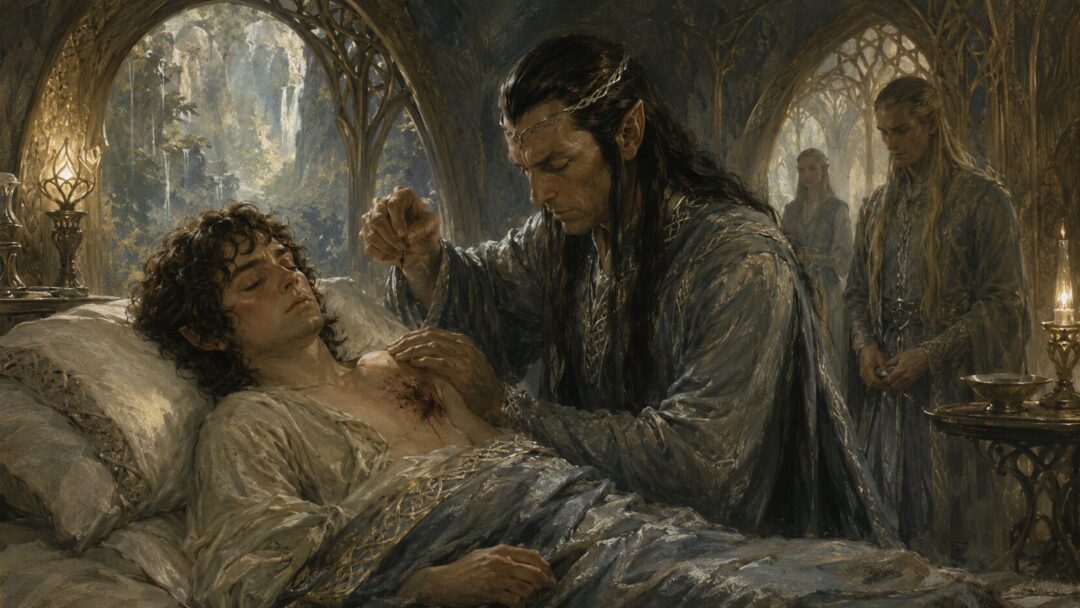
In Rivendell, Elrond succeeds where Strider could not. He finds and removes the splinter, and Frodo awakens after long danger. This is a true healing, but it is not a simple reset.
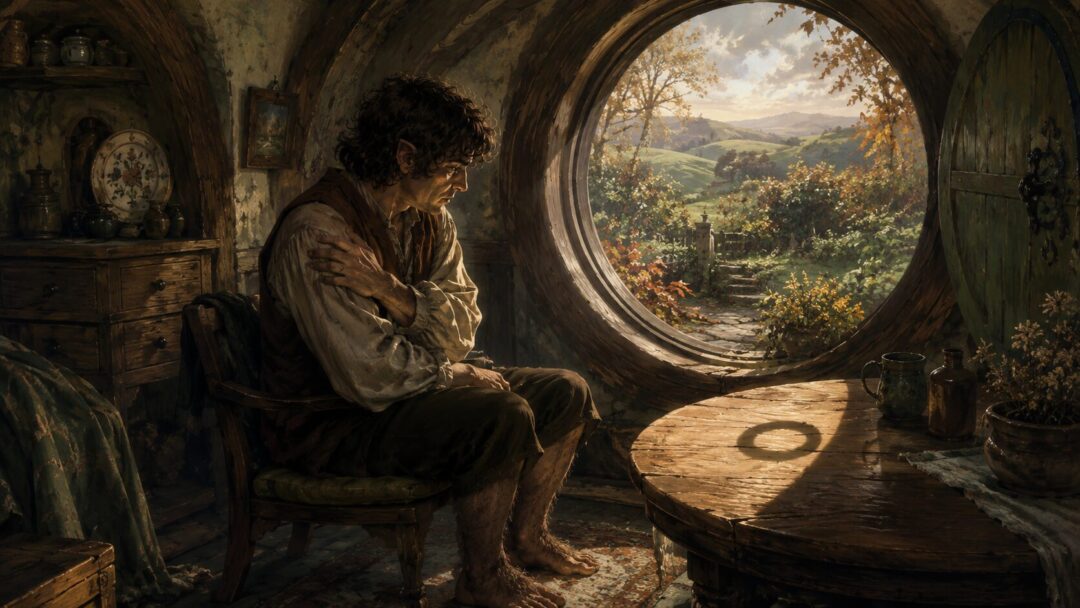
The wound becomes part of Frodo’s story. Later, he suffers on anniversaries of his injuries and burdens. The Morgul-wound returns in memory and pain. It is not just a scar of flesh; it is one of the marks left by contact with the deepest malice of the Enemy.
This is one of the quiet tragedies of Frodo’s arc. Middle-earth can be saved, the Ring destroyed, the Shire restored, and still Frodo himself is not fully restored within it. The Morgul-knife foreshadows that truth early. Some victories do not erase what was endured to achieve them.
Elrond removes the shard, but the experience of being drawn toward shadow remains.
The Knife Reveals the Enemy’s Real Strategy
The Morgul-knife is terrifying because it shows how Sauron’s power works at its most intimate level. He does not only conquer by armies. He corrupts, bends, isolates, and transforms. The knife is a weapon of possession disguised as a weapon of murder.
Had Frodo died outright, the Ring might still have been taken. But the Morgul-knife offered something worse: Frodo alive in some diminished, enslaved form, robbed of freedom and made useful to the Enemy. Gandalf’s later explanation implies that Sauron would have tormented him for bearing and withholding the Ring.
That is the moral horror of the wound. The Enemy does not only want the Ring back. He wants the will of the Ring-bearer broken beneath him.
In that sense, the Morgul-knife is a small version of the whole war. The struggle is not only over territory, fortresses, or thrones. It is over whether persons remain themselves under the pressure of fear and power.
Why Frodo’s Resistance Matters
Frodo is often physically overmatched in The Lord of the Rings. On Weathertop, he faces beings far beyond his strength. Yet the story does not treat him as useless. His resistance changes the outcome.
He puts on the Ring in fear, which increases the danger. But he also resists the Rider, strikes out, and calls on a holy name. The blow fails to reach his heart. The fragment remains deadly, but the Enemy’s immediate purpose is frustrated.
This is a pattern that follows Frodo all the way to Mordor. He is not victorious because he is stronger than evil. He endures, resists, receives help, and is preserved through mercy beyond his own power. The Morgul-wound is the first great sign that the Quest will not be won by simple heroics.
Frodo can be wounded. He can be changed. He can even fail. But he is not easily made into a servant.
The Real Work of the Morgul-knife
So what was the Morgul-knife really doing to Frodo?
It was not merely killing him. It was not merely poisoning him. It was trying to relocate him spiritually and bodily into the shadow-world of the Ringwraiths. It aimed for the heart because the intended result was domination, not a normal wound. The splinter worked inward because the attack continued after the blade was gone. The growing cold, weakness, and altered sight all point toward Frodo being drawn nearer to the condition of a wraith.
The tragedy is that even after healing, Frodo carries the wound’s memory. The mercy is that the knife did not finish its work.
On Weathertop, the Enemy nearly turned the Ring-bearer into a thing he could command. But the blow was resisted, delayed, and finally undone in Rivendell. Frodo remained Frodo.
And in the long war against the Shadow, that mattered more than any sword-stroke on the hill.
Sources & Notes
- J.R.R. Tolkien, The Lord of the Rings, Book I, Chapter 11, “A Knife in the Dark” — Frodo puts on the Ring at Weathertop, sees the Nazgûl in their wraithly forms, resists, and is wounded by the Morgul-knife.
- J.R.R. Tolkien, The Lord of the Rings, Book I, Chapter 12, “Flight to the Ford” — Aragorn identifies the Morgul-wound, uses athelas for relief, and the race to Rivendell shows Frodo growing cold and fading.
- J.R.R. Tolkien, The Lord of the Rings, Book II, Chapter 1, “Many Meetings” — Gandalf explains that the knife-point was working inward toward Frodo’s heart and would have made him a wraith under Sauron’s command.
- J.R.R. Tolkien, The Silmarillion, “Of the Rings of Power and the Third Age” — gives the wider context of the Nine Rings turning mortal kings into Ringwraiths, servants bound to Sauron’s will.
- J.R.R. Tolkien, The Lord of the Rings, Book VI, Chapter 9, “The Grey Havens” — Frodo’s later recurring pain from the Weathertop wound supports the article’s point that Elrond’s healing did not erase the wound’s memory.