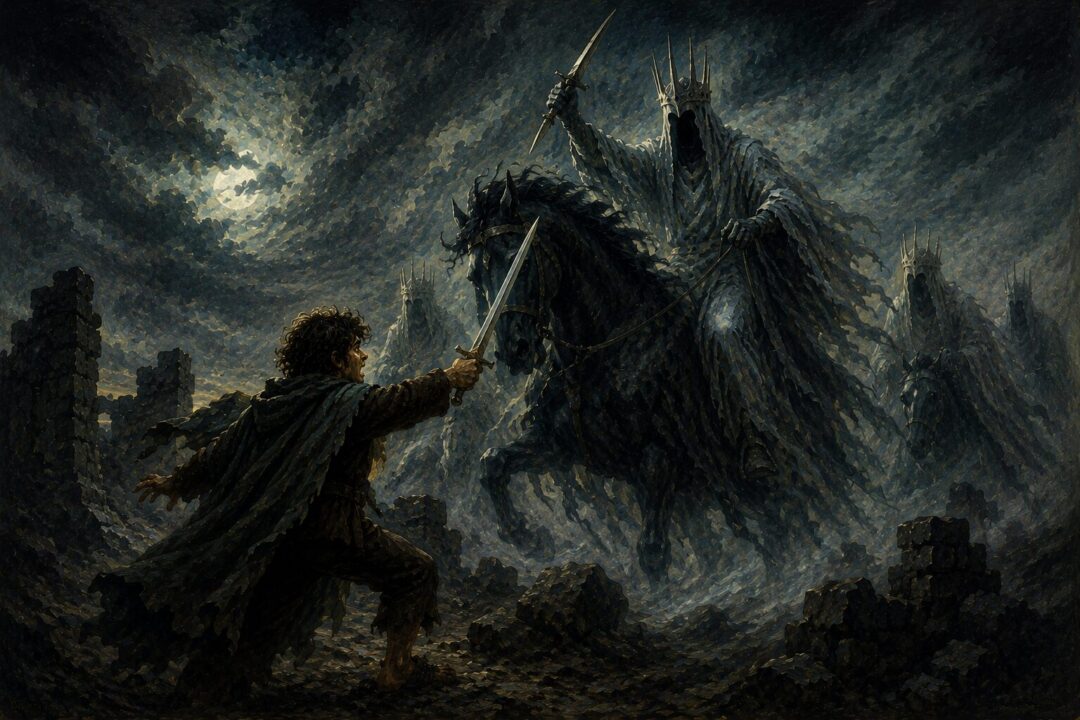
At Weathertop, Frodo Baggins does something small, frightened, and catastrophic: he puts on the Ring.
The choice lasts only moments. Yet in those moments, the dark hill of Amon Sûl changes. The night changes. The hunters pursuing him change. And Frodo himself briefly sees a reality hidden from ordinary eyes.
Many readers remember the scene for the terror of the Nazgûl attack. But one of its deepest revelations lies in what Frodo actually perceives once the Ring is on his finger. The Ring does not merely make him invisible. At Weathertop, it alters his perception of the world—and what he sees exposes one of the most unsettling truths in Middle-earth: the Ringwraiths are far more real in the unseen realm than they are in the visible one.
The Moment Frodo Puts On the Ring
The attack on Weathertop unfolds in darkness, fear, and confusion.
Aragorn has gone scouting. The hobbits sit exposed among the ancient ruins of Amon Sûl. Then Frodo senses them before he fully sees them: shapes advancing through the night, a growing dread pressing on his mind.
The text emphasizes not simple physical danger but psychological pressure. Frodo feels an overwhelming urge to put on the Ring. This matters. The impulse is not presented as a calm tactical decision.
“He had a desperate desire to follow” the command in his mind.
Whether this pressure comes from the Ring itself, from the Nazgûl’s influence, or from the interaction between the two is not exhaustively explained. But the scene makes one thing clear: wearing the Ring in the presence of the Nazgûl is precisely what the Enemy’s servants want.
Frodo resists briefly.
Then he yields.
And reality changes.
The Nazgûl Become Terribly Clear
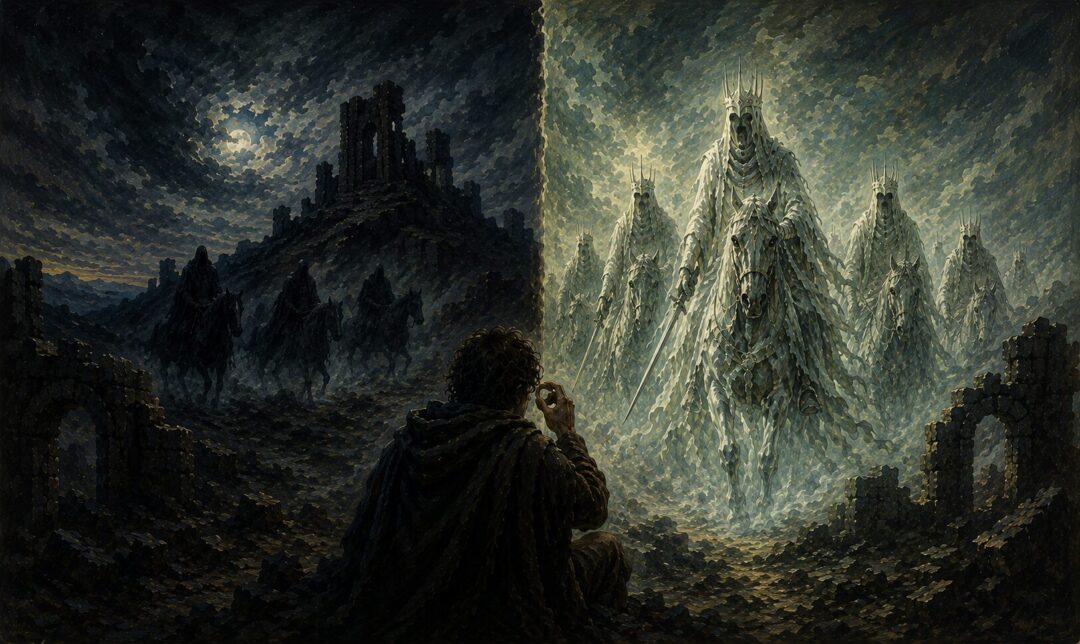
Before Frodo wears the Ring, the attackers are dark, cloaked figures.
Afterward, the concealment falls away.
Suddenly, he sees them “clearly.”
This is one of the most important visual transitions in The Lord of the Rings.
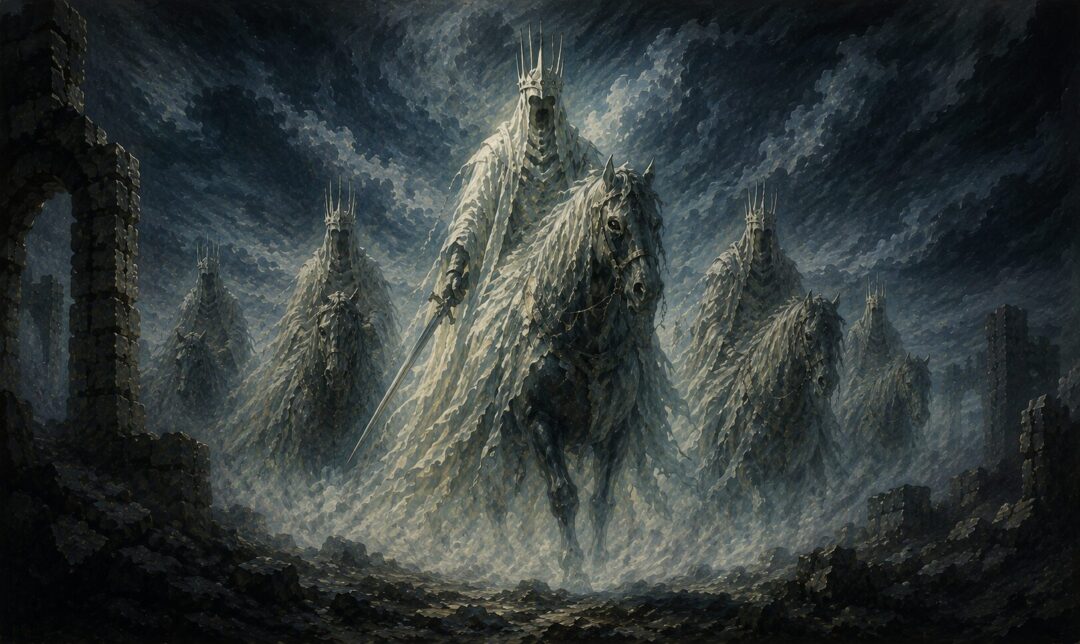
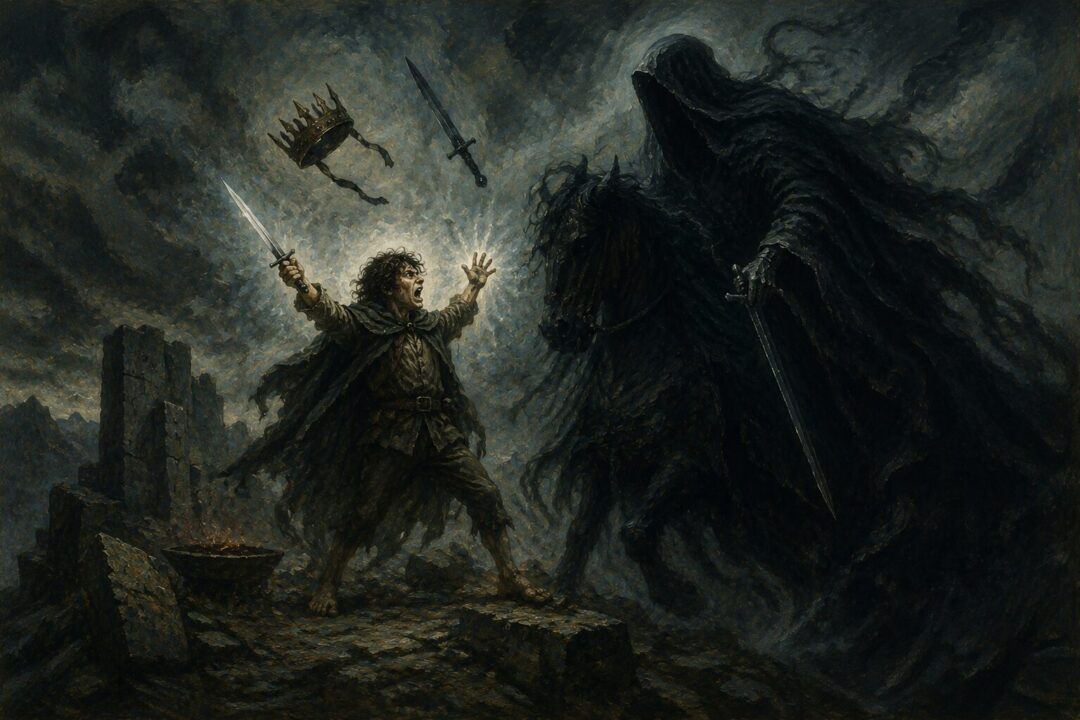
The black robes remain visible, but the chief figure is transformed in Frodo’s sight. The leader appears as a kingly being: a tall figure crowned and robed in white. Yet the garments are not untouched by holiness or authority. The robes shine with an unnatural pallor, and in one hand he holds a knife.
Most strikingly, the figure’s face is invisible beneath the crown.
This is not how ordinary eyes perceive the Nazgûl.
The text does not suggest the Ring creates hallucinations. Instead, it allows Frodo to perceive the Ringwraiths more nearly as they exist in the unseen dimension to which they belong.
That paradox matters. The terrifying revelation is not that the Nazgûl become monstrous when the Ring is worn.
It is that the shadowy cloaked riders seen by normal people are, in a sense, already disguises.
What the Ring Changes About Sight
The Ring’s power over visibility is easy to oversimplify.
For mortals like hobbits and Men, putting on the One Ring commonly causes physical invisibility in the ordinary world. But invisibility is only part of the effect.
The Ring also shifts the wearer’s relationship to another mode of existence often called the “unseen” realm.
This concept appears repeatedly across the legendarium, though Tolkien does not present it as a separate fantasy dimension with rigid mechanical rules. Rather, certain beings exist partly or primarily on levels of reality not fully accessible to ordinary embodied creatures.
The Nazgûl are central examples.
They were once living kings and lords of Men. Through their Rings of Power, they faded. Their bodies no longer appear normally in the visible world, though they can wear clothing and armor to provide form and presence.
That background explains the Weathertop revelation.
When Frodo enters the Ring’s mode of perception, he does not lose sight of the Nazgûl.
He sees them more truly.
The Ring strips away part of the veil that ordinarily conceals their condition.
Why the Ringwraiths Wanted Frodo to Wear the Ring
The scene becomes even darker when viewed from the Nazgûl’s perspective.
Frodo putting on the Ring is not merely dangerous because it reveals his location.
It draws him closer to their state of existence.
This danger is strongly implied throughout the journey and becomes clearer after Weathertop when Gandalf explains elements of what happened.
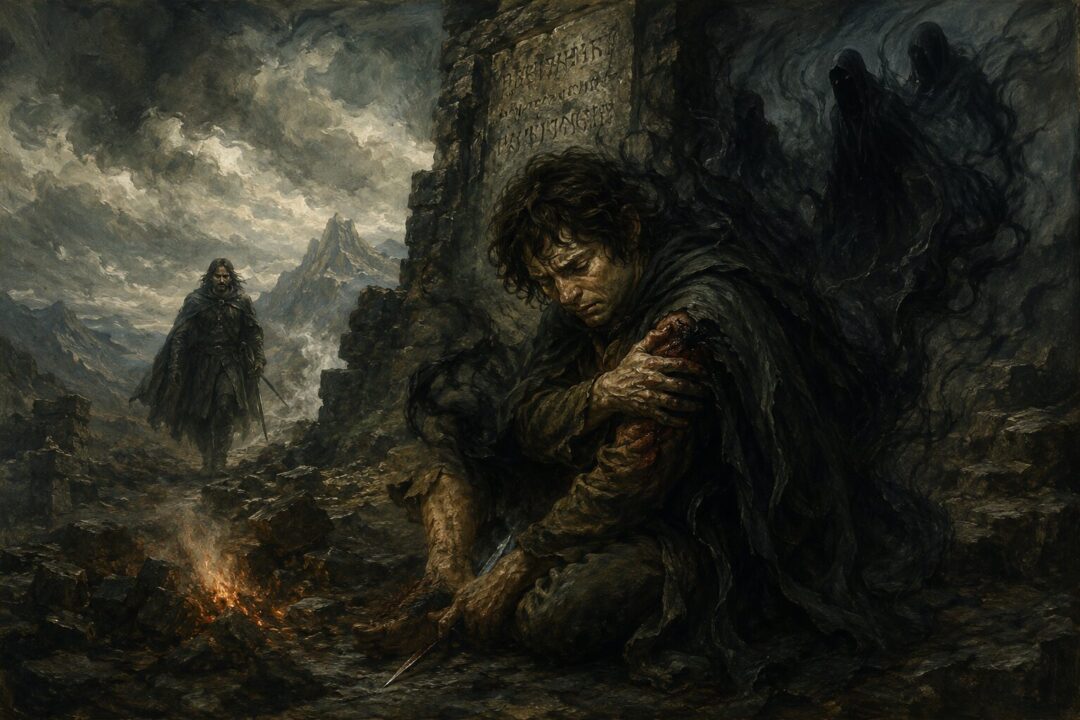
The Morgul-knife wound is not just poison. Its effect threatens transformation.
A fragment broken off in Frodo’s shoulder works inward toward his heart. Had the process completed, Gandalf warns, Frodo would have become “like a wraith under the domination of the Dark Lord.”
That explanation casts new light backward onto Weathertop.
The Ring and the Morgul-blade are not unrelated threats. Both operate along the terrifying borderland between visible life and wraith-like existence.
When Frodo puts on the Ring in the Nazgûl’s presence, he steps toward the terrain where they are strongest.
For a brief instant, he is becoming easier for them to perceive, influence, and claim.
The scene’s horror is metaphysical as much as physical.
Frodo is not simply hiding badly.
He is moving onto the enemy’s ground.
The White Robes and Crown: What Did Frodo Actually See?
One of the most discussed details in the passage is the Witch-king’s appearance.
Why white robes? Why a crown?
The crown is relatively straightforward. The chief Nazgûl is the Lord of the Nazgûl, later explicitly revealed as the Witch-king of Angmar, a ruler once feared among Men. Royal imagery fits his status and remembered identity.
The white robes are more difficult.
The text does not provide a direct explanation.
Readers should be cautious about claiming certainty here.
One possibility is that the whiteness reflects how Frodo perceives spiritual or unseen forms under altered vision: luminous, stark, and unnaturally clear against darkness.
Another reading sees bitter irony in the image. White garments and crowns traditionally signal kingship, authority, or sanctity. Here, those associations have been hollowed out and corrupted. The figure appears regal but faceless, exalted yet empty.
The text itself supports the essential point without resolving every symbolic detail: Frodo perceives not a ragged ghost but a being of dreadful authority.
That revelation deepens the scene’s menace. The Nazgûl are not wandering specters.
They are enslaved remnants of ancient power.
Frodo’s Resistance Inside the Unseen World
One overlooked aspect of Weathertop is that Frodo does not collapse immediately after putting on the Ring.
He sees more clearly—and then, astonishingly, he fights.
The leader advances. Frodo hears words spoken: “O Elbereth! Gilthoniel!”
He cries the invocation aloud and strikes with his sword.
This moment matters enormously.
Frodo is terrified, wounded, pressured by the Ring, and standing partly within the perceptual territory of the Nazgûl.
Yet he still acts.
The invocation of Elbereth is not random.
Across the story, Elbereth’s name carries profound significance among Elves and becomes associated with resistance against shadow. The text does not turn it into a mechanical spell formula, but the cry marks a turning of allegiance and will.
Frodo’s resistance here is deeply characteristic.
His courage rarely resembles martial confidence. More often, it appears as moral endurance under crushing fear.
At Weathertop, altered perception does not grant mastery.
It forces him to confront horror more directly than his companions can—and still choose defiance.
Seeing Too Much Comes at a Cost
The irony of Weathertop is brutal.
Frodo gains knowledge precisely when he is least equipped to bear it.
The Ring gives him clearer sight, but clearer sight is not empowering.
It is dangerous.
Middle-earth repeatedly warns that deeper perception can carry moral and spiritual cost. The palantíri reveal truths but expose minds to domination. Forbidden knowledge tempts. Power opens doors that cannot easily be closed.
The Ring operates according to a similar logic.
What Frodo sees at Weathertop is not a useful intelligence report about enemy anatomy.
It is intimate exposure to the world of wraiths.
And afterward, he does not simply recover.
The wound lingers. His perception changes permanently in subtle ways. He becomes unusually sensitive to the Nazgûl and to the Ring’s pull. Later episodes suggest that his encounter has left enduring marks.
Weathertop is not just an attack scene.
It is an initiation through terror.
The True Horror of What Frodo Saw
When readers imagine invisibility in fantasy, they often imagine escape: slipping unseen through danger.
At Weathertop, the One Ring does almost the opposite.
Frodo disappears from ordinary sight—but enters a condition where the Nazgûl become vividly present.
The world sharpens into terrible clarity.
The cloaked hunters reveal ancient, crown-bearing forms. Hidden realities surface. The unseen presses against the visible.
And beneath the immediate danger lies the deeper threat: the possibility that Frodo himself could become like them.
That is the real horror of Weathertop.
The Ring does not merely hide its bearer.
It teaches him, for a dreadful moment, how the Ringwraiths see.
Sources & Notes
- J.R.R. Tolkien, The Lord of the Rings, Book I, Chapter 11, “A Knife in the Dark” — Frodo’s wearing of the Ring at Weathertop makes the Nazgûl suddenly clear to him, including the crowned, white-robed figure with the knife.
- J.R.R. Tolkien, The Lord of the Rings, Book II, Chapter 1, “Many Meetings” — Gandalf explains the Morgul-knife fragment and warns that Frodo would have become a wraith under the Dark Lord’s domination.
- J.R.R. Tolkien, The Lord of the Rings, Book I, Chapter 2, “The Shadow of the Past” — Gandalf’s account of the Rings explains how mortal bearers can fade from the visible world and become permanently invisible.
- J.R.R. Tolkien, The Silmarillion, “Of the Rings of Power and the Third Age” — the Nine Rings enslave mortal kings and warriors, making them Ringwraiths and chief servants of Sauron.
- J.R.R. Tolkien, The Lord of the Rings, Book II, Chapter 1, “Many Meetings” — Gandalf’s remarks on the Seen and Unseen, and on Glorfindel’s presence in both, give the wider framework for Frodo’s altered sight.