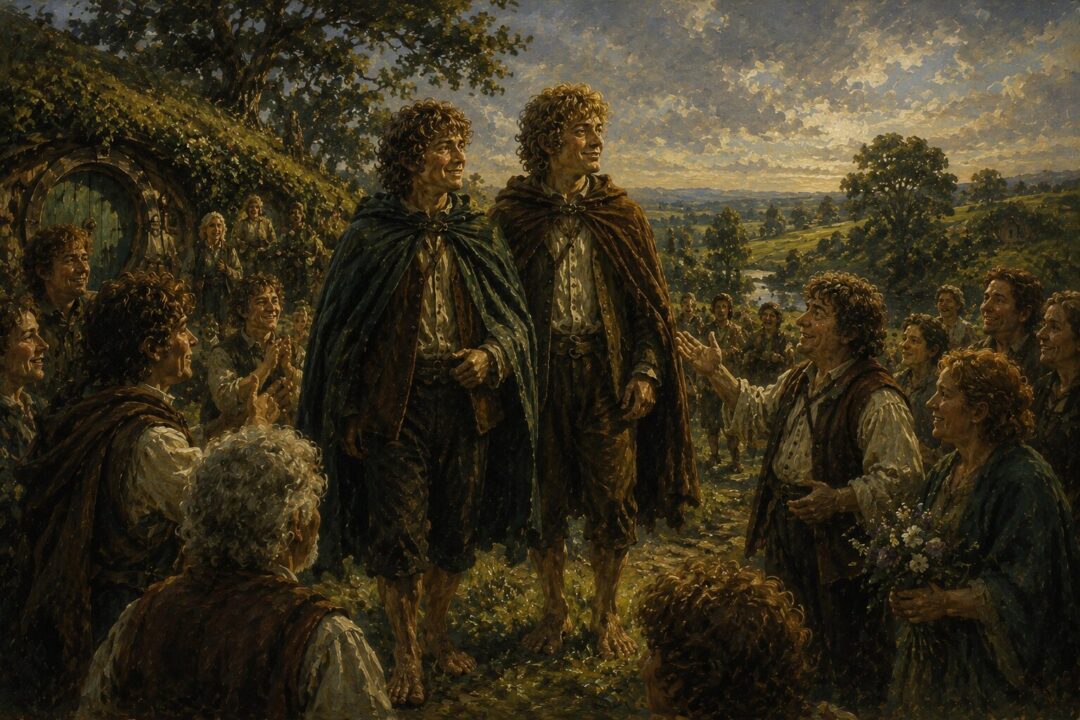
When Meriadoc Brandybuck and Peregrin Took first appear in The Lord of the Rings, they seem like exactly what many readers expect Hobbits to be: cheerful, curious, fond of meals, fond of comfort, and not especially concerned with the affairs of the wider world.
Yet when they ride back into the Shire at the end of the War of the Ring, they are almost unrecognizable.
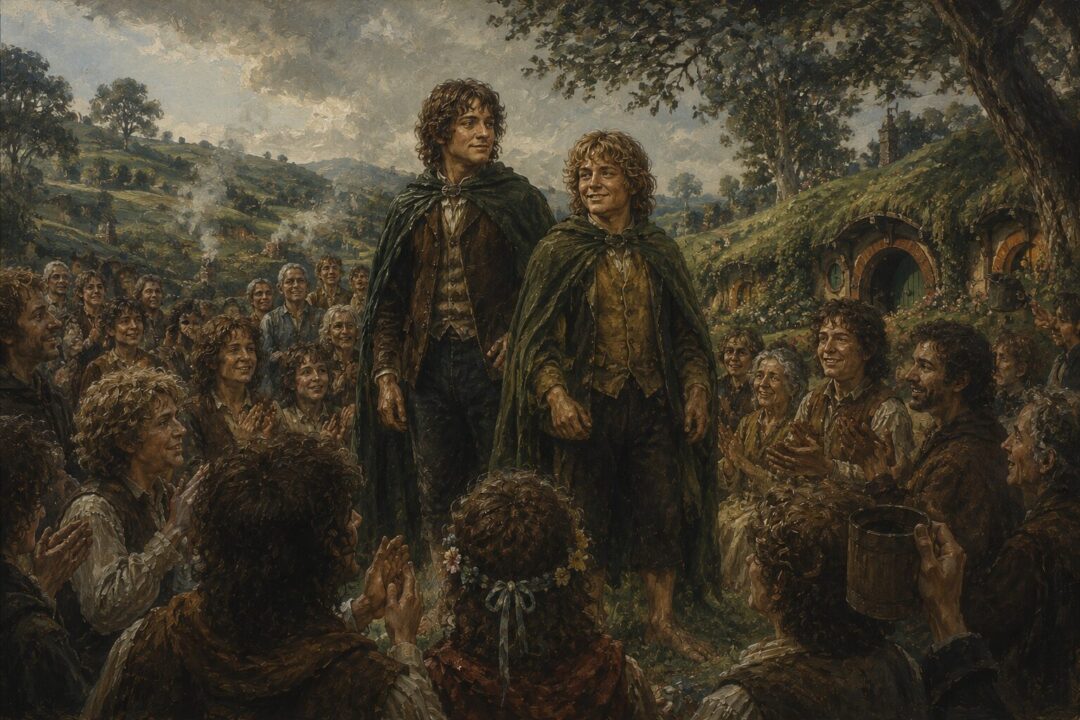
They are still Hobbits. They still laugh, feast, and enjoy life. But they return taller, stronger, more confident, and far more capable than the people who left. More importantly, they come back with a sense of responsibility that most Hobbits never acquire. They have seen kingdoms rise and fall, fought in great battles, stood beside kings, and looked directly into the face of evil.
Their transformation is one of the most remarkable character arcs in Tolkien’s legendarium—not because they become heroes in the conventional sense, but because they return home changed without losing who they are.
The Hobbits Who Were Never Meant to Go
At the beginning of the story, Merry and Pippin are not warriors.
Merry is intelligent, practical, and somewhat more mature than his younger cousin. He plays a key role in helping Frodo leave the Shire and is often the most organized member of the Hobbit companions. Yet he remains fundamentally a Shire Hobbit whose experience is limited to local concerns.
Pippin begins in an even more carefree state. Young, impulsive, and often reckless, he frequently acts before thinking. His curiosity causes problems more than once, most famously in Moria when he drops a stone into the well, helping alert enemies to the Fellowship's presence.
Neither Hobbit leaves home expecting to influence the fate of kingdoms.
In fact, much of the early journey emphasizes their vulnerability. They are physically small, inexperienced, and largely dependent upon stronger companions for protection.
Yet Tolkien repeatedly shows that courage is not the absence of weakness. It is the willingness to act despite weakness.
The transformation of Merry and Pippin begins long before they ever wear armor or ride into battle. It begins the moment they choose not to abandon their friends.
Captivity Became Their First Test
The breaking of the Fellowship changes everything.
When Uruk-hai capture Merry and Pippin near Amon Hen, their journey separates dramatically from Frodo’s. Instead of accompanying the Ring-bearer toward Mordor, they are dragged into danger against their will.
At first glance, captivity seems like a setback. In reality, it becomes the beginning of their independence.
During the march across Rohan, both Hobbits demonstrate resilience and resourcefulness. Pippin deliberately drops his brooch as a clue for Aragorn, Legolas, and Gimli. Later, the pair escape amid the chaos of battle between the Orcs and the Riders of Rohan.
For perhaps the first time in the story, they must survive without guidance from older or stronger companions.
No wizard is directing them. No Ranger is protecting them.
Their decisions are their own.
The frightened travelers who left the Shire begin learning self-reliance in the wilderness of Middle-earth.
Fangorn Forest Changed Their Understanding of the World
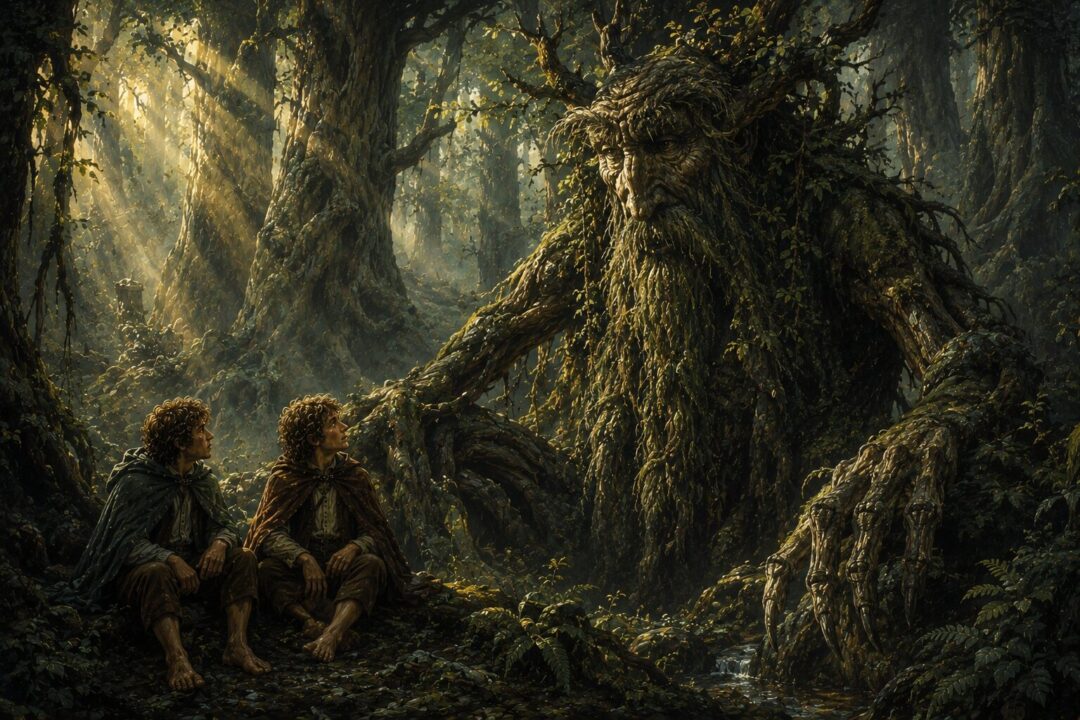
Their meeting with Treebeard marks another crucial stage in their development.
Most Hobbits live in a world measured by farms, fields, villages, and family connections. Fangorn exposes Merry and Pippin to something vastly older.
Treebeard is not simply an unusual creature. He is a living witness to ages of history stretching back beyond anything the Shire remembers.
Through the Ents, the Hobbits encounter a perspective almost unimaginable to ordinary people. Time moves differently. Decisions carry weight across centuries. The destruction of forests is not merely practical loss but part of a much deeper tragedy.
Their participation in the Entmoot allows them to influence events on a scale far beyond anything they could have imagined. Treebeard later acknowledges that the Hobbits helped awaken the Ents to immediate action against Saruman.
Importantly, Merry and Pippin do not become powerful by commanding others. They become significant because they learn how to communicate urgency, truth, and moral necessity.
That lesson remains with them for the rest of their lives.
Saruman's Fall Revealed the Limits of Power
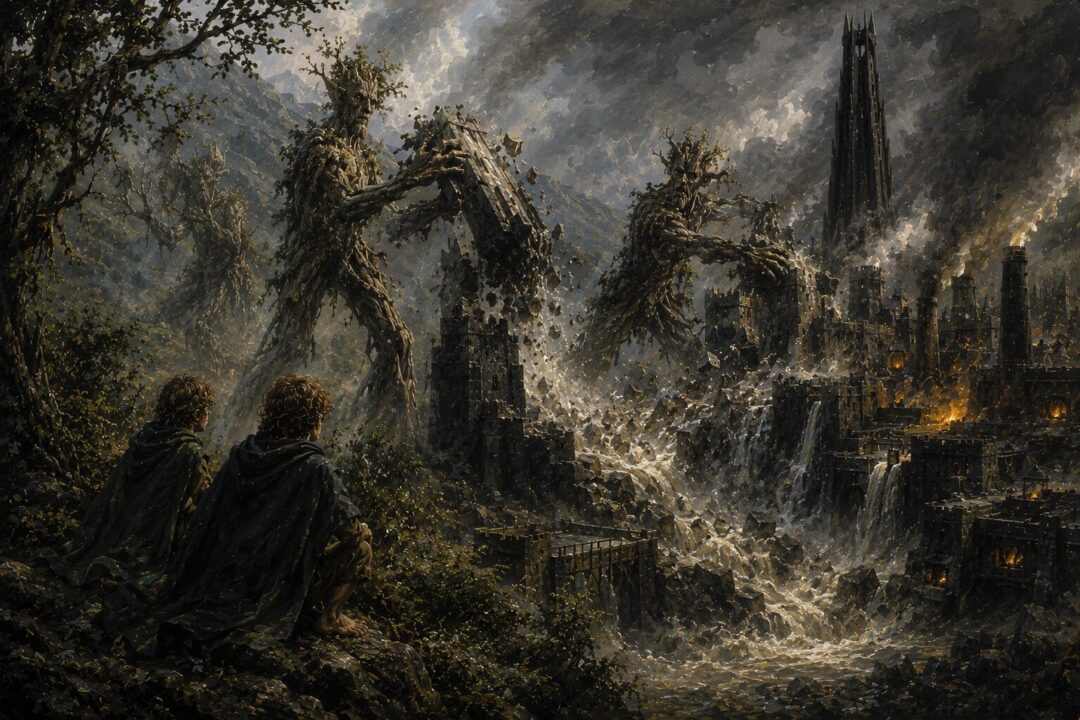
The destruction of Isengard gives Merry and Pippin a front-row view of one of the central themes of Tolkien’s work.
Saruman possesses immense knowledge and authority. He commands armies, machinery, and fortifications. Yet his power collapses because it has become detached from wisdom and humility.
The Hobbits witness this downfall directly.
What makes this important is that Merry and Pippin are among the least powerful characters in the story. They have no armies. No magic. No political authority.
Yet they watch a mighty figure fail while simple people endure.
The experience reinforces a truth that appears throughout the legendarium: greatness is not measured primarily by strength, rank, or domination.
This understanding shapes the leaders they later become in the Shire.
Service Under Kings Taught Them Responsibility
One of the most visible changes occurs when the two cousins enter military service.
After arriving at Minas Tirith, Pippin swears service to Denethor, Steward of Gondor. Later, Merry becomes a member of King Théoden’s household in Rohan.
These moments are significant because they represent deliberate commitments rather than accidents of circumstance.
For perhaps the first time, both Hobbits formally accept duties larger than themselves.
Pippin's service exposes him to the burdens of governance and war. He witnesses Denethor’s despair, the defense of Minas Tirith, and the terrible costs of leadership during crisis.
Merry experiences a different education. Through Théoden he encounters nobility marked not by arrogance but by loyalty, courage, and sacrifice.
Neither Hobbit merely observes these figures from a distance.
They serve them personally.
The experience teaches discipline, accountability, and the importance of keeping one's word even under terrifying circumstances.
They Faced Death and Chose Courage
The greatest changes occur on the battlefield.
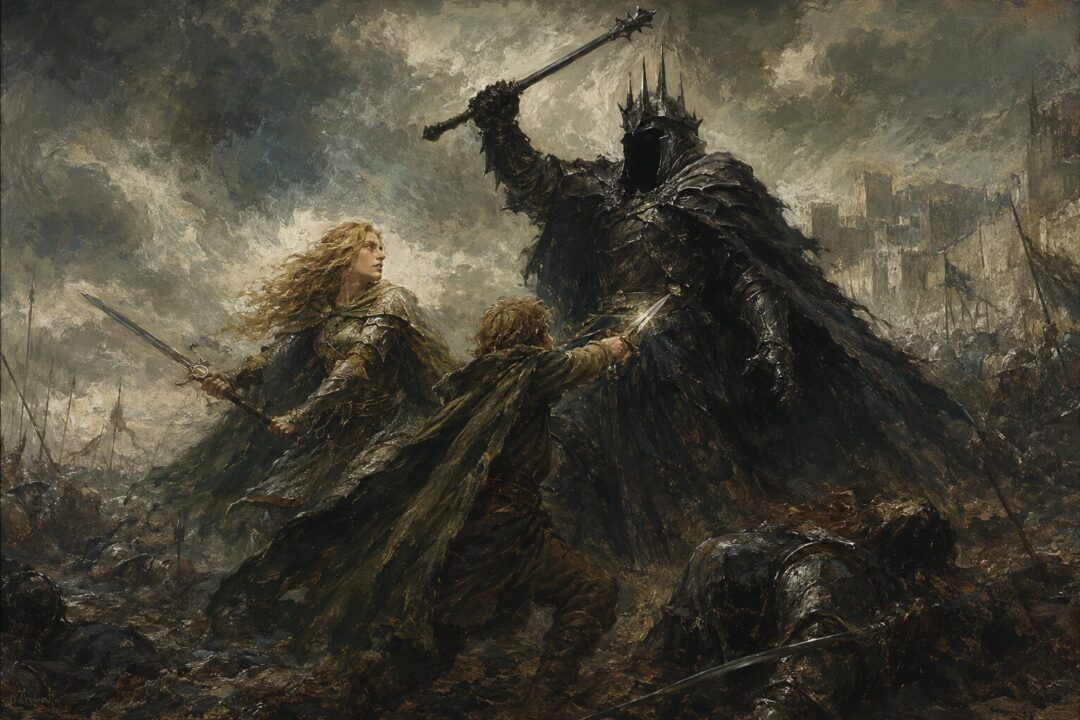
Merry rides with the Rohirrim toward Minas Tirith despite being ordered to remain behind. Hidden on Dernhelm’s horse, he reaches the Pelennor Fields and participates in one of the most important moments of the war.
When the Witch-king confronts Éowyn, Merry does not flee.
Instead, he strikes the Lord of the Nazgûl from behind, helping make possible the enemy’s defeat. The text directly links his action with the fulfillment of the prophecy that the Witch-king would not fall by the hand of a man.
Merry’s courage is especially striking because he fully understands the danger before him.
Pippin undergoes his own test during the Siege of Gondor.
He helps save Faramir from Denethor’s attempt to burn both himself and his son alive. Pippin recognizes what is happening, seeks Gandalf's aid, and acts despite the enormous authority of the Steward.
Neither act stems from physical strength.
Both arise from moral courage.
The impulsive Hobbit and the comfortable country gentleman become individuals willing to risk everything for others.
The Ent-Draughts Changed Their Bodies, But Experience Changed Their Souls
One of the most obvious signs of transformation is physical.
While staying with Treebeard, Merry and Pippin drink Ent-draughts. The text explicitly states that these drinks contribute to their unusual growth. By the end of the story they become exceptionally tall for Hobbits.
This physical change is real, but Tolkien presents it almost as a symbol of something deeper.
Many characters notice their increased stature.
Yet their true growth is not measured in inches.
They have gained confidence without arrogance.
They have learned judgment without losing compassion.
They have acquired worldly experience without becoming cynical.
Their physical height reflects an inner enlargement that cannot be quantified.
They have become bigger people in every meaningful sense.
Returning Home Was the Final Test
Ironically, the most important challenge awaits them in the Shire.
After surviving the War of the Ring, they discover that their homeland has suffered under the influence of Saruman and his followers.
This is where their transformation becomes undeniable.
Earlier in the story, Merry and Pippin needed protection from others. Now they provide leadership themselves.
At the Battle of Bywater, they help organize resistance against the ruffians who have taken control of the Shire. Their experience, confidence, and authority allow them to coordinate action where many local Hobbits are uncertain or intimidated.
The contrast is dramatic.
The young Hobbits who once depended upon Aragorn and Gandalf now serve as examples for their own people.
Yet they do not attempt to become kings or rulers.
They use what they have learned to restore ordinary life rather than replace it.
That restraint is one of the clearest signs of maturity.
They Returned as Themselves—Only Better
Many stories portray growth as becoming someone entirely different.
Tolkien takes a subtler approach.
Merry and Pippin never stop being Hobbits.
They still enjoy good food, companionship, laughter, and celebration. Their affection for the Shire remains intact. They do not reject their origins in favor of the grander world they have seen.
Instead, they bring wisdom back with them.
Their journey reveals that true maturity does not require abandoning one's identity. It means deepening it.
The Shire gave Merry and Pippin kindness, loyalty, humor, and love of home. The wider world gave them courage, perspective, discipline, and responsibility.
Together, those qualities create two of the most complete characters in The Lord of the Rings.
By the end of the tale, they are not different because they have become less Hobbit-like.
They are different because they have become the fullest version of what Hobbits can be.
Sources & Notes
- J.R.R. Tolkien, The Lord of the Rings, Book III, Chapter 3, “The Uruk-hai” — Merry and Pippin’s captivity, Pippin’s dropped brooch, and their escape show the first hard test of their independence.
- J.R.R. Tolkien, The Lord of the Rings, Book III, Chapter 4, “Treebeard” — Fangorn, the Ent-draughts, and the Entmoot place the young Hobbits inside an older, wider history and begin their physical and moral enlargement.
- J.R.R. Tolkien, The Lord of the Rings, Book V, Chapter 1, “Minas Tirith” — Pippin’s oath to Denethor turns his journey into formal service and brings him face to face with Gondor’s burden of war.
- J.R.R. Tolkien, The Lord of the Rings, Book V, Chapters 2–3, “The Passing of the Grey Company” and “The Muster of Rohan” — Merry’s attachment to Théoden and Rohan gives him a comparable lesson in loyalty, duty, and courage.
- J.R.R. Tolkien, The Lord of the Rings, Book V, Chapter 6, “The Battle of the Pelennor Fields” — Merry’s stroke against the Witch-king shows how his courage matters in one of the war’s decisive moments.
- J.R.R. Tolkien, The Lord of the Rings, Book VI, Chapter 8, “The Scouring of the Shire” — Merry and Pippin return as confident leaders, helping organize the Shire’s resistance without ceasing to be Hobbits.