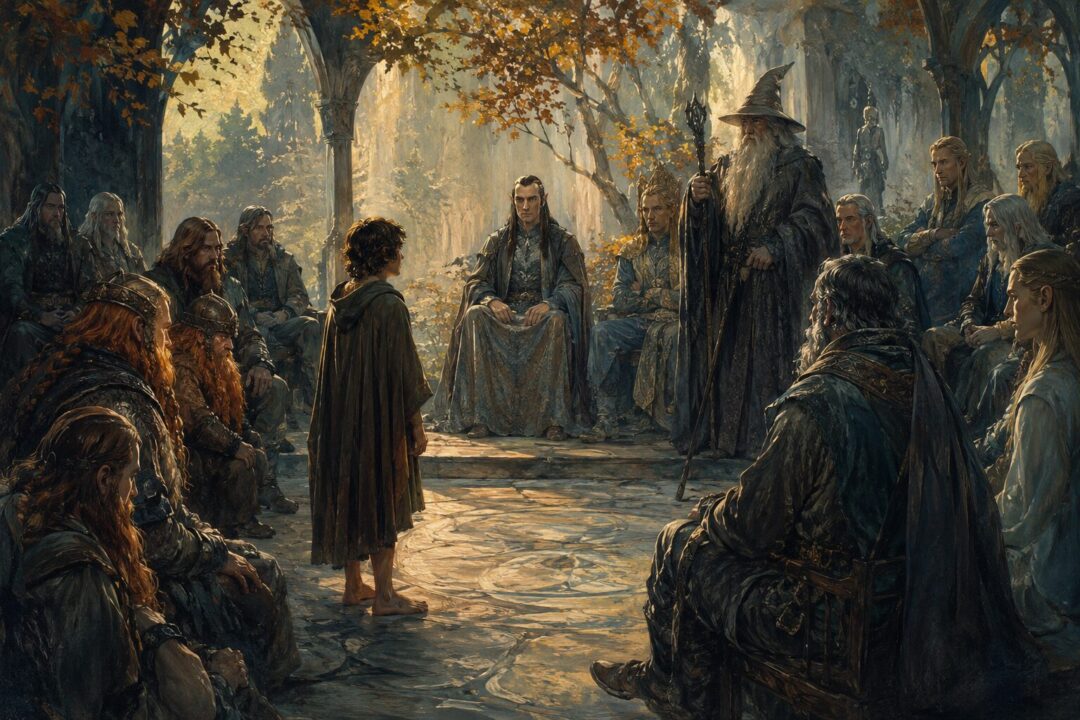
In a valley hidden beneath the Misty Mountains, the fate of Middle-earth was placed into the hands of a hobbit.
Not a king. Not a warrior. Not one of the Wise. At the Council of Elrond, when the One Ring was finally brought before the leaders of the Free Peoples, the task of carrying it into the heart of Mordor fell to Frodo Baggins—a small, inexperienced hobbit from the Shire.
At first glance, the decision seems astonishing. The Ring had corrupted mighty rulers, ensnared great warriors, and deceived some of the wisest beings in the world. Why would Elrond, one of the oldest and most knowledgeable leaders in Middle-earth, place such a burden upon the smallest people he knew?
The answer reveals one of the deepest themes in Tolkien’s legendarium: power is not defeated by greater power. It is defeated by humility, mercy, endurance, and the refusal to dominate others.
The Council Faced an Impossible Problem
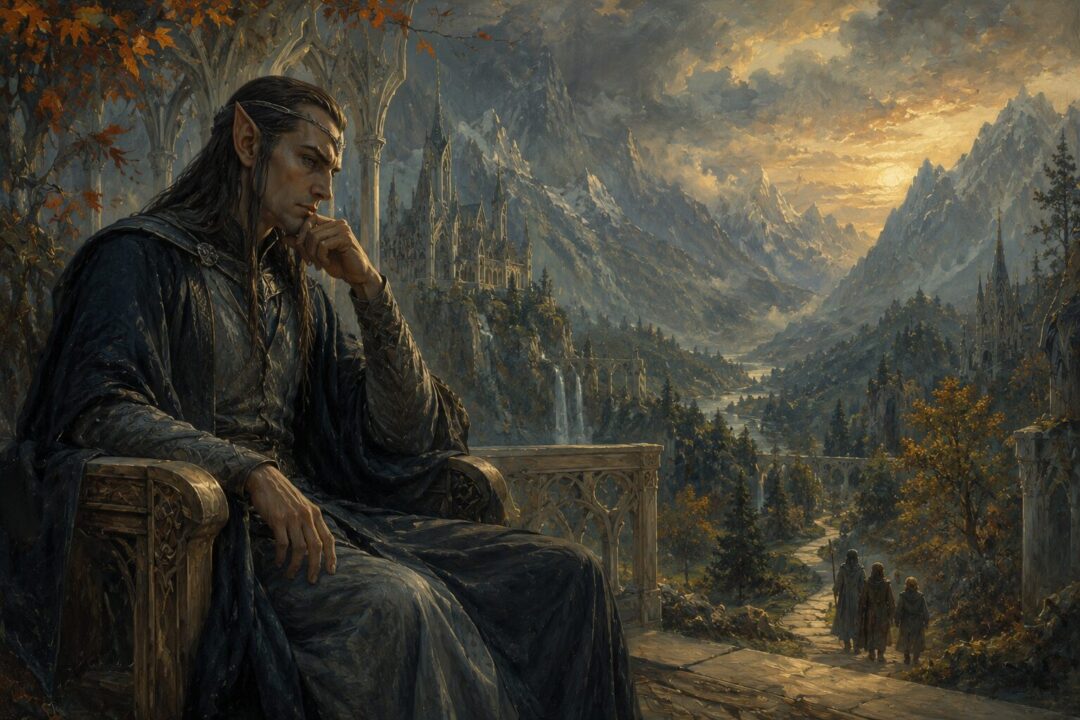
The Council of Elrond was not choosing the strongest champion. It was trying to solve an impossible dilemma.
The One Ring could not simply be hidden forever. Sauron was growing in strength and actively searching for it. Elrond explicitly rejects the idea that Rivendell could preserve the Ring indefinitely. Even if hidden from Sauron for a time, eventually all strongholds would fall if the Dark Lord regained enough power.
Nor could the Ring be safely used against him.
This possibility is discussed directly during the Council. Some wondered whether the Ring might be wielded as a weapon. Elrond and Gandalf understood the danger immediately. Anyone powerful enough to challenge Sauron with the Ring would eventually become another tyrant. The Ring enhanced the desire to dominate and bent even noble intentions toward corruption.
The Wise therefore faced a grim reality: the Ring could not be hidden, guarded, or used.
It had to be destroyed.
That decision immediately created another question. Who could possibly carry it?
Greatness Was Often a Weakness
Throughout Middle-earth’s history, extraordinary individuals repeatedly fell because they sought power for worthy purposes.
The clearest example is Isildur. After the defeat of Sauron at the end of the Second Age, he stood at the very place where the Ring could have been destroyed. Yet he claimed it as weregild for his father and brother. Whether he fully understood its danger or not, he could not surrender it.
Centuries later, the Ring continued to exert its influence on powerful people.
Boromir never desired evil for its own sake. He wanted to save Gondor. Yet the Ring transformed that noble goal into temptation. He began imagining victory, strength, and mastery. The desire to protect his people became the pathway through which corruption entered.
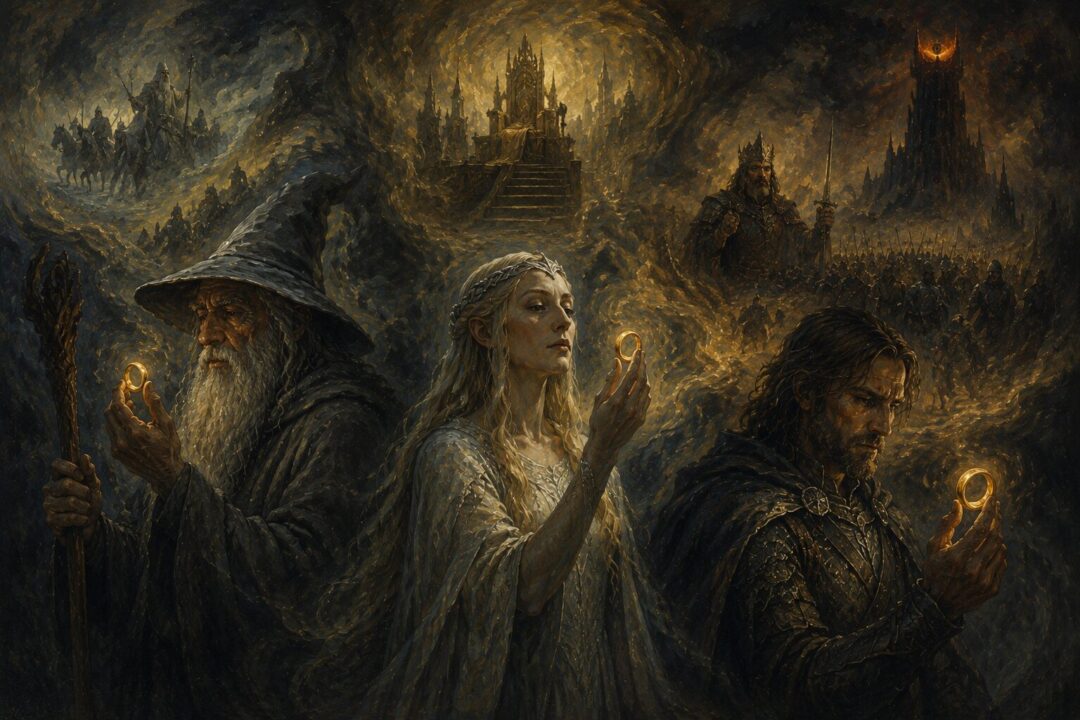
Even Gandalf feared taking the Ring. He openly refused Frodo’s offer in Bag End, explaining that through him the Ring would wield a terrible power. His compassion and desire to do good would not protect him from corruption; they would make the corruption even more dangerous.
Galadriel reached a similar conclusion when Frodo offered her the Ring in Lórien. She acknowledged that she had long imagined what she might become if she accepted it. Her rejection of the Ring is one of the great moral victories of The Lord of the Rings precisely because she understood the temptation.
Elrond belonged to this same category of powerful individuals. He possessed immense wisdom, authority, and ancient lineage. Such qualities made him a valuable leader—but they also meant he was not the ideal Ring-bearer.
The stronger the individual, the greater the danger if the Ring gained influence over them.
Hobbits Possessed an Unexpected Advantage
Hobbits were not immune to corruption. The story never claims otherwise.
Bilbo became possessive of the Ring. Frodo struggled under its growing burden. Sméagol, who shared hobbit-like ancestry through the Stoors, was utterly destroyed by it.
Yet hobbits possessed characteristics that made them unusually resistant compared to many other peoples.
Their ambitions were small.
Most hobbits did not dream of ruling kingdoms, commanding armies, or reshaping the world. They valued gardens, meals, family traditions, local gossip, and peaceful routines. Such desires gave the Ring fewer pathways through which to tempt them.
Gandalf seems to recognize this long before the Council. He repeatedly expresses admiration for hobbits and their surprising resilience. Their obscurity protected them. Their simplicity gave them strengths that powerful societies often overlooked.
This does not mean hobbits were morally superior to everyone else. Rather, their ordinary nature created a measure of resistance against the Ring’s promises of domination.
The Ring offered power.
Many hobbits simply did not know what to do with power on that scale.
Bilbo Had Already Changed Elrond’s Perspective
Elrond’s trust in hobbits did not begin with Frodo.
Decades earlier, he had watched Bilbo Baggins participate in the Quest of Erebor.
Bilbo arrived in Rivendell as an unlikely burglar attached to a company of dwarves. By conventional standards, he appeared completely unsuited to adventure. Yet he repeatedly succeeded where stronger companions failed.
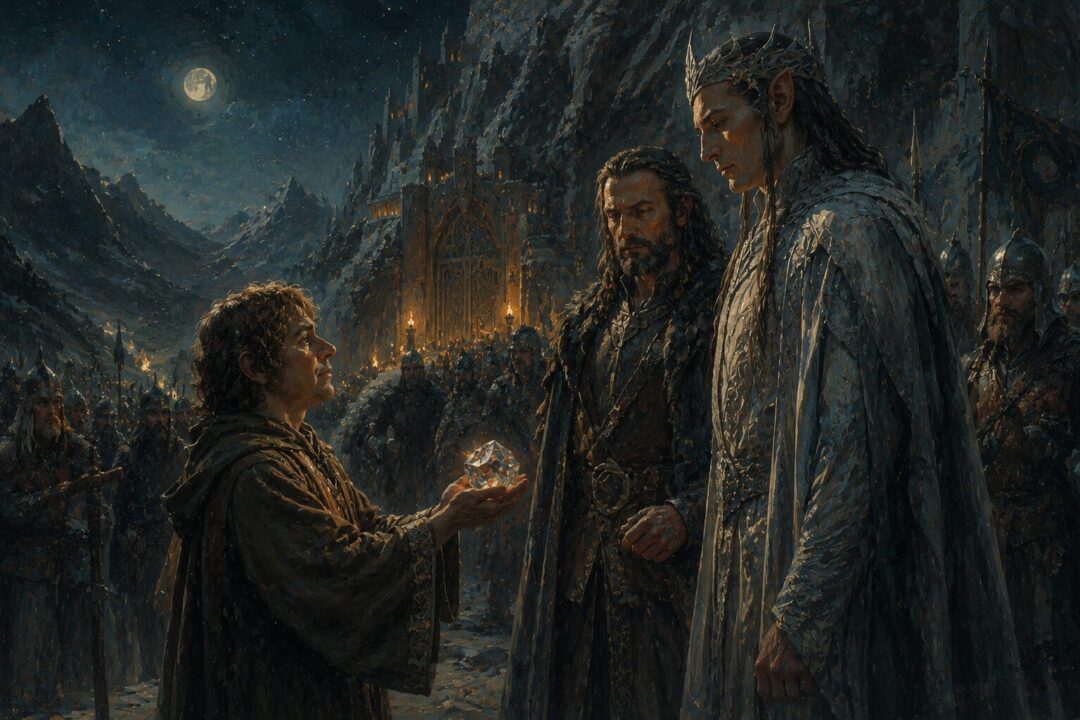
He escaped Gollum through wit rather than force. He rescued the dwarves from giant spiders in Mirkwood. He helped free them from imprisonment among the Wood-elves. Most importantly, he demonstrated moral courage when he surrendered the Arkenstone in an attempt to prevent war.
That final act was particularly significant.
Bilbo chose peace over treasure. He willingly risked the anger of Thorin Oakenshield because he believed bloodshed should be avoided. The decision reflected humility, judgment, and independence of mind.
Elrond knew Bilbo’s story. By the time of the War of the Ring, Bilbo had already provided evidence that hobbits could display extraordinary courage precisely because they lacked conventional ambitions.
The lesson was difficult to ignore.
Frodo Volunteered Freely
One detail is often overlooked when discussing Elrond’s trust.
Elrond did not appoint Frodo.
Frodo volunteered.
At the Council, after long debate and uncertainty, Frodo stepped forward and declared that he would take the Ring, though he did not know the way.
The significance of this moment cannot be overstated.
Throughout The Lord of the Rings, free choice carries enormous moral weight. The Fellowship is not created through coercion. The Ring-bearer is not selected by rank. No authority figure commands Frodo to undertake the quest.
Instead, he accepts the burden willingly.
Elrond immediately recognizes the importance of this choice. He praises Frodo’s decision and acknowledges that the task has been appointed to him.
This reflects a recurring principle throughout the legendarium: courage is most meaningful when freely chosen.
Elrond trusted Frodo not because he was powerful enough for the task, but because he willingly embraced responsibility despite understanding its danger.
Elrond Understood the Limits of Wisdom
One of Elrond’s defining traits is humility before uncertainty.
Despite his immense knowledge, he rarely speaks as though he controls events. At the Council, he openly admits that many things remain unclear. The Wise can perceive threats and possibilities, but they cannot fully predict the future.
This attitude distinguishes him from characters who seek mastery.
Elrond recognizes that success may emerge from unexpected places. The history of Middle-earth repeatedly demonstrates this pattern. Small actions create enormous consequences. Seemingly insignificant individuals alter the course of ages.
The destruction of the Ring ultimately depends upon countless unlikely decisions: Bilbo sparing Gollum, Frodo showing mercy, Sam’s loyalty, Faramir’s restraint, and many other acts that no strategist could fully plan.
Elrond’s wisdom includes recognizing the limits of wisdom itself.
Because of that, he remains open to possibilities others might dismiss.
Including the possibility that a hobbit could save the world.

The Smallest People Carried the Greatest Hope
The irony at the heart of The Lord of the Rings is deliberate.
Sauron thinks in terms of power. He assumes enemies will seek military victory, political advantage, or domination through the Ring. The idea that someone would willingly carry ultimate power toward destruction lies largely outside his imagination.
This blindness becomes one of his greatest weaknesses.
The quest succeeds not because the Free Peoples possess overwhelming strength but because they embrace values Sauron cannot understand. Humility, friendship, mercy, sacrifice, and perseverance repeatedly prove more important than military might.
Hobbits embody those qualities more naturally than most.
They are not fearless. Frodo often experiences terror. Sam frequently doubts himself. Merry and Pippin make mistakes.
Yet they continue moving forward.
That persistence matters more than heroics.
When Elrond trusted Frodo, he was not gambling on hidden strength or secret greatness. He was recognizing a truth that runs throughout Middle-earth’s history: the desire to rule is often a liability, while the willingness to serve can become a source of extraordinary power.
The burden was given to the smallest people because they were least likely to seek mastery over others. In a struggle defined by the corrupting lure of domination, that made all the difference.
The fate of Middle-earth did not rest upon the strongest hand.
It rested upon the hand most willing to let power go.
Sources & Notes
- J.R.R. Tolkien, The Lord of the Rings, Book II, Chapter 2, “The Council of Elrond” — Elrond rejects hiding or wielding the Ring, and Frodo freely volunteers to take it to Mordor.
- J.R.R. Tolkien, The Lord of the Rings, Book I, Chapter 2, “The Shadow of the Past” — Gandalf refuses the Ring and frames Bilbo’s pity, hobbit resilience, and mercy as more important than force.
- J.R.R. Tolkien, The Lord of the Rings, Book II, Chapter 7, “The Mirror of Galadriel” — Galadriel’s temptation and refusal show why great power would make the Ring more dangerous, not safer.
- J.R.R. Tolkien, The Hobbit, Chapters 5, 8, 9, and 16 — Bilbo’s riddling escape, rescue of the dwarves, and surrender of the Arkenstone establish a hobbit pattern of wit, mercy, and peace-making over domination.
- J.R.R. Tolkien, The Letters of J.R.R. Tolkien, Letter 131 — Tolkien describes Sauron’s evil in terms of order, control, and domination, supporting the article’s contrast between mastery and humility.