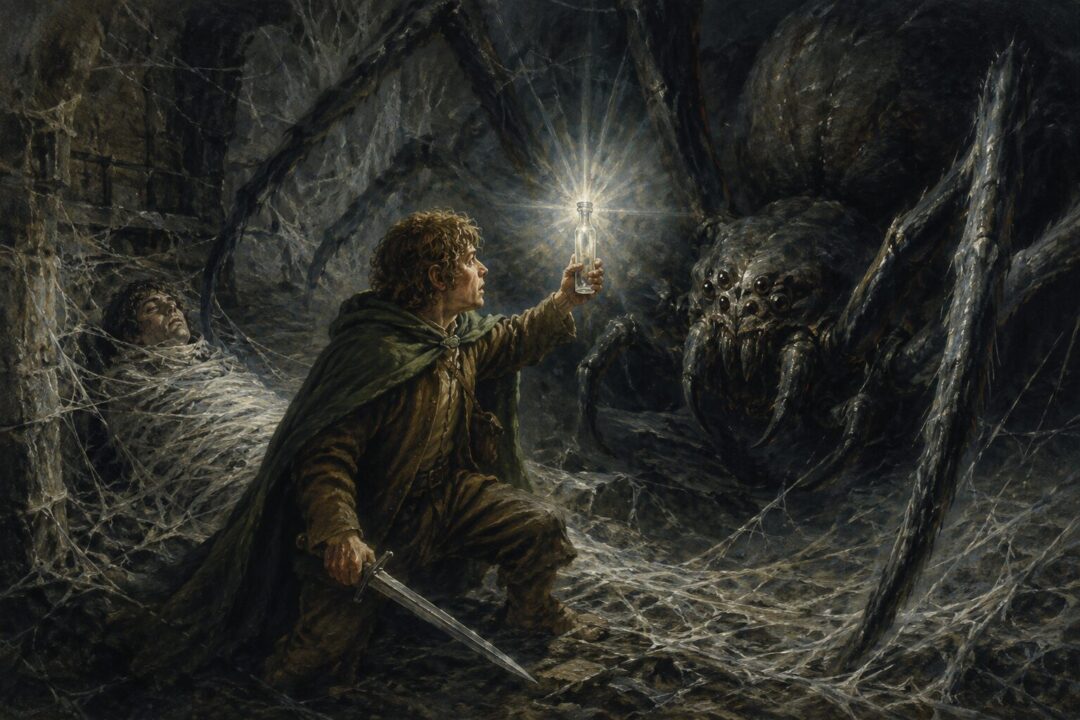
Sting was not the greatest sword in Middle-earth. Samwise Gamgee was not a prince, captain, wizard, or warrior of renown. Shelob was not a battlefield enemy waiting to be met in open combat. Yet in the black pass above Minas Morgul, one of the most terrible creatures left in the Third Age was driven back by a hobbit gardener carrying an Elven blade and a glass of starlight.
That is the strange power of the scene. Sam does not defeat Shelob because he is secretly stronger than Aragorn, Boromir, Éomer, or Faramir. He succeeds because Shelob’s kind of terror is not answered best by strength. Her lair is a place made to unmake courage before battle even begins: darkness, suffocation, stench, confusion, isolation, and despair. A greater warrior might have entered with more skill, more pride, and more expectation of victory. Sam enters with almost none of that.
He enters because Frodo is in danger.
That difference matters.
Shelob Was Not Merely a Large Spider
Shelob is easy to reduce to a monster encounter: a giant spider in a tunnel, beaten back by a brave companion. But the text frames her as something older and darker than a natural beast. She is described as the last child of Ungoliant to trouble the unhappy world, a remnant of an ancient devouring darkness rather than a creature of ordinary wilderness.
She is not Sauron’s servant in any clean military sense. Sauron knows of her, tolerates her, and uses the terror of her presence near Cirith Ungol. Yet Shelob serves herself. She hungers. She hoards. She consumes. Even Sauron’s Orcs fear her and speak of her with a mixture of superstition and practical dread.
That means the fight against Shelob is not simply a duel against a powerful animal. It is a collision with a predatory evil that works through paralysis. She waits in darkness. She separates victims. She strikes from behind. She does not seek honorable combat, and she does not give her prey a clear field on which courage can arrange itself.
A warrior trained for battle might be prepared for Orcs, arrows, shields, or open challenge. Shelob offers something worse: the collapse of orientation itself.
The Lair Was Designed to Break the Strong
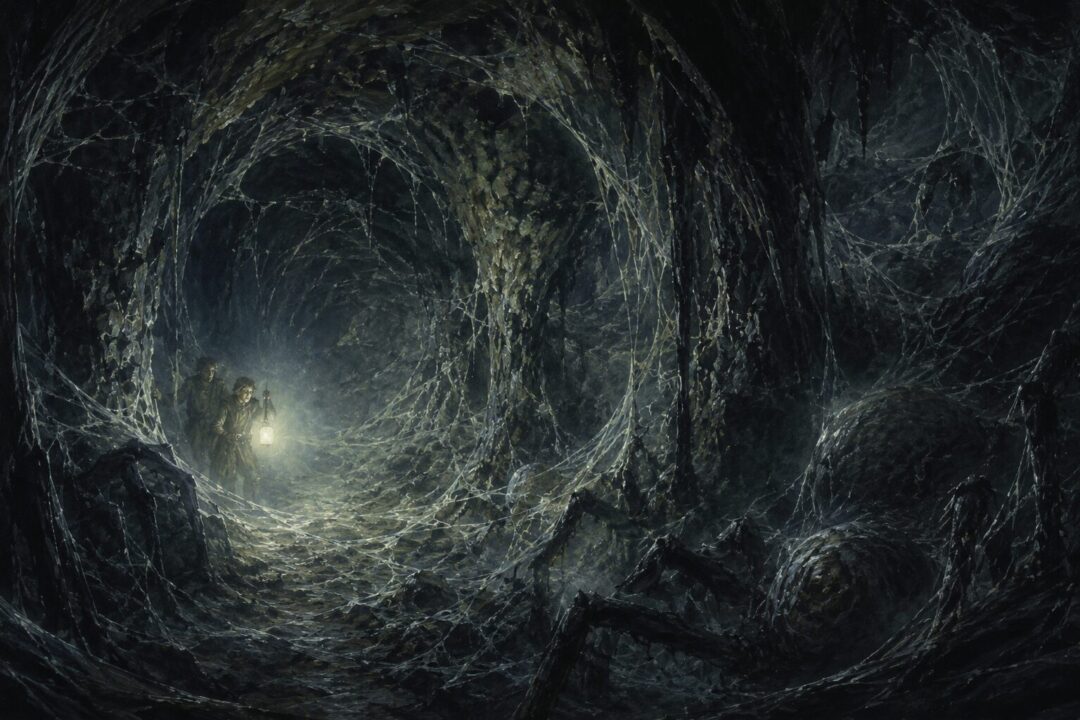
Before Sam ever raises Sting, the real assault has already begun. Shelob’s tunnel attacks the senses. It is lightless, foul, airless, and disorienting. Frodo and Sam move through a space where ordinary courage has little to grip. There is no banner, no formation, no visible enemy, no command to follow. They are reduced to breath, touch, fear, and trust.
This is why the question “Could a stronger warrior have beaten Shelob?” is more complicated than it sounds. Physical strength would help only if the warrior reached Shelob in the right state of mind, with the right tools, at the right instant. But Shelob’s advantage is that most victims never get that kind of clean encounter.
Her method is ambush and terror. She lets the darkness fight first. Then she strikes when the victim is already lost.
Sam’s success comes partly because he is not trying to master the lair. He is not there to conquer it, map it, cleanse it, or win fame from it. He is following Frodo. When Frodo is attacked, Sam’s purpose becomes violently simple. The whole horror of the place narrows into one fact: his master and friend is being taken.
That simplicity gives him a kind of clarity that prideful courage might not.
Frodo First Reveals the Answer
Sam’s victory is not isolated. Frodo has already shown the first key to resisting Shelob: the Phial of Galadriel. In the darkness of the tunnel, the star-glass becomes more than a lamp. It carries the light of Eärendil’s star, preserved through Galadriel’s gift. Against Shelob, whose ancestry reaches back toward Ungoliant’s devouring darkness, that light has deep symbolic and spiritual force.
The text does not turn the Phial into a simple magical weapon that automatically destroys Shelob. It repels, wounds, and terrifies her. Frodo uses it before Sam does, and Shelob withdraws from its radiance. But Frodo is later caught outside the tunnel when Shelob comes again. The light matters, but it does not remove danger from the story.
This is important. Sam is not victorious because he possesses a cheat code. He wins because several fragile things come together: Frodo’s resistance, Galadriel’s gift, Bilbo’s old blade Sting, Sam’s loyalty, Shelob’s own overconfidence, and the timing of a desperate counterattack.
The scene is not about raw strength overcoming evil. It is about providentially gathered small things being used at the exact moment when great strength might be too slow, too proud, or too blind.
Sam’s Courage Is Reactive, Not Ambitious
Many warriors in Middle-earth are brave, and the text does not ask us to despise martial courage. Aragorn, Éomer, Faramir, Glorfindel, and many others show real greatness. But Sam’s courage in Shelob’s pass has a different quality.
He does not seek combat. He does not imagine himself as a champion. He does not want to prove his worth. His first movement is not toward glory but toward Frodo. When he sees Frodo bound and being dragged away, grief and fury break through his fear.
That emotional root matters. Sam is not fighting to win a contest. He is fighting to stop a violation. Shelob has turned Frodo into prey, into a wrapped object to be consumed. Sam’s response is intensely personal: he refuses to let his friend be taken.
A stronger warrior might still have acted nobly. But stronger warriors in Tolkien’s world are often tempted by large solutions: command, mastery, force answered by force. Sam has no such illusion available to him. He cannot dominate Shelob’s world. He can only interpose himself between Shelob and Frodo.
That is precisely why he does the one thing required.
Sting Worked Because Shelob Misjudged Him
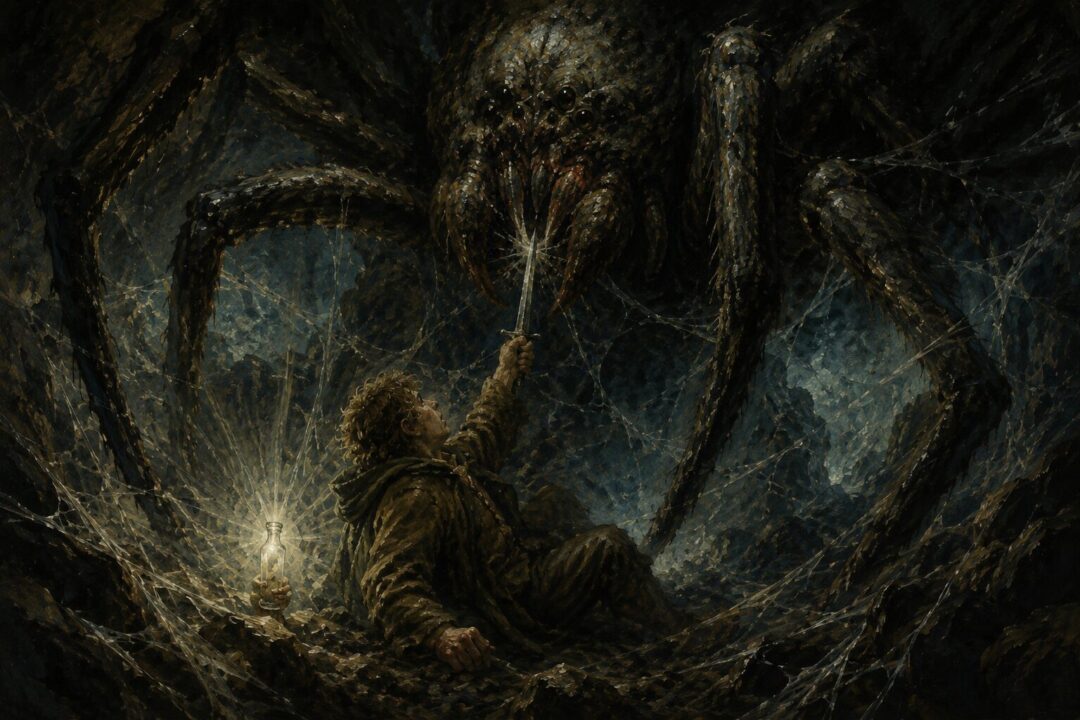
Sam does wound Shelob with Sting, but even this is not a conventional triumph of swordsmanship. He strikes at her eye, and later, when Shelob tries to crush him with her body, he holds the blade upward. Shelob’s own weight drives her onto the Elven sword.
That detail is crucial. Sam does not overpower Shelob. He survives her attack long enough for her strength to become part of her wound.
This is a recurring moral pattern in Middle-earth: evil often misjudges the small, the humble, and the apparently weak. Shelob’s attention is fixed on prey. She is not expecting a hobbit like Sam to become a true danger. She is immense, ancient, and hungry; he is small, exhausted, and terrified. Her contempt is part of her defeat.
A mighty warrior might have drawn Shelob’s full caution sooner. Sam, by contrast, is underestimated until he is already close enough to matter. His smallness is not a secret superpower, but it does change the shape of the encounter. Shelob’s habits are built around domination. Sam’s resistance is too sudden, too loyal, and too unprofitable for her to understand quickly.
The Phial Did What Strength Could Not
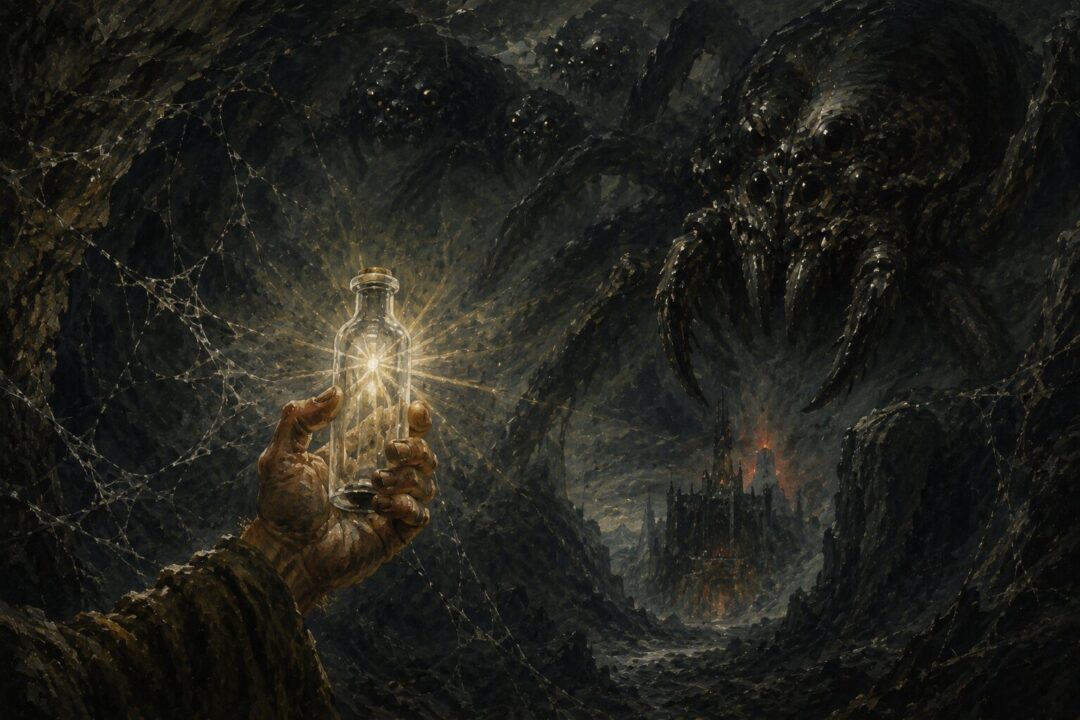
When Sam lifts the Phial, the scene shifts from physical struggle to spiritual opposition. Shelob can endure wounds, hunger, darkness, and violence. But the light is different. It is not merely brightness; it is a sign of the ancient light opposed to the darkness from which Shelob’s lineage descends.
The text suggests that Sam’s use of the Phial becomes more powerful in the extremity of his need. He calls out in Elvish words he does not fully understand in scholarly terms, yet the cry is effective because it is bound to faith, memory, and desperate love. He has received more from the Elves than equipment. He has received a connection to a world larger and older than his fear.
This is where a stronger warrior might fail if he relied only on arms. Shelob is not beaten by steel alone. Sting wounds her, but the Phial drives the terror back into her. Sam needs both: the blade of an old Elven making and the star-glass of Galadriel’s gift.
More importantly, he needs the humility to use what has been given.
Sam Does Not Know He Is a Hero
One of the most moving parts of the episode is that Sam’s great deed does not make him feel triumphant. After Shelob retreats, he turns back to Frodo and believes him dead. The victory becomes anguish almost immediately. He is forced into “the choices of Master Samwise,” deciding whether to remain beside Frodo or take the Ring and continue the Quest.
That aftermath prevents the fight from becoming a simple monster-slaying legend. Sam does not stand over Shelob as a conqueror. He does not even know whether she will die. The text leaves Shelob’s final fate uncertain. What matters is not that Sam destroys her, but that he prevents her from ending the Quest.
His victory is defensive, temporary, and costly. It buys just enough time for the story to continue.
That is very Tolkienian. The fate of Middle-earth does not turn because the strongest person wins the largest fight. It turns because a servant remains faithful in a place where no one is watching and no song seems likely to remember him.
Why Greater Warriors Might Have Failed
It is not that Aragorn or Glorfindel or another great figure would necessarily lose to Shelob in a fair fight. Tolkien never stages such a comparison, so certainty would be false. A great Elf-lord or a seasoned Dúnadan might have possessed strength, perception, and courage far beyond Sam’s.
But Shelob’s pass is not a fair fight.
A stronger warrior might fail by entering too openly, trusting too much in weapons, or drawing Shelob’s caution before the decisive moment. He might be separated, trapped, poisoned, or overwhelmed in darkness before skill could matter. He might also lack the exact combination of gifts Sam carried: Sting, the Phial, and a love for Frodo that instantly overruled self-preservation.
Sam’s success depends on circumstance as much as character. He is not “better” than the great warriors of Middle-earth in general. He is exactly right for this moment.
That is the deeper answer. Shelob is defeated by the qualities she cannot read: pity, service, devotion, and smallness joined to ancient grace. She understands hunger. She understands fear. She understands victims. She does not understand a hobbit who will run toward her because someone he loves is being dragged away.
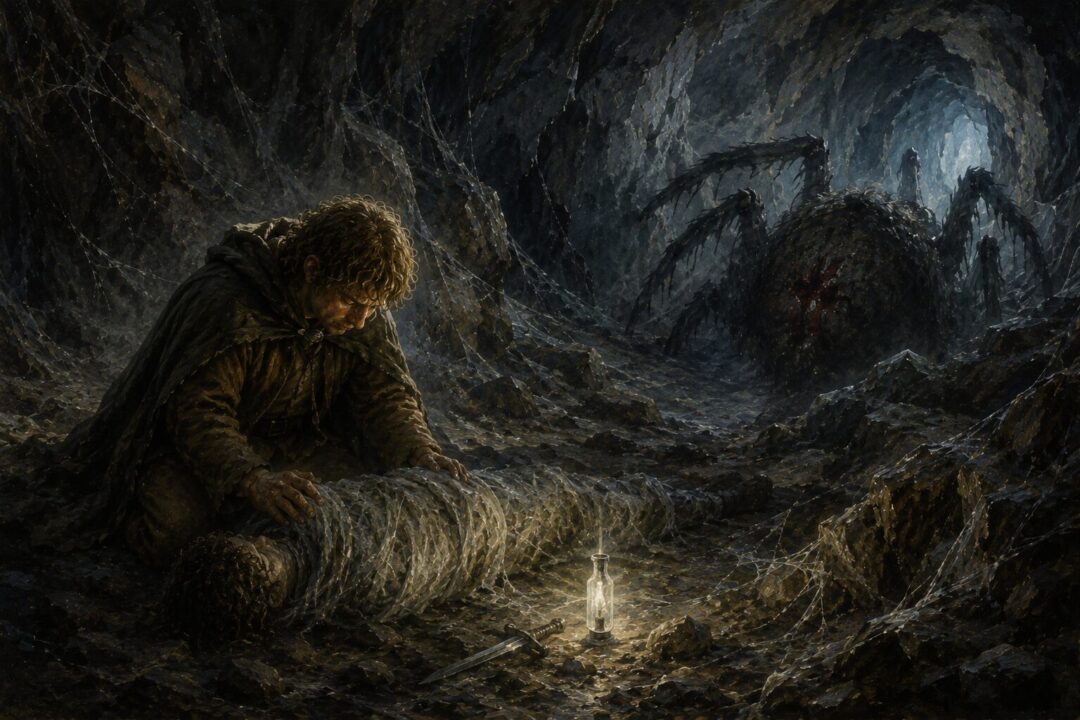
The Small Hand Against the Ancient Dark
Sam fighting Shelob works because the scene gathers one of the central truths of The Lord of the Rings into a single violent moment. Evil is vast, old, and clever, but it repeatedly fails to measure the humble correctly. The Ring itself passes through the hands of the small. Mordor watches for armies and captains, not gardeners. Shelob watches for prey, not love armed with a short sword.
Sam does not win because he becomes a traditional hero. He wins because he remains Sam: frightened, loyal, practical, furious, tender, and unable to abandon Frodo. In that moment, his lack of grandeur is not a weakness. It is the shape his courage takes.
A stronger warrior might have brought greater force into Shelob’s lair. Sam brought something rarer: a heart that did not stop at terror.
And in the dark pass of Cirith Ungol, that was enough.
Sources & Notes
- J.R.R. Tolkien, The Lord of the Rings, Book IV, Chapter 9, “Shelob’s Lair” — Shelob’s Ungoliant lineage, the oppressive darkness of her tunnel, and Frodo’s first use of Galadriel’s Phial against her.
- J.R.R. Tolkien, The Lord of the Rings, Book IV, Chapter 10, “The Choices of Master Samwise” — Sam’s rescue of Frodo, the wounds dealt with Sting, Shelob’s own weight driving her onto the blade, and Sam’s use of the Phial.
- J.R.R. Tolkien, The Lord of the Rings, Book II, Chapter 8, “Farewell to Lórien” — Galadriel gives Frodo the Phial, filled with the light of Eärendil’s star, for use in dark places.
- J.R.R. Tolkien, The Silmarillion, “Quenta Silmarillion,” Chapter 8, “Of the Darkening of Valinor” — Ungoliant as the ancient devouring darkness behind Shelob’s ancestry.
- J.R.R. Tolkien, The Letters of J.R.R. Tolkien, Letter 131 — Tolkien’s storycraft emphasis on domination, humility, and unlikely instruments resisting overwhelming evil.