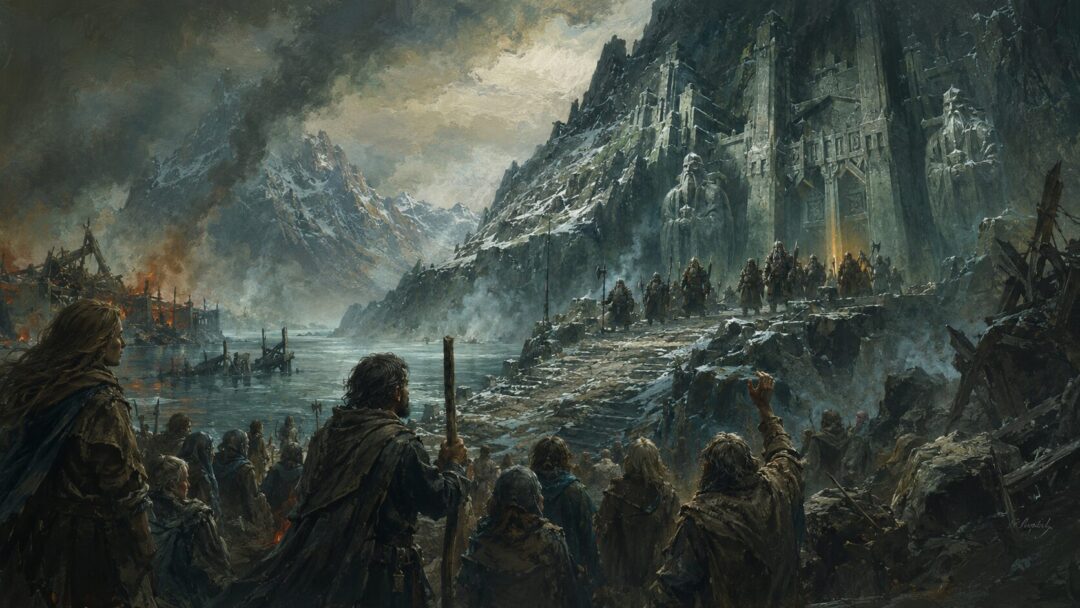
The Lonely Mountain should have been the end of the story.
Smaug was dead. The secret door had been found. The long-lost halls of Erebor had been entered again. Thorin Oakenshield, heir of Thráin and grandson of Thrór, stood at last inside the kingdom his people had lost. Around him lay the gold of the Mountain, the old wealth of the Dwarves, the heirlooms of Dale, and above all the Arkenstone, the Heart of the Mountain.
On the surface, everything that follows looks like a quarrel over treasure. Bard wants compensation for Lake-town. The Elvenking comes north with armed strength. Thorin refuses to divide the hoard. Bilbo steals away with the Arkenstone in the hope that one jewel might buy peace. Dáin marches from the Iron Hills. Then, before Dwarves, Elves, and Men can destroy one another, Goblins and Wargs descend from the north.
But the Battle of Five Armies is not really about treasure. The gold is the visible object everyone can point to. The deeper struggle is over something harder to measure: legitimacy, memory, fear, justice, and whether old grief can be mastered before it becomes another dragon.
The Treasure Is Real — But It Is Not Simple Greed
It would be too easy to say that everyone at the Mountain simply wants gold.
The treasure of Erebor is not just loose wealth. For Thorin, it represents a broken kingship restored. It is the proof that his house was not merely a wandering remnant. The halls under the Mountain are bound to his identity, and the hoard has become tangled with his right to rule.
For Bard and the people of Lake-town, the treasure means survival. Smaug has destroyed their town. Bard has killed the dragon, but the victory has left his people homeless, cold, and dependent on aid. His claim is not merely opportunistic. He asks for help and recompense after a disaster caused by the dragon that had long occupied the Mountain. He also invokes older claims connected with Dale and the wealth once taken by Smaug.
For the Elvenking, the matter is more restrained than many retellings suggest. The text does not make him a simple treasure-hungry villain. He marches after hearing that Smaug is dead, but he also turns aside to aid the Lake-men when he learns of their ruin. His presence at the Mountain certainly increases pressure on Thorin, yet the strongest moral claim there belongs to the suffering people of Lake-town.
The treasure matters because it gives form to everyone’s claim. But the real question is not “Who wants gold?” It is “What does the gold now mean after a dragon has sat on it for generations?”
Smaug’s Hoard Still Behaves Like a Dragon
Smaug is physically dead before the battle begins. Spiritually, his influence lingers.
Dragons in Tolkien’s legendarium are not just large beasts with treasure. They are possessive, destructive, and cunning. Smaug’s power is not limited to fire. He knows how to plant suspicion. His conversation with Bilbo is full of insinuation: What are the Dwarves really planning? What share will Bilbo receive? How will they carry the treasure away? Smaug understands that treasure can divide allies without a flame being breathed.
After his death, the hoard continues to do exactly that.
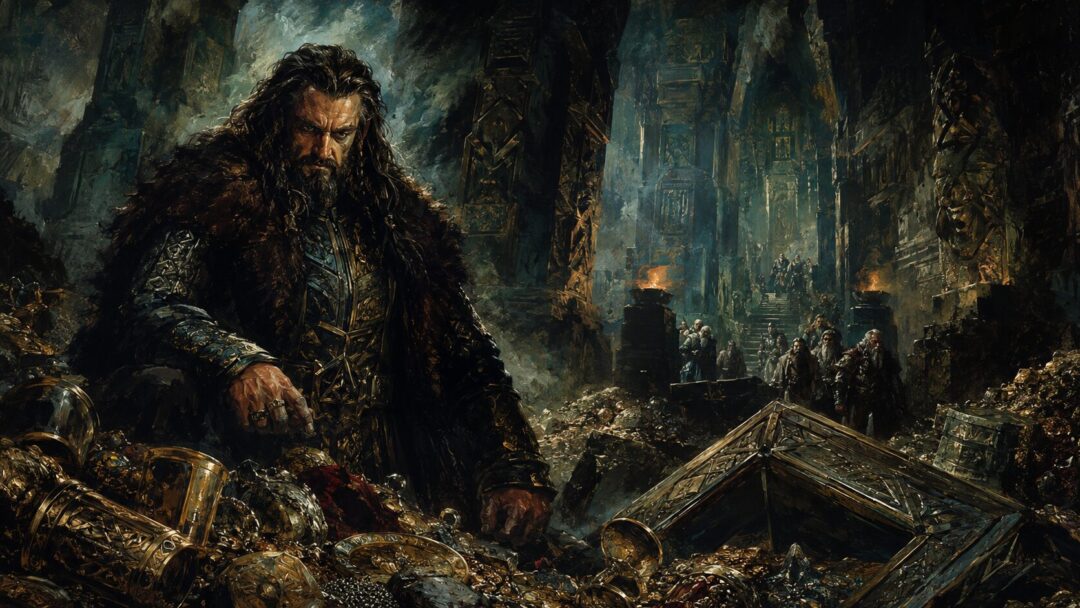
Thorin becomes increasingly possessive inside the Mountain. He is not wrong to regard Erebor as his ancestral kingdom. He is not wrong to value the Arkenstone as a royal heirloom of enormous significance. But his refusal to acknowledge the desperate condition of Lake-town shows how the treasure has narrowed his vision. The gold does not create his pride from nothing; it feeds what is already wounded in him.
This is why the conflict is so tragic. Thorin is not a random miser. He is a dispossessed king who has endured exile, humiliation, and loss. His desire to reclaim what was stolen is understandable. Yet the moment he stands among the treasure, restoration begins to harden into possessiveness. The hoard becomes less a kingdom to be healed than a thing to be defended at any moral cost.
The dragon is gone, but dragon-sickness remains.
Bilbo Sees the Moral Shape of the Crisis
Bilbo’s decision to take the Arkenstone to Bard and the Elvenking is one of the most morally daring acts in The Hobbit.
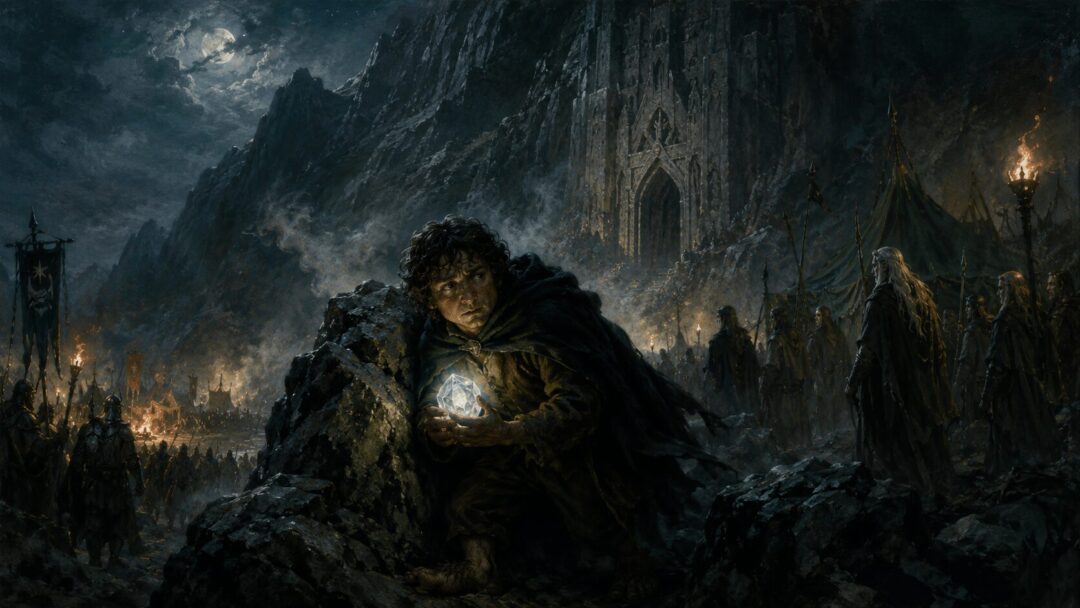
He does not do it because he hates Thorin. He does it because he can see the direction of events more clearly than the great figures around him. Thorin will not yield. Bard and the Elvenking will not simply vanish. Dáin is coming with armed Dwarves. The Mountain is becoming a place where injured pride, real need, and ancestral claims are about to collide.
Bilbo’s act is legally and morally complicated. He has been promised a share of the treasure, and he treats the Arkenstone as that share. Thorin, however, values it beyond all other objects. Bilbo knows the act will feel like betrayal. He also knows that without some shocking intervention, negotiations may fail entirely.
This is important: Bilbo does not solve the crisis by force. He tries to create a bargaining piece. The smallest person in the story attempts to interrupt the machinery of war by giving up the greatest jewel he could have kept.
That choice reveals the heart of the episode. The real treasure in the chapter is not the Arkenstone. It is the ability to choose peace over possession. Bilbo’s courage is not battlefield courage, though he later stands in battle. It is the courage to be misunderstood while trying to prevent needless bloodshed.
The Arkenstone Is Not Just a Jewel
The Arkenstone intensifies the conflict because it is not ordinary treasure.
It is described as the Heart of the Mountain, found beneath Erebor and treasured by the Dwarves of Durin’s line. For Thorin, it carries dynastic and symbolic weight. To hold the Arkenstone is not merely to own a beautiful gem. It is to possess the object most closely associated with the restored kingship under the Mountain.
That is why Bilbo’s use of it is so powerful. Gold can be counted, weighed, and divided. The Arkenstone cannot be divided without destroying what it means. It concentrates the whole argument into one object.
Bard and the Elvenking do not need the stone in itself the way Thorin does. Its value in the negotiation is that Thorin cannot bear to leave it outside his possession. Bilbo has found the one object that might force Thorin to bargain.
Yet the plan nearly fails because Thorin’s attachment to the stone is not rational. He agrees to exchange a fourteenth share for it, but his rage against Bilbo shows how far the crisis has gone. The Arkenstone exposes him. It reveals that what is at stake is not an orderly legal settlement, but the condition of Thorin’s heart.
The Armies Arrive for Different Reasons
The title “Battle of Five Armies” can make the event sound like a single planned war. It is not.
The Men of Lake-town come from ruin and need. The Elves come with their own interests, but also as allies and helpers to the Lake-men. Thorin’s Dwarves hold the Mountain. Dáin’s Dwarves arrive to support Thorin. These groups are on the edge of fighting one another before the larger danger appears.
Then come the Goblins and Wargs.
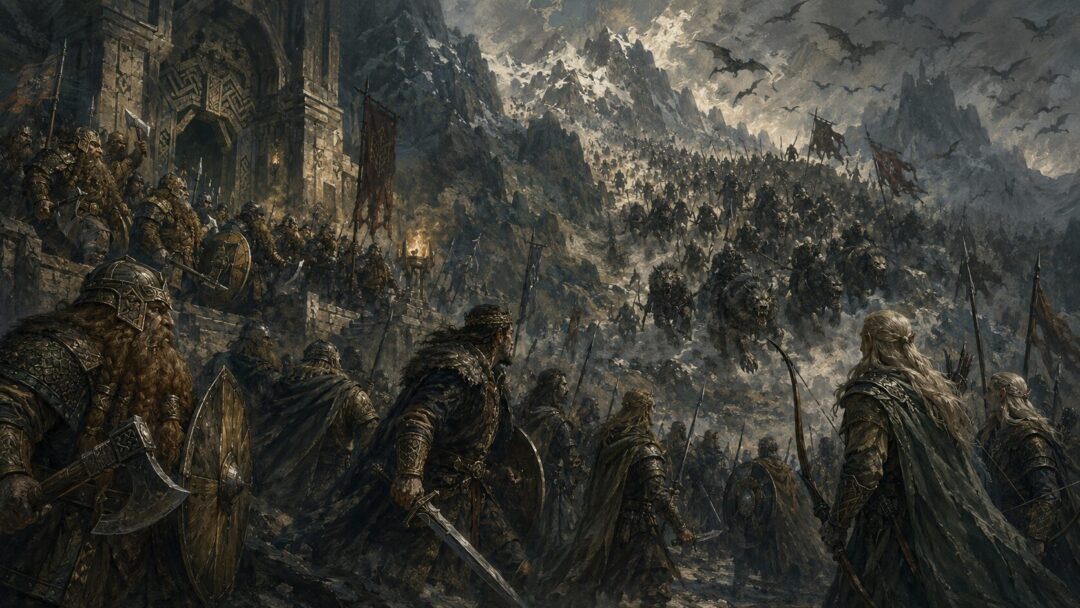
Their arrival changes the meaning of the whole event. The quarrel over treasure is suddenly revealed as dangerously small beside a broader threat from the north. The Free Peoples have nearly spent their strength preparing to fight each other while enemies gather. In the text, the Goblins are connected with vengeance for the death of the Great Goblin and with the opportunity created by Smaug’s fall. The Mountain, no longer guarded by the dragon, has become a strategic and symbolic prize.
So the battle is not only an interruption of a treasure dispute. It is a revelation. The old enemies of the wild are moving, and the divided peoples around Erebor must decide whether they are rivals or allies.
Gandalf’s Warning Reframes the War
Gandalf’s role is crucial because he sees beyond the immediate quarrel.
Throughout The Hobbit, Gandalf’s concern is larger than the comfort of one company of Dwarves. The quest to Erebor is not only a private recovery mission; it removes Smaug from the board. In the wider history of Middle-earth, a great dragon in the north is a terrible potential danger. Even within The Hobbit itself, Gandalf’s sudden alarm when the Goblins arrive shows that the quarrel at the gate has become almost absurdly small.
His warning forces the armies to change their moral posture. A moment earlier, Dwarves, Elves, and Men are close to battle over claims, insults, and treasure. A moment later, they must become a coalition.
That shift is one of the great hidden turns of the story. The Battle of Five Armies is remembered for swords and spears, but its deepest movement is from division to reluctant unity. The treasure dispute nearly becomes a disaster. The arrival of the Goblins turns it into a test of whether the Free Peoples can recognize the true enemy in time.
Thorin’s Redemption Comes Too Late — But Not Too Late to Matter
Thorin’s final transformation does not erase the harm he has done. His harshness toward Bilbo, his refusal to aid the Lake-men sooner, and his willingness to let the conflict escalate remain part of his tragedy.
Yet he does emerge from the Mountain.
When the battle turns desperate, Thorin and his companions break out and join the fight. This does not make him flawless. It does show that the king buried beneath pride and possessiveness has not been completely lost. He finally turns his strength outward, against the enemies who threaten all.
His deathbed reconciliation with Bilbo is the moral answer to the treasure conflict. Thorin recognizes, too late for his own life, that the values represented by Bilbo are greater than hoarded wealth. Food, cheer, song, and simple kindness belong to a world healthier than the one ruled by possessiveness.
That moment is not sentimental decoration. It is the judgment of the story. Thorin’s greatness is real, but incomplete until he can bless the hobbit he had condemned. His tragedy is that he learns the lesson only after the battle has taken its price.
The Real Prize Is the Future of the North
After the battle, the treasure is divided. Bard receives wealth. The Elvenking receives gems. Bilbo accepts only a modest portion. Dáin becomes King under the Mountain. Dale is restored under Bard. Erebor again becomes a power in the north.
These outcomes show why the battle cannot be reduced to treasure. What is truly being settled is the future shape of the region after Smaug.
Will Erebor become an armed hoard under a bitter king? Will Lake-town’s survivors be abandoned? Will Elves, Men, and Dwarves deepen their mistrust? Will Goblins and Wargs seize the opportunity created by the dragon’s death? Or will the death of Smaug make room for renewed kingdoms and alliances?
The answer comes through terrible cost. Thorin, Fíli, and Kíli die. Many others fall. Victory does not feel clean. But the aftermath points toward restoration rather than mere enrichment. Dale rises again. Erebor is reestablished. The north is strengthened.
The treasure is redistributed, but that is not the true healing. The true healing is that the hoard no longer belongs to a dragon’s isolation. It begins to move again through gift, compensation, kingship, and rebuilding.
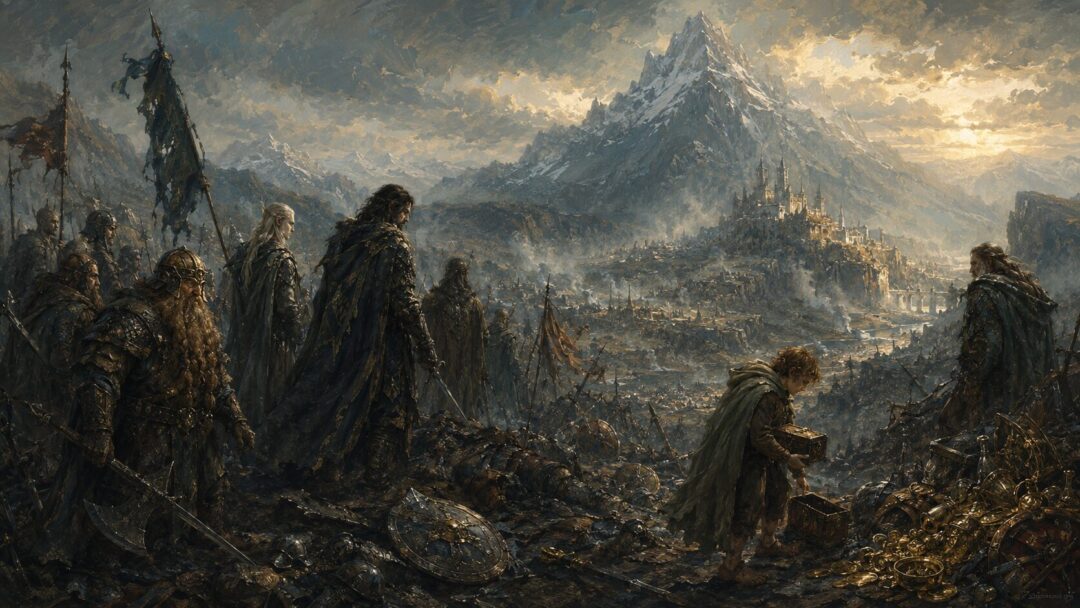
The Battle Was About What Treasure Does to the Heart
The Battle of Five Armies begins with treasure because treasure is the test everyone understands.
Gold can expose injustice: Lake-town genuinely needs aid. Gold can preserve memory: Thorin’s people really were robbed of their home. Gold can restore kingdoms: Erebor and Dale both depend on the wealth and security of the Mountain. But gold can also shrink the soul until every plea sounds like theft and every neighbor looks like an enemy.
That is why the battle is not really about treasure. It is about whether treasure will serve life or life will serve treasure.
Smaug hoarded wealth in deathly isolation. Thorin nearly repeats the pattern in a more human and tragic form. Bilbo breaks the pattern by surrendering the very thing he could have claimed. Bard seeks redress for the living. The Elvenking, whatever his own desires, aids the ruined. Dáin inherits not only a treasure, but a responsibility. And the Goblins reveal what happens when the Free Peoples forget that their quarrels are not the only forces moving in the world.
The Mountain is won, but not because gold is kept. It is won because, at the edge of ruin, possession gives way to alliance.
That is the overlooked irony of the Battle of Five Armies: the treasure draws the armies together, but it is not what saves them. They survive only when the hoard stops being the center of the story.
Sources & Notes
- J.R.R. Tolkien, The Hobbit, ch. 12, “Inside Information” — Smaug’s talk with Bilbo shows how the dragon uses suspicion, treasure, and promised shares to divide the companions.
- J.R.R. Tolkien, The Hobbit, ch. 14, “Fire and Water” — Bard’s slaying of Smaug leaves Lake-town ruined, giving his later claim on the treasure a survival-and-recompense basis rather than simple greed.
- J.R.R. Tolkien, The Hobbit, ch. 15, “The Gathering of the Clouds” — Thorin’s possessiveness, Bard’s demands, the Elvenking’s aid to the Lake-men, and the Arkenstone’s symbolic weight frame the crisis before the battle.
- J.R.R. Tolkien, The Hobbit, ch. 16, “A Thief in the Night” — Bilbo’s surrender of the Arkenstone is presented as a risky attempt to force peace before Dwarves, Elves, and Men come to blows.
- J.R.R. Tolkien, The Hobbit, ch. 17–18, “The Clouds Burst” and “The Return Journey” — the Goblin/Warg attack redirects the armies toward a common enemy, and Thorin’s deathbed words judge kindness above hoarded gold.