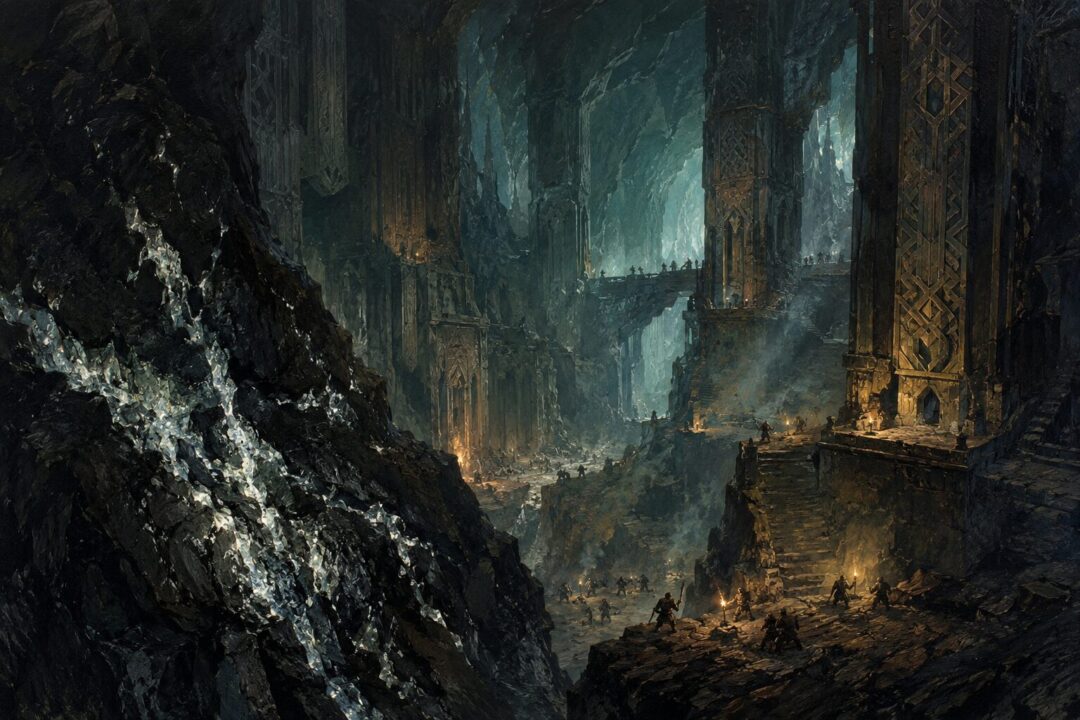
In Moria, gold is almost a distraction.
The Fellowship enters Khazad-dûm expecting darkness, stone, Orcs, and old Dwarven splendor. What they find is something stranger: a ruined kingdom whose true wealth was not gold, jewels, or iron, but a pale metal hidden beneath the mountains. Gandalf calls it Moria-silver, or true-silver. The Elvish name is mithril. The Dwarves had their own name for it, but did not share it.
That small detail matters. Mithril was not merely expensive. It was intimate. Secret. Bound to Dwarven craft, Dwarven pride, and Dwarven disaster.
Its value was legendary because it joined qualities that Middle-earth rarely allows to exist together. It was beautiful and useful, light and strong, precious and practical. It could adorn a king, protect a hobbit, enrich a kingdom, and tempt miners deeper into the dark. That is why mithril was worth more than gold.
And that is why it was dangerous.
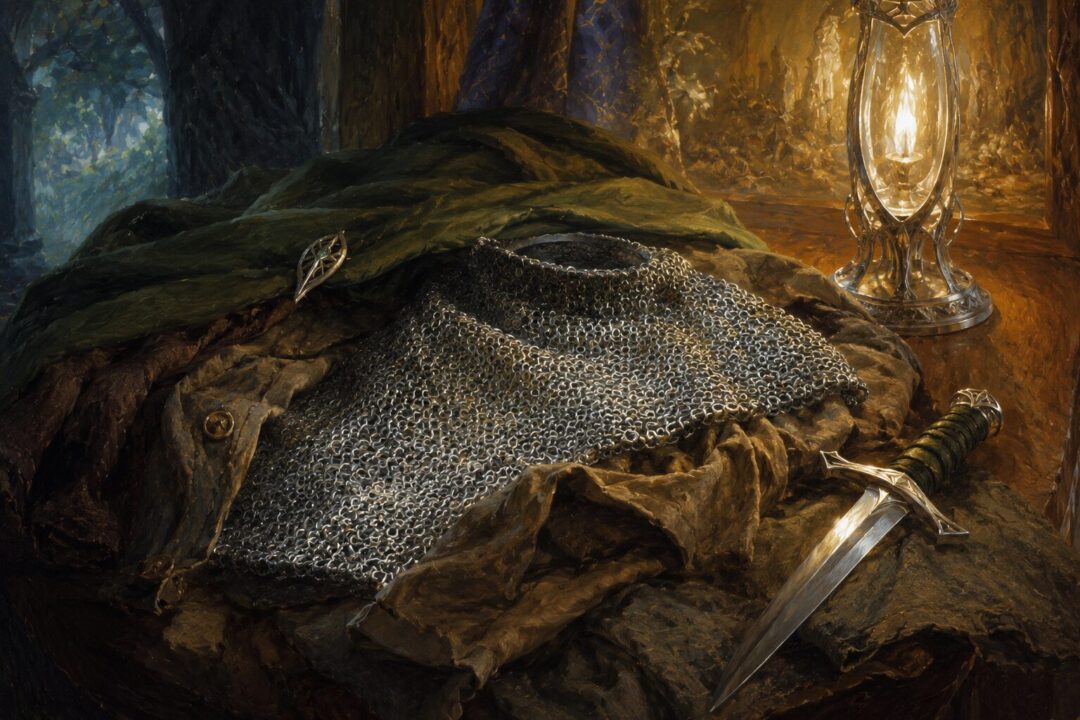
The Metal That Made Gold Look Common
Gandalf’s explanation in Moria is the clearest account of mithril’s value. Khazad-dûm did not become glorious chiefly because of ordinary treasure. Its unmatched wealth came from mithril, found there in abundance when the Dwarves still ruled their halls.
He says its worth had once been ten times that of gold. By the time of the War of the Ring, it had become beyond price, because little remained above ground and the old source was effectively lost.
That is an important distinction. Mithril was not valuable only because it was rare. It was already worth far more than gold while it could still be mined. Its later scarcity made it priceless, but its natural qualities made it precious from the beginning.
Gold in Tolkien’s world often carries the danger of possession. It can draw desire, hoarding, rivalry, and dragon-sickness. Mithril is different. It is not just treasure to be stored. It is treasure that works. It can be shaped into mail, ornament, and possibly other works of craft. It offers beauty without uselessness and strength without heaviness.
That combination makes it more alluring than gold. Gold can buy power. Mithril can become power.
Lightness, Strength, and the Wonder of Dwarf-Craft
The mithril-coat given to Bilbo, and later Frodo, shows why this metal mattered so much. It was not a heavy breastplate made for a great warrior. It was a shirt of small rings, light enough for a hobbit to wear beneath ordinary clothing, yet strong enough to stop deadly blows.
In The Hobbit, Thorin gives Bilbo a coat of mail from the treasure of the Lonely Mountain. Later, The Lord of the Rings identifies it as mithril. By the time Frodo wears it, the mail has become one of the quiet miracles of the Quest.
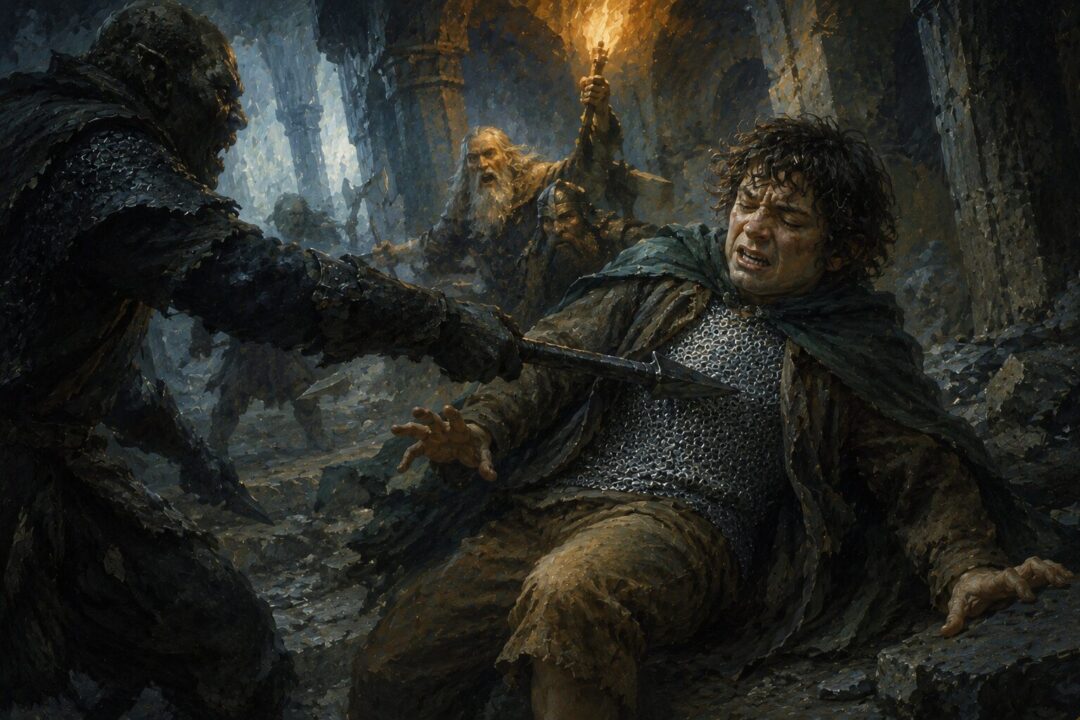
It saves him in Moria when a spear-thrust that should have killed him is stopped by the hidden coat. The blow still hurts him badly; mithril does not make him invulnerable. But it turns death into survival.
That is the power of mithril in the story. It does not defeat the Enemy. It does not replace courage, mercy, friendship, or endurance. It simply preserves life at the moment when the Quest could have failed in a dark chamber far from Mordor.
This is one reason its worth is so hard to measure. A gold treasure can be counted. Frodo’s survival cannot.
“Greater Than the Value of the Whole Shire”
The most astonishing statement about mithril is Gandalf’s remark that Bilbo’s coat was worth more than the whole Shire and everything in it.
That line can sound almost absurd if read as a simple market estimate. The Shire is not a pile of coins; it is farms, mills, homes, roads, food, memory, and ordinary lives. But that is exactly why the comparison is so powerful. Gandalf places a hidden royal treasure under the clothes of a small hobbit from a land that barely understands such things.
Frodo carries something worth more than his homeland while trying to save that homeland from a power that would destroy or enslave it.
There is tragic irony here. The Shire’s value is moral and living. Mithril’s value is material, historical, and almost mythical. The coat is “worth” more than the Shire in treasure terms, but the Quest exists so that places like the Shire can continue to exist at all.
That contrast keeps mithril from becoming mere luxury. In Frodo’s case, the richest garment in Middle-earth is not worn for pride. It is worn in secrecy, fear, and need.
Why Moria Could Not Stop Digging
Mithril also helps explain the doom of Khazad-dûm.
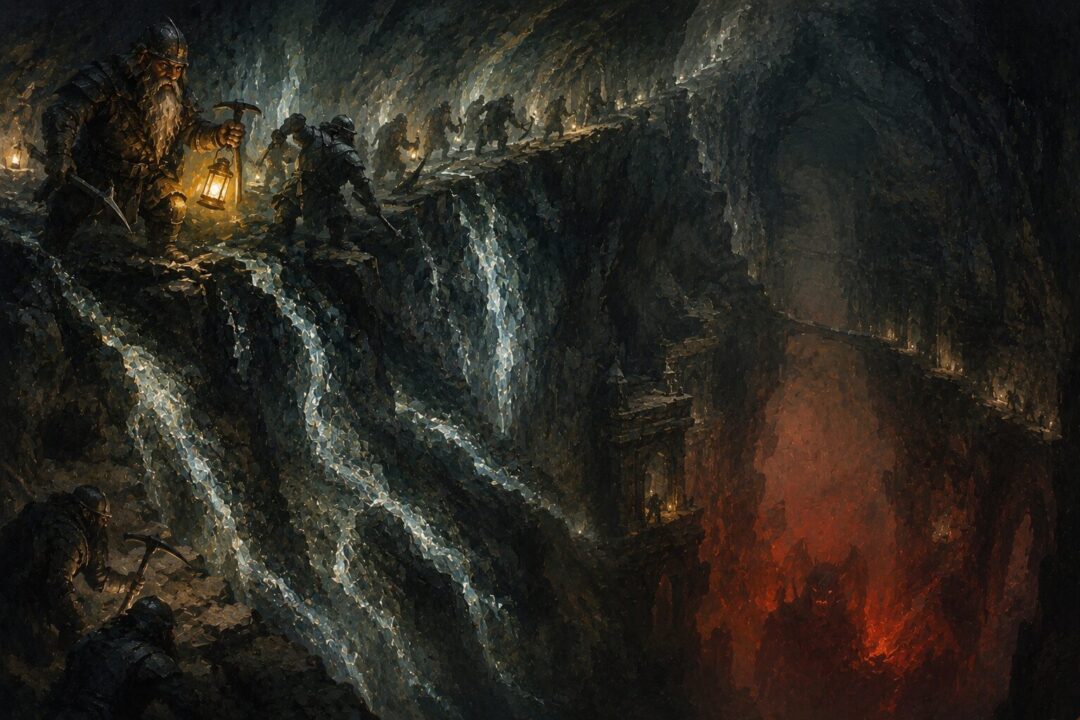
The Dwarves of Moria were not foolish because they valued mithril. The metal truly was extraordinary. Their craft, wealth, and fame were tied to it. But Gandalf’s account makes the danger plain: the Dwarves delved too greedily and too deep, and awakened Durin’s Bane.
The text does not say mithril itself was evil. That matters. Mithril is not like the One Ring. It does not corrupt by an active will. It has no voice, no malice, and no purpose of domination.
Its danger lies in desire and depth.
The more precious the thing beneath the mountain became, the more reason there was to keep going. Wealth justified risk. Skill overcame caution. Need became habit. The Dwarves followed value downward until they encountered something older and stronger than their kingdom.
Mithril was not the Balrog. But the search for mithril helped lead the Dwarves into the Balrog’s realm.
That makes it one of Middle-earth’s most dangerous treasures: not cursed in itself, but capable of drawing a great people beyond the limits of wisdom.
The Hidden Cost of Priceless Things
By the late Third Age, mithril is “beyond price” because the old abundance is gone. This is not just economic scarcity. It is historical loss.
Moria’s mithril once represented living craft: miners, smiths, halls, trade, pride, and the strength of Durin’s folk. After the fall of Khazad-dûm, mithril becomes a relic of a broken world. Existing pieces survive, but the great source is lost in darkness.
That changes the meaning of every mithril object. A mithril coat is no longer only a fine armor. It is a fragment of a vanished greatness. To own it is to hold something that cannot easily be replaced.
This is why Gimli reacts so strongly when he learns Frodo is wearing a corslet of Moria-silver. He understands what the hobbits do not. Bilbo’s “pretty” shirt is not merely pretty. It belongs to the highest order of Dwarven treasure.
Yet the coat’s journey is humble. It passes from Thorin to Bilbo, from Bilbo to Frodo, from Frodo’s body into the hands of Orcs, and finally becomes a token used by Sauron’s servants to torment the Captains of the West with false despair.
Even priceless beauty can be dragged into the theater of fear.
Mithril and the Enemy’s Imagination
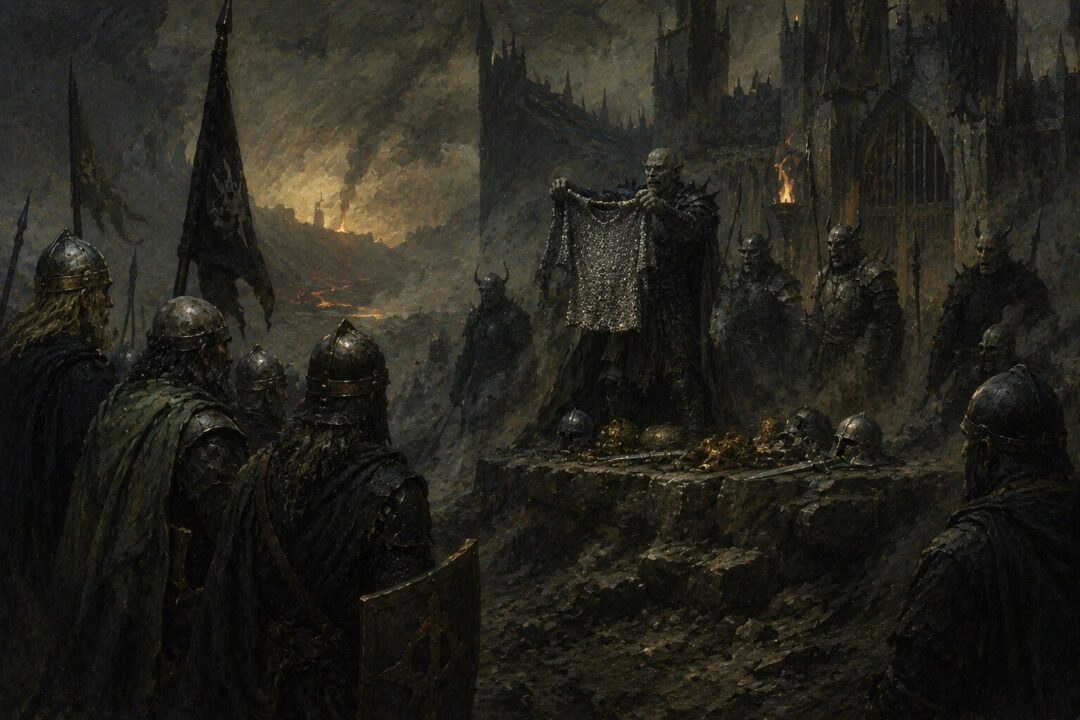
Sauron’s servants display Frodo’s gear before the Black Gate, including the mithril-coat, to suggest that the Ring-bearer has been captured. The gesture is psychological warfare. The coat’s value is no longer economic. It becomes evidence, bait, and threat.
This reveals another danger of mithril: because it is rare and recognizable, it can become a symbol others use. A common shirt would mean little. A mithril shirt proves that the prisoner, or supposed prisoner, is no ordinary wanderer.
The Enemy does not need to understand Frodo’s courage to understand the value of what he carried. Mithril becomes part of a lie designed to break hope.
This is one of the darker patterns in The Lord of the Rings. Good things are not safe simply because they are good. Beauty can be stolen. Heirlooms can be weaponized. Precious objects can be made to serve fear, even when they were given in love.
The Difference Between Mithril and the Ring
Mithril and the One Ring are both small, hidden, and almost unimaginably valuable. But they represent opposite kinds of preciousness.
The Ring magnifies domination. Its value lies in control, conquest, and the will to possess. It offers power by corrupting the one who tries to use it.
Mithril, by contrast, does not seek mastery. Its highest use in the story is protective. It saves Frodo without ruling him. It is a treasure that becomes most noble when it is given away: Thorin gives it to Bilbo; Bilbo gives it to Frodo; Frodo survives because others before him did not hoard it uselessly.
Still, the comparison is uncomfortable. Both objects show that value creates danger. The Ring is dangerous because of what it is. Mithril is dangerous because of what people may do to obtain, possess, or exploit it.
One corrupts the soul directly. The other tests wisdom indirectly.
A Treasure That Could Save a Life but Ruin a Kingdom
Mithril’s story is full of contradiction. It is purer than greed but often found near greed. It is beautiful but born from dark mines. It protects the weak but helped draw the strong into peril. It is priceless, yet its greatest moment is not in a treasury, but under Frodo’s plain clothes when a spear strikes in Moria.
That is why mithril was worth more than gold. Gold is treasure. Mithril is treasure transformed into craft, defense, memory, and wonder.
But that is also why mithril was more dangerous. A gold hoard can tempt kings and dragons. Mithril could tempt an entire civilization downward, step by step, until the search for hidden wealth crossed into hidden terror.
In Middle-earth, the rarest things are seldom safe. The Silmarils bring wars and oaths. The Rings of Power bend desire toward domination. The Arkenstone hardens Thorin’s heart. Mithril is gentler than these, but not harmless.
It asks a quieter question: how deep will you go for something beautiful?
For the Dwarves of Khazad-dûm, the answer became fatal. For Frodo, the same metal became mercy in the form of armor. That is the strange moral life of mithril. It could not save Moria from what lay beneath it. But it helped save the Ring-bearer long enough for the Quest to continue.
And in the end, that made one small shirt of silver mail worth more than any king’s ransom.
Sources & Notes
- J.R.R. Tolkien, The Lord of the Rings, Book II, Chapter 4, “A Journey in the Dark” — Gandalf explains mithril/Moria-silver, its extraordinary value, the Dwarves’ secrecy, and the deeper delving that awakened Durin’s Bane.
- J.R.R. Tolkien, The Hobbit, Chapter 13, “Not at Home” — Thorin gives Bilbo the small coat of mail from Erebor’s treasure, later understood as the mithril-shirt.
- J.R.R. Tolkien, The Lord of the Rings, Book II, Chapter 5, “The Bridge of Khazad-dûm” — Frodo survives the spear-thrust in Moria because of the hidden mithril coat.
- J.R.R. Tolkien, The Lord of the Rings, Book III, Chapter 1, “The Departure of Boromir” — Aragorn and Gimli identify the mail-shirt as mithril and stress its astonishing worth after Frodo’s survival.
- J.R.R. Tolkien, The Lord of the Rings, Book V, Chapter 10, “The Black Gate Opens” — the Mouth of Sauron displays Frodo’s mithril-coat as a weapon of fear and false despair.