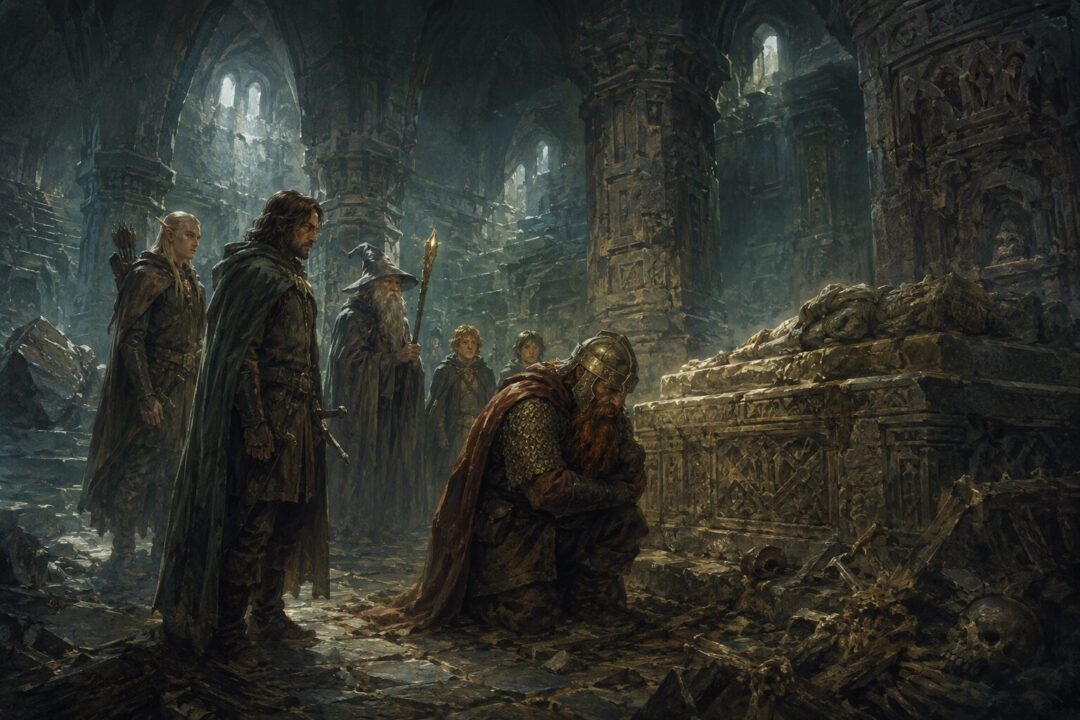
Few locations in The Lord of the Rings are remembered as vividly as Balin’s Tomb.
The Fellowship enters Moria hoping for a difficult journey. They expect darkness, exhaustion, and danger. What they do not expect is a grave.
Until that moment, the quest still feels like an adventure, however perilous. There are hardships on Caradhras, pursuit by enemies, and growing uncertainty, but the Company remains intact and hopeful. In the Chamber of Mazarbul, that changes. The tomb of Balin confronts them with something deeper than physical danger: the realization that entire peoples, kingdoms, and dreams can simply vanish.
The horror of Balin’s Tomb is not merely that Dwarves died there. It is that the Fellowship discovers the fate of a colony that believed it could reclaim lost greatness—and failed utterly. The scene transforms Moria from a dangerous place into a haunted one. Every shadow suddenly has a history. Every silence becomes evidence of catastrophe.
This is the moment when the journey through Khazad-dûm stops being an expedition and becomes a descent into tragedy.
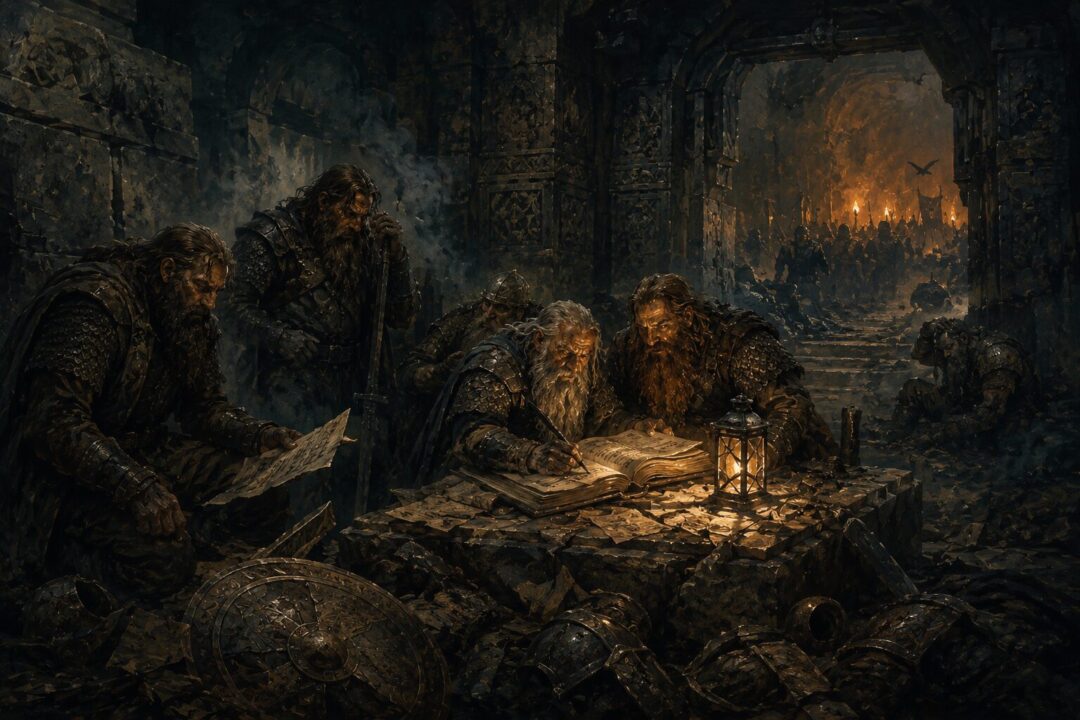
The Dream That Led Balin Back to Moria
To understand why the tomb matters, it is important to remember who Balin was.
In The Hobbit, Balin is one of the companions of Thorin Oakenshield and one of the Dwarves who shows particular kindness toward Bilbo. Unlike many members of Thorin’s company, he survives the Battle of Five Armies and later becomes an important lord in Erebor.
Years after the restoration of the Lonely Mountain, Balin undertakes an ambitious project. According to the account in Appendix A of The Lord of the Rings, he leads a colony into Moria in an attempt to recolonize Khazad-dûm, the ancient kingdom of Durin’s Folk.
At first the venture appears successful. The colony enters Moria, gains control of important areas, and Balin becomes Lord of Moria. Yet the records preserved in the Chamber of Mazarbul reveal only fragments of what followed. Increasing attacks from Orcs eventually overwhelm the settlement. Balin himself is slain beside the Mirrormere, and the colony is destroyed.
The Fellowship does not merely discover a tomb. They discover the remains of a failed restoration.
For Gimli especially, this is devastating. Before entering Moria, he hopes they may encounter Balin or learn news of the colony. Instead, he finds proof that the dream ended years earlier.
A Tomb at the Heart of a Lost Kingdom
The setting amplifies the horror.
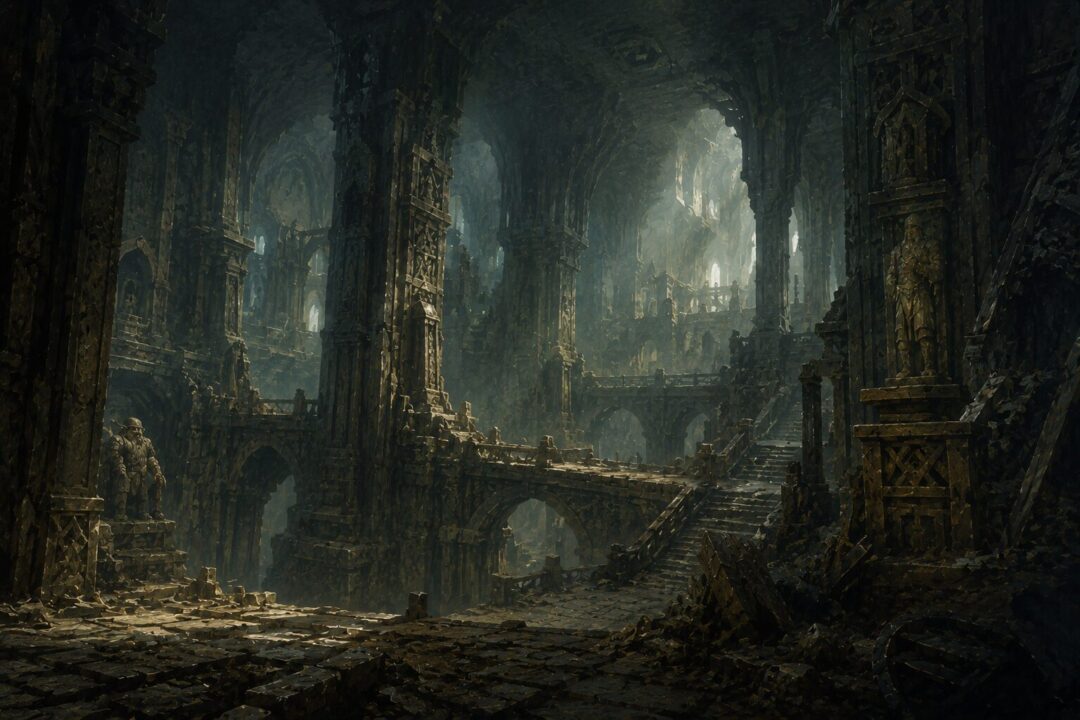
The Chamber of Mazarbul lies within the vast ruins of Khazad-dûm, once the greatest Dwarven city in Middle-earth. Long before the Fellowship arrived, the kingdom had already suffered one catastrophe after another.
The Dwarves abandoned Moria after awakening Durin’s Bane, the Balrog that dwelt beneath the mountains. Orcs later occupied much of the realm. Generations passed. The halls became places of fear rather than pride.
Yet traces of former greatness remain everywhere.
The Fellowship walks through enormous halls supported by mighty pillars. They cross chambers built by master craftsmen. The architecture itself testifies to a civilization of extraordinary skill and ambition.
Then, in the middle of that grandeur, they find a grave.
The contrast is striking. Vast kingdoms are often imagined as immortal. The tomb proves otherwise. Even the heirs of Durin, whose history stretches back to the Elder Days, cannot preserve everything they build.
The horror comes partly from scale. This is not the death of one individual. It is the visible collapse of centuries of hope.
The Book of Mazarbul and the Terror of Recorded Doom
One of the most chilling moments in the entire novel occurs when Gandalf examines the Book of Mazarbul.
Unlike many dangers in fantasy literature, the destruction of Balin’s colony is not discovered through prophecy or magical vision. It is revealed through records left behind by ordinary people.
The surviving pages recount attacks, mounting losses, desperate defenses, and eventual disaster. The text becomes increasingly fragmented. Some passages are damaged or incomplete. Others trail off abruptly.
The famous final words are among the most terrifying lines in the book:
“We cannot get out.”
What makes the record so disturbing is its immediacy.
The reader does not encounter a polished historical summary. Instead, the Book of Mazarbul preserves the perspective of people living through the catastrophe. The colony’s last defenders did not know they were writing history. They were trying to survive.
As the entries become more frantic, the Fellowship—and the reader—experiences events almost in real time. The past suddenly feels present.
The chamber ceases to be an archaeological site. It becomes a crime scene.
Horror Through Absence Rather Than Monsters
Most horror stories rely on visible threats.
Moria does eventually provide those threats. Orcs attack. A cave-troll appears. The Balrog emerges from the depths.
Yet Balin’s Tomb demonstrates a different kind of horror.
The chamber is frightening before any enemy enters.
The Fellowship is surrounded by evidence of people who should be there but are not. Empty halls replace bustling city streets. Silent rooms replace living communities. The tomb itself represents a voice permanently lost.
This use of absence is one of the most effective techniques in the narrative.
The characters begin assembling a story from fragments. A skeleton here. A damaged page there. A sealed chamber. Broken defenses. Signs of desperate resistance.
Each clue forces the imagination to complete the picture.
The reader never receives a detailed account of the colony’s final hours. The gaps make the tragedy more unsettling, not less. Uncertainty becomes part of the terror.
The Moment the Fellowship Understands Their Vulnerability
Before Moria, the Fellowship has survived considerable dangers.
Frodo escaped the Nazgûl. Rivendell offered refuge. The Council of Elrond formed a plan. Even the failed crossing of Caradhras leaves the Company intact.
Balin’s Tomb alters the emotional landscape.
The Fellowship is no longer confronting hypothetical dangers. They are standing among the remains of people who attempted something similar and failed.
The colony possessed advantages the Fellowship lacks. It consisted largely of Dwarves familiar with Moria. It occupied fortified positions. It had years to establish itself.
Yet it was destroyed.
That realization hangs over the scene.
If Balin’s people could not survive here, why should the Fellowship expect to do better?
The tomb strips away illusions of safety. The quest suddenly feels fragile.
The Company is not protected by destiny from suffering or death. The evidence is literally in front of them.
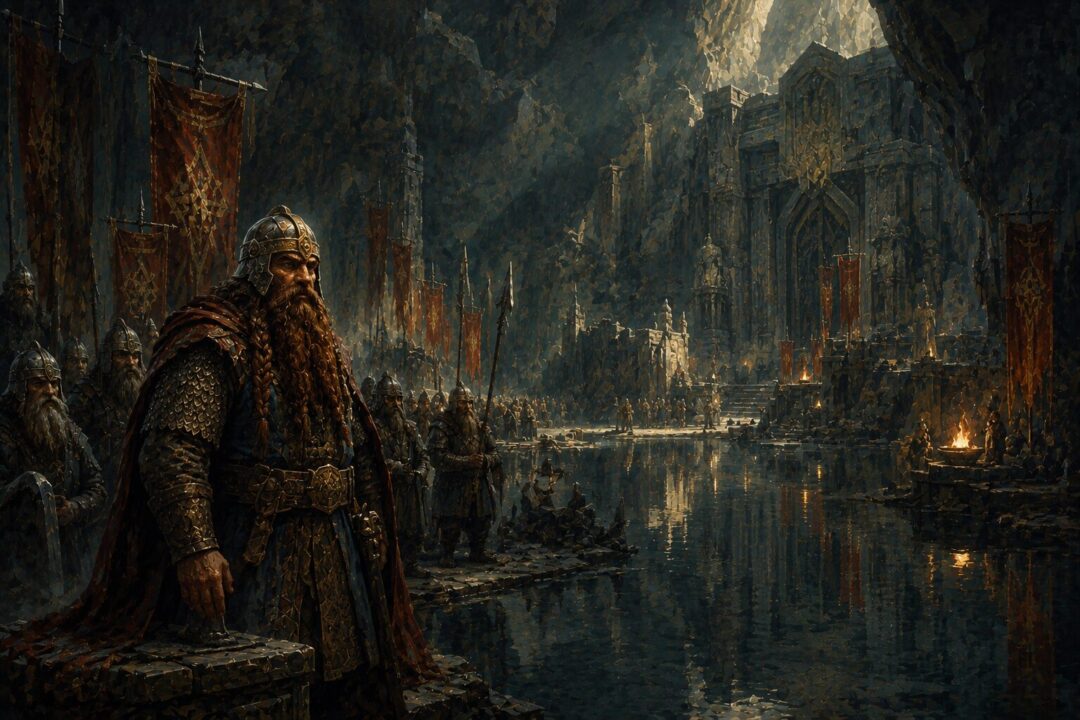
Gimli’s Personal Tragedy
No member of the Fellowship experiences the discovery more painfully than Gimli.
For him, Balin is not merely a historical figure. He is a respected lord of his people and a companion of his father’s generation. The possibility of finding Balin represented one of the few hopeful prospects within Moria.
Instead, Gimli encounters proof of irreversible loss.
His reaction underscores an important aspect of Tolkien’s storytelling. Large historical events are often experienced through personal grief.
The fall of kingdoms matters because individuals loved those kingdoms.
The destruction of Balin’s colony is not significant only because it affects Dwarven history. It matters because it affects people who remember Balin, admire him, and mourn him.
Gimli’s sorrow anchors the tragedy in human emotion.
Without that grief, the tomb would simply be a relic. Through Gimli, it becomes a wound.
A Warning About the Passing of Ages
The deeper theme of Balin’s Tomb extends beyond Moria itself.
Throughout The Lord of the Rings, readers repeatedly encounter the remnants of earlier ages. Ancient watchtowers crumble. Forgotten kingdoms linger as ruins. Great peoples diminish or depart.
Middle-earth is filled with memory.
Balin’s colony represents an attempt to reverse that process. The Dwarves sought not merely to survive but to restore what had been lost. Their failure reinforces one of the central realities of the setting: some declines cannot simply be undone.
This does not mean restoration is impossible. Gondor endures. Erebor prospers. The Shire survives.
Yet the books consistently show that restoration comes with limits. Not every kingdom can be reclaimed. Not every wound can be healed.
Khazad-dûm remains one of the clearest examples.
The tomb stands as a reminder that courage and determination do not guarantee success.
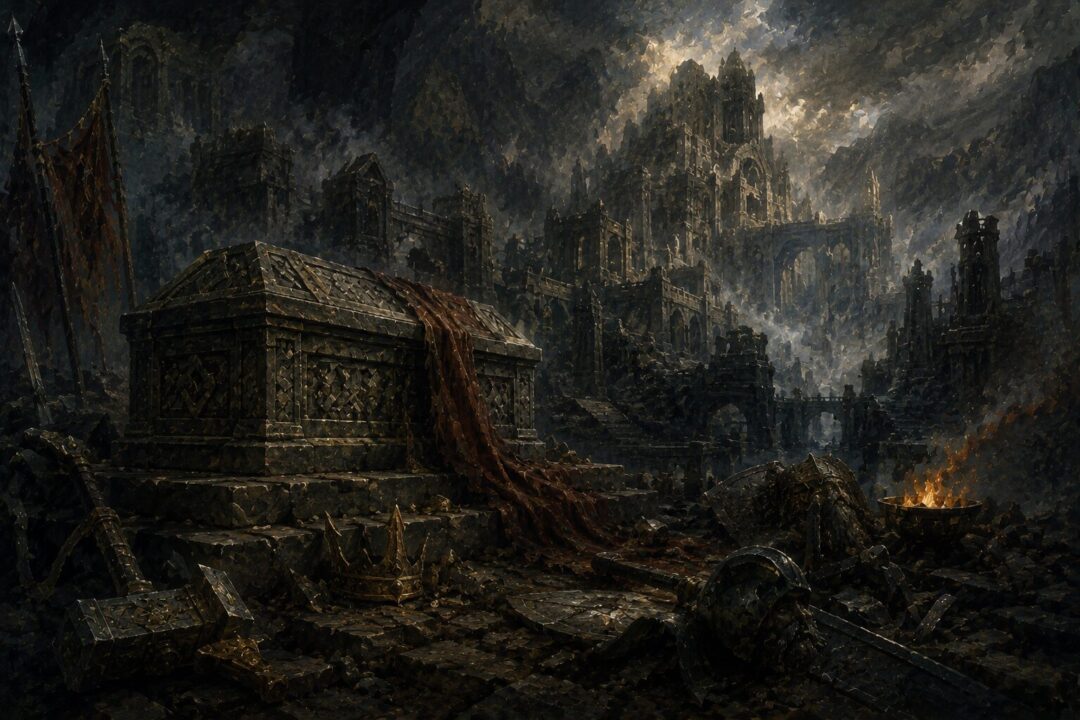
Why the Scene Still Feels So Powerful
Many readers remember the later action in Moria: the battle in the Chamber of Mazarbul, the flight across the Bridge of Khazad-dûm, and Gandalf’s confrontation with the Balrog.
Yet those events derive much of their power from what happens first.
Balin’s Tomb establishes the emotional stakes.
By the time Orcs attack, the Fellowship already knows what failure looks like. By the time the Balrog appears, the mines already feel cursed by accumulated loss. The horror is not created by monsters alone. It emerges from history.
The scene works because it combines several fears at once: death, isolation, forgotten civilizations, failed dreams, and the realization that entire communities can disappear without rescue.
In a story filled with legendary battles and world-changing events, the Chamber of Mazarbul remains unforgettable because it is intimate. A stone tomb. A damaged book. A handful of bones. A dream that ended in darkness.
That is the moment Moria stops being a setting and becomes a nightmare.
And from that point forward, the Fellowship never again travels through Middle-earth with the same innocence it possessed before opening the door to Balin’s grave.
Sources & Notes
- J.R.R. Tolkien, The Lord of the Rings, Book II, Chapter 4, “A Journey in the Dark” — the Fellowship’s entry into Moria, Gimli’s hope for Balin, and the discovery of the tomb in the Chamber of Mazarbul.
- J.R.R. Tolkien, The Lord of the Rings, Book II, Chapter 5, “The Bridge of Khazad-dûm” — the Book of Mazarbul, the words “We cannot get out,” and the attack that turns the chamber from memorial into immediate peril.
- J.R.R. Tolkien, The Lord of the Rings, Appendix A, “Durin’s Folk” — Balin’s return to Khazad-dûm, his brief rule as Lord of Moria, his death by the Mirrormere, and the colony’s destruction.
- J.R.R. Tolkien, The Lord of the Rings, Appendix B, “The Tale of Years” — the chronology of Balin’s expedition to Moria and the later loss of contact before the Fellowship arrives.
- J.R.R. Tolkien, The Silmarillion, “Of the Rings of Power and the Third Age” — background on Khazad-dûm/Moria, Durin’s Bane, and the long ruin underlying the Fellowship’s descent.