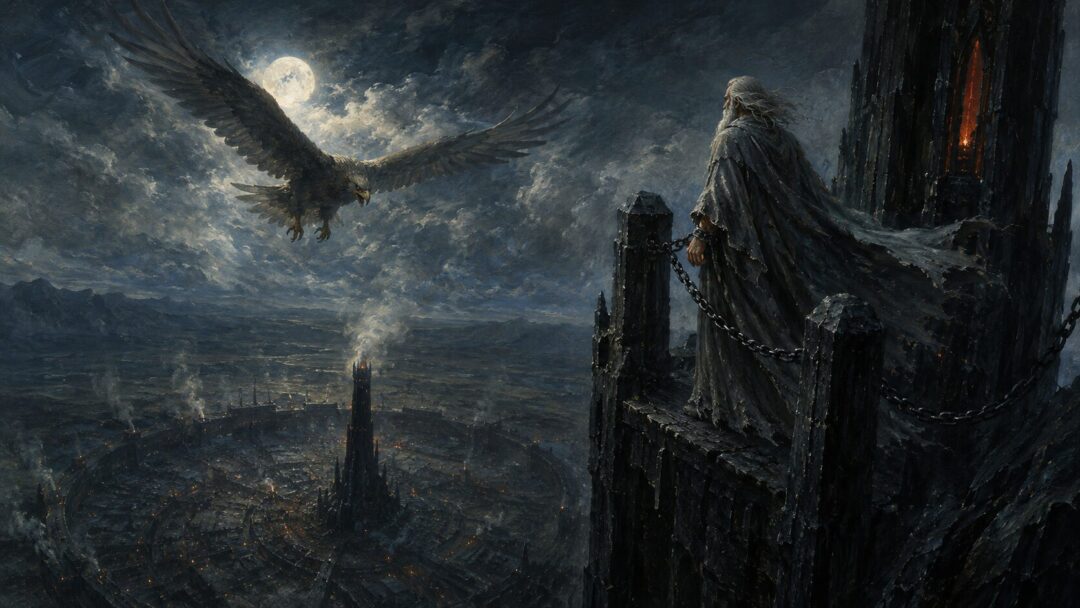
When Gandalf is trapped on the pinnacle of Orthanc, the rescue does not come from a sword, an army, or a plan worthy of the Wise. It comes on wings.
That detail is easy to overlook because Radagast the Brown himself is easy to overlook. In The Lord of the Rings, he appears only briefly in Gandalf’s account at the Council of Elrond. In The Hobbit, he is mentioned rather than developed. In the wider lore, he remains one of the strangest of the Istari: a Wizard who was sent to oppose Sauron, yet seems to vanish into the margins of the story.
But the birds connected with Radagast do not vanish. They cross borders, carry news, become tools of Saruman, and—by a turn that looks almost accidental—help bring Gandalf out of captivity. In a story where kings, captains, and Ring-bearers matter, Radagast’s birds reveal another kind of power: not command, but attention; not domination, but relationship; not glory, but the quiet movement of news through the living world.
The Wizard Who Almost Disappears
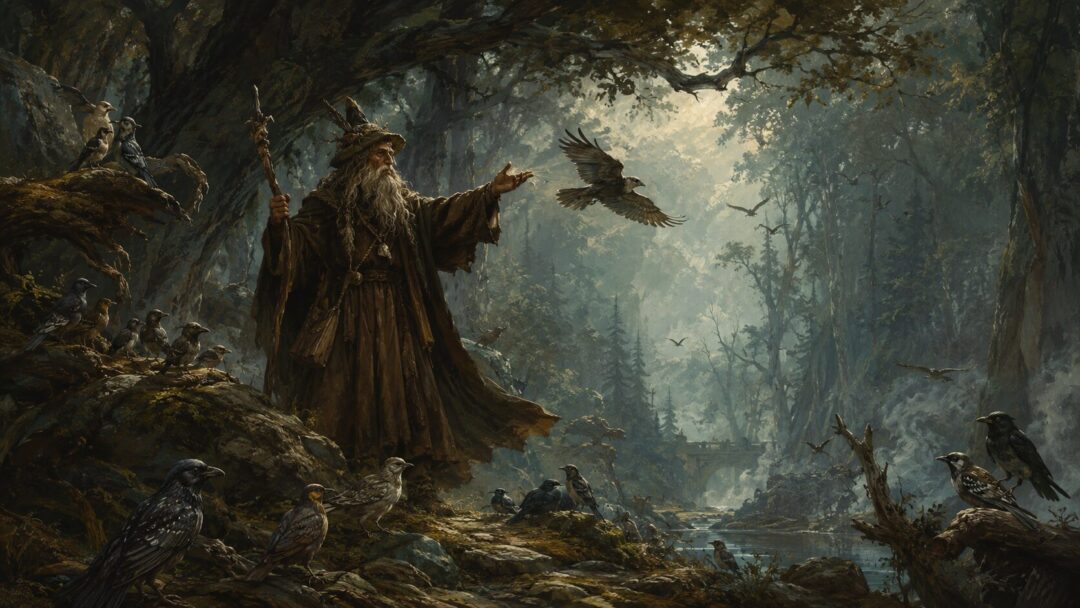
Radagast is not presented as a major mover of the War of the Ring. Gandalf calls him “a worthy Wizard” and says he has much lore of herbs, beasts, and especially birds. That is praise, but it is limited praise. Radagast is useful, knowledgeable, and honest, yet not portrayed as one of the chief strategists of the West.
His home, Rhosgobel, lies near the western borders of Mirkwood, a fitting place for a figure attached more to the wild than to councils. The texts place him near the world of forests, animals, and old roads, rather than the great political centers of the age. He is not shown in Rivendell, Minas Tirith, Lórien, or the Shire at the decisive moments.
This absence has often led readers to treat him as a failure. That judgment is not baseless, but it needs care. In the account of the Istari, Radagast becomes deeply attached to the beasts and birds of Middle-earth. One version says he became enamoured of them and forsook Elves and Men. That sounds like a falling-away from the central mission of the Wizards, who were sent to resist Sauron by counsel, not by domination.
Yet Radagast’s very attachment to birds and beasts also becomes the reason he matters at all in The Lord of the Rings. His weakness and his contribution are almost the same thing.
Saruman Saw a Fool; Gandalf Saw a Network
The crucial event begins before Gandalf reaches Isengard. Radagast meets him and delivers Saruman’s message: the Nazgûl are abroad, and Gandalf should come to Orthanc for counsel. Radagast does not know Saruman has become treacherous. He is being used.
Saruman later sneers at him as “Radagast the Bird-tamer,” “Radagast the Simple,” and “Radagast the Fool.” His contempt is revealing. Saruman thinks of Radagast as a lesser mind, someone useful only because he can be manipulated. He sees the bird-friend as a convenient courier.
Gandalf sees more. Before going to Isengard, he asks Radagast to send messages to all the beasts and birds that are his friends, telling them to bring news to Orthanc. This is one of the most important overlooked requests in the early War of the Ring. Gandalf understands that the Wise do not see everything. Roads are watched, riders are hunted, and rumor is uncertain. But birds can cross land in ways that armies cannot. Beasts can notice movements that proud rulers ignore.
The result is ironic. Saruman uses Radagast to lure Gandalf into a trap. Gandalf uses Radagast’s friendships to create the conditions for his own escape.
The Birds Become More Than Messengers
Radagast himself does not break open Orthanc. He does not challenge Saruman. He does not arrive with staff raised and birds circling like a storm. The text gives no such scene.
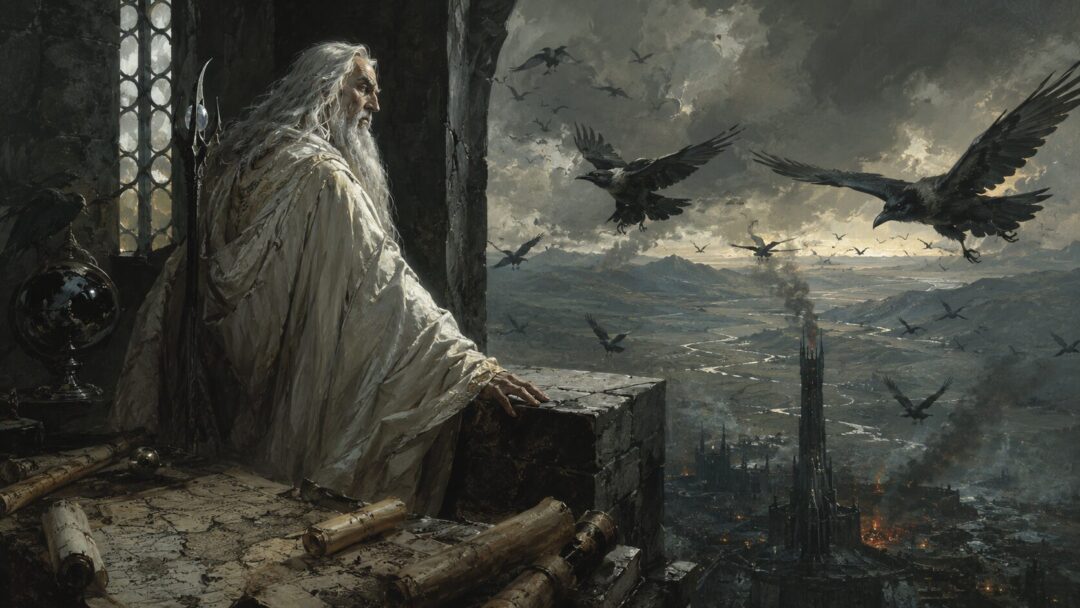
Instead, Gwaihir the Windlord comes to Orthanc bearing news. He is not merely wandering by without cause. He comes because Radagast had sent out the birds, as Gandalf requested. When Gwaihir discovers Gandalf imprisoned on the summit of the tower, he carries him away.
That means Radagast’s birds help overturn one of Saruman’s most dangerous early victories. Had Gandalf remained trapped, Frodo’s road might have been very different. The Company might never have been formed in the same way. The counsel at Rivendell would have lacked one of its central voices. The later stand against the Balrog, the return of Gandalf, and the guidance of Théoden all depend, in the chain of events, on Gandalf not remaining a prisoner of Orthanc.
This does not make Radagast the secret hero of the War. The texts do not say that. But it does mean that his friendships with birds are not decorative lore. They become part of the hidden machinery by which providence and free action meet.
Radagast may have failed to stand where he should have stood. His birds still carried the news that helped save the one Wizard who did.
A Small Correction: The Moth Is Not the Textual Point
Many modern fans associate Gandalf’s rescue from Orthanc with a moth. That is a visual idea from adaptation, not a detail from the book. In the written account, the important connection is not a moth whispering to an Eagle, but Radagast’s wider network of beasts and birds carrying news.
This matters because the book’s version is less magical in appearance and more morally interesting. The rescue is not a sudden spell. It is the result of Gandalf trusting a neglected friendship-system in the living world. It is also the result of Radagast doing at least one thing faithfully: sending out the messages he was asked to send.
The birds are not pets. They are not a whimsical accessory to a nature-loving Wizard. They are independent living creatures within a world where animals, Eagles, ravens, horses, wolves, and other beings can possess agency, memory, and allegiance. Middle-earth is not a human-only battlefield.
That is why Radagast’s birds may matter more than Radagast himself. He fades from the visible war, but the relationships he cultivated remain active.
Birds in Middle-earth Are Never Just Background
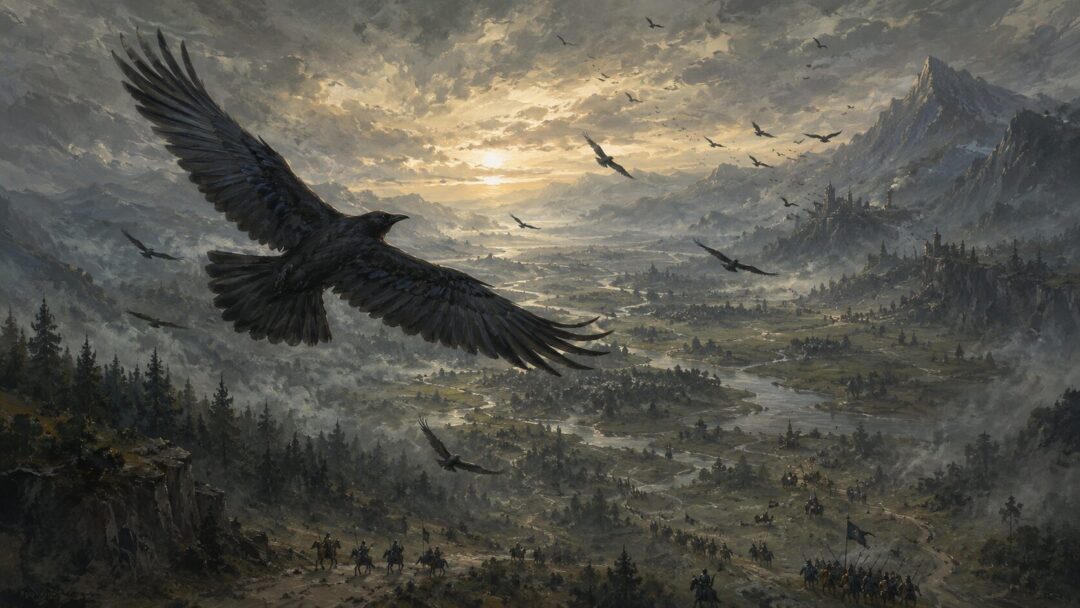
Radagast’s birds also belong to a wider pattern. Birds in Tolkien’s world often carry knowledge, warning, or intervention. The Eagles appear at decisive moments in The Hobbit and The Lord of the Rings. Ravens have old associations with the Dwarves of Erebor. Crebain from Dunland become ominous signs of surveillance as the Fellowship travels south. Even when the birds are not morally simple, they are rarely meaningless.
This is one reason Saruman’s use of birds as spies is so disturbing. He does not understand friendship with living things as Radagast does. He turns the air itself into an intelligence system. The same creatures that can bring aid can also become instruments of fear.
Radagast, by contrast, is not shown mastering birds through tyranny. Gandalf’s language emphasizes friendship. That distinction fits one of the deep moral divisions in Middle-earth: the difference between cooperation with the natural world and possession of it. Sauron and Saruman bend, breed, spy, command, and industrialize. The better powers ask, befriend, awaken, heal, and preserve.
Radagast may be too narrow in his love. But the kind of love he has is not evil. The danger is not that he cares for birds and beasts. The danger is that he may have cared for them in a way that drew him away from Elves and Men when the Shadow required wider service.
The Tragedy of a Good Gift Used Poorly
Radagast’s story is tragic because his gift is real. He is not a fraud. Gandalf’s respect for him is not sarcasm. He knows herbs, beasts, and birds. He has friendships few others possess. He is trusted enough that Gandalf acts on his message, even though that message leads to danger.
But a real gift can become a narrowed life. The texts imply that Radagast’s devotion to wild creatures may have diminished his part in the larger resistance to Sauron. Unlike Saruman, he does not seem to fall through pride, domination, or hunger for the Ring. If he fails, his failure is softer and sadder: a turning aside into a beloved corner of the world while the whole world is threatened.
That makes him an unusually human figure for a Wizard. Many people fail not by choosing evil outright, but by shrinking their duty to the part of goodness they personally prefer. Radagast’s birds show the beauty of his vocation. His absence shows its possible cost.
Still, the War of the Ring is full of partial instruments. Boromir falls but helps save Merry and Pippin for a time. Gollum is treacherous, yet his final act brings about the Ring’s destruction. Théoden is restored after long decline. Even flawed service can be woven into a larger deliverance.
Radagast’s birds fit that pattern. They do not erase his failure, if failure it is. They keep his story from being only failure.
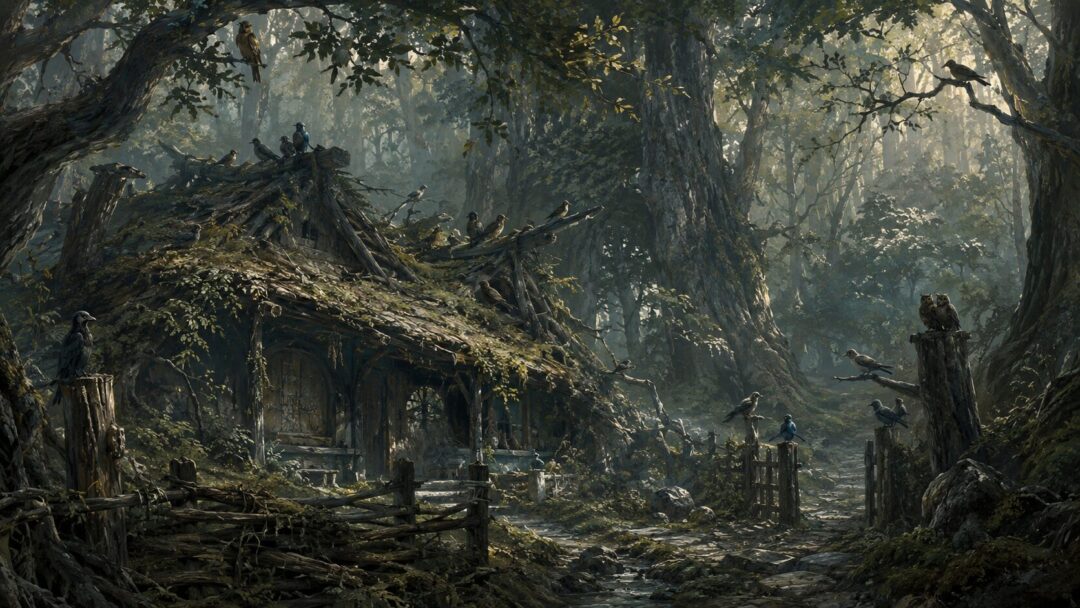
Why the Birds May Matter More
Radagast himself is hard to measure because the narrative gives us so little. His birds, however, leave consequences. Through them, news moves. Through them, Gwaihir comes. Through Gwaihir, Gandalf escapes. Through Gandalf’s escape, the resistance to Sauron keeps its most necessary guide.
The great irony is that Saruman underestimates the very world he tries to exploit. He uses Radagast because he thinks the Brown Wizard is simple. He trusts that birds can serve as tools. But he fails to account for loyalty, friendship, and chance—or what the story often treats as something deeper than chance.
In Middle-earth, power does not always announce itself. Sometimes it is a Hobbit carrying pity into Mordor. Sometimes it is an old horse-lord remembering courage. Sometimes it is an Eagle arriving over a tower because a bird-friend sent messages into the wild.
Radagast may never stand in the center of the tale. His birds do something more important: they prove that the margins of Middle-earth are alive. The forests, skies, and wild creatures are not passive scenery around the deeds of kings. They are part of the struggle itself.
And in that sense, Radagast’s greatest contribution may not be what he personally does, but what his friendships make possible after he has passed out of sight.
Sources & Notes
- J.R.R. Tolkien, The Lord of the Rings, Book II, Chapter 2, “The Council of Elrond” — Gandalf recounts Radagast’s warning, Saruman’s use of him, the request to send birds and beasts for news, and Gwaihir’s arrival at Orthanc.
- J.R.R. Tolkien, The Hobbit, Chapter 7, “Queer Lodgings” — Beorn’s remarks place Radagast near Mirkwood and establish his reputation as a Wizard associated with wild lands rather than great councils.
- J.R.R. Tolkien, Unfinished Tales, “The Istari” — the fullest account of Radagast’s attachment to birds and beasts, and of the Wizards’ mission and uneven faithfulness to it.
- J.R.R. Tolkien, The Silmarillion, “Of the Rings of Power and the Third Age” — summarizes the Istari as emissaries sent to resist Sauron by counsel and encouragement, framing Radagast’s vocation and possible failure.
- J.R.R. Tolkien, The Lord of the Rings, Book II, Chapter 3, “The Ring Goes South” — the crebain from Dunland show birds as agents of surveillance and warning in the War of the Ring, a darker counterpart to Radagast’s friendships.