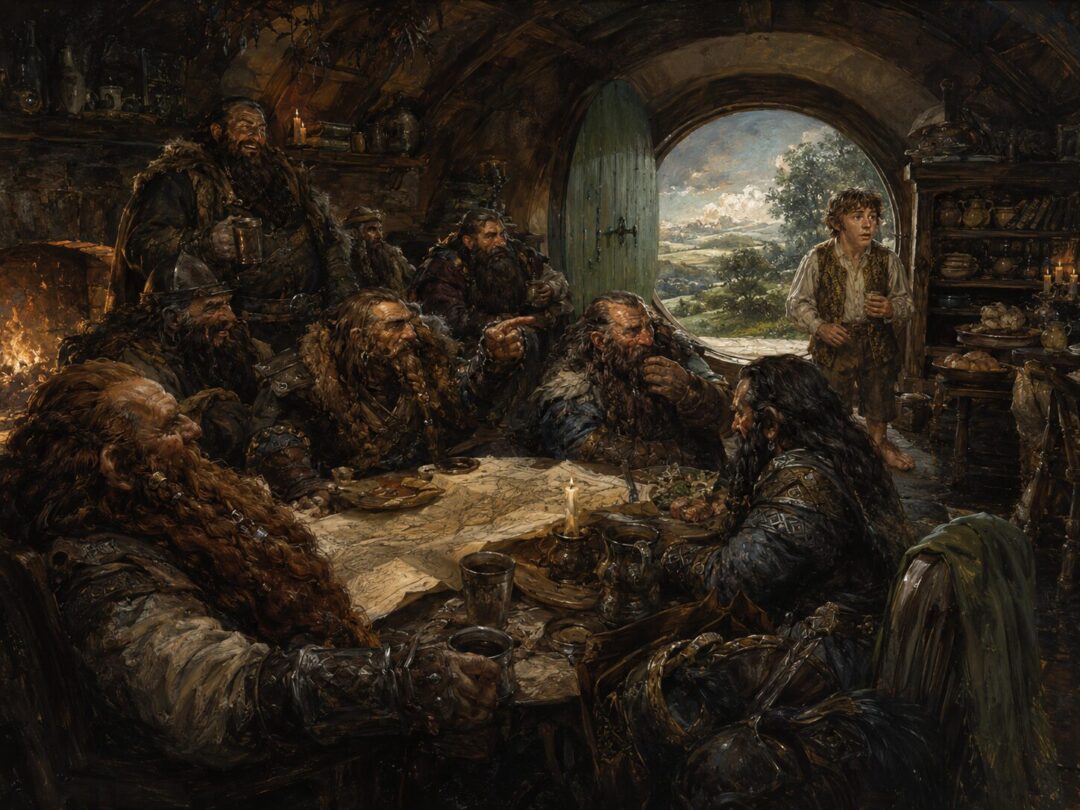
The Hobbit begins with a hole in the ground, a respectable little home, a pantry full of food, and a hobbit who has no desire to be uncomfortable. It is almost impossible to imagine a softer doorway into Middle-earth than Bag End. Bilbo Baggins is not a warrior, a prince, or a doomed king. He is a small person worried about tea, pocket-handkerchiefs, and unexpected guests.
And yet by the end of the story, that same hobbit is standing in the shadow of a mountain where armies gather over treasure, a king is consumed by possessiveness, and victory comes soaked in grief.
That is the strange power of The Hobbit. It begins like a children’s adventure because Bilbo begins as someone protected from the true cost of the world. But the story does not remain safe. It keeps widening. First the danger is comic. Then it is frightening. Then it becomes moral. By the end, the real monster is not only a dragon. It is what treasure, pride, and fear can do to people who believe they are finally getting what they deserve.
Bag End Is Not Just Comfort — It Is Innocence
The opening of The Hobbit feels deliberately domestic. Bilbo lives in a well-ordered world where danger is something that happens elsewhere. His home is warm, stocked, respectable, and predictable. The humor of the first chapter comes from the invasion of that predictability: Gandalf marks the door, the dwarves arrive one after another, and Bilbo’s quiet life becomes crowded with songs, dishes, maps, and plans for burglary.
This is why the beginning can feel like a children’s story. Its first tension is not war or doom, but social embarrassment. Bilbo is overwhelmed because his breakfast-and-supper existence has been interrupted by people who speak of dragons as if they are problems to be solved.
But that gentle opening is doing something important. It gives the reader a moral baseline. Bag End is ordinary life: food, manners, peace, and the small dignity of being left alone. When the story later reaches greed, homelessness, devastation, and war, the memory of Bag End remains in the background. We understand what is being risked because we have seen what peace looks like.
Bilbo does not start as heroic because the story wants courage to feel earned. He is not born into legend. He is pulled into it, reluctantly, almost absurdly. That makes his later choices more meaningful.
The Adventure Begins as Play, Then Refuses to Stay Harmless
Early danger in The Hobbit often has a fairy-tale shape. Trolls turn to stone. Goblins sing grotesque songs. Riddles become a matter of life and death. Giant spiders speak with cruel appetite. The world is frightening, but it is still told with a kind of brisk, storybook energy.
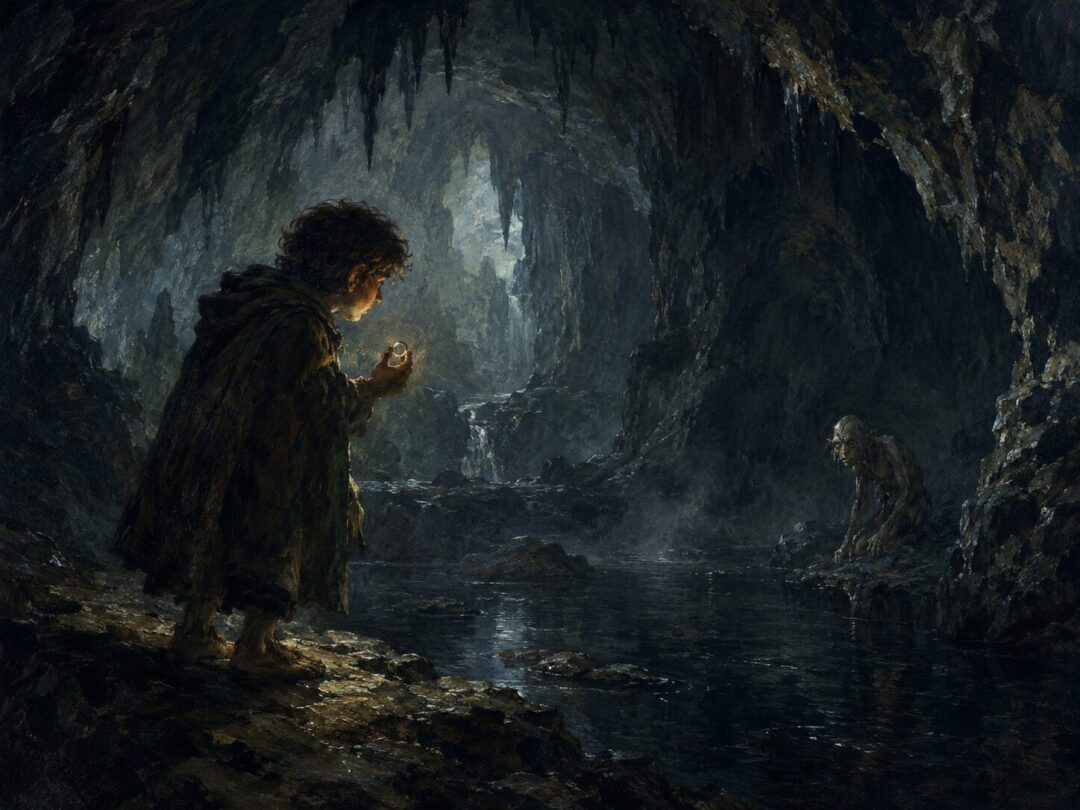
Yet even here the darker Middle-earth is already showing through. The trolls are not merely comic obstacles; they would eat the travelers. The goblins are not harmless villains; they are violent, organized, and vengeful. Gollum is not simply a riddle-creature; he is a ruined being living in darkness, shaped by secrecy, hunger, and the Ring long before the reader fully understands what the Ring is.
The tone is playful, but the consequences are real.
This is one reason The Hobbit can be misremembered as only lighthearted. It has songs, jokes, and narratorly warmth, but it also keeps introducing the reader to the same moral universe that will later dominate The Lord of the Rings. Pity matters. Mercy matters. Possession changes the possessor. Small choices made in darkness can echo far beyond the person making them.
Bilbo’s encounter with Gollum is the clearest example. He escapes partly through wit, partly through luck, and partly because he does not kill Gollum when he has the chance. The Hobbit does not yet reveal the full future importance of that mercy, but even inside this story the moment matters. Bilbo’s greatness begins not when he wins, but when he refuses to become cruel simply because he has power over someone weaker and more wretched.
Smaug Turns the Story From Quest Into Judgment
At first, the dwarves’ goal seems straightforward: reclaim the Lonely Mountain and the treasure stolen by Smaug. There is justice in that desire. Thorin and his people have suffered exile. Erebor was taken from them. Their longing for home is not false.
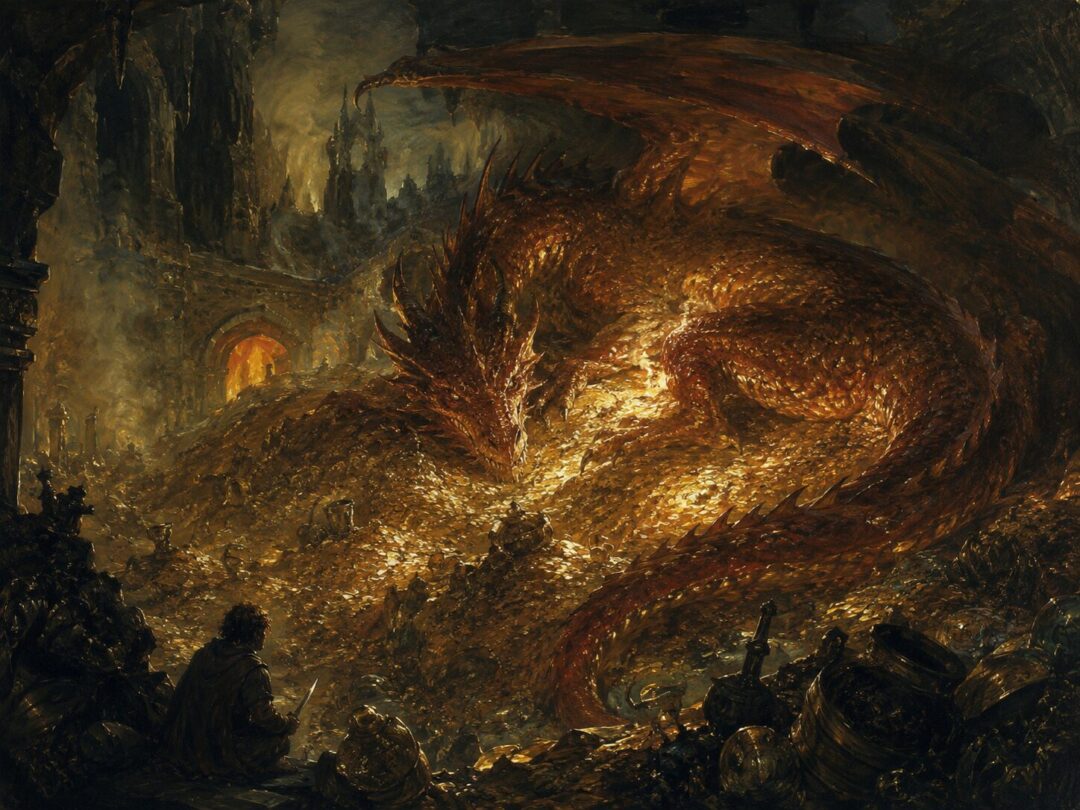
But The Hobbit becomes more complicated because the treasure is not morally neutral. The hoard has been guarded by a dragon. Smaug has lain on it, brooded over it, and made it the center of his identity. He does not merely possess wealth; he is possessed by possession. His pride, suspicion, and contempt are all tied to the gold beneath him.
When Bilbo finally speaks with Smaug, the story changes shape. The dragon is not just a beast to be outwitted. He is intelligent, seductive, and dangerous through words as well as fire. He plants doubt. He understands greed. He sees how easily a company of companions can become divided once reward enters the conversation.
This is where the warning deepens. The treasure that motivates the quest can also corrupt its end. The same mountain that promises restoration can become a trap. The question is no longer simply, “Can the dragon be defeated?” It becomes, “What will victory do to the victors?”
That is a much darker question than the one asked at Bilbo’s round green door.
Thorin’s Fall Is Tragic Because His Claim Is Not Imaginary
Thorin Oakenshield is not a simple villain. That is what makes the ending hurt.
His desire to reclaim Erebor is rooted in loss, memory, and inheritance. The Lonely Mountain is not merely a vault to him. It is kingship, ancestry, dignity, and the restoration of a people scattered by disaster. If Thorin had no rightful claim, his possessiveness would be easier to dismiss.
But The Hobbit’s warning is sharper than that. It shows how even a real grievance can become spiritually dangerous when it hardens into absolute entitlement.
After Smaug’s death, the treasure becomes the center of a new conflict. Bard has a claim connected to Lake-town’s destruction and the old wealth of Dale. The Elvenking has his own part in the gathering tension. Thorin, fortified inside the Mountain, refuses to yield as the situation worsens. The texts present his condition as bound up with the dangerous power of treasure long guarded by a dragon. That does not erase his responsibility, but it frames his fall as more than ordinary selfishness.
This is the tragic irony: Thorin wins back the Mountain and nearly loses himself inside it.
The children’s-story surface has now fully cracked. There is no longer a simple line between good companions and evil monsters. Smaug is dead, but dragonish thinking survives around his hoard. The desire to possess, defend, and dominate outlives the dragon himself.
Bilbo Becomes Heroic by Betraying the Logic of Treasure
Bilbo’s most important act near the end is not a feat of strength. It is a moral gamble.
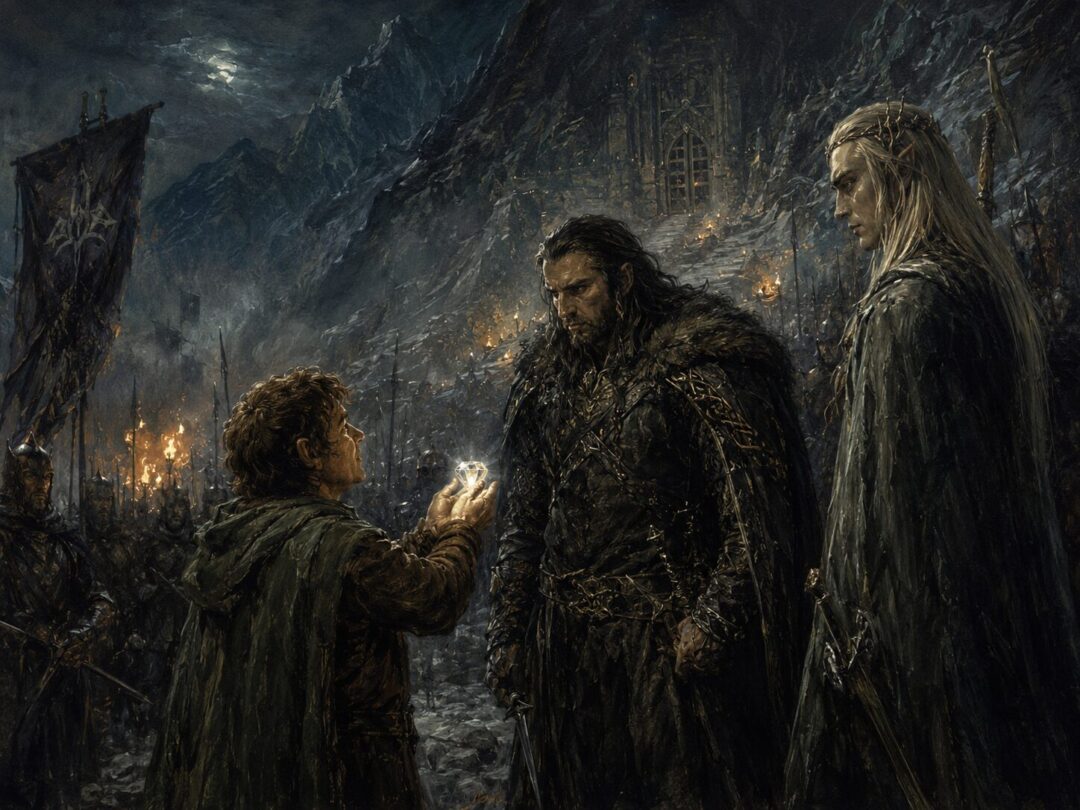
When he secretly gives the Arkenstone to Bard and the Elvenking, he is not doing it because he hates Thorin. The opposite is closer to the truth. Bilbo is trying to prevent a war. He uses the one object Thorin values most as leverage because ordinary persuasion has failed.
This act is complicated. Bilbo has found the Arkenstone and kept it hidden. Thorin would certainly see its surrender as betrayal. But the story presents Bilbo’s choice as one made against escalating disaster. He is willing to be hated if hatred is the price of stopping bloodshed.
That is a very un-childish moral position.
A simpler adventure might end with the burglar claiming his reward and going home. The Hobbit instead asks whether loyalty to a friend can ever require resisting that friend’s worst impulse. Bilbo’s courage has matured. At the beginning, he feared inconvenience and public embarrassment. By the end, he risks exile, anger, and danger in order to keep treasure from becoming a cause of slaughter.
The small hobbit who once worried about his pantry now sees more clearly than kings and warriors.
The Battle of Five Armies Is Victory Without Innocence
The Battle of Five Armies does not arrive as a glorious reward. It interrupts a near-war among Dwarves, Men, and Elves when a greater threat appears: goblins and Wargs. The free peoples are forced into alliance, and the battle ends with victory, but not the kind of victory that restores the beginning.
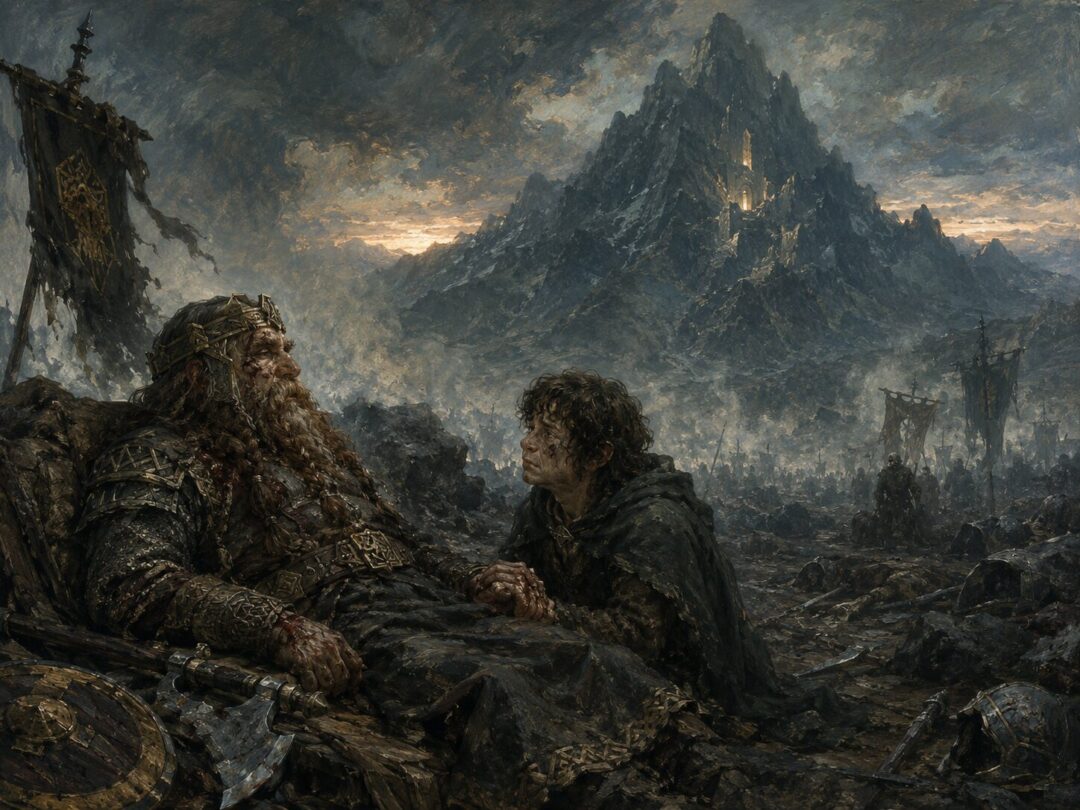
Thorin is mortally wounded. Fíli and Kíli die defending him. Many others fall. The Mountain is reclaimed, but the cost is heavy.
This is where The Hobbit most clearly stops being merely the tale it seemed to be at the start. A children’s adventure may include danger, but here the ending insists on moral accounting. The treasure is won. The dragon is gone. The armies of enemies are defeated. And yet the emotional center is not triumph, but loss and repentance.
Thorin’s final reconciliation with Bilbo matters because it restores what greed nearly destroyed: friendship, humility, and the recognition that food, cheer, and kindness may be worth more than hoarded gold. The exact wording of that farewell is one of the book’s most famous moral moments, but its meaning is larger than any single line. Thorin dies having seen too late that the values of Bag End were not small after all.
They were the point.
The Warning Hidden Inside the Fairy Tale
The Hobbit begins like a children’s story because it understands that innocence is real. Warm homes, songs, meals, jokes, and small comforts are not trivial. They are the things that make life worth defending.
But it ends like a warning because innocence alone cannot survive without moral courage. The world outside Bag End contains monsters, yes, but also subtler dangers: greed disguised as justice, pride disguised as kingship, suspicion disguised as wisdom, and victory disguised as possession.
Bilbo returns home changed. He is still Bilbo, but not the same Bilbo. He has seen that adventure is not merely treasure maps and songs under the stars. It is hunger, fear, riddles in the dark, burning towns, divided allies, and friends dying after bitter words.
Yet the story does not become hopeless. Its warning is not that the world is too dark for small people. It is that small people may be the only ones clear enough to resist the darkness when the great become trapped by their own claims.
The Hobbit starts with a hobbit-hole because that is what peace looks like.
It ends beneath the shadow of the Lonely Mountain because that is what peace can cost.
And between those two places, Bilbo learns that growing up does not mean abandoning kindness. It means discovering that kindness may have to become brave.
Sources & Notes
- J.R.R. Tolkien, The Hobbit, “An Unexpected Party” — establishes Bag End’s domestic comfort and Bilbo’s reluctant entry into adventure.
- J.R.R. Tolkien, The Hobbit, “Riddles in the Dark” — Bilbo’s encounter with Gollum, including the choice not to kill him, anchors the article’s point about mercy and moral growth.
- J.R.R. Tolkien, The Hobbit, “Inside Information” — Smaug’s conversation with Bilbo shows the dragon’s pride, suspicion, and power to turn treasure into division.
- J.R.R. Tolkien, The Hobbit, “The Gathering of the Clouds” and “A Thief in the Night” — Thorin’s claim hardens around the hoard, while Bilbo uses the Arkenstone to try to prevent war.
- J.R.R. Tolkien, The Hobbit, “The Clouds Burst” and “The Return Journey” — the Battle of Five Armies, Thorin’s repentance, and the final contrast between hoarded gold and simple kindness support the article’s warning-shaped ending.