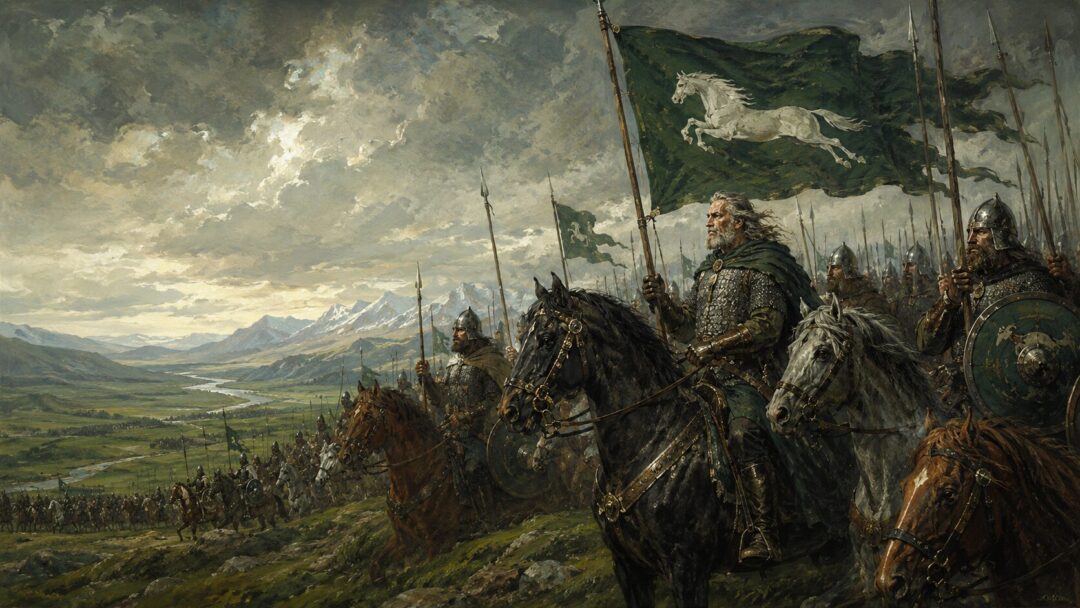
When the Riders of Rohan thunder toward Minas Tirith, the image is easy to simplify: flashing blades, bright helms, spears in the dawn, Théoden crying his people into battle. But the deeper power of Rohan was never only in the steel its warriors carried. A sword could kill an Orc. A spear could break a shield-wall. Yet Rohan’s horses could change the map.
That is the overlooked truth of the Mark. The Rohirrim were feared not because they owned better weapons than Gondor, nor because they possessed hidden lore like the Elves. Their strength lay in movement, distance, speed, and a bond between rider and horse so central that it shaped their name, their banners, their kingship, and their usefulness in the War of the Ring.
Rohan’s swords mattered in the moment of impact. Its horses mattered before the battle began.
The Mark Was Built Around the Horse
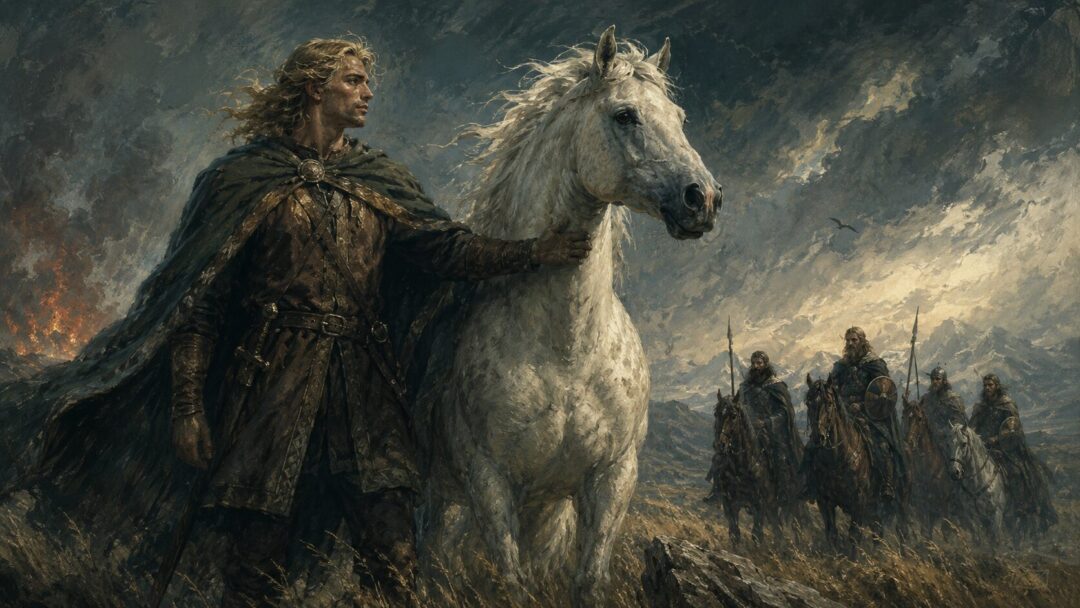
Rohan is not merely a kingdom that happens to have cavalry. In the texts, its identity is bound to horses so tightly that outsiders name its people through that bond. “Rohirrim” is a Sindarin name generally understood as the horse-lords or horse-host, while their own culture speaks through the language of riders, herds, musters, and mounted war.
This is not decorative worldbuilding. It explains why Rohan could exist where it did and why Gondor valued it so desperately. The land of the Mark was wide, grassy, and open, suited to horse-breeding and fast movement. Its people did not defend themselves like the stone-cities of Gondor or the hidden woodland realms. They lived by the ability to ride, gather, pursue, withdraw, and strike.
Their emblem also tells the story. Rohan’s royal sign is not a sword, crown, tower, or jewel. It is a white horse on green. The symbol is not merely heraldic pride; it expresses what the kingdom believes itself to be. Rohan’s power is alive, swift, and difficult to cage.
That makes the article’s question more than a military comparison. Horses mattered more than swords because horses were not just equipment. They were Rohan’s economy, nobility, memory, and war-machine in one.
Eorl’s Kingdom Began With a Ride
The foundation of Rohan is inseparable from the ride of Eorl the Young. In the history preserved around the Oath of Eorl, the Éothéod come south to aid Gondor in a time of great need. Their arrival at the Field of Celebrant changes the fate of Gondor, and afterward Cirion grants them Calenardhon, the land that becomes Rohan.
That story matters because it establishes Rohan’s role from the beginning: not as a realm of walls, but as a realm that can answer distance. Gondor does not need another city. It needs riders who can come when roads are dangerous, borders are strained, and time is nearly gone.
The Oath of Eorl makes this practical strength into a moral bond. Rohan’s speed becomes part of its honor. To ride to Gondor’s aid is not simply a tactical choice; it is the keeping of an ancient promise. This is why the Red Arrow and the muster of Rohan carry such weight later in The Lord of the Rings. When Gondor calls, the question is not only whether Théoden has enough men. It is whether Rohan can still be itself.
Swords cannot keep an oath across hundreds of miles. Horses can.
Felaróf and the Royal Meaning of the Mearas
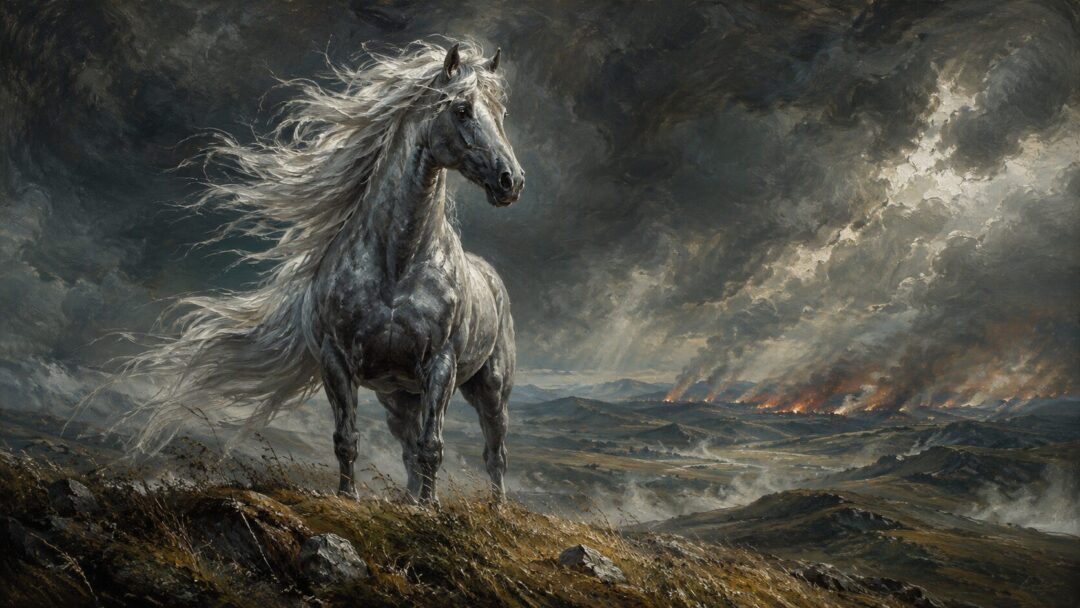
The deeper lore of Rohan’s horses begins with Felaróf, the great horse associated with Eorl. The texts describe Felaróf as the ancestor of the Mearas, the noble horses of Rohan. These were no ordinary breed. They were long-lived, intelligent, and so proud that they would bear only the Lord of the Mark or his sons, until the exceptional case of Shadowfax.
The story of Felaróf is striking because it is not just a tale of taming. It is about mastery restrained by relationship. Felaróf is not treated as a simple beast of burden. He becomes part of the royal tradition of Rohan, and from him descends a line of horses that belongs almost to the sacred edge of the Mark’s kingship.
This is where Rohan differs from a generic cavalry culture. The finest horses of the Mark are bound to legitimacy. The king’s relationship with such a horse reflects more than personal wealth. It reflects whether the ruler stands inside the old pattern of the kingdom.
A sword can be inherited, stolen, reforged, or given away. A horse like one of the Mearas must consent in a deeper sense. That makes Rohan’s greatest horses symbols of authority that cannot be reduced to property.
Shadowfax Shows the Limit of Ownership
Shadowfax, chief of the Mearas, makes this point even clearer. He is called the greatest of Rohan’s horses, yet he is not simply controlled by Rohan’s king. Gandalf rides him, and the texts carefully preserve the sense that Shadowfax is not an object passed from hand to hand like a weapon. He bears Gandalf because he wills it.
That detail matters. In Middle-earth, the highest forms of power often resist domination. The One Ring corrupts because it tempts the will to control. By contrast, Shadowfax represents a different kind of power: cooperation freely given. He does not need bit or bridle in the ordinary sense. He is not valuable because he can be forced. He is valuable because he is noble enough to choose.
This also helps explain why Rohan’s horse-lore feels morally important rather than merely practical. The Mark’s best strength is not mechanical. It is relational. Rider and horse must trust one another. The speed that saves kingdoms depends on a bond that tyranny cannot easily imitate.
One reading is that Shadowfax shows Rohan’s highest ideal more purely than many of its human politics do. While Théoden is trapped for a time in weakness and manipulation, Shadowfax remains untamed, uncorrupted, and impossible to reduce to another person’s scheme.
The Enemy Understood the Value of Horses
Rohan’s enemies also understood that horses were more important than swords. This is one of the clearest ways the texts reveal their strategic value. The servants of Sauron and the forces aligned against the West do not treat Rohan’s horses as a minor detail. Horses are coveted, stolen, and targeted because they determine what Rohan can do.
During the War of the Ring, the Black Riders require horses for speed and pursuit. Rohan is associated with the finest horses, and suspicion falls at one point on the idea that horses have gone from Rohan toward Mordor. The fuller picture is more complicated and should be stated carefully: the Rohirrim do not appear as willing servants of Mordor, and Éomer strongly rejects that idea. The texts instead suggest raids, theft, and pressure around the value of horses.
That distinction matters. The Shadow wants the strength of Rohan without the honor of Rohan. It wants the horse-power of the Mark severed from oath, kinship, and free allegiance.
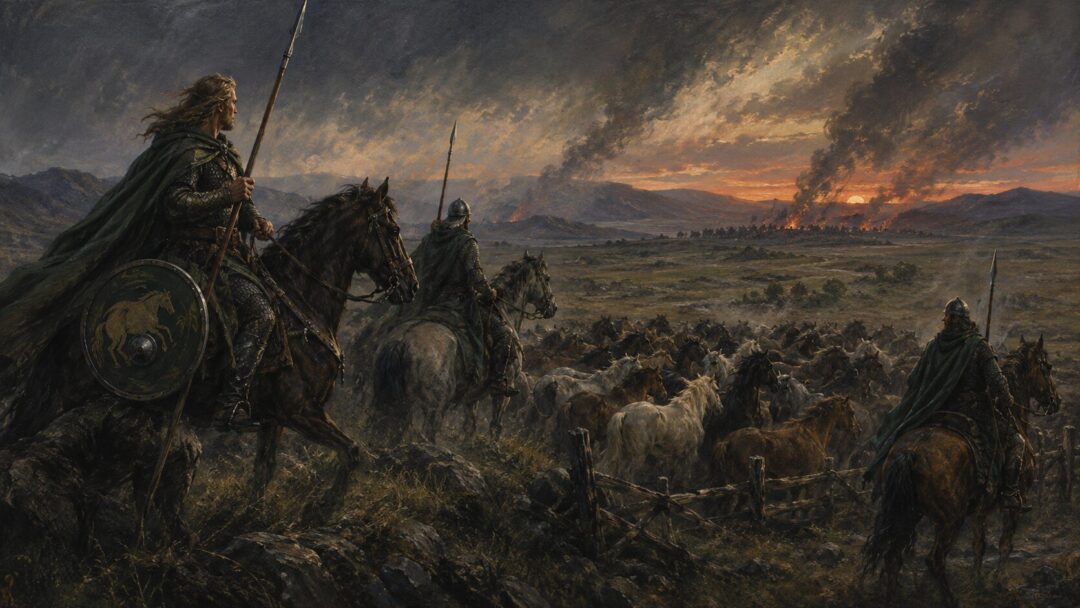
Saruman’s threat works differently but points to the same truth. Isengard’s war against Rohan is not only a clash of armies; it is an attempt to break the kingdom’s ability to move and answer. Burn villages, scatter people, kill riders, seize crossings, and the horse-lords become trapped in fragments. A mounted culture that cannot gather is a wounded culture.
Théoden’s Restoration Is a Return to Motion
When Théoden is restored in Meduseld, the change is not merely that he thinks more clearly. His recovery is expressed through movement. He rises, goes out, takes up authority again, and returns to the field. The king of Rohan must not remain shut in a hall while his riders bleed across the land.
This is why the image of Théoden riding is so powerful. His kingship is not complete in speech alone. It becomes visible when he mounts and leads.
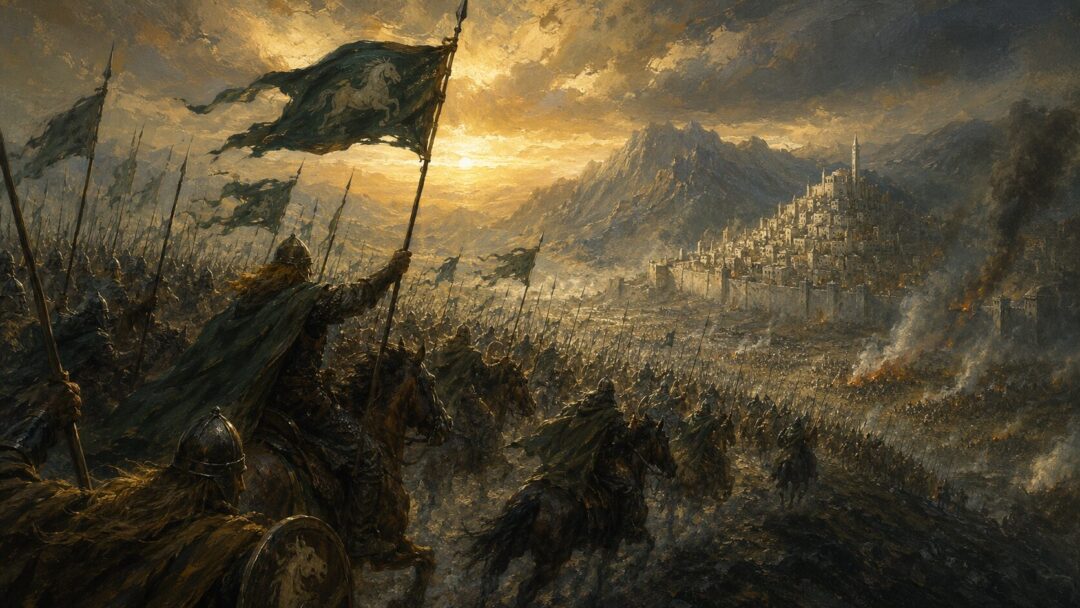
The same pattern appears in Rohan’s larger war-story. The people are endangered when delayed, divided, or deceived. They become themselves again when they muster and ride. Helm’s Deep is a defensive battle, but even there mounted movement remains decisive in the wider arc. At the Pelennor Fields, Rohan’s arrival is only possible because its strength is mobile. The Rohirrim do not defeat despair by holding a wall. They break into the battle from afar.
Their swords matter when they meet the enemy. Their horses make the meeting possible.
Pelennor: The Charge That Only Rohan Could Make
The Ride of the Rohirrim to Minas Tirith is the great proof of Rohan’s value. Gondor has stone, discipline, ancient lineage, and a mighty city. But when Minas Tirith is encircled, those strengths are not enough. The city needs something from outside the siege. It needs speed, surprise, and courage arriving over distance.
Rohan provides exactly that.
The tragedy of Théoden and Snowmane also reveals the cost. Snowmane carries the king into the field and falls upon him after being struck. The horse is not incidental scenery in Théoden’s death. He is bound to the king’s final glory and final wound. Rohan’s greatness and vulnerability meet in that moment: the same living power that bears the king to renown can also become part of his doom.
This does not reduce Snowmane to a symbol. It does the opposite. It shows how fully horse and rider share the fate of the Mark. In Rohan, war is never only men with weapons. It is men and horses entering peril together.
Why Swords Alone Could Never Save Rohan
A sword is personal. A horse is civilizational.
That is the simplest way to understand why Rohan’s horses mattered more. A sword extends the arm of one warrior. A horse extends the reach of an entire people. Horses let news travel, armies gather, borders breathe, scouts return, refugees flee, kings answer oaths, and hope arrive where hope was no longer expected.
Without horses, Rohan would still have brave warriors. But it would not be the same kingdom. It could not answer Gondor as Eorl answered Cirion. It could not define itself as the Riddermark. It could not produce the dread and wonder of a charge heard before it is seen. It could not turn grassland into strategy.
The Rohirrim’s blades killed enemies. Their horses made them Rohirrim.
And that is the hidden rule behind Rohan’s glory: its greatest weapon was not forged in a smithy. It was bred, named, loved, ridden, and trusted. Steel could win a duel. The horses of Rohan could carry an oath through darkness and bring it to the battlefield at dawn.
Sources & Notes
- J.R.R. Tolkien, The Lord of the Rings, Appendix A, II, “The House of Eorl” — Eorl, Felaróf, the Mearas, and the horse-centered foundations of the Mark.
- J.R.R. Tolkien, Unfinished Tales, “Cirion and Eorl and the Friendship of Gondor and Rohan” — the ride to the Field of Celebrant, the Oath of Eorl, and Calenardhon becoming Rohan.
- J.R.R. Tolkien, The Lord of the Rings, Book III, Chapter 2, “The Riders of Rohan” — Éomer, the Rohirrim’s mounted warfare, and the dispute over horses taken toward Mordor.
- J.R.R. Tolkien, The Lord of the Rings, Book III, Chapter 6, “The King of the Golden Hall” — Théoden’s renewal, Shadowfax, and the king’s return to motion and command.
- J.R.R. Tolkien, The Lord of the Rings, Book V, Chapters 3 and 6, “The Muster of Rohan” and “The Battle of the Pelennor Fields” — the Red Arrow, the ride to Minas Tirith, and Snowmane’s part in Théoden’s fall.