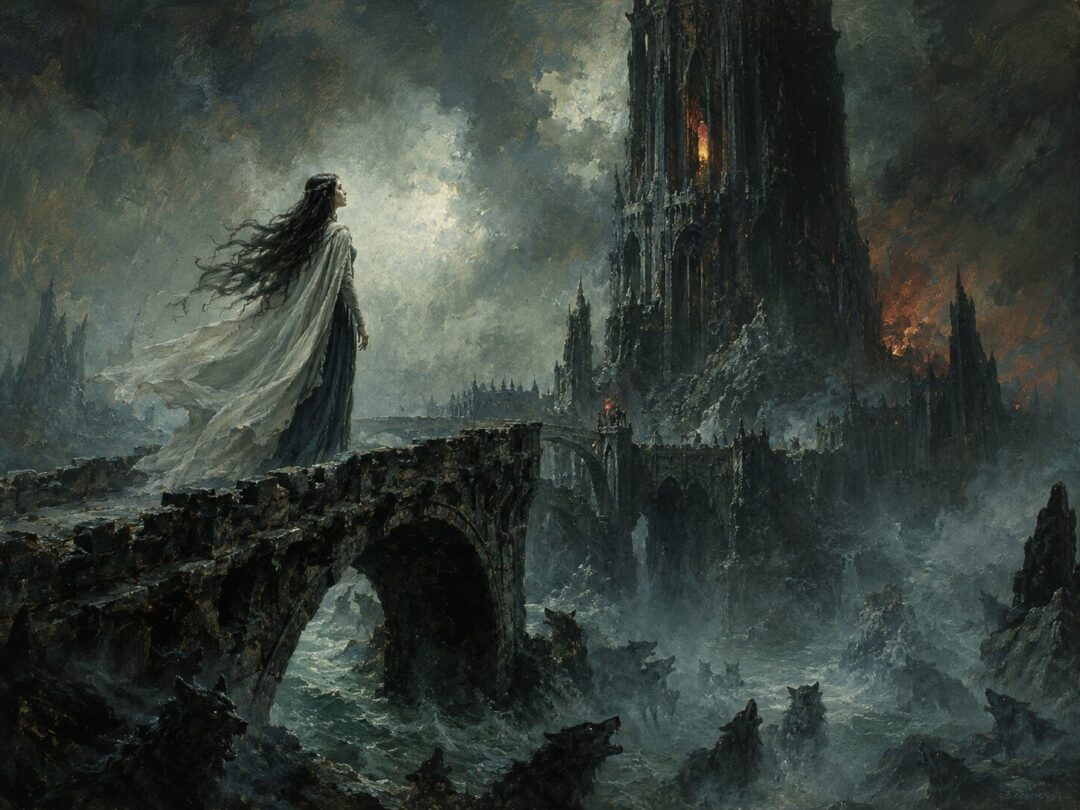
Before Sauron becomes the Eye in the mind of later readers, before Mordor, before Barad-dûr, before the One Ring, he is found in a colder and more unsettling place: a captured Elven watchtower in Beleriand, ruling an island of werewolves.
That matters.
Because the Sauron of the First Age is not yet the distant, almost abstract terror of the Third Age. He is not merely a will pressing outward from Mordor. He has a body. He has servants. He makes tactical choices. He can be deceived, resisted, wounded in pride, and forced to abandon a stronghold.
And the person who exposes that truth most clearly is not a king leading an army.
It is Lúthien.
Her victory at Tol-in-Gaurhoth does not make Sauron weak. The texts never treat him as weak. He is already one of the great servants of Morgoth, a master of sorcery, fear, disguise, imprisonment, and domination. But that is exactly why the episode is so revealing. Lúthien does not beat a minor villain. She confronts a power who has already destroyed Finrod’s disguise, broken his company, and turned an Elven fortress into a place of dread.
Yet Sauron still loses.
And in that defeat, we see something easy to forget when looking backward from The Lord of the Rings: Sauron was never unbeatable. He became mythic partly because distance, fear, and the Ring made him seem larger than any single confrontation. But Lúthien’s story preserves an older truth. Evil in Middle-earth may be vast, ancient, and terrifying, but it is not absolute.
The Sauron Before Mordor
In the First Age, Sauron is not yet the Dark Lord of Middle-earth in his own right. He is the servant of Morgoth. That does not make him insignificant. In the tale of Beren and Lúthien, he holds Tol-in-Gaurhoth, the Isle of Werewolves, once the Elven fortress Minas Tirith built by Finrod Felagund to guard the vale of Sirion. After Sauron takes it, the place becomes a corrupted stronghold, associated with wolves, sorcery, and imprisonment.
This is an important stage in Sauron’s character. He is already recognizable as the same being he will later become: a planner, a deceiver, a lord of fear, and a power who prefers control to simple destruction. But he is also still operating within the world in a more direct way. He occupies a fortress. He commands creatures. He interrogates captives. He personally engages in contests of power.
That makes his defeat by Lúthien feel different from the later fall of the Ring. In the Third Age, Sauron is overthrown through the destruction of the object into which he has poured much of his power. In the First Age, he is beaten in a direct confrontation of presence, will, song, shape, and doom.
The later Sauron feels like a system. The earlier Sauron still feels like a personified terror who can make a mistake.
Finrod Shows Sauron’s Strength First
Lúthien’s victory only means something because the story first shows how dangerous Sauron truly is.
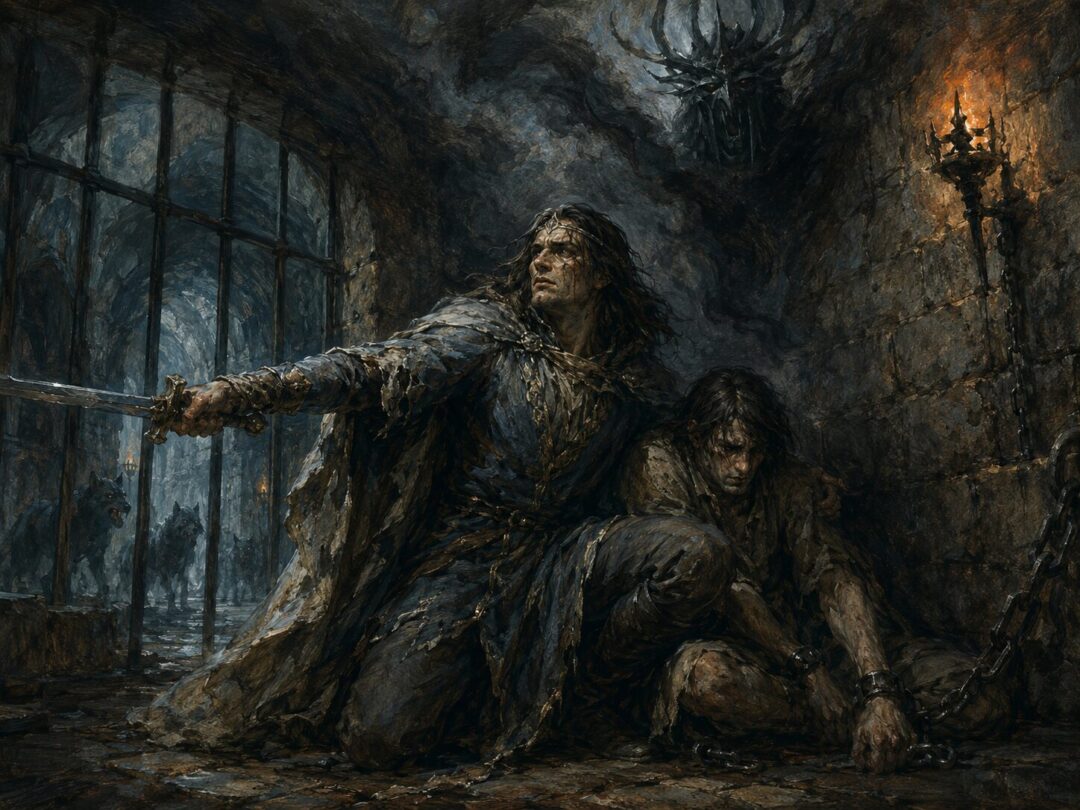
Beren, Finrod, and their companions approach the north in disguise. Finrod is no ordinary Elf. He is one of the great Noldorin princes, wise, noble, and powerful. Yet when the company falls into Sauron’s hands, the struggle becomes a contest of song and sorcery. Finrod resists, but Sauron overcomes him.
This is not a small defeat. Finrod is not portrayed as foolish or cowardly. His fall shows that Sauron’s power is real. Sauron strips away disguise, imprisons the company, and sets werewolves upon them one by one. Finrod eventually dies saving Beren from a werewolf in the dungeon.
So when Lúthien arrives, she is not walking into a villain’s lair after others have nearly succeeded. She is coming after some of the noblest strength in Beleriand has already failed.
That is the first reason this episode makes Sauron look beatable without making him look small. His fortress has teeth. His sorcery works. His cruelty has consequences. The floor of the story is death.
Lúthien’s victory rises out of that darkness.
Lúthien Does Not Fight Like a Warrior-King
Lúthien does not defeat Sauron by becoming a conventional military hero. That is one of the deepest things about the episode.
She does not arrive with an army. She does not claim a throne. She does not meet Sauron on his own terms of domination. Her power is bound to song, beauty, enchantment, courage, and a kind of fearless love that moves through the story like something older than strategy.
This does not mean her power is soft in the sense of being harmless. In Tolkien’s world, song can shape, reveal, conceal, challenge, and undo. Lúthien’s art is not decoration. It is power expressed in a form Sauron cannot fully master.
Sauron’s strength is control. He binds, imprisons, exposes, interrogates, and devours hope. Lúthien’s strength is harder for him to grasp because it is not rooted in possession. She comes to rescue Beren, but her courage is not merely romantic sentiment. It becomes an active force against a fortress built on fear.
That is the contradiction at the center of the scene: Sauron appears stronger by every worldly measure, yet Lúthien brings the kind of power his worldview underestimates.
Huan and the Prophecy Sauron Misreads
Lúthien does not stand alone. Huan, the great hound of Valinor, is essential to Sauron’s defeat.
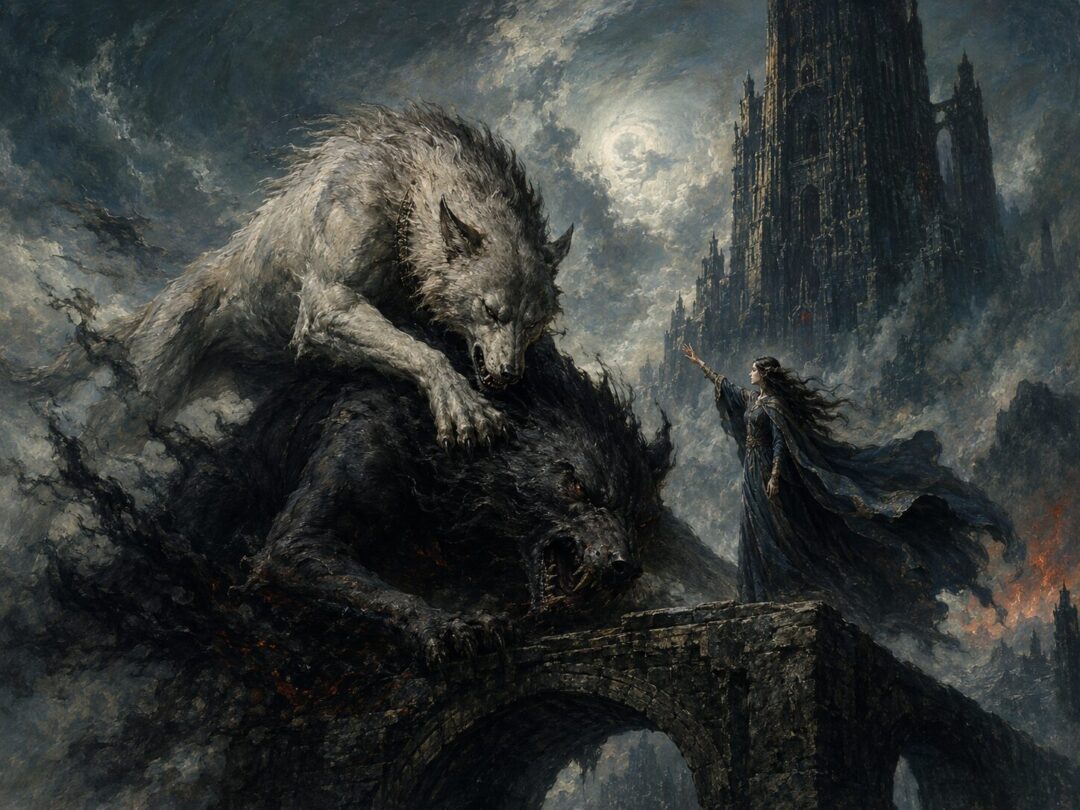
The prophecy concerning Huan says that he will meet his death only before the mightiest wolf that would ever walk the world. Sauron knows this and tries to exploit it. He takes the form of a great wolf, attempting to make himself the fulfillment of that doom.
This is one of Sauron’s most revealing mistakes.
He understands the prophecy as a loophole to be manipulated. He assumes that if Huan must fall before the greatest wolf, then Sauron can become that wolf and force fate to serve him. But the attempt fails. Huan overcomes him. Sauron is trapped, and Lúthien demands mastery of the tower from him.
The episode exposes a recurring flaw in evil throughout Middle-earth: the belief that fate, words, promises, and hidden laws can be bent by cleverness alone. Sauron is brilliant, but brilliance is not wisdom. He sees the shape of the prophecy but not its moral depth.
He tries to wear doom like a costume.
It does not fit him.
Why Sauron’s Defeat Feels So Humiliating
Sauron is not destroyed at Tol-in-Gaurhoth. That should be said clearly. Lúthien does not end his existence. He escapes and continues to serve Morgoth. Later ages will suffer terribly because Sauron survives.
But the form of his defeat is still humiliating.
He loses control of his own fortress. He is forced to yield the mastery of Tol-in-Gaurhoth. The prisoners are released. The tower’s power is broken. The Isle of Werewolves, which had been a symbol of Sauron’s domination, becomes the site of his exposure.
The texts imply a kind of reversal. Sauron had turned Finrod’s watchtower into a place of fear. Lúthien turns that fear back upon him. He had imprisoned others in darkness. Now he is the one constrained. He had used beasts as instruments of terror. Now, in wolf-form, he is overcome by Huan.
This is why the scene is so satisfying. It does not merely say that Sauron can be defeated. It shows that his own methods can become a trap. His love of domination narrows him. He cannot imagine that the forces he dismisses—love, song, loyalty, pity, and faithful courage—might become more dangerous to him than armies.
Before the Eye, There Was a Beaten Sorcerer
The Sauron of The Lord of the Rings feels almost untouchable because he is rarely seen directly. He is rumor, pressure, nightmare, command, and surveillance. Even his name carries weight. By the late Third Age, he has become mythic not only through power, but through absence.
That absence matters. A hidden enemy grows in the imagination. A ruler who is not seen can seem everywhere. A will operating through armies, Nazgûl, palantíri, spies, fear, and the Ring can feel less like a person and more like a law of the world.
But the First Age story punctures that illusion before it forms.
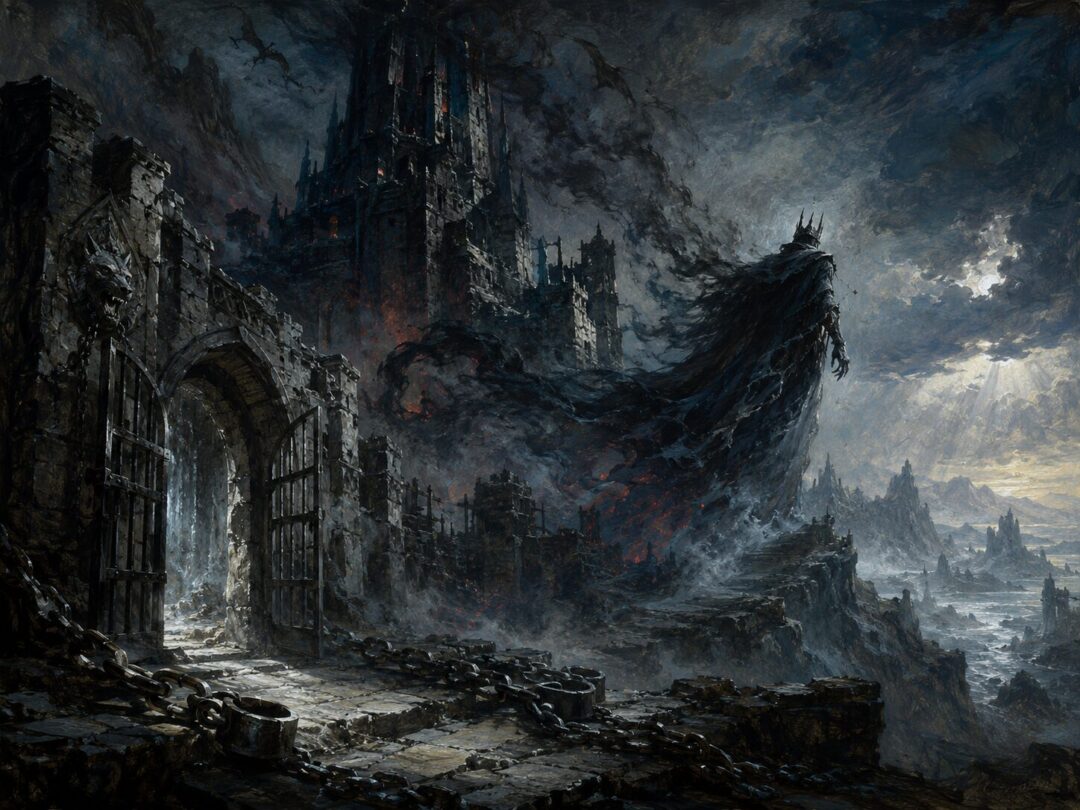
At Tol-in-Gaurhoth, Sauron is still immense, but he is not beyond encounter. He can be challenged. He can misjudge. He can flee. The fact that he survives does not erase the fact that he is beaten.
This makes the later struggle against him more meaningful, not less. If Sauron were simply invincible until a technical weakness destroyed him, Middle-earth would be a colder story. But Lúthien’s victory shows that the Shadow has always had cracks. The great question is whether anyone has the courage, humility, or providential chance to find them.
Lúthien Reveals the Hidden Rule of Middle-earth
One reading of this episode is that Lúthien reveals a hidden rule running through the legendarium: power that seeks only mastery is spiritually incomplete.
Sauron can dominate. He can terrify. He can perceive much. He can break disguises and command monsters. But he cannot understand everything. He cannot fully comprehend the strength of free loyalty because he does not possess it. He cannot truly use love because he treats living beings as instruments. He cannot command beauty except by corrupting or exploiting it.
Lúthien’s power is different. It is not weaker because it is beautiful. It is not less serious because it is bound to song. In her, beauty becomes defiance. Love becomes movement. Grief becomes courage. Art becomes rescue.
That is why she makes Sauron look beatable. Not because she reduces him to a lesser enemy, but because she reveals the limits of his kind of greatness.
Sauron is terrifyingly powerful inside the logic of control.
Lúthien steps outside that logic.
The Victory That Foreshadows Later Defeats
Lúthien’s confrontation with Sauron also foreshadows a pattern that returns later. Sauron is most vulnerable when he misreads the motives of others.
In the Third Age, he cannot imagine that anyone would seek to destroy the Ring rather than use it. In the First Age, he misreads the situation around Lúthien and Huan. In both cases, his intelligence is enormous, but his moral imagination is limited.
That limitation is not stupidity. It is corruption.
Sauron understands ambition because he is ambitious. He understands fear because he uses fear. He understands power because he worships order through power. But when faced with self-giving love, faithful service, or the refusal to possess, he becomes less certain.
This does not mean he is easily fooled. It means his deepest assumptions are wrong.
Lúthien’s victory is therefore not an isolated fairy-tale interruption in the darker history of the First Age. It is one of the clearest early signs that Sauron’s defeat will never come through a stronger version of Sauron’s own will. It will come through something he cannot properly value.
Why This Moment Matters
Lúthien makes Sauron look beatable because she catches him before the later ages cover him in distance and dread.
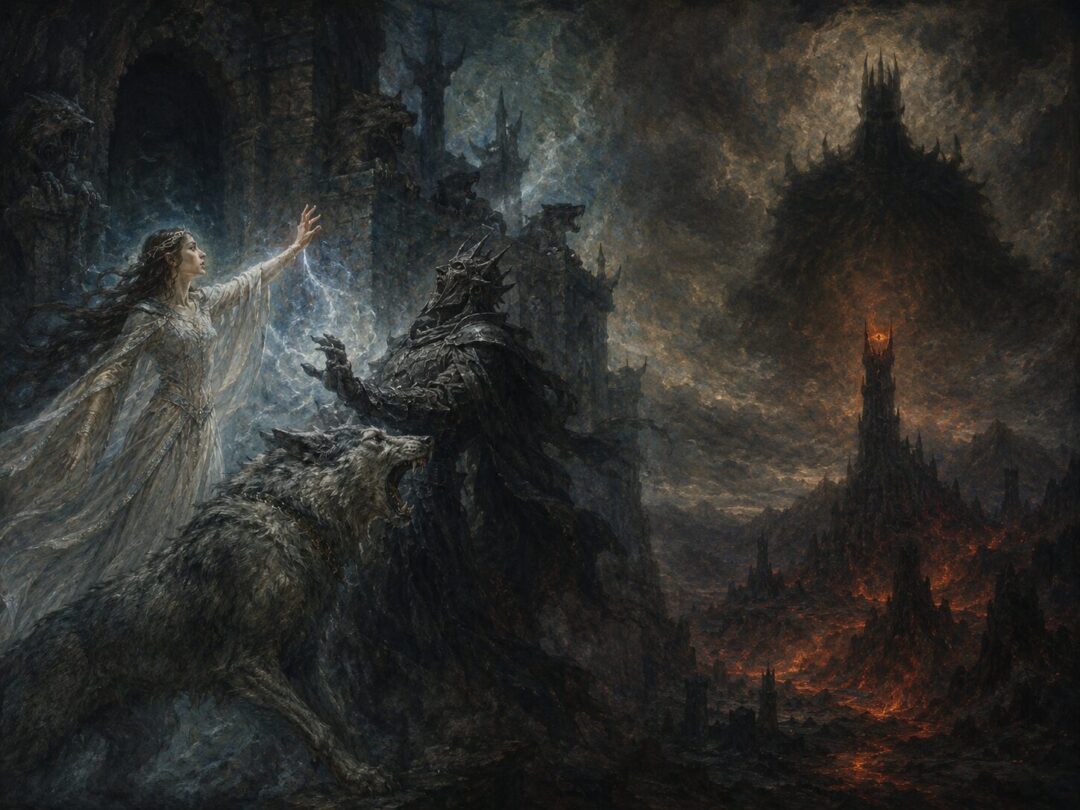
She meets him when he is already dreadful, but not yet mythically remote. She faces him when his evil has a local address: a tower, a bridge, a dungeon, an island. She defeats him not by denying his power, but by proving that power is not the same as final authority.
That is the overlooked beauty of the episode.
Sauron’s later legend depends on the feeling that he is inevitable. Lúthien’s story says otherwise. Long before the Ring is destroyed, long before Barad-dûr falls, long before the peoples of the West make their last stand, Sauron is forced to flee from a woman singing before his tower and a hound whose loyalty he cannot corrupt.
The Shadow is real.
But it is not ultimate.
And in the First Age, before Sauron becomes the great mythic terror of the later world, Lúthien shows Middle-earth something it will need to remember until the very end: even the most terrible servants of darkness can be made to tremble when they meet a power they cannot understand.
Sources & Notes
- J.R.R. Tolkien, The Silmarillion, “Of Beren and Lúthien” — Sauron’s rule of Tol-in-Gaurhoth, his contest with Finrod, and Lúthien and Huan’s victory over him.
- J.R.R. Tolkien, The Silmarillion, “Of Beren and Lúthien” — Huan’s doom, Sauron’s wolf-shape, and the surrender of the tower’s mastery after Sauron is overcome.
- J.R.R. Tolkien, The Silmarillion, “Of the Rings of Power and the Third Age” — Sauron’s later rise around Mordor, the One Ring, and his more remote Third Age dominion.
- J.R.R. Tolkien, The Lord of the Rings, Book II, Chapter 2, “The Council of Elrond” — Sauron’s strategic blindness about anyone seeking to destroy the Ring rather than wield it.
- J.R.R. Tolkien, The Letters of J.R.R. Tolkien, Letter 131 — Tolkien’s account of Sauron’s corruption as a desire for order, domination, and control.