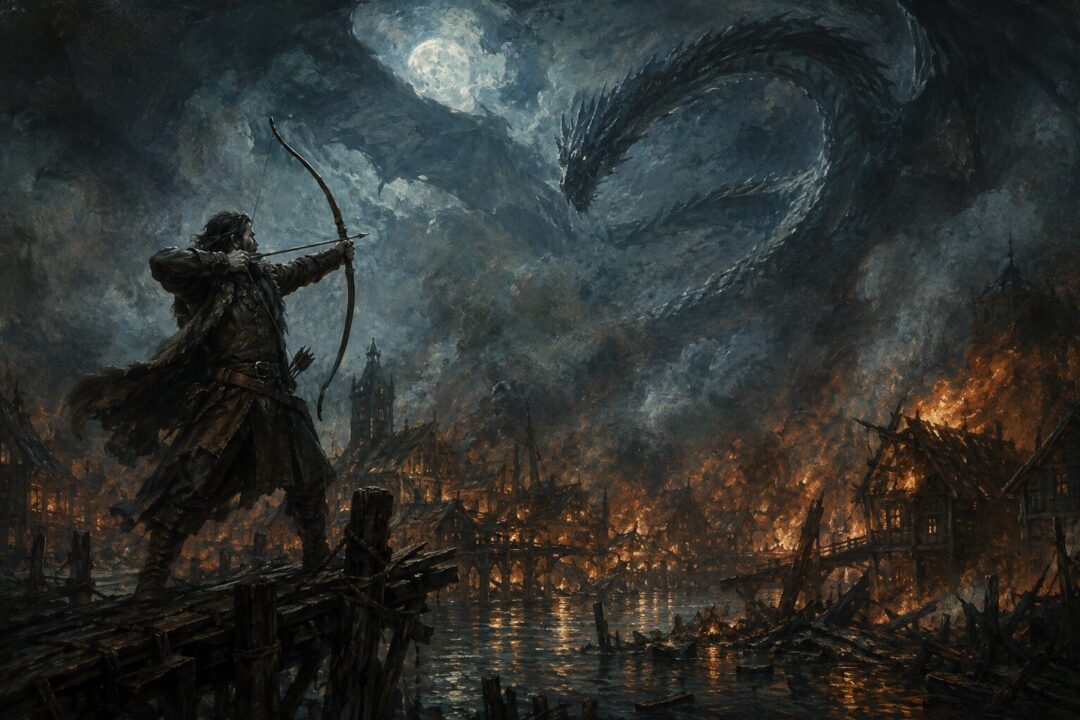
Smaug dies from one arrow.
That is the part everyone remembers: the dragon wheeling above Lake-town, the last bowman standing, the black shaft flying into the one unarmoured place beneath the left breast. On the surface, it can feel almost too sudden. After all the terror of Smaug, after the ruin of Dale, after the long occupation of the Lonely Mountain, the great dragon is ended by a single shot.
But the deeper power of that moment is not randomness. Bard’s shot is not a lucky guess fired into the dark. It is the meeting point of several kinds of memory: family memory, civic memory, craft memory, animal memory, and the newly carried memory of Bilbo’s discovery inside the Mountain.
The Black Arrow matters because it is not merely a weapon. It is the last surviving piece of a broken inheritance.
The Last Arrow Was Not Chosen by Chance
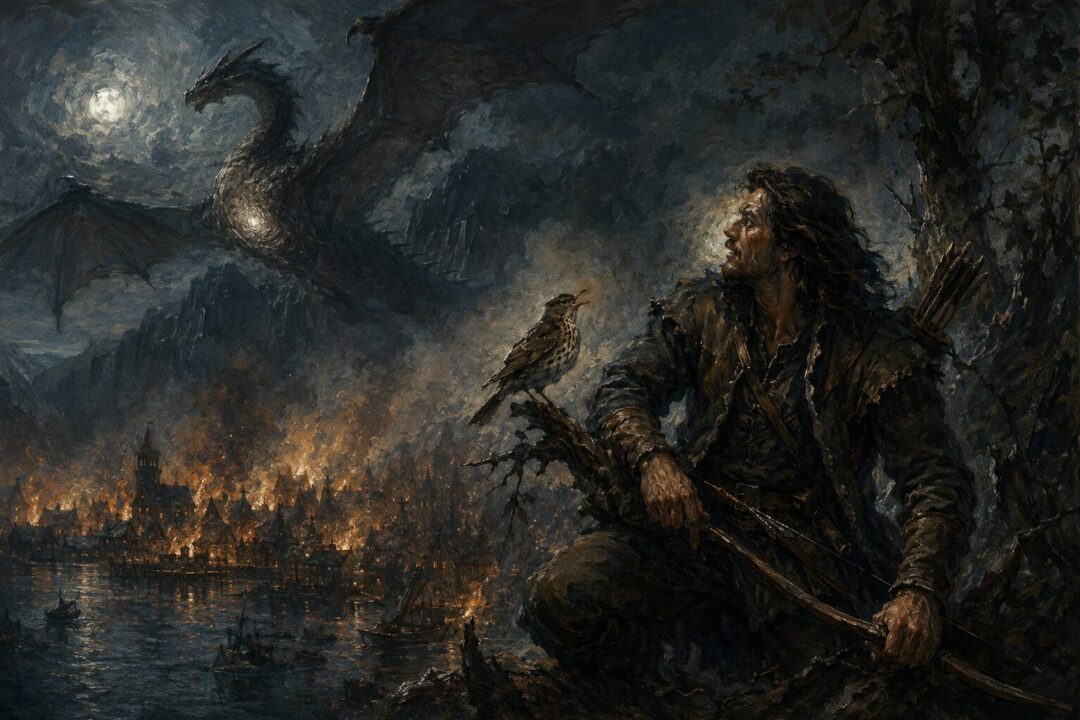
When Smaug attacks Lake-town, Bard is not introduced as a glorious king in waiting. He is a grim bowman, a man whose warnings have often sounded unpleasant to the people around him. Yet when the town burns and most hope fails, he remains at his post longer than others.
The important detail is that Bard does not simply pull any arrow from his quiver. The Black Arrow has been saved until the end. He speaks to it as something known, trusted, and remembered. He says, in essence, that it has never failed him and that he has always recovered it. He also says he received it from his father, and that it came “from of old.”
That does not prove the arrow is magical in a simple spell-like sense. The text never clearly says that. Bard himself wonders whether it came from the forges of the true king under the Mountain, but even that is framed as a hope or invocation, not a technical explanation.
This matters. The Black Arrow is powerful in the story not because the reader is handed a rulebook about enchanted ammunition, but because the arrow carries continuity. It has passed through hands. It has survived use. It belongs to a line of memory stretching back before Bard’s poverty and exile in Lake-town.
By the time it is fired at Smaug, it is not only Bard’s last arrow. It is the last arrow of an older world.
Bard Is the Man Lake-town Almost Forgot How to Hear
Bard’s role in Lake-town is strange. He is respected enough to command archers, but his temperament makes him unpopular. He is the one who gives dark warnings. He is the one people associate with grim predictions rather than comfort.
That detail is easy to overlook, but it prepares the reader for his deeper function. Bard remembers danger in a town that wants trade, song, and comfort. Lake-town lives under the shadow of the Mountain, but its people have turned the old dragon stories into something distant enough to be discussed rather than feared. Smaug is real, but time has softened terror into rumour.
Bard has not entirely surrendered to that forgetfulness. His grimness is not just mood. It is a kind of historical burden. He descends from Girion, lord of Dale, the city destroyed when Smaug came. Bard’s bloodline is not ornamental. It means that the fall of Dale is not ancient trivia to him. It is family history.
That does not mean Bard knows exactly how to kill Smaug before the thrush arrives. He does not. But he is the sort of man who has kept the right thing long enough for the right knowledge to reach him.
In Middle-earth, this is often the difference between wisdom and luck. Luck arrives only where someone has endured long enough to receive it.
The Arrow Carries the Memory of Dale
The Black Arrow’s origin is never fully explained, and that uncertainty gives it power. Bard says he had it from his father, and his father had it “from of old.” He also appeals to the possibility that it came from the forges of the true king under the Mountain.
That phrase links the arrow not merely to Bard’s family but to the old world of Dale and Erebor. Before Smaug, the Men of Dale and the Dwarves under the Mountain lived in a relationship of skill, trade, and splendour. The destruction of Dale and the exile of the Dwarves broke more than buildings. It broke a pattern of civilization.
The arrow may be one of the last objects still carrying that older pattern forward. It is black, repeatedly recovered, and trusted by Bard above all other shafts. Yet the text stops short of telling us exactly what it is. That restraint is important. The arrow’s meaning does not depend on a mechanical explanation.
It is enough that Bard treats it as an heirloom, not as disposable ammunition.
That is why the moment feels ritualistic. Bard does not merely aim. He remembers. He invokes the arrow’s past. He connects his own desperate present to a lost order of kings, smiths, fathers, and ruined cities.
Smaug represents hoarded history: treasure stolen, kingdoms interrupted, memory buried under gold. The Black Arrow represents history kept alive in poverty, carried quietly until it is needed.
The Thrush Is the Missing Link
Bard’s shot still would have failed without the thrush.
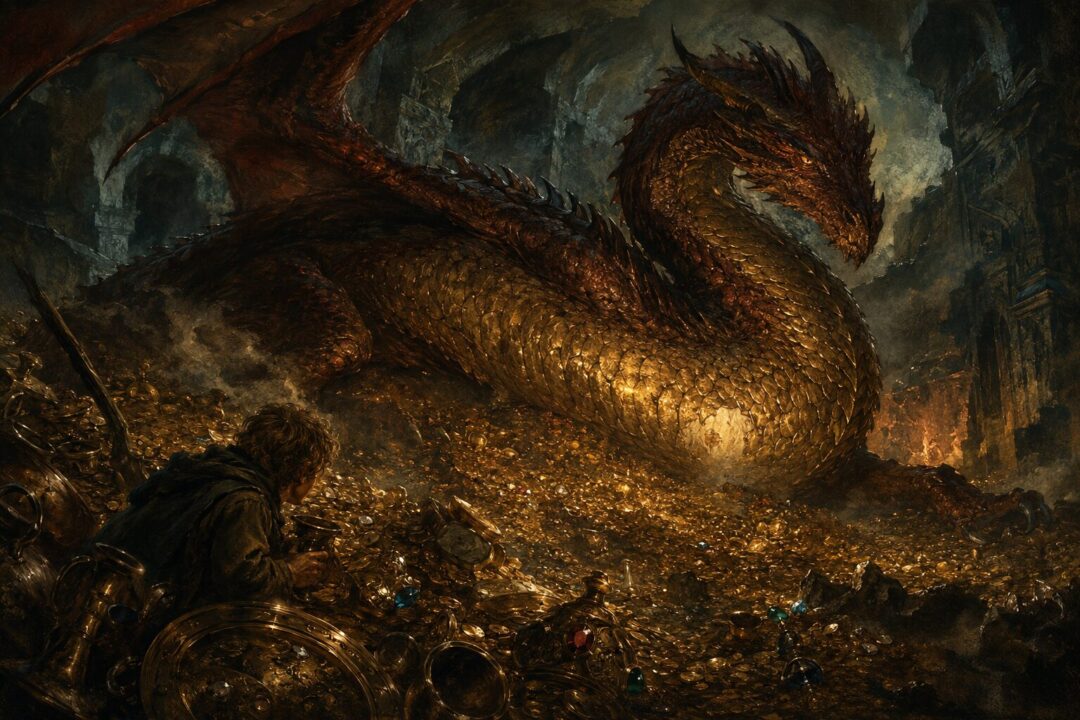
Bilbo is the one who discovers Smaug’s vulnerable place. During his encounter with the dragon, he notices the bare patch in the jewel-armour on Smaug’s underside. Bilbo later speaks of it, and the old thrush hears. When Smaug attacks Lake-town, the bird brings that knowledge to Bard.
This is not random either. The thrush belongs to an older pattern of communication around Dale and the Mountain. In The Hobbit, thrushes are not merely decorative birds. The old thrush understands speech, carries messages, and becomes part of the hidden network by which knowledge moves when armies and kings cannot yet act.
Bard’s ability to understand the thrush is itself a memory-link. The text associates this with the Men of Dale, who once understood the speech of such birds. In other words, Bard’s ancestry is not just political. It is practical. He receives the message because he belongs to a people whose old relationship with the natural world has not completely vanished.
The dragon is defeated by information moving through unlikely channels: Bilbo’s observation, the thrush’s hearing, Bard’s inherited ability to understand, and the Black Arrow’s final flight.
That is not mere luck. It is memory becoming action.
Smaug’s Weakness Is Physical, But Also Moral
Smaug’s bare patch is a literal vulnerability. The dragon’s underside is crusted with gems and gold from lying on his hoard, but one place remains uncovered. Bilbo sees what Smaug himself does not properly fear.
Yet the weakness also fits Smaug’s moral shape. Smaug is proud, possessive, and supremely confident in his own impregnability. He believes his armour, terror, and intelligence make him untouchable. He can read Bilbo’s riddling speech shrewdly enough to guess that Lake-town has helped the intruders, but he cannot imagine that his own display of magnificence has exposed him.
He has turned stolen treasure into armour, but not into true security.
That is one of the bitter ironies of The Hobbit. Smaug’s hoard protects him and reveals him. His greatness makes him visible. His pride gives Bilbo time to look. His attack on Lake-town brings him within range of the one man who can receive the message and use the arrow.
Again, none of this requires exaggerating the text. The story does not say Smaug is killed by a prophecy. It does not say the Black Arrow is destined in a rigid mechanical sense. But the pattern is clear: evil is undone by the small truths it dismisses.
A hobbit notices. A bird remembers. An heir listens. An old arrow flies.
Bard Does Not Win Because He Is the “Chosen One”
It is tempting to read Bard as the hidden king who appears at the correct moment because the story needs someone noble to kill the dragon. But that is not quite how The Hobbit presents him.
Bard is noble by descent, but he is not living in splendour. He is a captain in Lake-town, not a crowned ruler. His authority after Smaug’s fall has to be recognized through action, not assumed in advance. The people turn to him because he survives, organizes, and speaks for real losses.
His legitimacy comes through responsibility.
That is why the Black Arrow is so important. It does not make Bard king. It reveals what kind of man he already is: patient, grim, faithful to old things, able to stand when others flee, able to act when knowledge arrives.
The arrow does not replace Bard’s courage. It concentrates it.
This also prevents the scene from becoming cheap luck. Bard is not randomly handed a dragon-slaying tool moments before firing. He has carried it. He has saved it. He has used it before and recovered it. The arrow’s history and Bard’s discipline belong together.
The Shot Restores More Than It Destroys
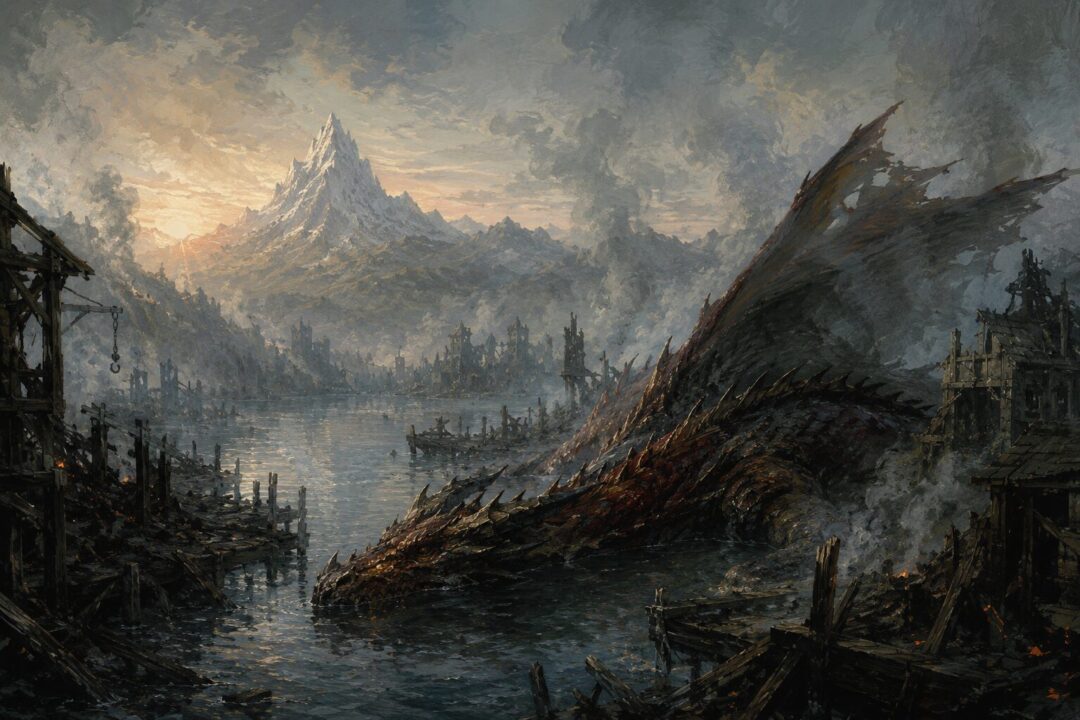
Smaug’s death does not immediately bring peace. In fact, it releases new conflict. The treasure becomes the center of dispute between Bard, the Lake-men, Thorin, and the Elvenking. The dragon’s body falls and destroys much of Lake-town. Suffering continues.
That is part of the realism of Tolkien’s moral world. Killing the monster does not erase the damage the monster caused. It only makes justice possible again.
Bard’s claim after Smaug’s death is not merely personal ambition. He speaks for the people of Lake-town, who have lost homes and kin, and for the inheritance of Dale, which Smaug ruined. The Black Arrow, then, is connected to restoration rather than simple revenge. It opens the way for Dale to be rebuilt and for an older order in the North to return.
But the restoration is costly. Bard’s shot saves the future by bringing down the terror of the past, yet the dragon still crushes the town in death. Victory arrives with wreckage beneath it.
That complexity makes the arrow feel less like a fairy-tale trick and more like a memory that has waited through ruin for its one terrible use.
Memory Is the Hidden Weapon of the Scene
The most beautiful thing about Bard’s Black Arrow is that it only works because many fragile things have survived.
The arrow survived from old days. Bard’s line survived the fall of Dale. The knowledge of bird-speech survived in him. The thrush survived long enough to hear and carry Bilbo’s discovery. Bilbo survived Smaug’s chamber and noticed what a warrior might have missed. The people of the Lake survived long enough for one bowman to stand and shoot.
The scene is therefore not about a lucky arrow. It is about preservation.
Smaug is a creature of possession. He gathers treasure and keeps it from use. He turns beauty into a bed, wealth into isolation, and fear into dominion. Against him comes a weapon that has been preserved differently. The Black Arrow has not been hoarded for greed. It has been kept for need.
That is the moral contrast.
Smaug sits on memory and makes it sterile. Bard inherits memory and makes it answer.
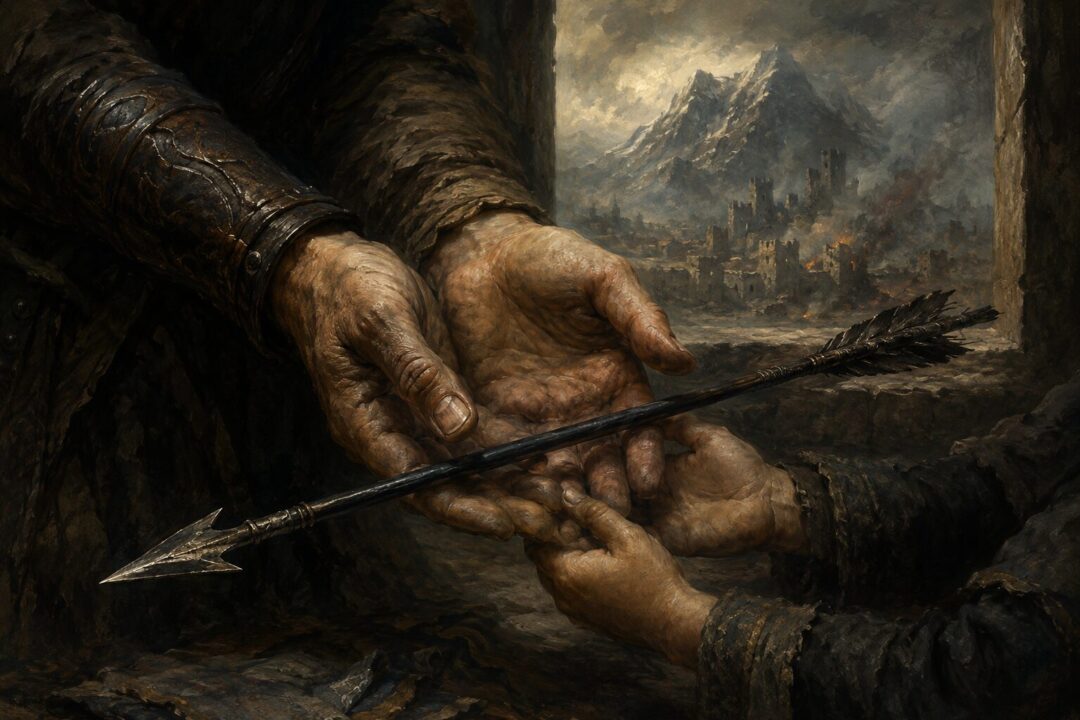
The Arrow Flies Because the Past Is Not Dead
Bard’s shot is sudden, but it is not random. It is the visible end of a long invisible chain.
The Men of Dale did not vanish entirely. The craft of the Mountain was not wholly forgotten. The speech of birds was not completely lost. Bilbo’s small act of attention was not wasted. Even the grim man whom Lake-town found uncomfortable had a role no more cheerful voice could fill.
The Black Arrow is memory given form: dark, old, recovered, saved until the last.
That is why the scene still resonates. Smaug is not defeated by brute force. He is defeated by the things he failed to value: a small observer, an old bird, an exiled heir, a preserved inheritance, and a truth carried from one place to another at exactly the right moment.
In that sense, Bard’s arrow is not luck at all.
It is the past, finally finding its mark.
Sources & Notes
- J.R.R. Tolkien, The Hobbit, “Inside Information” — Bilbo notices the bare patch in Smaug’s jewel-armour and speaks of it where the old thrush can hear, supplying the knowledge Bard later needs.
- J.R.R. Tolkien, The Hobbit, “Fire and Water” — Bard stands as the last bowman, receives the thrush’s message, addresses the Black Arrow as an heirloom from his father and “from of old,” and kills Smaug through the exposed hollow.
- J.R.R. Tolkien, The Hobbit, “Fire and Water” — Bard is identified with Girion’s line and with the old Dale ability to understand thrushes, tying the shot to inherited memory rather than mere accident.
- J.R.R. Tolkien, The Hobbit, “The Gathering of the Clouds” — after Smaug’s fall, Bard speaks for the ruined Lake-men and the claims of Dale, showing that the dragon’s death opens a question of restoration, not simple treasure-taking.
- J.R.R. Tolkien, The Hobbit, “The Return Journey” — Bilbo’s later passage through Dale and Lake-town shows Bard’s kingship and rebuilding after the dragon, completing the article’s arc from preserved inheritance to renewed order.