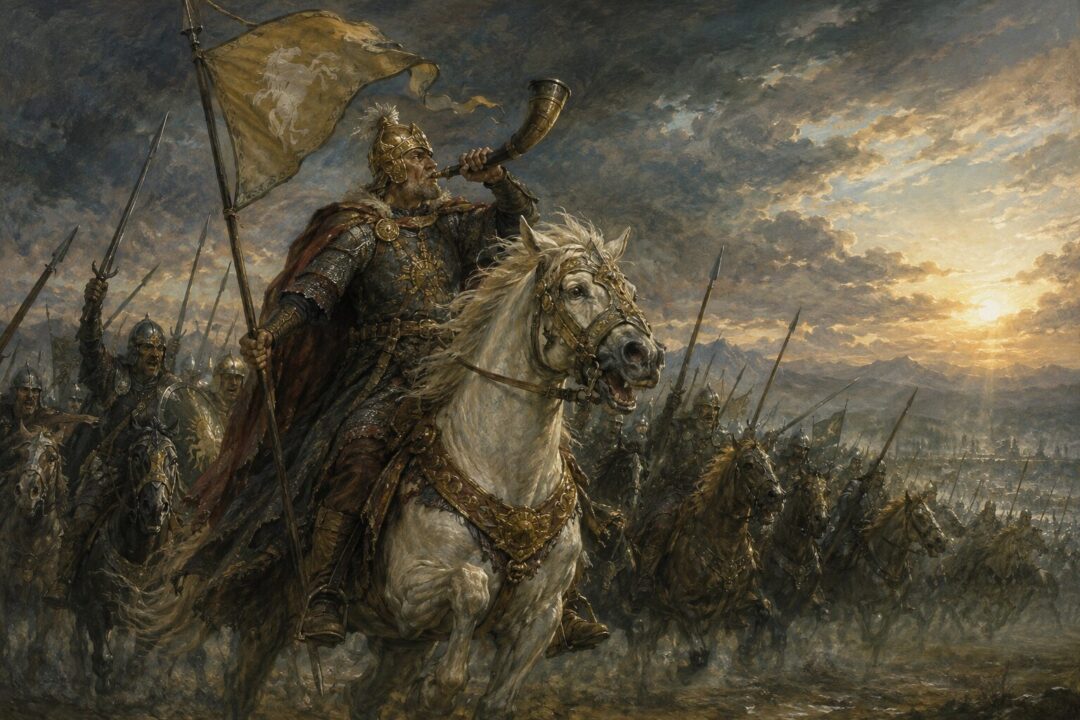
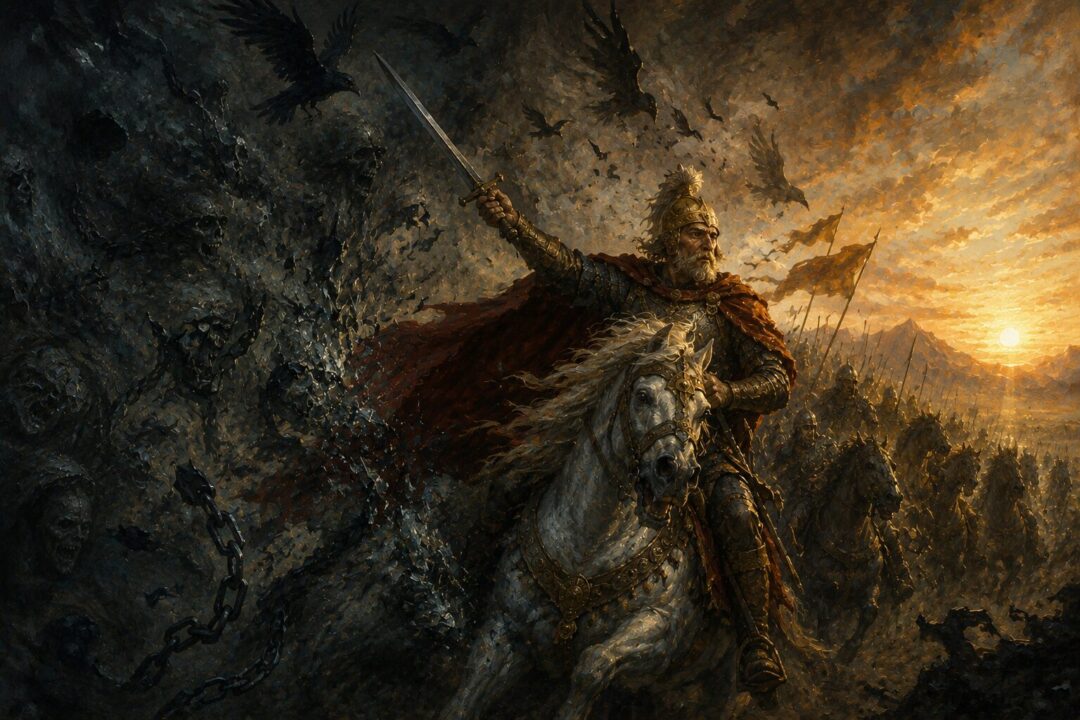
The horns of the Rohirrim sound on the Pelennor Fields. The old king rises in his stirrups. Fear breaks. Riders laugh beneath the shadow of death.
Many battle scenes aim for spectacle. Théoden’s charge does something rarer. It hurts, uplifts, and unsettles at the same time.
That emotional power is not simply about cavalry, heroism, or a last-minute rescue. It comes from everything that had to die inside Théoden before he could ride as he does in The Return of the King. His charge lands hard because it is not merely a military maneuver. It is an old man’s recovery of courage, a people’s refusal to vanish, and one of Middle-earth’s clearest moments where despair meets defiant joy.
Théoden Is Not Introduced as a Heroic War-King
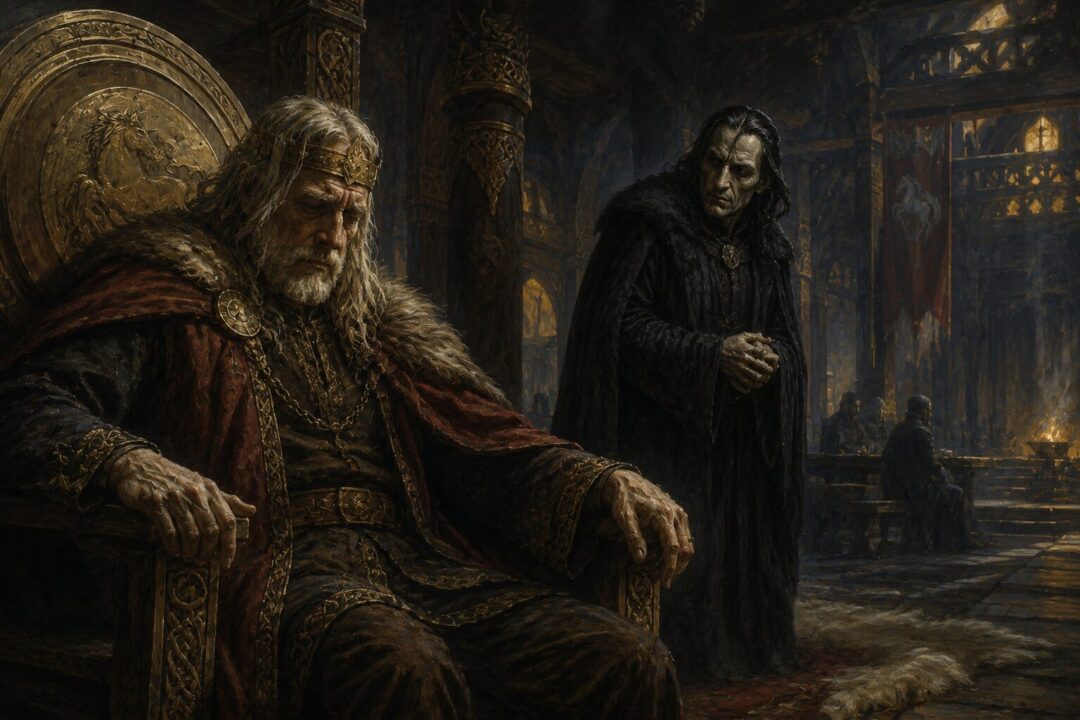
When readers first meet Théoden in The Two Towers, he is diminished.
The King of Rohan sits bent with age in Meduseld. His judgment is clouded. His household is compromised. Gríma Wormtongue has spent years feeding fear, suspicion, and paralysis into the court. Whether through manipulation alone or through darker influence connected to Saruman’s designs, the practical effect is the same: the king who should embody motion and leadership has become hesitant and inward-looking.
This matters.
If Théoden were introduced as an unstoppable warrior-king, his later charge would feel impressive but predictable. Instead, the story begins with decay.
Rohan itself reflects this condition. The Mark is threatened from without and weakened from within. Riders are scattered. Trust is damaged. The king mourns his son Théodred. Age presses on him.
So when Gandalf confronts Théoden in Meduseld, the scene is not just magical liberation. It is political, emotional, and moral awakening. Théoden does not merely regain strength. He chooses to see clearly again.
That distinction is important because Tolkien’s heroes are rarely transformed by power alone. Again and again, the deeper issue is whether a person will act once illusions, fear, and excuses are stripped away.
The Charge Matters Because Théoden Has Already Chosen Death
By the time the Rohirrim arrive at Minas Tirith, Théoden is not riding toward likely victory.
He knows the odds.
The beacons have called. Gondor is under assault by overwhelming forces from Mordor. Even before the Rohirrim reach the Pelennor, uncertainty hangs over the journey. Théoden himself voices the possibility that they ride to destruction.
This gives the charge its emotional weight.
Much modern battle storytelling relies on hidden confidence: the audience senses that the heroes will somehow prevail. Théoden’s ride does not operate from that emotional logic.
The king rides because honor, loyalty, and necessity require it.
The text repeatedly emphasizes shadow, doom, and the nearness of death. Théoden is not intoxicated by dreams of glory. He has already crossed a psychological threshold. He has accepted mortality.
That acceptance changes everything.
His courage is not the absence of fear. Nor is it naive optimism. It is action taken after fear has been acknowledged.
This is one reason the charge feels unusually human. The emotional core is recognizable beyond fantasy: there are moments when people act not because success is guaranteed but because failing to act would betray who they are.
Tolkien Builds the Scene Like the Breaking of a Spell
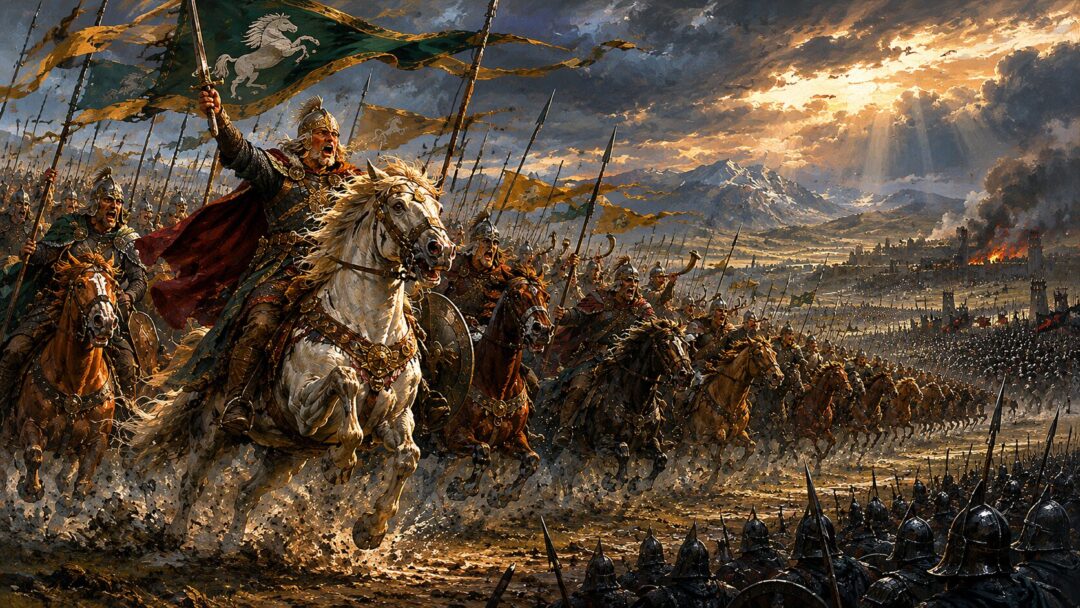
Before the charge begins, the atmosphere on the Pelennor is oppressive.
Darkness from Mordor covers the battlefield. Gondor appears close to collapse. Hope has narrowed to almost nothing.
Then comes one of the great emotional reversals in The Lord of the Rings.
The Rohirrim arrive.
But Tolkien does not present this as simple reinforcement entering combat. He frames it almost like the return of a forgotten force of life.
The horns sound.
Morning comes.
The riders are revealed.
And Théoden changes.
The text famously describes him seeming renewed — not aged and burdened but fierce, kingly, almost transfigured in spirit. His banner streams. Snowmane surges forward. The old king becomes, for a moment, startlingly alive.
Importantly, Tolkien does not suggest literal de-aging or supernatural invincibility. Rather, the scene uses elevated heroic language to express an inner reality. Théoden has become fully himself again.
That is why the charge feels larger than tactics.
Something psychological and symbolic is happening. Despair’s monopoly has been broken.
Joy Appears in the Middle of Doom
One of the most overlooked details in Théoden’s charge is its strange emotional tone.
There is joy in it.
Not safety. Not certainty. Joy.
The text describes Théoden as filled with battle-fury and fierce exhilaration. The Rohirrim sing as they ride. Their attack is not emotionally flat determination.
This matters because it complicates what courage looks like in Middle-earth.
Too often, bravery is imagined as grim endurance alone. Tolkien allows something more paradoxical: in facing unavoidable danger, characters sometimes experience an almost painful intensity of aliveness.
The moment is not cheerful in a casual sense. Death is everywhere. Yet the riders are no longer spiritually pinned beneath fear.
That emotional reversal hits readers hard because it reflects a deep human truth. There are moments when people confronting catastrophe discover not comfort but clarity.
Théoden’s charge embodies that paradox. Doom has not disappeared. But it no longer controls the meaning of the moment.
The Charge Carries the Weight of an Entire Dying Culture
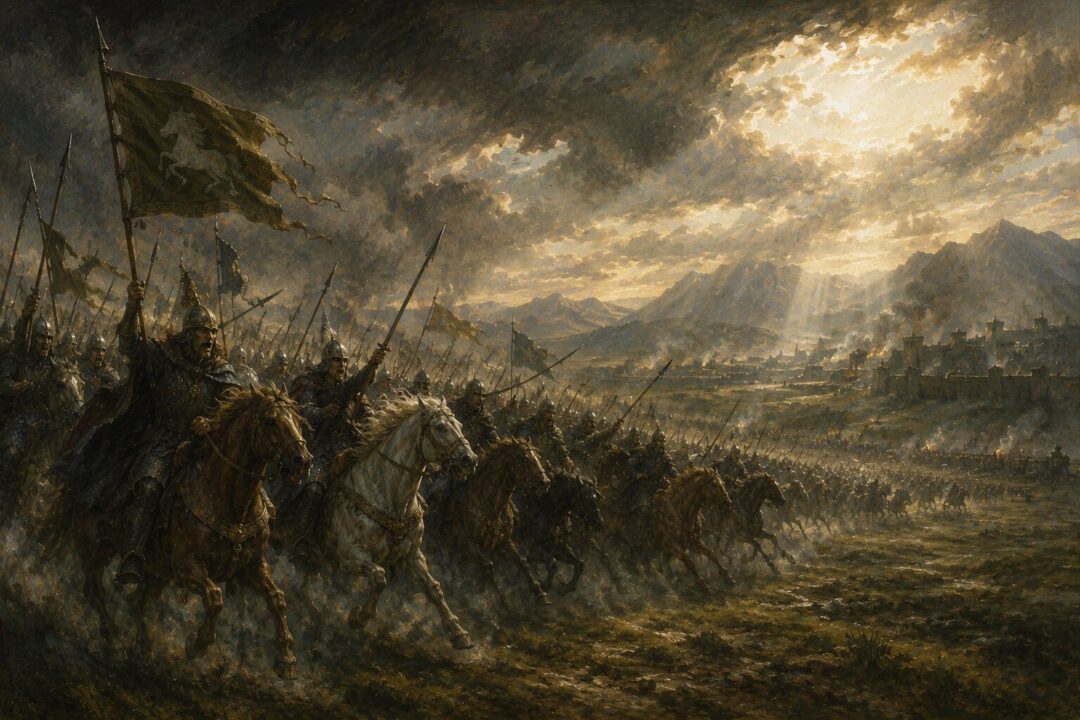
The ride of the Rohirrim also resonates because it represents more than individual heroism.
Rohan is deeply tied to themes of memory, ancestry, and passing ages.
The culture of the Rohirrim is shaped by horses, oral tradition, burial mounds, songs of the dead, and loyalty to ancient bonds. Their world carries echoes of older heroic traditions where fame, mortality, and kinship are tightly intertwined.
When Théoden rides, readers are not watching anonymous cavalry.
They are watching a people answer the question of whether they still deserve to endure.
This becomes sharper because Middle-earth is full of decline.
Great realms fade. Ancient wisdom diminishes. The story repeatedly asks what dignity looks like in a world where loss cannot be prevented.
The Rohirrim do not ride under illusions of permanent triumph. Their courage exists inside historical fragility.
That gives the scene unusual emotional density.
The charge is thrilling precisely because it is shadowed by transience.
Théoden’s Finest Moment Ends in Tragedy
Another reason the scene lingers emotionally is that Tolkien refuses to protect it from cost.
Théoden’s greatest hour becomes his last.
After the charge smashes into the enemy ranks, after the astonishing reversal of momentum, disaster returns. The Lord of the Nazgûl enters the battle. Snowmane falls. Théoden is mortally wounded.
The structure matters.
Many stories would preserve the triumphant king as reward for heroic action. Instead, Middle-earth often binds glory and grief together.
Yet Théoden’s death scene is not meaningless ruin.
He does not die confused, broken, or spiritually defeated as he once lived under Wormtongue’s influence. He dies reconciled to himself.
His farewell carries tenderness and unfinished sorrow. He thinks of Éowyn. He speaks of his house and heirs. His mortality is personal, not abstract.
That humanity deepens the earlier charge.
Readers know, consciously or not, that the moment’s beauty cannot be frozen. It exists precisely because it is fleeting.
Why Théoden’s Charge Still Feels Different From a Normal Battle Scene
The charge of the Rohirrim endures because it combines elements that fantasy rarely balances this successfully.
It has scale without losing intimacy.
It has mythic language without abandoning human vulnerability.
It offers exhilaration without denying terror.
And most importantly, it understands that courage is not produced by confidence alone.
Théoden’s ride matters because an aging king who had once fallen into despair chooses, finally and completely, to be who he was meant to be — even when that choice points toward death.
That is why the scene still hits harder than a normal battle sequence.
It is not fundamentally about winning.
It is about what happens when fear no longer gets the final word.
For a few terrible, glorious moments on the Pelennor Fields, an old king, a threatened people, and a darkening world answer despair not with certainty of survival but with motion, song, and the thunder of hooves under the rising sun.
Sources & Notes
- J.R.R. Tolkien, The Lord of the Rings, Book III, Chapter 6, “The King of the Golden Hall” — Théoden is first shown diminished under Gríma’s counsel before Gandalf’s intervention restores his clear sight and kingly action.
- J.R.R. Tolkien, The Lord of the Rings, Book V, Chapter 3, “The Muster of Rohan” — the gathering at Dunharrow frames the ride to Gondor as a grim duty undertaken with death and uncertainty plainly in view.
- J.R.R. Tolkien, The Lord of the Rings, Book V, Chapter 5, “The Ride of the Rohirrim” — the horns, dawn, Théoden’s battle-fury, song, and thunder of hooves give the charge its mixture of doom, joy, and sudden renewal.
- J.R.R. Tolkien, The Lord of the Rings, Book V, Chapter 6, “The Battle of the Pelennor Fields” — Théoden’s victorious charge turns into his mortal fall beneath Snowmane, binding the scene’s glory to grief and cost.
- J.R.R. Tolkien, The Lord of the Rings, Appendix A, “The House of Eorl” — the history and burial traditions of the Rohirrim support the article’s emphasis on memory, ancestral loyalty, and a culture riding under the shadow of decline.