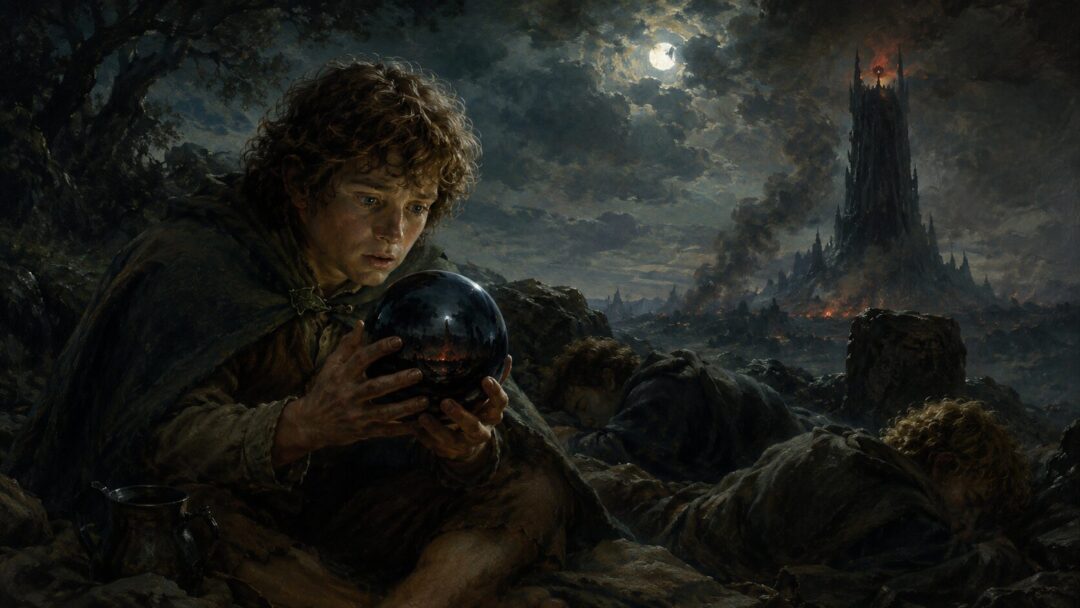
The strangest thing about Pippin’s mistake is that it was not heroic, strategic, or even especially meaningful when it began. It was curiosity. A hobbit who had already thrown a stone into a well in Moria, asked too many questions at the wrong time, and felt the itch of unexplained things found himself near a dark, heavy globe from Orthanc — and wanted to know what it was.
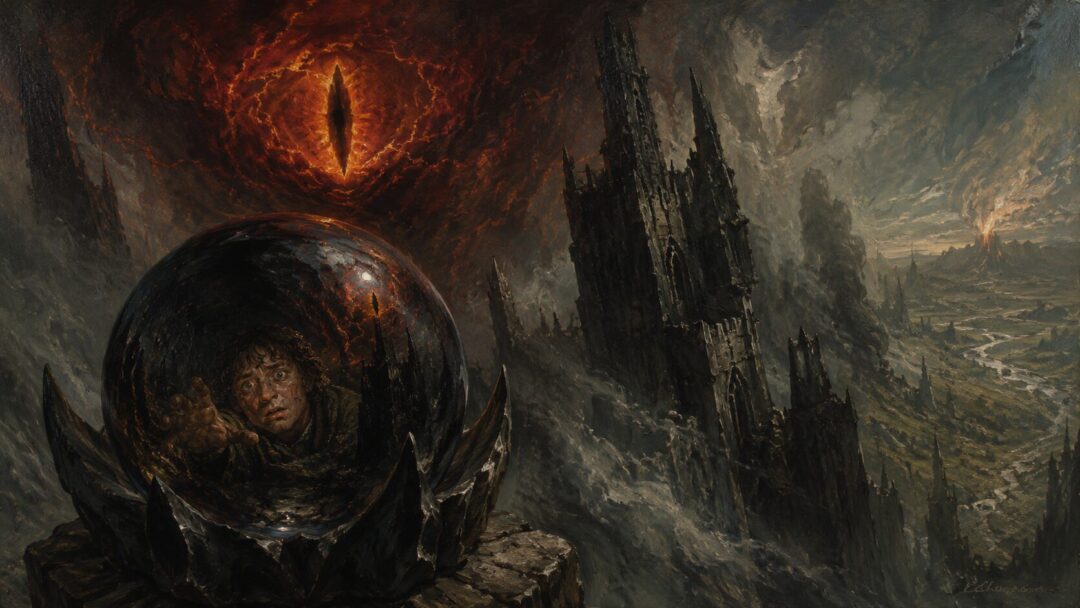
That small weakness should have been disastrous. In one sense, it nearly was. Pippin looked into the palantír and was seen by Sauron, who possessed another Stone and had long used such devices to dominate, deceive, and gather knowledge. Yet the same rash act also helped create one of the great false patterns in the War of the Ring. Sauron saw a hobbit. He knew “Shire” and “Baggins” from Gollum. He knew Saruman had been hunting the Ring. He knew the Orthanc-stone had belonged to Saruman. But he misunderstood the meaning of what he saw.
Pippin’s curiosity became a clue — but a false one.
The Foolish Act That Was Not Random
Pippin’s encounter with the palantír happens after the fall of Isengard’s power. Gríma Wormtongue throws a heavy object from Orthanc, intending harm, and it misses its mark. The object is recovered: the Orthanc-stone, one of the ancient seeing-stones associated with the Dúnedain. Gandalf quickly understands its danger, but Pippin does not. To him, it is mysterious, forbidden, and therefore almost unbearable.
This matters because Pippin is not acting like a villain or a traitor. He is not seeking power in the manner of Saruman. He is not trying to command armies or rival kings. His fault is smaller and more familiar: the inability to leave a dangerous thing alone. The scene works because the moral scale is so strange. A childlike impulse touches a world-shaking instrument.
The palantíri are not evil in themselves. They are tools of seeing and communication, made for lawful use by those with knowledge and right. But in the late Third Age, the network of meaning around them has been corrupted. Sauron has access through the captured Ithil-stone, Saruman has been ensnared through the Orthanc-stone, and Denethor’s later use of the Anor-stone will show how even a strong and rightful mind can be worn down by partial truth.
Pippin enters that peril without understanding it. That innocence does not make the act safe. It makes the result more ironic.
What Sauron Thought He Had Seen
The crucial point is that Sauron does not receive a full explanation. He sees Pippin through the Stone and interprets the sight according to what he already believes. The text implies that Sauron assumes the hobbit is in Saruman’s keeping at Orthanc, because the Orthanc-stone should still be there. This is the first major error.
Sauron is not ignorant. He knows enough to be dangerous. He has learned of the Shire and Baggins through Gollum. He knows the Ring has reappeared in the world. He knows Saruman has been seeking it. If a hobbit suddenly appears in the Orthanc-stone, Sauron can easily connect the wrong dots: Saruman has captured a halfling connected with the Ring.
The false clue is powerful precisely because it is not nonsense. It is built from real fragments: a real hobbit, a real Stone, a real search for the Ring, a real treachery by Saruman, and a real fear that the Ring may soon be used. Sauron’s mistake is not that he has no evidence. His mistake is that he reads the evidence through pride and suspicion.
Pippin gives Sauron a piece of truth in the wrong frame.
Why the Mistake Helped Gandalf
Gandalf’s reaction shows how serious the danger is. He questions Pippin sharply, learns what happened, and immediately rides with him to Minas Tirith. This is not merely punishment or panic. Gandalf understands that Sauron’s attention has been stirred, and that Pippin must be removed from the place Sauron thinks he is.
That movement is important. If Sauron expects Saruman to have a captured hobbit in Orthanc, then discovering otherwise too soon could unravel part of the confusion. Instead, Pippin is carried away. Saruman’s treachery, Orthanc’s fall, the possession of the Stone, and the whereabouts of the halfling all become muddled in the Enemy’s mind.
There is a deep irony here. Pippin’s curiosity creates danger, but it also creates a misleading trail. The mistake is not praised as wisdom. It remains a mistake. Yet in the larger pattern of the story, it becomes one of those flawed acts that is not allowed to end only in ruin.
That is a repeated pattern in the Ring-story. Mercy toward Gollum, Bilbo’s pity, Frodo’s endurance, Sam’s loyalty, and even the errors of the small can have consequences beyond their intention. Pippin does not outwit Sauron. He stumbles into a moment Sauron misreads.

The Enemy’s Blind Spot: Power Expects Power
Sauron’s deeper failure is not bad eyesight. It is bad imagination.
Again and again, the Wise rely on the fact that Sauron cannot easily believe his enemies would seek to destroy the Ring rather than wield it. At the Council of Elrond, the chosen course is to cast the Ring into the fire where it was made, because only there can the threat truly be ended. But from Sauron’s perspective, such a choice is almost unthinkable. The Ring is power, domination, preservation, command — everything he values.
This does not mean Sauron is foolish. It means his wisdom is bent around his own nature. He can understand ambition. He can understand treachery. He can understand a rival seizing a weapon. He can understand Saruman wanting the Ring, Denethor despairing beneath pressure, or a lord of Men claiming kingship and challenging him. What he cannot easily understand is renunciation.
That is why Pippin’s accidental appearance matters. A hobbit in the Stone does not reveal Frodo’s true road. Instead, it confirms Sauron’s suspicion that the Ring-drama is still moving through the channels of possession, interrogation, rivalry, and command. Someone has the halfling. Someone wants the Ring. Someone will try to use it.
In that worldview, Pippin is not a person. He is evidence.
Aragorn Turns the False Clue Into a Weapon
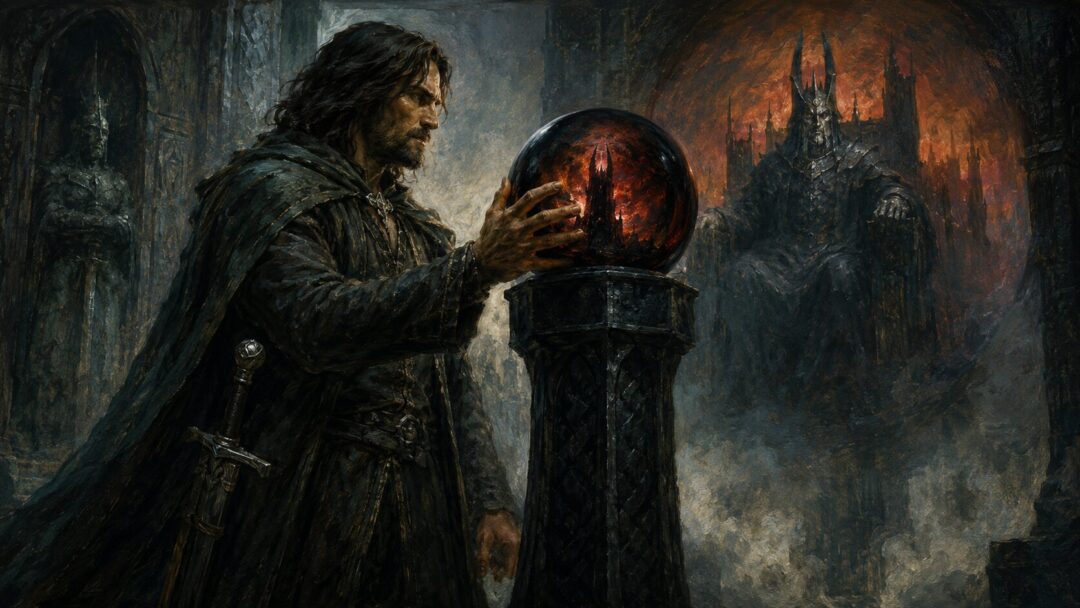
Pippin’s moment with the Stone does not stand alone. It becomes part of a larger deception when Aragorn later uses the Orthanc-stone himself. Unlike Pippin, Aragorn has both the strength and the right to challenge Sauron through it. He reveals himself as Isildur’s heir. He does not reveal the Ring. But his act is timed to press upon Sauron’s fears.
This is where the false clue sharpens. Sauron has already seen a hobbit through the Orthanc-stone. He knows the heirs of Isildur are still a threat in memory and symbol. He sees Aragorn rise suddenly after the defeat of Saruman and before the great assault on Gondor fully resolves. One conservative reading is that Sauron begins to suspect the Ring has passed into the hands of a new claimant — not a hidden hobbit creeping toward Mordor, but a lord of the West preparing to challenge him.
The texts do not require us to say Sauron knows with certainty that Aragorn has the Ring. Certainty is too strong. What they show is that the Captains of the West deliberately act on Sauron’s likely assumptions. Aragorn’s self-revelation, Pippin’s earlier appearance, and the march to the Black Gate together make a pattern Sauron is prepared to believe.
The trap works because it resembles his own logic.
The Last Debate and the Bait of Desperation
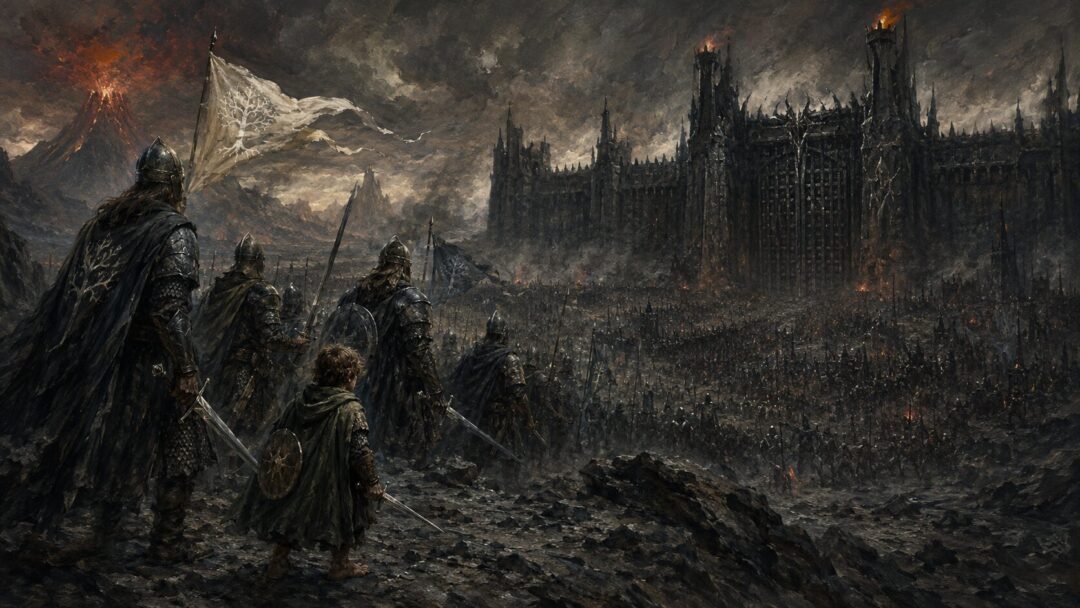
After the victory at the Pelennor Fields, the West still cannot defeat Sauron by military strength. The armies available to Aragorn are too few. The real hope remains Frodo and Sam, somewhere beyond sight. At the Last Debate, the leaders choose a desperate strategy: march to the Black Gate, not because they can conquer Mordor, but because they may draw Sauron’s eye away from the Ring-bearer.
This is the point at which Pippin’s earlier mistake becomes part of a deliberate design. The West offers Sauron a story: the heir of Isildur has come openly; a halfling has been seen in relation to Orthanc; Saruman has fallen; Gondor still resists; the Captains now move toward Mordor in what looks like reckless boldness. To a mind obsessed with domination, this can look like the beginning of a Ring-lord’s challenge.
It is not only a military diversion. It is a psychological lure.
Sauron takes the bait because the bait is shaped like his fear. He fears not humility, but rivalry. He fears not two exhausted hobbits crawling through ash, but a claimant using the Ring as a weapon of command. When the armies of the West stand before the Morannon, they are horribly outmatched, and the text makes clear that Sauron has indeed taken the proffered bait.
Pippin at the Black Gate
Pippin himself later stands among the forces of the West at the Black Gate. That is easy to overlook. The hobbit whose curiosity helped create the false clue is present when the deception reaches its final form. He is no longer merely the impulsive Took who could not resist a forbidden object. He is a Guard of the Citadel, a servant of Gondor, and one small member of a doomed-looking host.
This does not erase his foolishness. It completes its arc. Pippin’s growth is not from foolishness to flawless wisdom, but from careless curiosity to costly courage. He has seen Sauron’s malice directly. He has watched great powers move around small choices. At the Morannon, he is no strategist; he is a participant in the last throw of the West.
The contrast is striking. In the palantír, Pippin is alone, secretive, and overwhelmed. At the Black Gate, he stands openly with others, still afraid, but no longer merely meddling. The same small hobbit who gave Sauron a misleading glimpse now helps embody the final misdirection.
The Tragic Comedy of the Small
There is something almost comic about the beginning of this chain: Pippin cannot sleep because he wants to know what the shining black thing is. But the comedy is edged with terror. In Middle-earth, curiosity is not automatically a virtue. There are doors better left shut, names better left unsaid, and powers too old for the inexperienced hand.
Yet the story does not simply condemn curiosity. Hobbits are curious because they are alive to the world. Their questions, appetites, mistakes, and affections make them different from the great powers who think in terms of possession and rule. Pippin’s curiosity is dangerous because it lacks discipline, but it is not the same as Saruman’s hunger. Saruman looks into the Stone and is drawn into designs of power. Pippin looks and is nearly broken by a terror he cannot master.
That difference matters. Sauron can exploit weakness, but he also misclassifies it. He sees the small through the logic of the great. He turns Pippin into a clue, but not into the right kind of clue. He treats a frightened hobbit as a sign of the Ring’s capture or movement within the politics of power. He does not see the real pattern: that the fate of the Ring has moved into hands that do not fit his categories.
The False Clue That Hid the True Road
Pippin’s curiosity became Sauron’s false clue because it gave the Enemy something plausible to believe. It did not defeat Sauron. It did not redeem carelessness. It did not provide a master plan. But it helped thicken the fog around the one fact Sauron most needed to perceive: the Ring was not being brought to a throne, a battlefield, or a rival lord. It was being carried toward destruction.
The genius of the deception is that it uses Sauron’s intelligence against him. He can gather signs. He can connect names. He can pressure minds through ancient instruments. He can interpret bold moves by kings and captains. But his interpretations are ruled by the assumption that power will be answered by power.
Pippin’s glimpse in the palantír gives him a clue. Aragorn’s challenge gives him another. The march to the Black Gate gives him the final shape of the lie. Sauron sees enough to be convinced, but not enough to be saved from his own conclusion.
A hobbit’s curiosity opened the door. Sauron’s pride walked through it.
Sources & Notes
- J.R.R. Tolkien, The Lord of the Rings, Book III, Chapter 11, “The Palantír” — Pippin looks into the Orthanc-stone, is confronted by Sauron, and Gandalf reads the danger in what Sauron may now assume.
- J.R.R. Tolkien, The Lord of the Rings, Book V, Chapter 2, “The Passing of the Grey Company” — Aragorn deliberately uses the Orthanc-stone and reveals himself to Sauron as Isildur’s heir.
- J.R.R. Tolkien, The Lord of the Rings, Book V, Chapter 9, “The Last Debate” — the Captains of the West choose to march on the Black Gate as a diversion to draw Sauron’s attention from the Ring-bearer.
- J.R.R. Tolkien, The Lord of the Rings, Book V, Chapter 10, “The Black Gate Opens” — Sauron’s forces answer the challenge at the Morannon, with Pippin present among the desperate host.
- J.R.R. Tolkien, The Letters of J.R.R. Tolkien, Letter 131 — Tolkien frames Sauron’s central motive as domination and order, supporting the article’s reading of why Sauron interprets events through the logic of power.