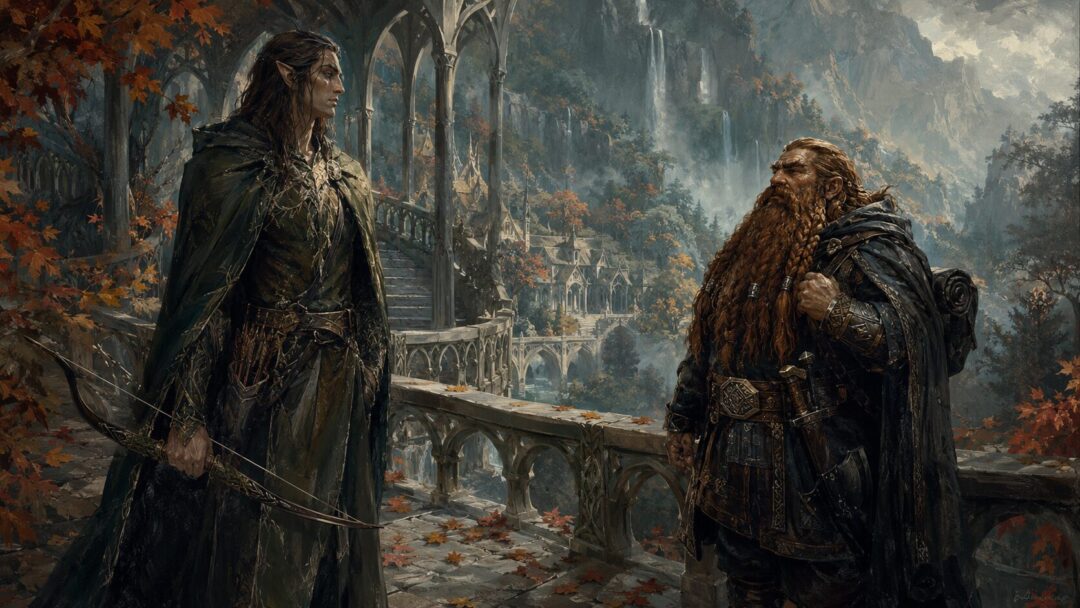
The strangest thing about Legolas and Gimli is not that an Elf and a Dwarf became friends.
It is that their friendship survived long enough to become a sign of something larger than personal loyalty. In a story full of broken kingdoms, fading peoples, old grudges, and inherited suspicion, their bond quietly turns into one of the clearest pictures of healing after the War of the Ring.
At first, they seem almost designed to dislike each other. Legolas is a prince of the Woodland Realm, one of the Elves of northern Mirkwood. Gimli is the son of Glóin, one of Thorin’s companions from The Hobbit. Their peoples carry memories of mistrust, and not all of those memories are ancient abstractions. The quarrel between Elves and Dwarves runs deep in the histories of Middle-earth, from the ruin of Doriath in the First Age to later suspicion between the Wood-elves and Thorin’s company.
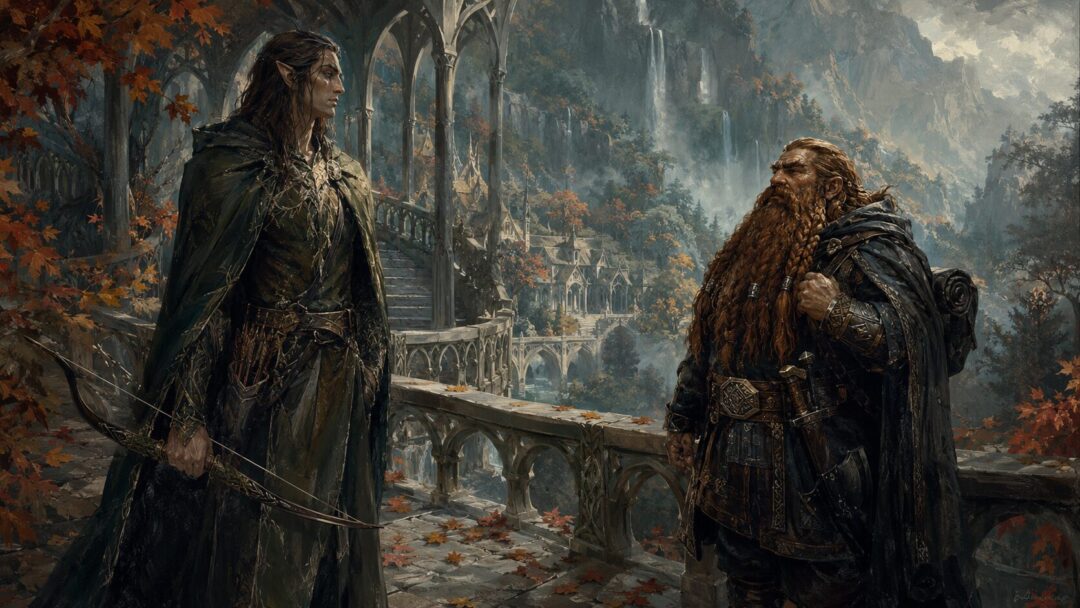
So when Legolas and Gimli stand together in Rivendell, they do not begin as symbols of harmony. They begin as heirs to old wounds.
That is why their friendship matters. It does not erase history. It shows that history does not have to have the final word.
The Fellowship Begins With Old Distrust
The Council of Elrond gathers many peoples who have reasons not to trust one another. Men doubt Men. Elves remember the failures of the past. Dwarves come with their own griefs and guarded pride. The Ring does not enter a united world. It enters a world already cracked.
Legolas and Gimli embody one of those cracks.
Their early exchanges are not warm. Gimli is defensive about Dwarven honor, especially after the fall of Balin’s colony in Moria. Legolas, though not cruel, carries the distance of an Elf whose people have long stood apart from Dwarves. The Fellowship does not magically make them brothers the moment they leave Rivendell.
That is important. Their friendship is not sentimental. It grows under pressure.
The first great turning point comes in Lothlórien. Gimli enters the Golden Wood under suspicion. Haldir and the Galadhrim are wary of a Dwarf passing into their hidden realm. Gimli, in turn, is proud and angry at being treated as a danger. Legolas is present for this tension, and he could easily remain only on the Elven side of the divide.
But Lórien changes Gimli.
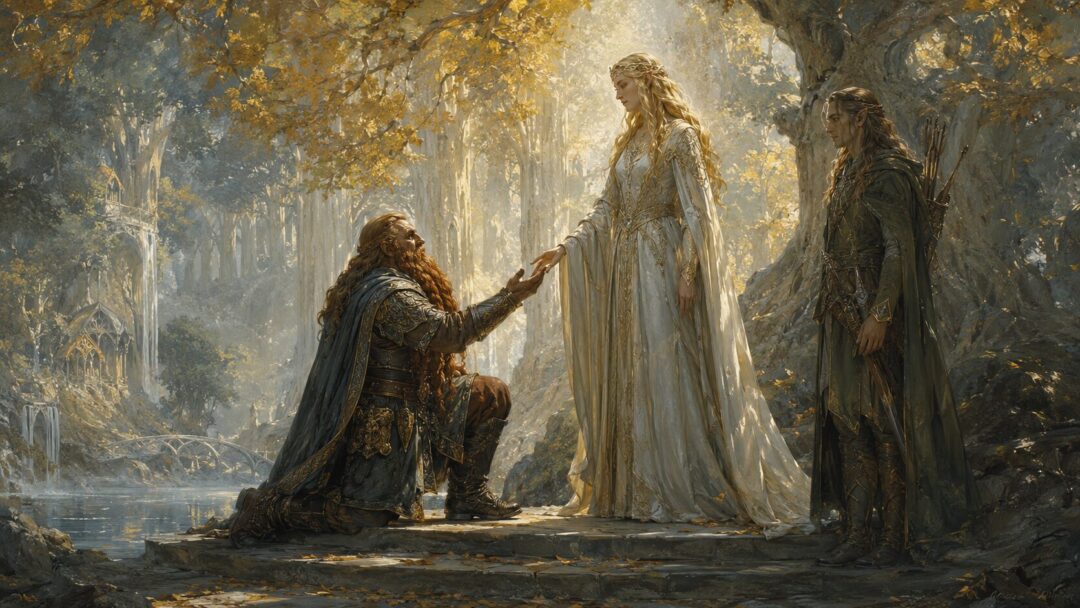
His encounter with Galadriel is one of the most important moments in his life. She honors him by asking about Khazad-dûm in its own language and by speaking generously of Dwarven grief. Gimli’s heart is moved, not by flattery, but by recognition. He is seen rightly. He leaves Lórien not diminished but deepened.
Legolas witnesses this. The Elf sees that a Dwarf can love beauty, memory, and loss with a depth not unlike the Elves themselves.
Gimli’s Love of Galadriel Opens the Door
Gimli’s devotion to Galadriel can be misunderstood if reduced to courtly admiration. It is more than that. Galadriel becomes, for him, a living contradiction to the old suspicion between their peoples.
When she gives him three strands of her hair, the gift is extraordinary not because it gives Gimli power, but because it gives him honor. It answers an old wound with grace. The texts do not say that this single gift heals all Elven-Dwarven estrangement. That would be too simple. But it clearly marks Gimli as changed, and it helps make possible the friendship that follows.
Legolas does not mock this change. He travels beside it.
From that point onward, their relationship softens. Their famous contest at Helm’s Deep, where they count their slain enemies, is often remembered for humor. Yet beneath the humor is trust. They fight separately in a terrible battle, but their rivalry is no longer rooted in contempt. It has become companionship.
That difference matters. Old hostility has been transformed into playful competition. The battlefield, grim as it is, reveals that they now measure themselves beside each other, not against each other as enemies.
Fangorn and Aglarond: Two Worlds Exchanged
The deepest sign of their friendship is not the battle-count. It is their promise to share wonder.
After Helm’s Deep, Gimli speaks with awe of the Glittering Caves of Aglarond. This is one of the great Dwarven moments in The Lord of the Rings. He does not describe stone as dead matter. He describes a living realm of beauty: caves, crystal, color, hidden chambers, and vast spaces shaped by time. To Gimli, the earth has a splendor that others have failed to see.
Legolas, being an Elf of woodland feeling, is not naturally drawn to caves. Earlier, Fangorn awakens something in him. The ancient forest is closer to his own heart than the deep places of stone.
So they make a bargain. Gimli will visit Fangorn if Legolas will visit Aglarond.
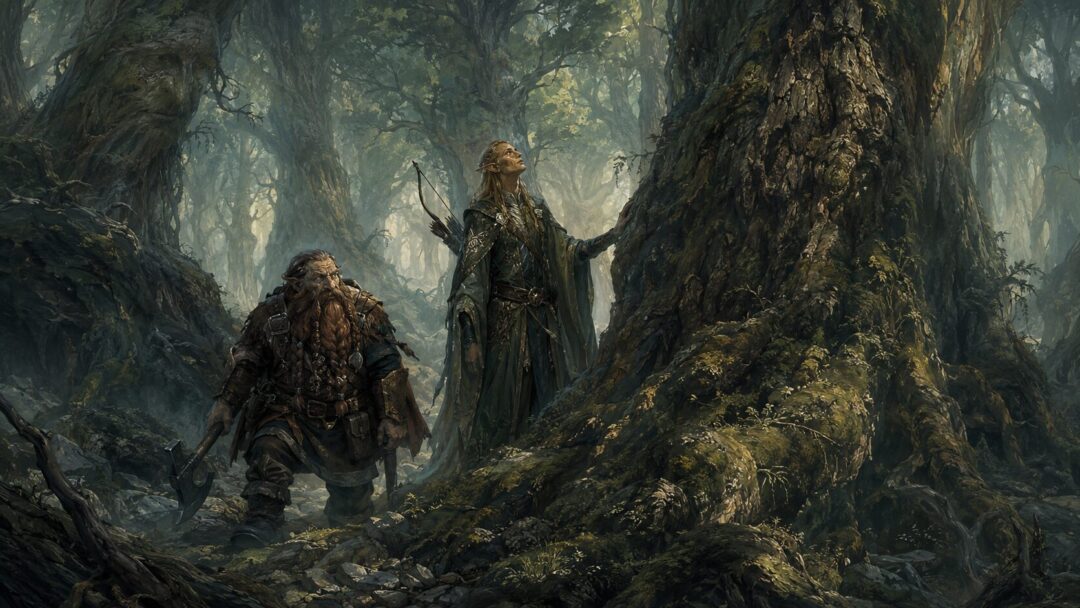
This promise is easy to overlook, but it is one of the most beautiful acts of cultural exchange in the story. Neither asks the other to abandon his own nature. Gimli does not become Elvish. Legolas does not become Dwarvish. Instead, each agrees to enter the other’s world with reverence.
That is more powerful than mere tolerance.
Tolerance can still keep distance. Legolas and Gimli move beyond distance. They learn to see through one another’s loves.
Their Friendship Changes How Beauty Is Seen
Legolas and Gimli do not simply become better friends. They become better witnesses.
Gimli teaches Legolas that the deep earth can be wondrous, not merely enclosed and dark. Legolas teaches Gimli that Fangorn is not merely a strange wood but an ancient living presence. Each one carries a form of beauty that the other might have dismissed.
This is why their friendship changes more than themselves. It changes the reader’s sense of Middle-earth.
Before them, Elves and Dwarves can feel like separate mythic worlds. Elves belong to stars, trees, song, memory, and fading light. Dwarves belong to stone, craft, endurance, treasure, and hidden halls. Their friendship reveals that these worlds were never meant to be enemies by nature. Their estrangement is historical, moral, and tragic—not inevitable.
The texts do not claim that all Elves and Dwarves are reconciled through them. That would go beyond the evidence. But Legolas and Gimli become a living exception strong enough to matter.
They show that ancient peoples can still be surprised by grace.
The War Makes Their Bond Public
Their friendship is not private for long. They travel with Aragorn. They fight at Helm’s Deep. They pass through the Paths of the Dead. They come to Minas Tirith. They stand in the great events surrounding the fall of Sauron.
This means their bond is witnessed in the world of Men.
That matters because the Fourth Age is not an Elven age or a Dwarven age. It is the age of Men, especially under Aragorn’s restored kingship. Legolas and Gimli’s friendship becomes part of the moral atmosphere of that renewal.
After the War, both remain connected to Aragorn’s realm. Gimli becomes associated with the Glittering Caves, where he is remembered as lord of a Dwarven people in Aglarond. Legolas brings Elves from the Woodland Realm to Ithilien, helping restore beauty to a land long shadowed by Mordor. These post-war traditions are recorded in Tolkien lore references and drawn from the appendices and related material: Gimli’s later association with Aglarond and Legolas’s settlement in Ithilien are standard parts of their remembered endings.
The point is not that their friendship creates Aragorn’s peace. It does not. Sauron’s defeat, the return of the King, and the courage of many peoples make that peace possible.
But their friendship belongs to that peace. It gives it a face.
Gimli the Elf-Friend Is Not a Small Title
Gimli is remembered as Elf-friend. That title carries weight because it is not obvious, not inherited, and not cheaply earned.
He does not gain it by abandoning Dwarven identity. In fact, he remains intensely Dwarvish: proud, loyal, stone-loving, fierce in battle, and devoted to the memory of his people. His friendship with Legolas does not flatten him into something more Elven. It allows him to be more fully himself without needing enmity to define him.
That is one of the story’s hidden moral achievements.
Many characters in Middle-earth are trapped by what they fear losing. Denethor fears the decline of Gondor. Saruman fears being second. Boromir fears the weakness of Men before Sauron. Even noble peoples can become guarded by memory and loss.
Gimli has every reason to remain guarded. Yet he opens himself to Galadriel, to Legolas, to Fangorn, and finally to a fate that no Dwarf could have expected.
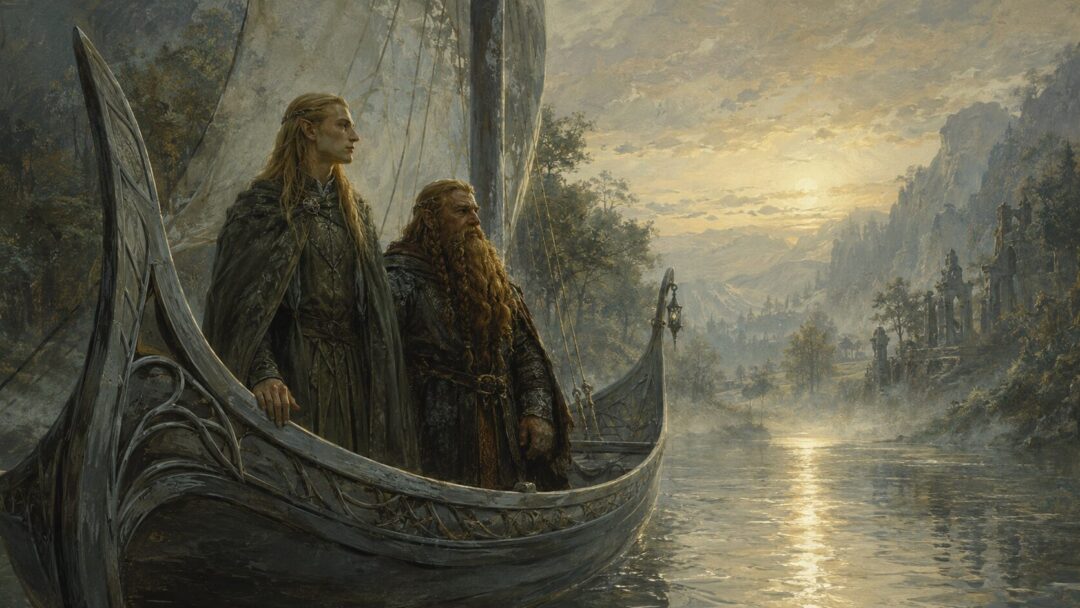
Legolas, too, is changed. His sea-longing awakens after he hears the gulls, and the call of the West becomes part of his story. Yet he does not simply vanish from Middle-earth at once. He remains for a time, and the tradition says he later builds a ship in Ithilien and sails over Sea. With him, it is said, goes Gimli. Lore references preserve the careful phrasing: Gimli’s passage is treated as a remarkable tradition, not something ordinary for Dwarves.
Encyclopedia of Arda
The Most Astonishing Ending Is Quiet
The idea that Gimli may have sailed into the West with Legolas is one of the strangest and most moving endings in the legendarium.
It should not be treated casually. The texts do not present Dwarves as people who normally leave Middle-earth for the Undying Lands. The tradition is explicitly unusual. Some accounts phrase it cautiously: “it is said” that Gimli went with Legolas. The reason given is their great friendship, and also, in some traditions, Gimli’s desire to see Galadriel again.
That ending changes the scale of their bond.
Friendship, in their case, crosses not only personal dislike, not only racial mistrust, not only war and distance, but the very borders of the world as normally imagined for their peoples.
It does not make Gimli immortal. The Undying Lands do not turn mortals into deathless beings. That is a common misunderstanding. The deeper wonder is not that Gimli escapes death, but that love and friendship carry him somewhere no Dwarf was expected to go.
Legolas does not merely tolerate Gimli. He brings him.
Gimli does not merely respect Legolas. He leaves Middle-earth with him.
A Friendship That Answers the Long Defeat
The Lord of the Rings is full of victories that are also endings. Sauron falls, but the Elves fade. Aragorn returns, but the old world passes away. Frodo saves the Shire, but cannot fully remain healed within it. The story’s joy is real, but never untouched by loss.
Legolas and Gimli’s friendship belongs inside that bittersweet pattern.
It does not reverse the fading of the Elves. It does not restore Khazad-dûm. It does not undo the ancient griefs between their peoples. But it proves that decline is not the only thing happening at the end of the Third Age.
Something new is also born.
Not a kingdom. Not a Ring. Not a weapon. A friendship.
That may seem small beside the fall of Barad-dûr. Yet Middle-earth often turns on small things: a hobbit’s pity, a gardener’s loyalty, a hidden road, a hand refusing to strike. Legolas and Gimli’s bond is another such small thing with large consequences. It shows that healing does not always arrive as a grand decree. Sometimes it begins as a promise: I will look at what you love, and I will not despise it.
That is why their friendship changed more than themselves.
It gave Elves and Dwarves, however briefly and however exceptionally, a different story to tell about one another. It gave the Reunited Kingdom a living emblem of the peace it hoped to build. And it gave readers one of the clearest signs that Middle-earth’s deepest wounds are not healed by power, but by humility, wonder, loyalty, and the willingness to cross an old border with a friend.
Sources & Notes
- J.R.R. Tolkien, The Lord of the Rings, Book II, Chapter 6, “Lothlórien” — the Fellowship enters Lórien under suspicion, and Gimli’s encounter with Galadriel begins the healing of old Elf-Dwarf distrust.
- J.R.R. Tolkien, The Lord of the Rings, Book II, Chapter 8, “Farewell to Lórien” — Galadriel’s gift of three hairs to Gimli marks an extraordinary act of honour across that divide.
- J.R.R. Tolkien, The Lord of the Rings, Book III, Chapters 7–8, “Helm’s Deep” and “The Road to Isengard” — Legolas and Gimli’s battle-count shifts rivalry into trusted companionship, followed by Gimli’s praise of Aglarond.
- J.R.R. Tolkien, The Lord of the Rings, Book III, Chapter 10, “The Voice of Saruman” — their Fangorn-and-Aglarond bargain shows each agreeing to enter the other’s world of wonder.
- J.R.R. Tolkien, The Lord of the Rings, Appendix A and Appendix B — the later traditions of Gimli as Lord of the Glittering Caves, Legolas in Ithilien, and the report that Gimli sailed with Legolas over Sea.
- J.R.R. Tolkien, The Silmarillion, “Of the Ruin of Doriath” — background for the deep historical bitterness between Elves and Dwarves that makes their friendship more than private affection.