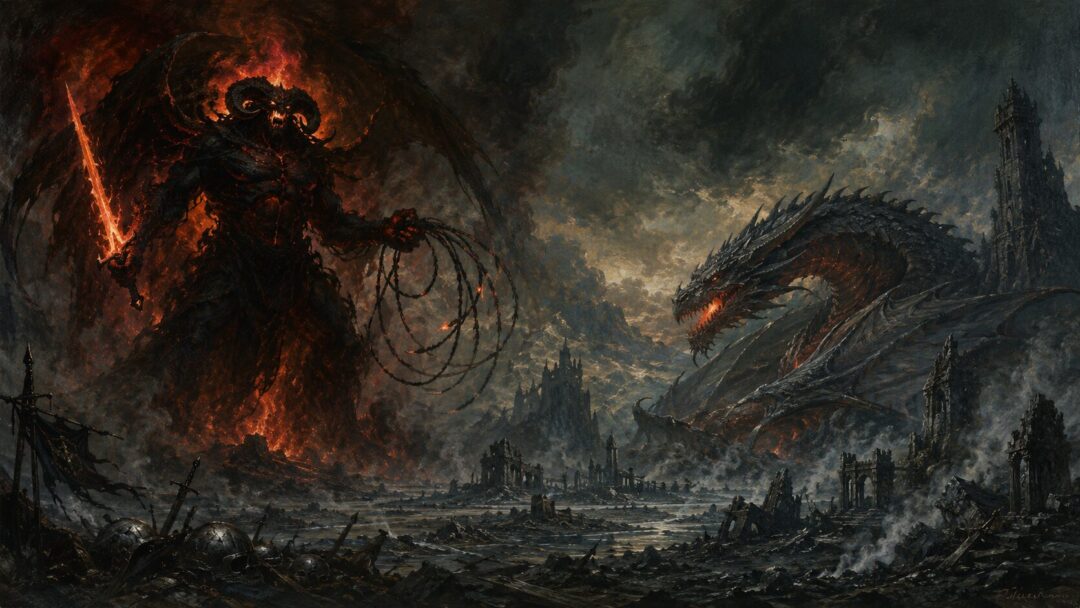
A Balrog on the Bridge of Khazad-dûm feels like the end of the world in human shape: shadow, flame, sword, whip, and a terror so old that even Legolas cries out in recognition. A dragon, by contrast, feels like the world itself has learned greed: gold, fire, riddling speech, armored hide, and a hunger that can empty kingdoms.
So which was stronger?
The tempting answer is to rank them like monsters in a game: Balrog above dragon, or dragon above Balrog. But Middle-earth resists that kind of measuring. The texts give us no neat power scale. They give us something more interesting: two different kinds of ruin. Balrogs are corrupted spirits, ancient servants of Morgoth from before the shaping of the world. Dragons are bred weapons of Morgoth, monstrous and cunning, made to break armies, kingdoms, and wills.
If we ask “which one wins in a fight?” the answer depends on which Balrog, which dragon, and what kind of strength we mean.
Balrogs Were Not Just Monsters
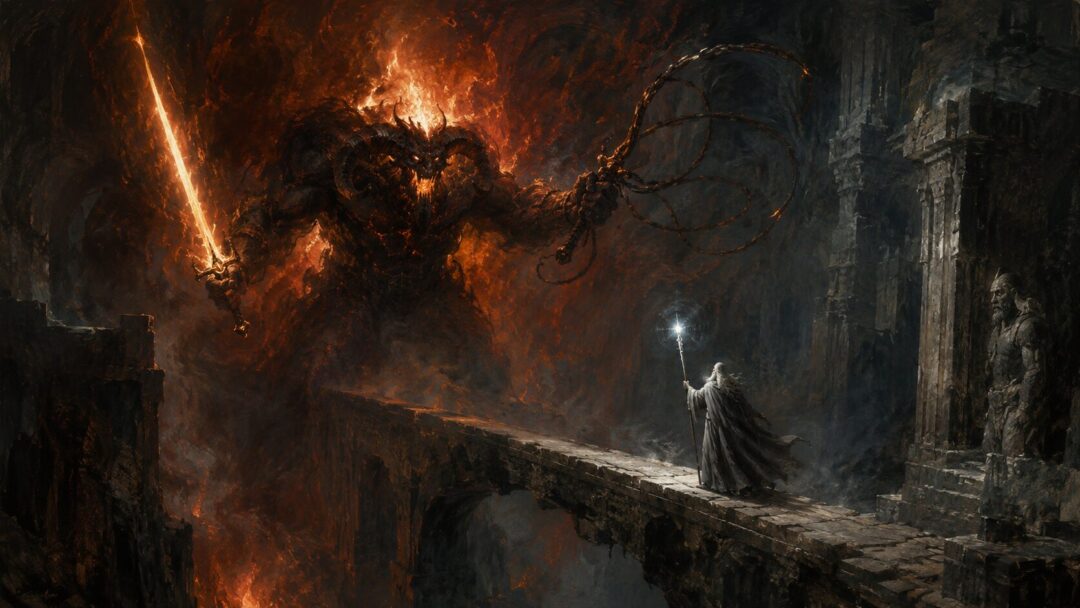
The most important fact about Balrogs is also the easiest to flatten: they were not merely beasts. They were spirits of the same broad order as the Maiar, corrupted into the service of Morgoth. In The Silmarillion they are called Valaraukar, “demons of terror,” and they appear as among Morgoth’s most dreadful servants.
That matters because a Balrog’s power is not only physical. Durin’s Bane is not frightening simply because it is large or fiery. When it comes in Moria, the fear around it has a spiritual weight. Gandalf recognizes it as a being of his own order, though fallen into darkness. Their contest is not just a duel of weapons but a clash of ancient powers.
Balrogs also appear at decisive moments in the First Age. Gothmog, Lord of Balrogs, is among Morgoth’s greatest captains. Balrogs help bring down Fëanor after his reckless pursuit of Morgoth. Gothmog later plays a terrible role in the death of Fingon during the Nirnaeth Arnoediad. At Gondolin, Balrogs are part of the horror that breaks the hidden city, and Gothmog himself is slain by Ecthelion only at the cost of Ecthelion’s own life.
That pattern is important. Balrogs can be slain, but never casually. Glorfindel kills a Balrog during the escape from Gondolin and dies in the act. Gandalf casts down Durin’s Bane after a battle that runs from the abyss below Moria to the peak of Zirakzigil, and Gandalf himself dies afterward. The texts consistently frame victory over a Balrog as a deed of almost unbearable cost.
Dragons Were Morgoth’s Weapons of Catastrophe
Dragons enter the story differently. They are not angelic spirits fallen into flame. They are bred horrors, devised by Morgoth as weapons. Yet that does not make them weaker in any simple sense.
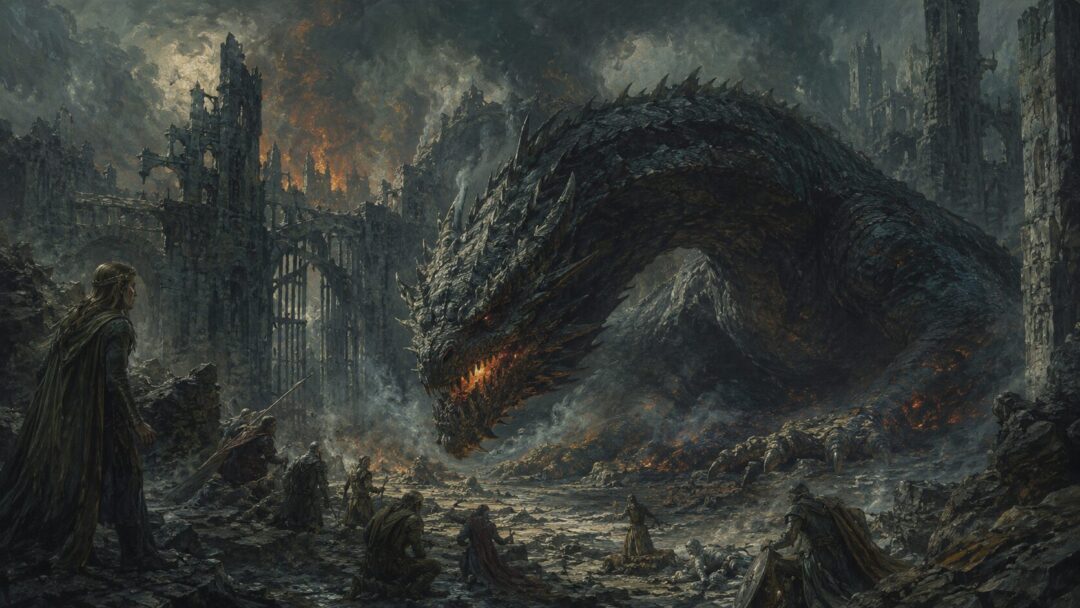
Glaurung, the first of the dragons, changes the shape of the wars of Beleriand. When he first appears too soon, he is driven back because he is not yet fully grown. Later, at full strength, he becomes one of Morgoth’s most devastating servants. He is not merely a fire-breathing creature. He is a manipulator, a deceiver, and a breaker of minds.
His destruction of Nargothrond is not just a military disaster. It becomes a moral and psychological disaster for Túrin. Glaurung does not defeat Túrin only with fire or force. He fixes him with his gaze, twists truth into torment, and sends him toward choices that deepen the tragedy of his family. In this sense, Glaurung’s strength is not only in his body. It is in his malice, speech, and power to dominate the imagination of others.
Later dragons show other kinds of strength. Smaug in The Hobbit is not presented as a First Age terror on the scale of Ancalagon, yet he destroys Dale, drives the Dwarves from Erebor, and holds the Lonely Mountain for many years. He is vain, cunning, armored, and terrifyingly intelligent. His weakness is specific and hidden: a bare patch in his jeweled armor. Without that knowledge, Bard’s shot would not have been the same kind of chance.
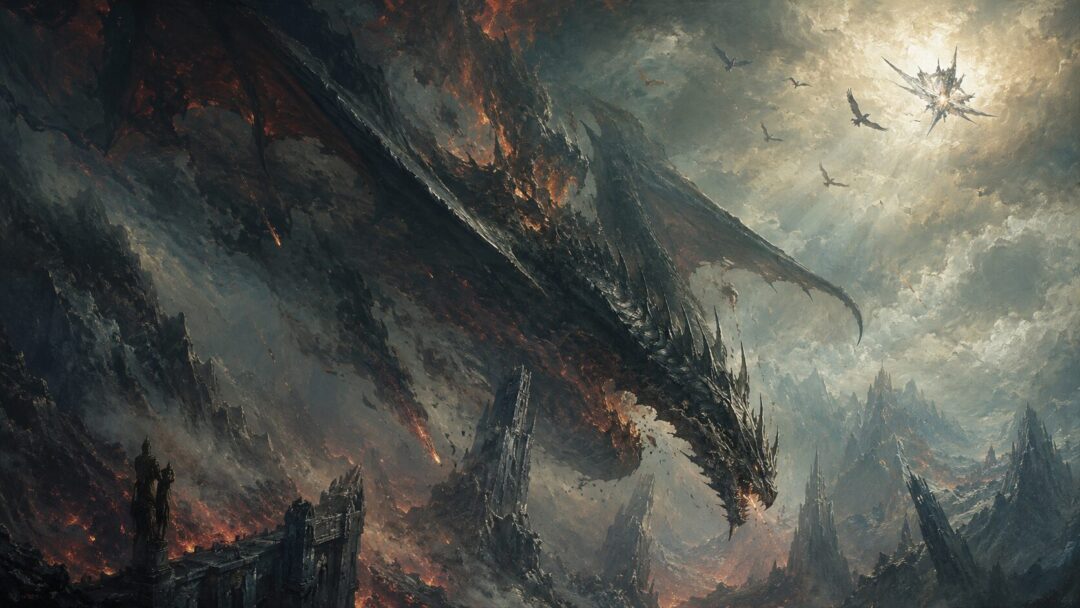
Then there is Ancalagon the Black, the greatest of the winged dragons, released during the War of Wrath. His fall is described in colossal terms: he is cast down upon the towers of Thangorodrim, and they are broken in his ruin. Even if the text does not pause to give measurements or a combat rating, the narrative scale around Ancalagon is enormous. He belongs to the final convulsion of Morgoth’s power in the First Age.
The Strongest Dragon May Outscale the Known Balrogs
If the question is narrowed to sheer destructive scale, the greatest dragons likely surpass any individual Balrog we see clearly in the narrative.
Ancalagon is the obvious case. A being whose fall breaks Thangorodrim is operating on a mythic scale far beyond the Bridge of Khazad-dûm or even the Fall of Gondolin as a personal duel. The winged dragons of the War of Wrath are presented as Morgoth’s last and terrible assault, so devastating that even the hosts of the West are driven back until Eärendil comes in Vingilot with the Eagles.
That does not mean “all dragons are stronger than all Balrogs.” Smaug, for instance, is mighty enough to destroy cities and kingdoms, but the texts never compare him directly with Durin’s Bane. Nor should we assume that because Smaug dies to Bard, he was therefore “weaker” in a simple way. Bard’s victory depends on courage, timing, the Black Arrow, and knowledge of Smaug’s one exposed weakness.
Still, when we speak of the largest dragons, especially Ancalagon, the dragons seem to become weapons of mass devastation. A Balrog is terrifyingly powerful as a personal and spiritual foe. A great dragon can be a battlefield-changing catastrophe.
But Balrogs May Be Higher in Nature
Here is where the answer turns.
If strength means spiritual order or innate being, Balrogs stand higher. They are not animals, however monstrous. They are corrupted Maiar, beings from before the world’s history as Elves and Men experience it. A dragon may be more physically vast, more destructive over a landscape, or more dangerous to an army. But a Balrog belongs to a deeper metaphysical category.
This is why Gandalf’s confrontation with Durin’s Bane feels different from Bard’s confrontation with Smaug. Bard faces a dragon as a mortal hero confronting a tyrant-beast with one fatal vulnerability. Gandalf faces something like a fallen counterpart: a spirit of fire and shadow from the ancient wars. Their battle is described almost as a descent through the hidden bones of the world, followed by an ascent to a mountaintop where both are spent.
In that sense, a Balrog’s power is concentrated. It does not need to be the size of Ancalagon to be one of the most dangerous beings left in Middle-earth. Durin’s Bane alone destroys the power of Khazad-dûm by killing Durin VI and later Náin I, forcing the Dwarves to abandon their greatest mansion. That is not the work of a random monster. It is the reawakening of an ancient evil that a kingdom cannot withstand.
Dragons Have a Different Kind of Mind-Power
One reason this comparison is so difficult is that dragons also possess powers beyond ordinary physical force.
Glaurung’s power over Túrin and Niënor is among the darkest examples. His gaze and speech have a binding, deceiving force. He uses truth and lies together, not simply to frighten but to redirect lives. Niënor’s loss of memory after encountering Glaurung is not just intimidation; it is enchantment-like domination.
Smaug’s power is subtler but still dangerous. Bilbo enters the conversation wearing the Ring, yet Smaug’s speech nearly works upon him. The dragon probes, flatters, threatens, and sows suspicion. He cannot see Bilbo clearly, but he can still strike at his thoughts. His words about the Dwarves and the treasure are not random boasting. They expose real tensions and tempt Bilbo toward mistrust.
This makes dragons more than siege engines. They are intelligent evils. Their strength includes greed, persuasion, memory, and malice. They do not merely burn halls; they poison judgment.
Balrogs Are Rare, Dragons Are Varied
Another problem with the question is that “Balrog” and “dragon” do not work the same way as categories.
Balrogs appear as a small and dreadful order of beings. Later writings reduce their number compared with some earlier conceptions, and the stories treat each encounter with one as momentous. A Balrog is never common scenery. When one appears, the narrative stops breathing.
Dragons, however, vary greatly. Glaurung is wingless but immensely dangerous. Ancalagon is a winged dragon of apocalyptic scale. Smaug is a late Third Age dragon, still terrible enough to dominate the North but not described in the same terms as the greatest dragons of the First Age. Other dragons are remembered in fragments: Scatha, for instance, matters historically, but we do not receive the same kind of detailed portrait.
So the better comparison is not “Balrogs versus dragons” as two equal species lists. It is “a corrupted Maia of fire and shadow versus a dragon of a particular age, kind, and stature.” Against some dragons, a Balrog might plausibly be the greater terror. Against Ancalagon, the answer is much harder to defend.
What the Texts Never Say
The safest lore answer is this: the texts never give a direct ranking.
They do not say, “Balrogs were stronger than dragons.” They do not say, “Dragons were stronger than Balrogs.” They show both as among Morgoth’s most dreadful servants, but they emphasize different roles.
Balrogs often appear as captains, executioners, and ancient demonic warriors. Dragons appear as bred weapons, hoard-lords, city-breakers, and mind-poisoners. Both can destroy kingdoms. Both can kill heroes. Both can be slain, but usually only through sacrifice, providence, hidden weakness, or extraordinary courage.
The debate becomes misleading when “stronger” means only “who would win.” Middle-earth is rarely interested in power as a clean ladder. The Ring itself proves that. The mightiest are not always the ones who prevail. The hidden wound, the small mercy, the overlooked weakness, and the moral choice often matter more than raw force.
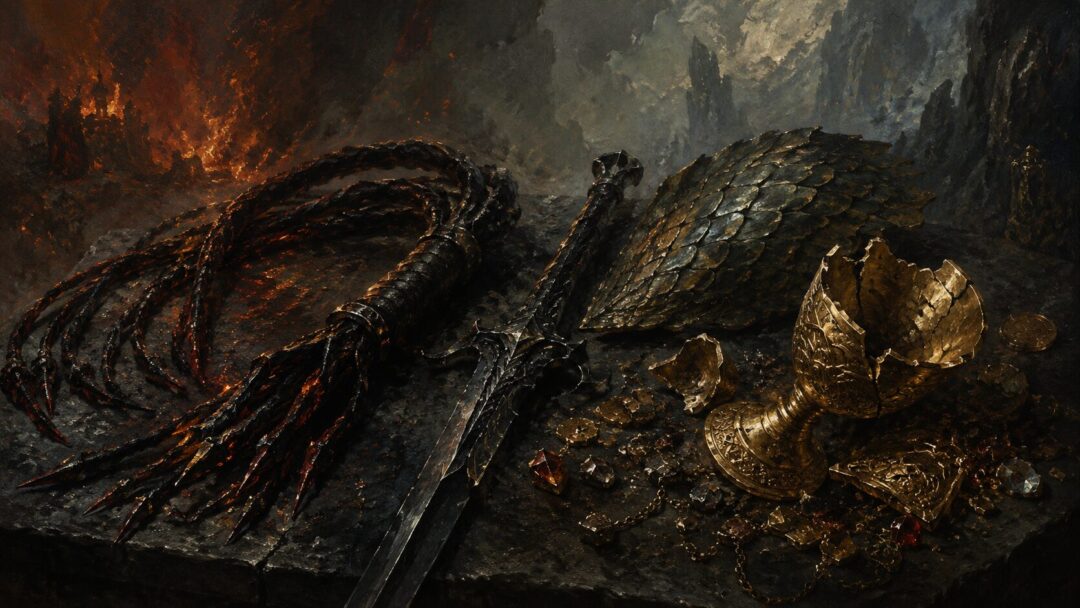
The Most Honest Answer
Were Balrogs stronger than dragons?
Some Balrogs were probably stronger than some dragons, especially if we mean spiritual potency, ancient terror, and concentrated personal power. Durin’s Bane is far more than a beast, and Gothmog stands among Morgoth’s greatest servants.
But the greatest dragons, especially Ancalagon, seem to exceed Balrogs in physical and battlefield scale. Glaurung, too, shows a kind of destructive influence that reaches beyond combat into fate, memory, and despair.
So Tolkien’s answer is not simple because Middle-earth gives us different kinds of power. Balrogs are fallen fire in almost human shape: ancient, willful, and spiritually dreadful. Dragons are embodied ruin: greed, flame, cunning, and catastrophic force.
A Balrog may be the deeper terror.
A dragon may be the greater disaster.
And in the world of Middle-earth, both truths can stand at once.
Sources & Notes
- J.R.R. Tolkien, The Silmarillion, “Valaquenta: Of the Enemies” — identifies the Balrogs as Valaraukar, spirits who followed Melkor and became demons of terror.
- J.R.R. Tolkien, The Lord of the Rings, Book II, Chapter 5, “The Bridge of Khazad-dûm” — shows Durin’s Bane as a terror of shadow and flame whom Gandalf treats as a peer-level ancient enemy, not a mere beast.
- J.R.R. Tolkien, The Silmarillion, “Of the Return of the Noldor” — Fëanor’s fatal pursuit ends when Balrogs surround him and Gothmog, Lord of Balrogs, gives him his death-wound.
- J.R.R. Tolkien, The Silmarillion, “Of Túrin Turambar” — Glaurung’s strength is physical, verbal, and psychological, ruining Nargothrond and bending Túrin and Niënor through his malice and gaze.
- J.R.R. Tolkien, The Hobbit, Chapter 12, “Inside Information” and Chapter 14, “Fire and Water” — Smaug combines armored destructive power with cunning speech, yet is slain through a precise hidden weakness.
- J.R.R. Tolkien, The Silmarillion, “Of the Voyage of Eärendil and the War of Wrath” — Ancalagon and the winged dragons appear as Morgoth’s last overwhelming assault, with Ancalagon’s fall breaking Thangorodrim.