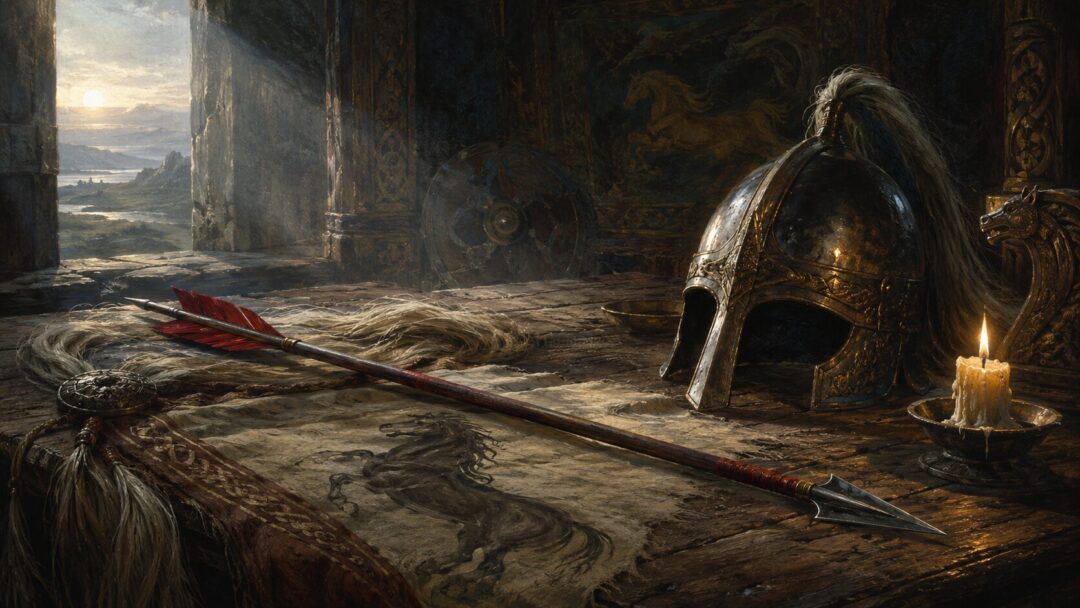
Helm’s Deep looks like the great trial of Rohan because it has all the signs of one: a battered king, a fortress in the mountains, rain, darkness, ladders on the wall, and the thunder of enemies filling the Deeping-coomb. It is the moment when Théoden seems to rise from despair into legend. The Hornburg has become, for many readers, the image of Rohan’s courage.
But in the text, Helm’s Deep is not the final measure of Rohan’s heart.
It is a desperate battle for survival. Rohan is cornered. Saruman’s army is already upon them. Théoden fights because he must. The deeper test comes afterward, when the king has survived, when his own land still needs protection, when he could choose caution, and when Gondor calls from far away under the Shadow of Mordor.
The real test of Rohan is not whether the Rohirrim can defend their own walls. It is whether they will ride beyond them.
Helm’s Deep Was Necessary, Not Optional
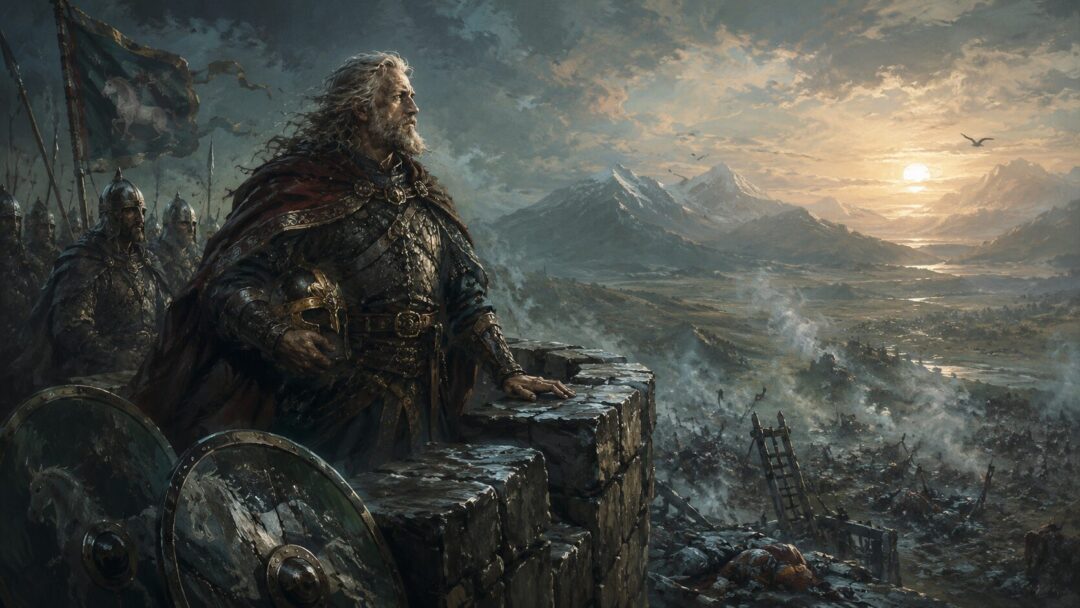
The Battle of the Hornburg, often called Helm’s Deep, takes place on the night of March 3–4 in the year 3019 of the Third Age. Saruman’s forces attack the mountain stronghold while Théoden, Aragorn, Éomer, and the defenders hold the fortress against overwhelming pressure. The wall is breached, the defenders are divided, and the battle seems close to ruin before dawn brings Gandalf and Erkenbrand with aid, along with the strange terror of the Huorns from Fangorn.
That matters because Helm’s Deep is not a romantic tournament of courage. It is a crisis forced upon Rohan. Théoden has only just been freed from the wasting influence around his throne. His kingdom is already wounded by raids, betrayal, fear, and divided command. Saruman has struck first. The Rohirrim do not march to the Hornburg because it is a glorious choice. They go there because the Westfold is in danger and because war has reached their own fields.
This does not make the courage of Helm’s Deep smaller. It makes it more immediate. The men in the Hornburg stand because there is nowhere else to stand. Their families, horses, homes, and king are bound up in the same struggle. The fortress becomes the visible line between Rohan and destruction.
Yet a test of survival is not the same as a test of generosity, oath, and hope.
Théoden’s First Victory Is Over Despair
Before Helm’s Deep can be fought, Théoden must return to himself. That is the first inner movement of Rohan’s story. The king who sat bent and diminished in Meduseld becomes again a lord of the Mark. His healing does not make him young, and it does not erase the losses already suffered, but it restores his ability to choose.
This is easy to miss because the battle follows so quickly. Théoden’s change is not simply that he can fight. It is that he can act as king again. He can judge counsel. He can ride among his people. He can face the fact that danger will not disappear because he fears it.
At Helm’s Deep, that renewed kingship is tested under pressure. Théoden does not remain hidden in the caves until others save him. Near dawn, when hope is nearly spent, he chooses to ride out. That charge is one of the great images of recovered courage in The Lord of the Rings. Still, it is a battlefield act made inside a siege. It answers the question: will Théoden die like a king rather than be trapped like a broken old man?
The answer is yes.
But the story is not finished with him there.
Saruman’s Defeat Does Not End Rohan’s Duty
After the Hornburg, Saruman’s military power is broken. Isengard is overthrown by forces Saruman never understood. The immediate western threat to Rohan is shattered. In a simpler heroic tale, that might be the end of the kingdom’s trial: the king returns, the fortress stands, the enemy falls.
But Middle-earth is not that simple.
Rohan’s victory at Helm’s Deep solves the local crisis but not the larger war. Mordor still moves. Minas Tirith is still in peril. The Enemy in the East is greater than Saruman, and Gondor’s survival matters to all free peoples. If Gondor falls, Rohan’s temporary safety will mean little.
This is where the moral weight shifts. At Helm’s Deep, Théoden defends his own land. After Helm’s Deep, he must decide whether to risk what remains of Rohan for another realm.
That decision is harder than it first appears. Rohan is not untouched. Its people have taken refuge. Its riders are scattered and weary. The king has only just survived one catastrophe. A cautious ruler could argue that his first duty is to preserve the Mark. He could say that Gondor is too far, Mordor too strong, and Rohan too wounded.
Instead, the story moves toward the Muster.
Dunharrow Shows the Real Shape of Fear
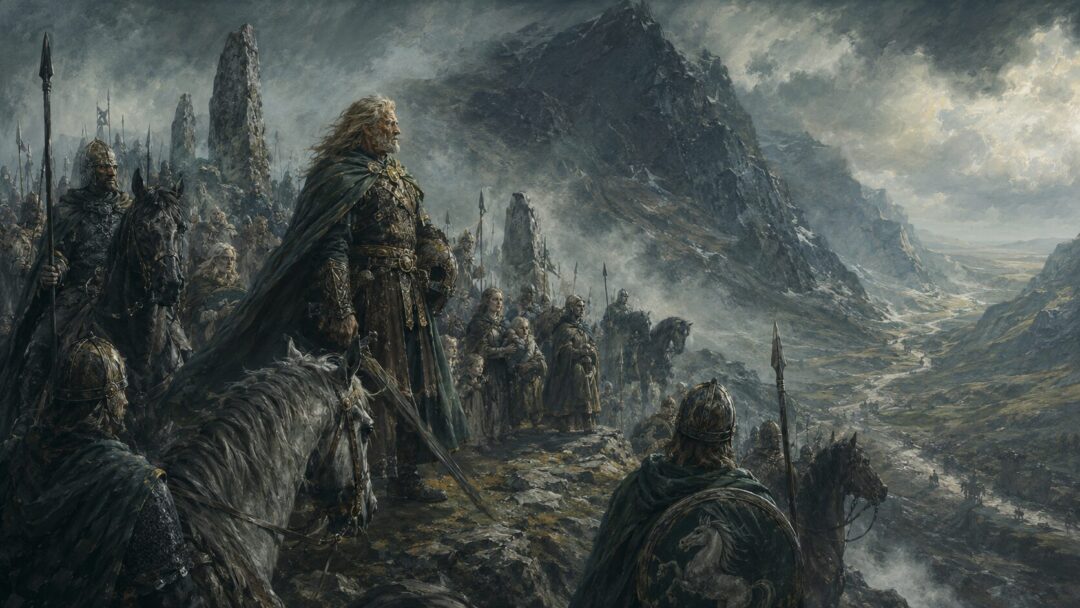
Dunharrow is not a battlefield in the same way Helm’s Deep is, but it may be more revealing. It is a place of refuge, memory, and dread. The people of Rohan have gathered there because war has come too close. Its geography is defensive and ancient: a high upland in the White Mountains near the haunted road that leads toward the Paths of the Dead.
At Dunharrow, the emotional landscape changes. The Rohirrim are no longer bracing against ladders in the night. They are waiting under the weight of a larger doom. The road to Minas Tirith lies ahead, but it is long, dangerous, and shadowed by the likelihood that they will arrive too late or die when they get there.
This is where Rohan’s courage becomes more than battlefield ferocity. The Riders must leave behind the people they are supposed to protect. Théoden must go east while his own kingdom remains vulnerable. Éowyn remains among the people, carrying a different wound: the pain of being left behind while great deeds and deaths are chosen by others.
Dunharrow asks a quieter question than Helm’s Deep: when the immediate danger to yourself has passed, will you still answer the need of another?
The Muster Is a Test of Oath and Identity
Rohan’s relationship with Gondor is not casual friendship. The Rohirrim live in the land of Calenardhon because Gondor granted it to Eorl and his people after ancient aid in battle. The bond between the two kingdoms is part of Rohan’s identity. To ride to Gondor is not simply a strategic move; it is an answer to history.
In “The Muster of Rohan,” Théoden and his Riders reach the outer hills after a hard journey. Éomer urges caution, but Théoden continues toward war. The remaining Riders gather, and the king moves toward Dunharrow, where his people have taken shelter.
This is the true test because an oath is easiest to admire when it costs nothing. Rohan’s ancient friendship with Gondor sounds noble in songs and halls. It becomes something else when the Red Arrow has come, when the beacons burn, and when men must decide whether old promises still bind the living.
The Rohirrim do not ride because victory is certain. They ride because refusing would make them something less than themselves.
Helm’s Deep Proved Rohan Could Stand
Helm’s Deep proves that Rohan can endure assault. Its defenders are brave, stubborn, and capable of holding against terror. The battle also restores confidence in Théoden’s kingship. He is no longer merely the king who was rescued from decline; he is the king who stood in war.
But endurance is only one kind of courage.
A people can defend their own gate and still refuse the wider burden of the age. A king can save his own hall and still fail his allies. A warrior culture can love glory and still shrink from sacrifice when the cause is not immediately its own.
This is why Helm’s Deep is not enough. It is the necessary first proof, not the final one.
The Ride to Gondor asks something larger: will Rohan spend its renewed strength on behalf of another people? Will Théoden use his restored kingship merely to preserve what remains, or will he risk it in a war that may end him?
The answer defines him more deeply than the defense of the Hornburg.
The Ride to Minas Tirith Is Chosen Sacrifice
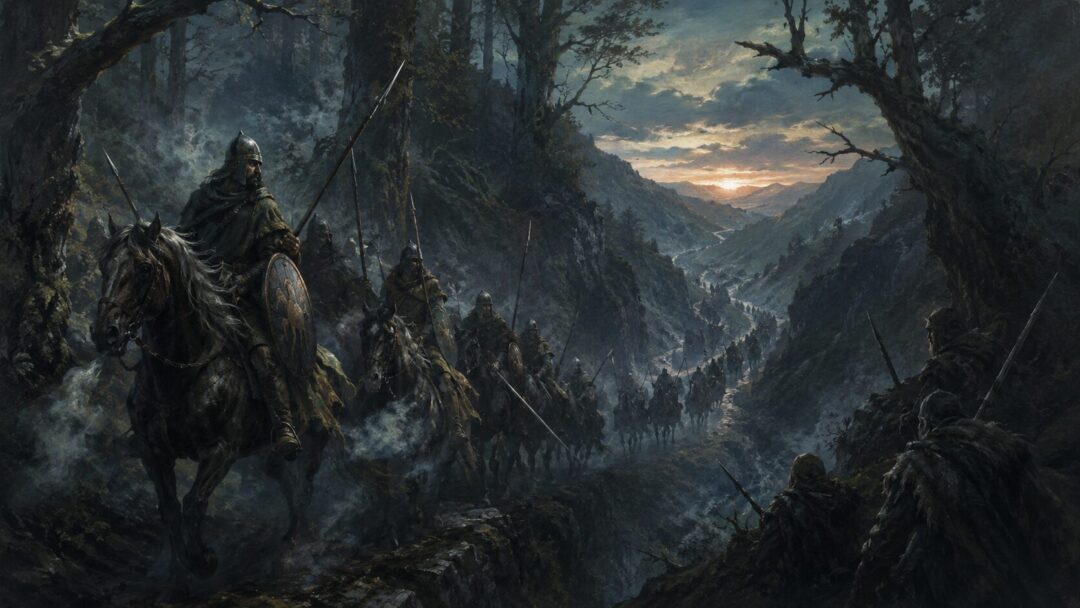
The ride to Minas Tirith is not presented as easy confidence. It is shadowed by delay, secrecy, fear, and uncertainty. The Rohirrim must pass through dangerous country. They need guidance through hidden ways. They do not know exactly what they will find before the walls of Gondor.
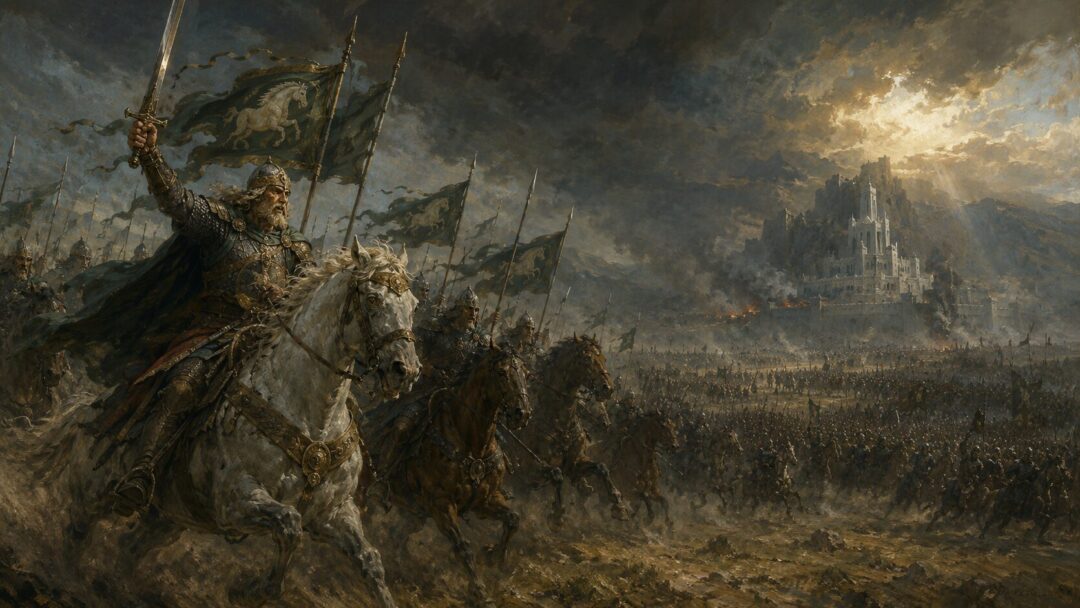
When they arrive at the Pelennor Fields, they do not find a clean battlefield waiting for honorable combat. They find a city under siege and a vast war already in motion. The Battle of the Pelennor Fields is the greatest battle of the War of the Ring and one of the largest conflicts of the Third Age. Théoden’s charge becomes decisive, but it also leads to his death.
That is why this moment matters so much. Théoden does not ride east to regain his own throne; he already has it. He does not ride to save Edoras directly; Edoras lies behind him. He rides because Gondor’s need has become his own.
In that sense, the Pelennor is not just a military climax. It is the completion of Théoden’s restoration. The king who had been trapped in a hall becomes the king who crosses the fields of another realm and dies under open sky.
Théoden’s Glory Is Not That He Survives
At Helm’s Deep, Théoden survives. At Minas Tirith, he does not.
That difference is crucial.
His death on the Pelennor does not cancel the victory of Helm’s Deep; it fulfills the arc that began there. Helm’s Deep gives him back the ability to act. The ride to Gondor gives him the chance to spend that recovered strength rightly.
There is a tragic mercy in this. Théoden does not become immortal, invincible, or untouched by age. He remains an old king who has lost years to weakness and manipulation. But he is granted the chance to end as himself. His final greatness is not that he avoids death, but that he meets it in the service of a cause beyond self-preservation.
That is a deeply Tolkienian pattern: victory often comes through surrender, mercy, endurance, and costly faithfulness rather than domination. Rohan’s finest hour is not merely that it breaks an enemy army. It is that it keeps faith when keeping faith may mean ruin.
Rohan’s Real Test Was What It Did After Victory
The temptation after Helm’s Deep would have been understandable. Rohan could have said: we have suffered enough. We have defeated Saruman. Let Gondor face its own darkness. Let us bury our dead and guard our borders.
That choice would not have been cowardice in the simplest sense. It would have sounded prudent. It might even have sounded responsible.
But it would have been a failure of the deeper thing Rohan represents at this point in the story: courage awakened into loyalty. Théoden’s people are not tested only by whether they can fight. They are tested by whether they can remember who they are when fear gives them reasons to forget.
Helm’s Deep is the night Rohan survives.
The Muster is the moment Rohan chooses.
The Pelennor is the field where that choice becomes legend.
That is why Helm’s Deep, for all its thunder, is not the real test of Rohan. The real test comes after the walls hold, after dawn breaks, after the king has a chance to keep what he has saved. Rohan’s greatness lies in the fact that it does not stop there.
It rides east.
Sources & Notes
- J.R.R. Tolkien, The Lord of the Rings, Book III, Chapter 6, “The King of the Golden Hall” — Théoden’s release from Gríma’s influence restores his capacity to judge, ride, and rule before Rohan’s trial in war.
- J.R.R. Tolkien, The Lord of the Rings, Book III, Chapter 7, “Helm’s Deep” — the Hornburg battle frames Rohan’s stand as desperate defense against Saruman, ending with Théoden’s dawn ride and Gandalf’s arrival.
- J.R.R. Tolkien, The Lord of the Rings, Book V, Chapter 3, “The Muster of Rohan” — the Red Arrow, Dunharrow, and Théoden’s mustering show Rohan choosing to answer Gondor despite danger and uncertainty.
- J.R.R. Tolkien, The Lord of the Rings, Book V, Chapter 5, “The Ride of the Rohirrim” — Théoden’s host reaches the Pelennor as allies, making Rohan’s loyalty more than survival of its own borders.
- J.R.R. Tolkien, Unfinished Tales, “Cirion and Eorl and the Friendship of Gondor and Rohan” — gives the deeper history of Calenardhon, Eorl’s aid, and the oath-bond behind Rohan’s obligation to Gondor.