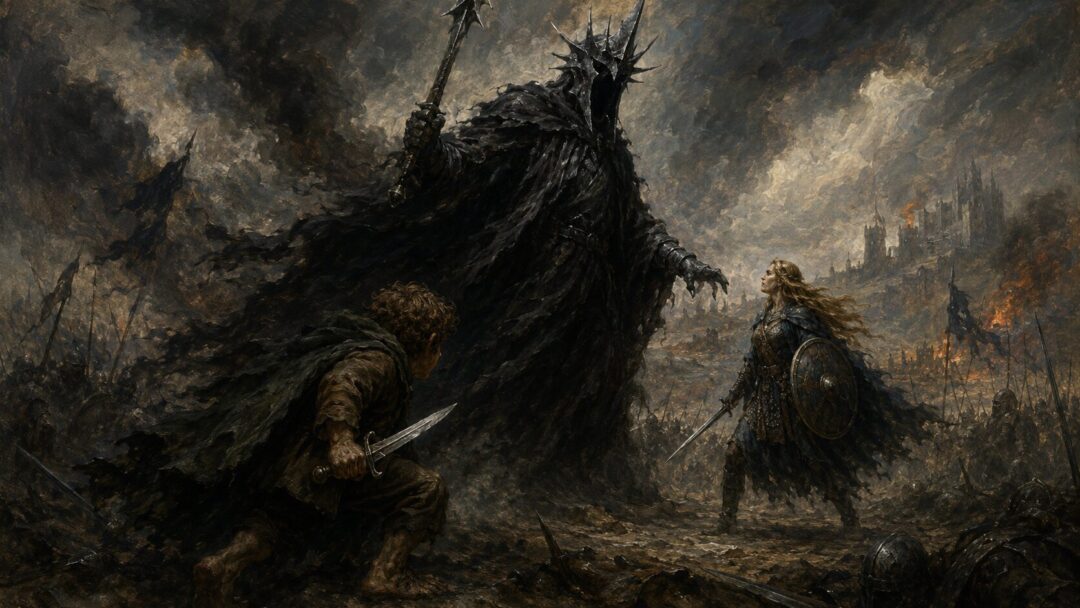
The Witch-king stood on the Pelennor Fields like a nightmare wearing a crown. Théoden lay crushed beneath Snowmane. Éowyn stood alone before the Lord of the Nazgûl. And nearby, almost forgotten in the smoke and terror, was Merry Brandybuck: a hobbit far from the Shire, armed not with a king’s sword, but with a blade taken from a haunted tomb.
That detail matters more than it first appears.
Merry’s courage was real. Without it, Éowyn would almost certainly have faced the Witch-king alone. But courage by itself was not the whole answer. In one of the strangest and most carefully prepared moments in The Lord of the Rings, Merry’s small act of bravery needed an ancient weapon made long before he was born, in a war he barely understood, against the same shadow now standing before him.
The blade in Merry’s hand was not just a useful dagger. It was history returning at the exact moment it was needed.
A Hobbit With the Wrong Kind of Weapon
Merry was not meant to be on the battlefield. Théoden had forbidden him to ride with the Rohirrim, and Merry only came to Minas Tirith because Dernhelm secretly carried him there. He arrives as someone small, overlooked, and physically outmatched by nearly everything around him.
That is part of the power of the scene. Merry is not transformed into a warrior prince. He does not suddenly become the equal of the captains of Gondor or Rohan. His fear remains understandable. His body is small. His weapon is short. His place in the battle is almost accidental.
Yet his courage awakens when he sees Éowyn facing the Witch-king. The text presents Merry’s action not as a grand military calculation but as a response of loyalty, pity, and horror. He cannot defeat the Lord of the Nazgûl in open combat. He cannot match him in strength. But he can move when fear tells him to stay still.
That movement is heroic. But the story does not pretend that bravery alone can cut through every kind of evil.
The Witch-king is not merely a battlefield commander. He is the Lord of the Nazgûl, a being whose power is bound up with sorcery, terror, and long servitude to Sauron. To strike him meaningfully requires more than good intentions and a sharp edge.
The Blade From the Barrow-downs
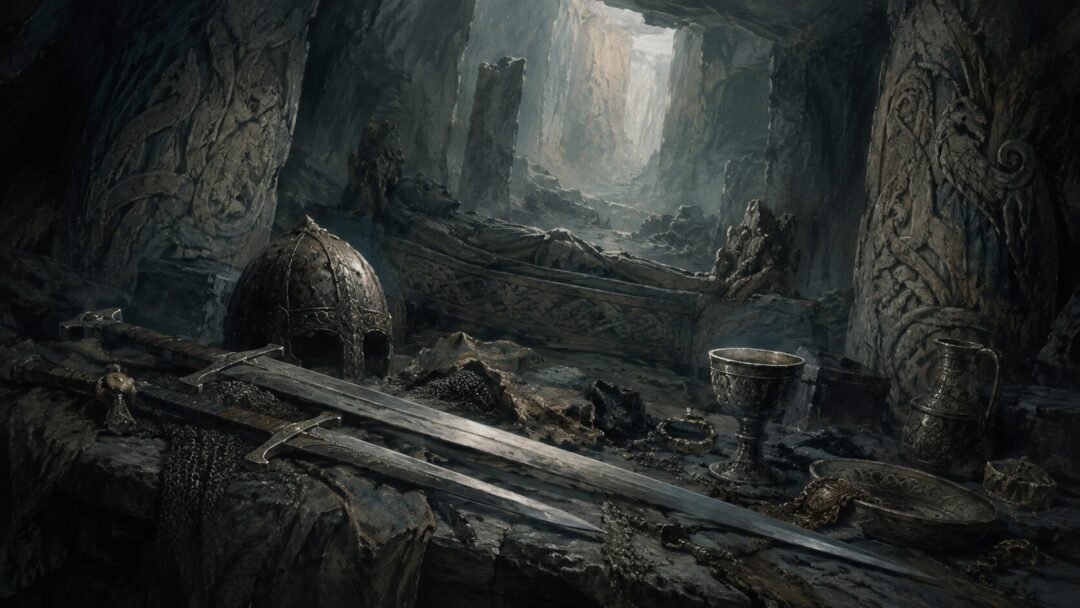
Merry’s sword came from the Barrow-downs, where the hobbits were trapped by a Barrow-wight and rescued by Tom Bombadil. After freeing them, Tom took ancient blades from the treasure of the mound and gave them to the hobbits.
These were not ordinary knives. They were works of Westernesse, connected with the old wars of the Dúnedain in the North. The text associates them with the enemies of Angmar, the realm once ruled by the Witch-king. Their presence in the barrow ties them to a buried world: Cardolan, Arnor, and the long defeat of the northern kingdoms.
This is one of the quietest pieces of setup in The Fellowship of the Ring. At first, the blades seem like practical gifts after a frightening side-adventure. For readers focused on the journey to Rivendell, they may feel like a small reward before the larger story resumes.
But the Barrow-downs are not a random detour. They place the hobbits in contact with the old griefs of Eriador. The dead of the North, the malice of Angmar, and the memory of wars against the Witch-king all lie beneath those green hills.
When Merry later strikes the Witch-king, the past is not decorative background. It becomes active.
The Old War Hidden Inside the New War
The War of the Ring is often seen through the great centers of the late Third Age: Minas Tirith, Mordor, Rohan, Lothlórien, Rivendell. But Merry’s blade carries the memory of an older northern struggle.
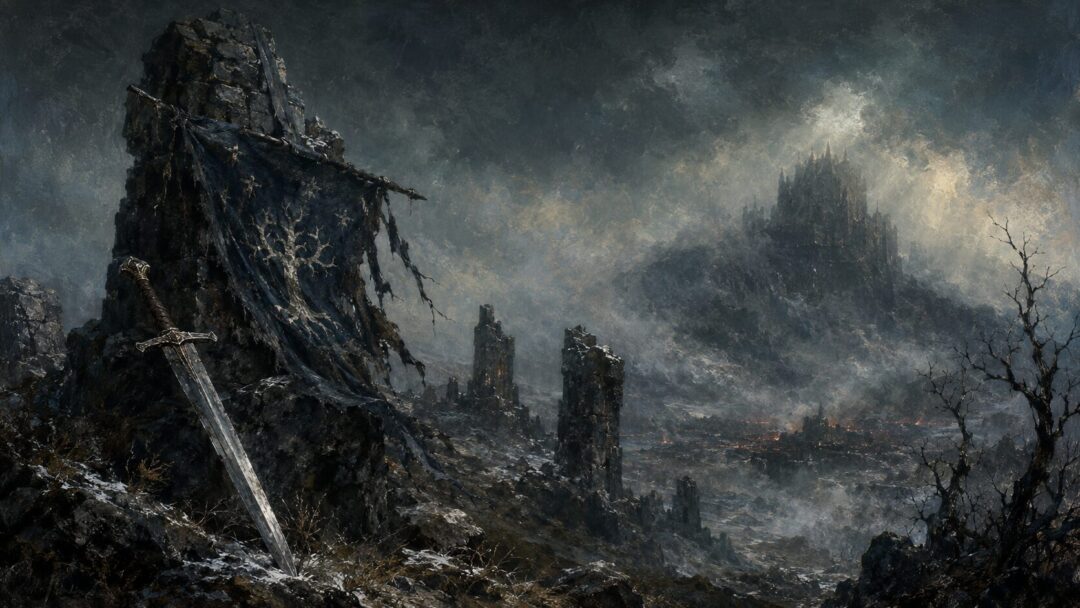
In the Third Age, the Witch-king ruled Angmar and made war on the divided remnants of Arnor. The northern kingdom had split into Arthedain, Cardolan, and Rhudaur, weakening the inheritance of Elendil. Angmar’s rise was not merely a military threat; it was part of the long wearing-down of the Dúnedain.
The Barrow-downs themselves became haunted after these wars and the disasters that followed. The ancient tombs of Men became places of fear. By the time Frodo, Sam, Merry, and Pippin entered them, the old kingdom was gone, but its wounds remained.
Merry therefore carries a weapon from a defeated people into a later war against the same dark power. He does not know the full weight of this. That is part of the irony. A hobbit of the Shire, almost untouched by the histories of kings, becomes the bearer of a blade made for a conflict older than his imagination.
The weapon does not make Merry great in the usual sense. Instead, it makes his small courage part of a much larger pattern.
What the Blade Actually Did
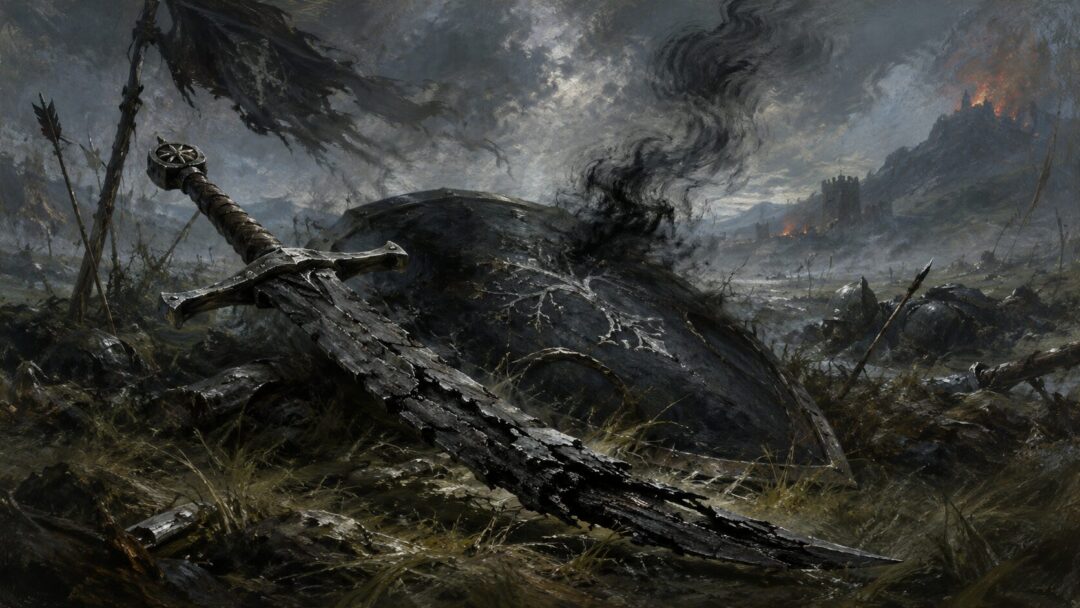
The text is unusually direct about the importance of Merry’s stroke. When he stabs the Witch-king from behind, his blade pierces the wraith’s leg, and the ancient weapon is destroyed. The narration says that no other blade, even in mightier hands, would have dealt that enemy such a bitter wound. It also says the sword broke the spell that bound the Witch-king’s unseen sinews to his will.
That is a remarkable statement, but it should be handled carefully.
The scene does not need to be turned into a mechanical rule, as if the Witch-king had a simple “invulnerability shield” that only one item could switch off. The text does not explain the matter in modern game-like terms. It tells us that this particular blade, made by enemies of Angmar, was uniquely fitted to wound him in a way ordinary steel would not.
Merry’s blow does not replace Éowyn’s deed. Éowyn still stands, defies the Witch-king, and delivers the final stroke. Nor does Éowyn’s courage erase Merry’s. The destruction of the Witch-king is a convergence: Éowyn’s defiance, Merry’s hidden strike, the old blade of Westernesse, and the prophecy spoken long before by Glorfindel that the Witch-king would not fall by the hand of man.
The wording leaves room for wonder rather than a tidy technical explanation. The blade matters because it belongs to the right history. Merry matters because he is brave enough to use it.
The Prophecy Needed More Than a Loophole
It is easy to reduce the Witch-king’s fall to a clever twist: “not by the hand of man” means a woman and a hobbit. That reading is not wrong, but it can become too thin if treated only as wordplay.
Glorfindel’s prophecy was not merely a riddle waiting for someone to exploit it. It pointed toward a fall the proud Witch-king could not imagine. He misread strength. He expected kings, captains, and warriors. He feared great powers, not the overlooked.
Éowyn was overlooked because she was a woman in a society that expected her to remain behind. Merry was overlooked because he was a hobbit, small and seemingly irrelevant to the great wars of Men. The Barrow-blade was overlooked because it came from a forgotten grave, not a famous royal armory.
All three are part of the answer.
The Witch-king falls not simply because the wording of a prophecy allowed it, but because his imagination was shaped by domination. He understood fear, command, and force. He did not understand the courage of those who had been dismissed.
Merry’s Courage Was Not Lessened by the Blade
Some readers may wonder whether the ancient blade reduces Merry’s heroism. If the weapon was specially suited to wound the Witch-king, did Merry’s courage matter less?
The opposite is true.
A powerful blade lying unused in a tomb does nothing. A prophecy does not swing a sword. Ancient craft does not act on its own. Merry still had to crawl through terror, come near the Lord of the Nazgûl, and strike when every instinct must have urged him to flee.
The blade gave Merry’s courage a way to matter against an enemy beyond him. That is very different from making the courage unnecessary.
Middle-earth often works this way. Small choices become decisive because they meet older powers, hidden mercies, or long-laid histories. Bilbo’s pity toward Gollum matters later in a way he could not foresee. Frodo’s endurance matters even when he cannot complete the Quest by strength of will alone. Merry’s courage matters because, at the crucial second, it is joined to a weapon prepared by the sorrows of another age.
This does not make the moment less human. It makes it more deeply human: no one stands entirely alone. The living inherit the losses, hopes, tools, and unfinished battles of the dead.
The Blade as Memory and Judgment
Merry’s sword is one of the great symbols of historical memory in The Lord of the Rings. It comes from a burial mound, a place where the past has literally been covered over. Yet the past has not lost its force.
The Men who made that blade could not save their own realm from ruin. Cardolan fell. Arnor passed away. Angmar did terrible harm. The Barrow-downs became a place of dread. If the story ended there, the blade would be only a relic of defeat.
But on the Pelennor Fields, that relic becomes judgment.
The Witch-king is wounded by a weapon born from the resistance of those he helped destroy. The old war reaches forward into the new one. The dead do not return as ghosts of vengeance in any simple sense, but their craft, their hatred of evil, and their defiance remain embodied in steel.
There is a severe beauty in that. Evil may outlast kingdoms, but it does not always escape what those kingdoms made in their resistance.
Why This Moment Still Feels So Powerful
Merry’s attack works because it joins several truths at once.
First, courage is necessary. Merry must choose to act while terrified.
Second, courage has limits. A hobbit with an ordinary knife would not necessarily have achieved the same result against the Lord of the Nazgûl.
Third, history matters. The weapon is not random. It comes from the long conflict between the Dúnedain of the North and Angmar.
Fourth, evil misjudges the small. The Witch-king is not brought down by the kind of opponent he expects.
That combination is why the scene feels so satisfying without becoming simple. Merry is neither the sole slayer of the Witch-king nor a meaningless assistant. Éowyn is neither saved by a trick nor reduced to finishing another person’s victory. The ancient blade is neither a magic shortcut nor an irrelevant detail.
Each part is needed.
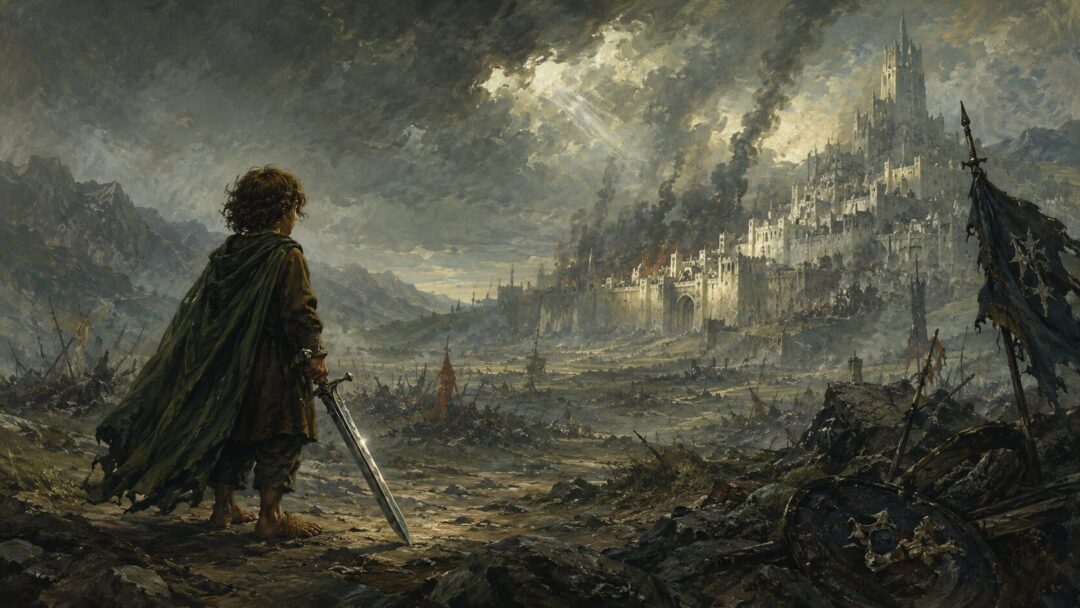
The Small Hand and the Ancient Blade
Merry’s courage needed an ancient blade because the enemy before him was not only a warrior. The Witch-king was a surviving terror from older wars, a servant of Sauron whose power had been feared for centuries. Against such a foe, ordinary bravery needed to be joined with something made for that darkness.
But the ancient blade also needed Merry.
It had lain in a barrow for long years, surrounded by death and memory. It could not choose its hour. It could not rise from the mound and seek justice. It had to be placed in the hand of someone small enough to be ignored and brave enough to act.
That is the hidden brilliance of the moment. The fall of the Witch-king is not just the triumph of prophecy, nor only the triumph of Éowyn, nor only the delayed revenge of Westernesse. It is all of these meeting in one terrible instant.
A forgotten blade. A shieldmaiden who refused to yield. A hobbit who should never have been there.
And because Merry found courage at the edge of despair, the old sword of the North finally reached the enemy it had been waiting for.
Sources & Notes
- J.R.R. Tolkien, The Lord of the Rings, Book I, Chapter 8, “Fog on the Barrow-downs” — Tom Bombadil arms the hobbits with blades of Westernesse from the barrow, explicitly tied to the old enemies of Angmar.
- J.R.R. Tolkien, The Lord of the Rings, Appendix A, “The North-kingdom and the Dúnedain” — gives the background of Arnor’s divided successor realms, Angmar’s war on the North, and the Witch-king’s long enmity with the Dúnedain.
- J.R.R. Tolkien, The Lord of the Rings, Book V, Chapter 3, “The Muster of Rohan” — Merry is denied a place with Théoden’s riders but is secretly carried by Dernhelm toward the battle he was not meant to enter.
- J.R.R. Tolkien, The Lord of the Rings, Book V, Chapter 6, “The Battle of the Pelennor Fields” — Merry’s Barrow-blade wounds the Witch-king in a way no ordinary blade could, enabling Éowyn’s final stroke.
- J.R.R. Tolkien, The Lord of the Rings, Appendix A, “Gondor and the Heirs of Anárion” — Glorfindel’s prophecy that the Witch-king would not fall “by the hand of man” frames the later convergence of Éowyn, Merry, and the ancient blade.